



Monday, April 23, 2018
Building a Better IMF: Report on IEO work, Spring 2018
From the 2018 IEO Dialogue:
“In January 2018, the Executive Board approved a Management Implementation Plan (MIP) prepared by IMF staff to follow up on the 2017 evaluation of THE IMF AND FRAGILE STATES. IMF staff will prepare a paper laying out a clear strategic framework to guide IMF involvement in social protection, for consideration by the Board in February 2019. This framework will discuss how to assess the macro-criticality of social protection and will lay out more effective approaches to program design for both concessional and non-concessional lending to mitigate adverse impacts of program measures on the most vulnerable.”
“In the last few months, the IMF has taken important actions to follow up on earlier evaluations. In February, the Executive Board approved general guidance on Fund engagement with currency unions when the policies of union-level institutions are critical to the success of Fund-supported programs—a step recommended in the 2016 evaluation of The IMF and the Crises in Greece, Ireland, and Portugal. Acting on recommendations of the 2016 IEO evaluation of Data at the IMF, the Executive Board approved an “Overarching Strategy on Data and Statistics at the Fund in the Digital Age” that sets a course for the IMF to better respond to the challenges and opportunities of digitalization.”
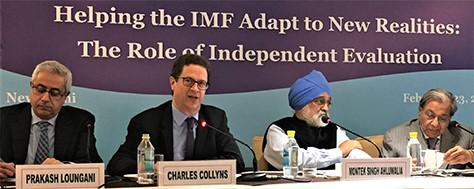
(From left to right) Prakash Loungani, IEO Advisor; Charles Collyns, IEO Director; Montek Singh Ahluwalia, former Deputy Chairman of the Planning Commission and former IEO Director; and N.K. Singh, Chairman of Fifteenth Finance Commission, participate in a seminar in New Delhi, India in February 2018.
From the 2018 IEO Dialogue:
“In January 2018, the Executive Board approved a Management Implementation Plan (MIP) prepared by IMF staff to follow up on the 2017 evaluation of THE IMF AND FRAGILE STATES. IMF staff will prepare a paper laying out a clear strategic framework to guide IMF involvement in social protection, for consideration by the Board in February 2019. This framework will discuss how to assess the macro-criticality of social protection and will lay out more effective approaches to program design for both concessional and non-concessional lending to mitigate adverse impacts of program measures on the most vulnerable.”
“In the last few months,
Posted by at 9:44 AM
Labels: Events, Inclusive Growth
Friday, April 20, 2018
Housing View – April 20, 2018
On the US:
- Why America Needs More Social Housing – American Prospect
- Housing: A shortage of cities – City Observatory
- Is Housing a Good Investment? Where You Stand Depends on Where You Sit – Federal Reserve Bank of New York
- Home Remodeling Expected to Remain Strong and Steady into 2019 – Harvard Joint Center for Housing Studies
On other countries:
- [Canada] Not In My Neighbor’s Back Yard: External Effects of Density – University of British Columbia
- [Canada] The Propagation of Regional Shocks in Housing Markets: Evidence from Oil Price Shocks in Canada – Centre for Economic Policy Research
- [China] Effect of land prices on the spatial differentiation of housing prices: Evidence from cross-county analyses in China – Journal of Geographical Sciences
- [Korea] Housing Dynamics in Korea – OECD
- [United Arab Emirates] Abu Dhabi’s housing market cools down – Financial Times
- [United Kingdom] Building more homes requires more than planning tweaks – Financial Times
- [United Kingdom] London house prices mark first annual drop since 2009 – Financial Times

Photo by Aliis Sinisalu
On the US:
- Why America Needs More Social Housing – American Prospect
- Housing: A shortage of cities – City Observatory
- Is Housing a Good Investment? Where You Stand Depends on Where You Sit – Federal Reserve Bank of New York
- Home Remodeling Expected to Remain Strong and Steady into 2019 – Harvard Joint Center for Housing Studies
Posted by at 5:00 AM
Labels: Global Housing Watch
Wednesday, April 18, 2018
New Book: Fiscal Policies and Gender Equality
The International Monetary Fund is deeply committed to playing its role in building a global economy that benefits all people—through policy advice, capacity development, and financial support.
– Managing Director Christine Lagarde
The IMF just published the new book “Fiscal Policies and Gender Equality”:
“This book explores how fiscal policies can contribute to addressing women’s and girls’ disadvantages in education, health, employment, and financial well-being, and represents the efforts of a team of researchers from a joint collaboration between the International Monetary Fund and the United Kingdom’s Department for International Development (DFID).”
My work with Lisa Kolovich is included as Chapter 3:
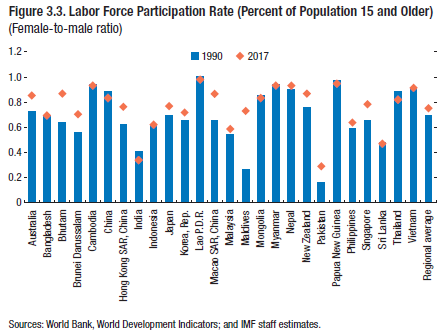
“Despite Asia’s progress over the past several decades in closing gender gaps in education, health, economic, and political outcomes, women and girls continue to encounter barriers relative to men. Gender gaps also continue in labor force participation, political representation, and health outcomes. To address these gender gaps, countries have implemented gender budgeting, which originated in Australia in the early 1980s and has since spread to more than 80 countries around the world.
This chapter summarizes the experiences of four countries in the Asia and Pacific region with well‑developed gender budgeting initiatives—Australia, India, Korea, and the Philippines—and analyzes several gender inequality outcomes in those countries. As in other regions, these four countries’ efforts vary in terms of design, implementation strategies, legal framework, and partner involvement. Nevertheless, several commonalities exist and provide insight into lessons learned.”
The book is available here.
The International Monetary Fund is deeply committed to playing its role in building a global economy that benefits all people—through policy advice, capacity development, and financial support.
– Managing Director Christine Lagarde
The IMF just published the new book “Fiscal Policies and Gender Equality”:
“This book explores how fiscal policies can contribute to addressing women’s and girls’ disadvantages in education, health,
Posted by at 7:16 PM
Labels: Inclusive Growth
Tuesday, April 17, 2018
Stabilizing China’s Housing Market
From a new IMF Working Paper by Richard Koss and Xinrui Shi:
“The sharp rise of house prices in China’s Tier-1 cities has fostered a great deal of commentary about the possibility of bubbles forming there. However, China’s unique housing market characteristics make it difficult to assess the macroeconomic severity of bursting bubbles, even if they exist. These include the setting of land supply and prices by the government, among many others. The presence of overbuilt “ghost cities” greatly complicates the ability of traditional macroeconomic policies to address these concerns. This paper looks at proposals to shore up the mortgage underwriting and legal infrastructure to help China withstand the impact of falling prices, should this occur.”

From a new IMF Working Paper by Richard Koss and Xinrui Shi:
“The sharp rise of house prices in China’s Tier-1 cities has fostered a great deal of commentary about the possibility of bubbles forming there. However, China’s unique housing market characteristics make it difficult to assess the macroeconomic severity of bursting bubbles, even if they exist. These include the setting of land supply and prices by the government, among many others.
Posted by at 5:07 PM
Labels: Global Housing Watch
World Economic Outlook, April 2018 Cyclical Upswing, Structural Change
The IMF just launched the April 2018 World Economic Outlook:
“The global economic upswing that began around mid-2016 has become broader and stronger. This new World Economic Outlook report projects that advanced economies as a group will continue to expand above their potential growth rates this year and next before decelerating, while growth in emerging market and developing economies will rise before leveling off. For most countries, current favorable growth rates will not last. Policymakers should seize this opportunity to bolster growth, make it more durable, and equip their governments better to counter the next downturn.”
Chapter 2 notes that “Dao, Furceri, and Loungani (2014) highlight the increasing role of participation as an absorber of state-level labor demand shocks.”
Chapter 3 notes the findings from my paper with Saurabh Mishra, Chris Papageorgiou, and Ke Wang that “Cross-border trade in services has been growing steadily over the past four decades, and now accounts for about one-fifth of global exports. […] The increase in the tradability of services is widespread across countries. […] In terms of industries, the increase in service exports has been particularly large in “modern” services that can be delivered at a distance, such as telecommunications, computer and information services, intellectual property, financial intermediation, and other business activities, including research and development and professional services.”
The full report is available here. My paper on regional labor market adjustment is available here. My paper on services trade is available here.
The IMF just launched the April 2018 World Economic Outlook:
“The global economic upswing that began around mid-2016 has become broader and stronger. This new World Economic Outlook report projects that advanced economies as a group will continue to expand above their potential growth rates this year and next before decelerating, while growth in emerging market and developing economies will rise before leveling off. For most countries, current favorable growth rates will not last.
Posted by at 4:17 PM
Labels: Inclusive Growth
Subscribe to: Posts