



Wednesday, January 9, 2019
Transport Infrastructure, City Productivity Growth and Sectoral Reallocation: Evidence from China
From a new IMF working paper:
“This paper examines the impact of highway expansion on aggregate productivity growth and sectoral reallocation between cities in China. To do so, I construct a unique dataset of bilateral transportation costs between Chinese cities, digitized highway network maps, and firm-level census. I first derive and estimate a market access measure that summarizes all direct and indirect impact of trade costs on city productivity. I then construct an instrumental variable to examine the causal impact of highways on economic outcomes and the underlying channels. The results suggest that highways promoted aggregate productivity growth by facilitating firm entry, exit and reallocation. I also find evidence that the national highway system led to a sectoral reallocation between cities in China.”
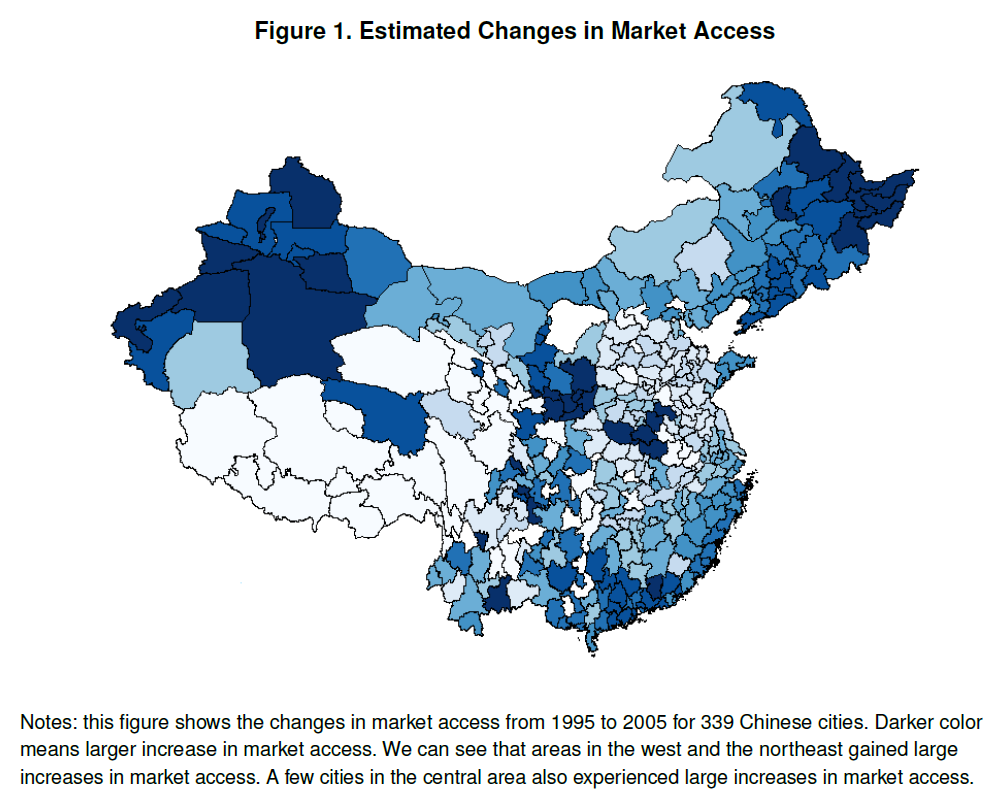
“The findings presented in this paper have important policy implications. Facing the threat of secular stagnation, policymakers are searching for tools to boost aggregate demand in the short run and promote economic growth in the long run. After the global recession, there has been a growing interest among policymakers worldwide in using infrastructure investments both as a short-term fiscal policy instrument and as a long-term growth generator. For example, the World Bank has consistently dedicated itself to investing in infrastructure in low-income countries to fight poverty. The International Monetary Fund is also actively advocating for more infrastructure investments in Latin America and Africa to meet the infrastructure needs and boost economic growth in these regions. The two recently-founded development banks–the Asian Infrastructure Investment Bank and the New Development Bank, were established under the leadership of China to address the increasing infrastructure needs in Asia. The US President Donald Trump envisions a trillion-dollar infrastructure plan. The increasing use of infrastructure projects by policymakers begs the question of whether the huge amount of tax dollars spent on infrastructure is well justified by their potential benefits.”
From a new IMF working paper:
“This paper examines the impact of highway expansion on aggregate productivity growth and sectoral reallocation between cities in China. To do so, I construct a unique dataset of bilateral transportation costs between Chinese cities, digitized highway network maps, and firm-level census. I first derive and estimate a market access measure that summarizes all direct and indirect impact of trade costs on city productivity. I then construct an instrumental variable to examine the causal impact of highways on economic outcomes and the underlying channels.
Posted by at 10:28 PM
Labels: Inclusive Growth
Regional differences in the Okun’s Relationship: New Evidence for Spain (1980-2015)
From a new paper on the Okun’s Law in Spain:
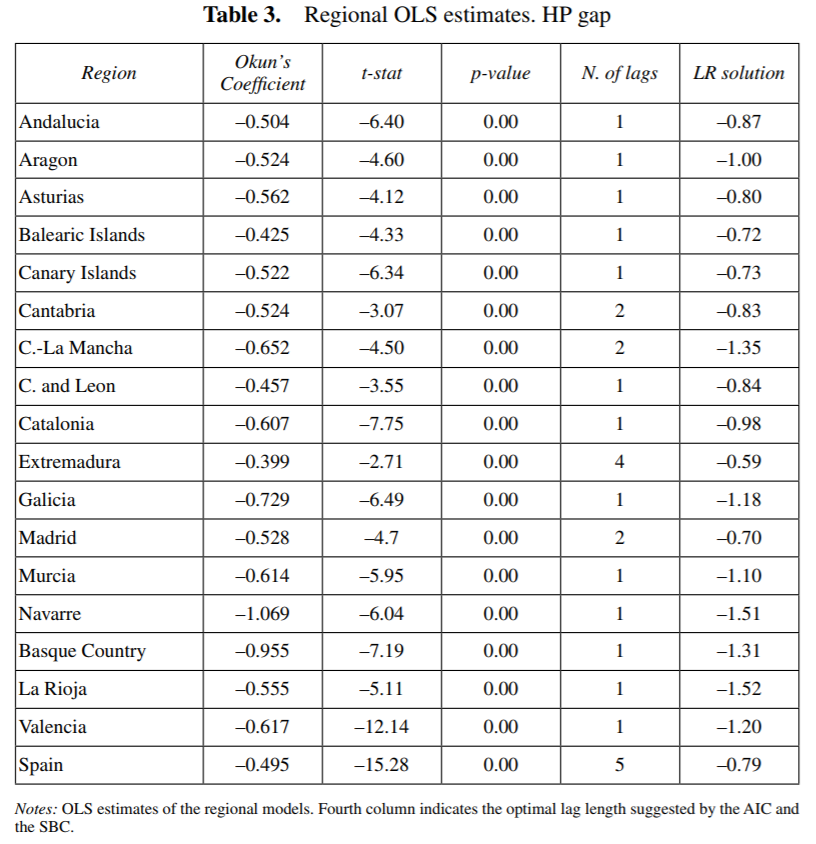
“This article provides new empirical evidence on the relationship between the unemployment rate and the output growth in Spain at the regional level. The “gap version” with the output growth on the left-hand side of the equation is our benchmark model. Our empirical results show that all coefficients are significant and show the expected negative sign. Significant regional differences in the Okun’s relationship, both for the short run and the long run, are found. These results are robust to two different specifications for the gaps: the HP filter and the QT procedure. In the final part of the article, it is also found that the OLS and the GMM estimates for panel data exhibit a similar pattern and that there is a clear asymmetry in the Okun’s relationship in booming and recession phases of the Spanish business cycle.”
From a new paper on the Okun’s Law in Spain:
“This article provides new empirical evidence on the relationship between the unemployment rate and the output growth in Spain at the regional level. The “gap version” with the output growth on the left-hand side of the equation is our benchmark model. Our empirical results show that all coefficients are significant and show the expected negative sign. Significant regional differences in the Okun’s relationship,
Posted by at 10:15 PM
Labels: Inclusive Growth
Sunday, January 6, 2019
2019 AEA’s papers on Inequality
Below is a preliminary list of papers that were presented at this year’s AEA Annual Meeting on January 4-6 in Atlanta, Georgia.
On income inequality
- Time Discounting, Savings Behavior and Wealth Inequality – Paper
- Wealth Inequality, Income Volatility, and Race – Paper
- Are Financial Information Technologies Making the Rich Richer? – Paper
- The Uncertainty of Academic Rent and Income Inequality: The OECD Panel Evidence – Paper
- Does Environmental Policy Affect Income Inequality? Evidence from The Clean Air Act. – Paper and Presentation
- Examining Interrelation between Global and National Income Inequalities – Paper and Presentation
- Top 1% Income Shares: Comparing Estimates Using Tax Data – Paper
- Modeling Wealth and Income Inequality: Implications for Optimal Taxation – AEA
- Openness and Income Disparity in Sub-Saharan Africa: A Cross-Country Analysis – AEA
- Military Expenditures and Income Inequality Evidence from a Panel of European Countries (1990-2015) – AEA
On wage and employment inequality
- Global Value Chains, Firms, and Wage Inequality: Evidence from China – Paper
- The Effects of Credit Supply on Wage Inequality between and within Firms – Paper
- College Tuition and Income Inequality – Paper
- The Innovation Premium to Soft Skills in low-skilled occupations – Paper
- Employment Inequality: Why Do the Low-Skilled Work Less Now? – Paper and Presentation
- Skill, Agglomeration, and Inequality in the Spatial Economy – Paper
- Closing the Gap: The Effect of a Targeted, Tuition-Free Promise on College Choices of High-Achieving, Low-Income Students – Paper
- Work and Grow Rich: The Dynamic Effects of Performance Pay Contracts – Paper
- Between Firm Changes in Earnings Inequality: The Role of Productivity Dispersion, the Composition of Firms and Workers, and Industry Earnings Differentials – AEA
- Is Employment Polarization Informative About Wage Inequality and Is Employment Really Polarizing? – AEA
- Income, Poverty, and Inequality over Two Decades – AEA
- Tasks, Occupations, and Wage Inequality in an Open Economy – AEA
On gender inequality
- Coordination of Hours within the Firm – Paper and Presentation
- The Role of Historical Resource Scarcity in Modern Gender Inequality – Presentation
- Gender Inequality and Economic Growth: Evidence from Industry-Level Data – Paper
- Managers’ Gender Norms and the Gender Gap – Paper
- Gender Earnings Inequality and Wage Policy in Kyrgyzstan: Evidence from Household Surveys, 2010-2016 – Paper
- Gender Inequality and Marketisation Hypothesis in sub-Saharan Africa – Paper
- Fiscal Policy Effectiveness on Gender Equality in Asia Pacific: Efficacy of Gender Budgeting – Paper and Presentation
- Fields of Study Choices and the Reproduction of Gender Inequalities – AEA
- The Global Cost of Gender Inequality – AEA
- Sexual Dimorphism in Stature as a Measure of Gender Inequality – AEA
- The Origins and Real Effects of the Gender Gap: Evidence from CEOs’ Formative Years – AEA
On inequality and everything else
- Land Inequality and the Provision of Public Works – Paper
- Consumption Inequality across Heterogeneous Families – Paper
- Coupled Lotteries – A New Method to Analyze Inequality Aversion – Paper
- Biased Perceptions? Consolidating Cross-Country Evidence on Objective and Perceived Inequality – Paper
- Investment-Specific Technological Change, Taxation and Inequality in the U.S. – Paper and Presentation
- The Effect of Political Power on Labor Market Inequality: Evidence from the 1965 Voting Rights Act – Paper
- Regional Inequality in the U.S.: Evidence from City-level Purchasing Power – Paper
- Inequality, Autocracy and Sovereign Funds as Determinants of Foreign Portfolio Flows – Paper and Presentation
- Does the Girl Next Door Affect Your Academic Outcomes and Career Choices? – Paper
- Beyond Piketty: A New Perspective on Poverty and Inequality in India – AEA
- Is India’s Employment Guarantee Program Successfully Challenging Her Historical Inequalities? – AEA
- Regional Differences in the Intergenerational Transmission of Inequality: Evidence from the NLSY – AEA
- Globalization and Inequality in Innovation: A Perspective from U.S. R&D Tax Credit Policy – AEA
- Information and Inequality – AEA
- Redistribution through Markets – AEA
- Estimating Inequality in Air Pollution Exposure – AEA
- Are There Macroeconomic Costs to Racial Inequality in the United States? – AEA
- Food Deserts and the Causes of Nutritional Inequality – AEA
- Spatial Justice, Uneven Development, and Intergenerational Inequality: A ‘Postcolonial’ United States of America – AEA
Below is a preliminary list of papers that were presented at this year’s AEA Annual Meeting on January 4-6 in Atlanta, Georgia.
On income inequality
- Time Discounting, Savings Behavior and Wealth Inequality – Paper
- Wealth Inequality, Income Volatility, and Race – Paper
- Are Financial Information Technologies Making the Rich Richer? – Paper
- The Uncertainty of Academic Rent and Income Inequality: The OECD Panel Evidence – Paper
- Does Environmental Policy Affect Income Inequality?
Posted by at 4:54 PM
Labels: Inclusive Growth
2019 AEA’s papers on Energy and Climate Change
Below is a preliminary list of papers that will presented at this year’s AEA Annual Meeting on January 4-6 in Atlanta, Georgia.
On energy and everything else
- United States Internal Migration Networks, Energy Use, and Emissions – Paper
- Too Much Energy: The Perverse Effect of Low Energy Price – Paper
- Are Energy Executives Rewarded For Luck? – Paper
- United States Internal Migration Networks, Energy Use, and Emissions – Paper
- Structural Approach to Dynamic Energy Pricing and Consumer Welfare – Presentation
- Smart Thermostats, Social Information, and Energy Conservation: Distributional Evidence from a Field Experiment – AEA
- Quantifying Negative Externalities of Energy Infrastructure Using Wellbeing and Hedonic Price Data: Evidence from Biogas Plants – AEA
- Air Conditioning and Global Energy Consumption – AEA
- The Internal and External Costs of Renewable Intermittency – AEA
- The Interplay between Renewables and Hydrocarbons in the Energy Transition – AEA
- Innovation, Openness, and Energy Demand – AEA
On carbon, gas, oil, and shale
- Fracking, farmers, and rural electrification in India – Paper
- Effects of Severance Tax on Economic Activity: Evidence from the Oil Sector – Paper and Presentation
- Oil for Food? Oil Spills and Agricultural Productivity – Paper
- Welfare Gains from Market Insurance: The Case of Mexican Oil Price Risk – Paper
- Business Cycles and Innovation Cycles in the Upstream Oil & Gas Industry: Surviving the Ups and Downs – Presentation
- Learning Where to Drill: Drilling Decisions and Geological Quality in the Haynesville Shale – Paper and Presentation
- Shale Gaz Extraction in the United States: Perspectives from Geo-Located Twitter Conversations and Academic Publications – Presentation
- Relinquishing Riches: Auctions Versus “Wild West” Negotiations in Texas Oil and Gas Leasing – AEA
- Nonlinear Causal Relationship between Shale Oil Price and Employment in the United States: Evidence from a Nonlinear ARDL Approach – AEA
- The Potential for Peak Oil Demand – AEA
- Station Heterogeneity and the Dynamics of Retail Gasoline Prices – AEA
- Bidding and Drilling Under Uncertainty: Identification and Estimation of Contingent Payment Auctions – AEA
On electricity
- Imperfect Markets Versus Imperfect Regulation in United States Electricity Generation – Paper
- Does Electrification Cause Industrial Development? Grid Expansion and Firm Turnover in Indonesia – Paper
- Do Reward and Reprimand Policies Reduce Electricity Distribution Losses? – Paper
- Optimization of a Prototype Electric Power System: Legacy Assets and New Investments – Paper and Presentation
- Dynamic Competition and Arbitrage in Electricity Markets: The Role of Financial Traders – Paper
- Ramping Up Renewable Energies: The Role of Ramping Cost and Electricity Storage – AEA
- Private and Social Costs of Misallocation in Indian Electricity Supply – AEA
- Testing for Market Efficiency with Transaction Costs: An Application to Financial Trading in Wholesale Electricity Markets – AEA
On electric vehicles
- Adoption of Electric Vehicles: Manufacturers’ Incentive and Government Policy – Paper
- Long-Term Transportation Electricity Use Considering the Effect of Autonomous-Vehicles: Estimates & Policy Observations – Paper
- Electric vehicles and residential energy consumption: An indirect rebound effect – AEA
On energy and policy
- Would Energy Tax Policy Significantly Influence the Diffusion Rate of The Renewable Energy Portfolio in The United States? – Paper and Presentation
- Impacts of Renewable Fuel Policy with Sentiment on the Energy and Agricultural Markets: A Vine Copula-based ARMA-GJR-GARCHX Model – Paper
- Using Emissions Trading Schemes to Reduce Heterogeneous Distortionary Taxes: the case of Recycling Carbon Auction Revenues to support Renewable Energy – Paper and Presentation
- Getting More of Something Without Subsidizing It: Impact of Time-of-Use Electricity Pricing on Residential Energy Efficiency and Solar Panel Adoption – AEA
On climate change and policy
- Market Power in Coal Shipping and Implications for U.S. Climate Policy – Paper
- Global Cost Estimates of Forest Climate Mitigation with Albedo: A New Integrative Policy Approach – Paper
- Unilateral Action under an Emissions Cap – Paper
- Climate Change Legislation and Social Values: Do They Complement or Substitute Each Other in Reducing Carbon Emissions? – AEA
On climate change and everything else
- Energy Efficiency and Directed Technical Change: Implications for Climate Change Mitigation – Paper
- Climate Risks of Sales Forecasts: Evidence from Satellite Readings of Soil Moisture – Paper and Presentation
- Climate Change Induced Inter-Province Migration in Iran – Paper
- Climate Finance under Conflicts and Renegotiations: A Dynamic Contract Approach – Paper
- Estimating the Impacts of Changes in Weather Circadian Rhythms on French Agricultural Production – Paper
- Heat and Learning – Paper
- Expectations and Adaptation to Environmental Risks – Paper
- Moving to Floodplains: The Unintended Consequences of the National Flood Insurance Program on Population Flows – Paper
- Salvation or Commodification? The Role of Money and Markets in Global Ecological Preservation – Paper
- Carbon Risk – Paper and Presentation
- Climate Change and Flood Beliefs: Evidence from New York Real Estate – Paper
- Climate Risks of Sales Forecasts: Evidence from Satellite Readings of Soil Moisture – Paper and Presentation
- The Effect of Local Pollution on the Cognitive Productivity of Judges: A Case Study of the Mexican Judiciary – AEA
- Creating comfort in a warming world: The role of smart thermostats – AEA
- Modeling System Complexity in the Context of Geopolitics Related to Climate Change – AEA
- Do Common-Pool Resources Help Insure Household Food Security from Climate Shocks? – AEA
- Malthus in Africa? Positive and Preventive Checks on Population in a Changing Climate – AEA
- Adaptation to Environmental Change: Agriculture and the Unexpected Incidence of the Acid Rain Program – AEA
- Ramping Up Renewable Energies: The Role of Ramping Cost and Electricity Storage – AEA
- Climate shocks, lake drying and children’s cognitive skills and violent behavior: Evidence from Chad – AEA
- A New Approach to Measuring Climate Change Impacts and Adaptation – AEA
- Learning, Adaptation and Climate Uncertainty: Evidence from Indian Agriculture – AEA
Below is a preliminary list of papers that will presented at this year’s AEA Annual Meeting on January 4-6 in Atlanta, Georgia.
On energy and everything else
Posted by at 10:11 AM
Labels: Energy & Climate Change
Thursday, January 3, 2019
Housing View – January 3, 2019 [2019 AEA Annual Meeting Special Edition]
Below is a preliminary list of papers that will presented at this year’s AEA Annual Meeting on January 4-6 in Atlanta, Georgia.
On housing and cycles
- Is Housing the Business Cycle? A Multi-resolution Analysis for OECD Countries – Paper
- The First Housing Bubble? Prices and Turnover in Amsterdam, 1582-1810 – Paper
- Residential Investment and Recession Predictability – Paper
- Residential House Prices, Commercial Real Estate and Bank Failures – Paper and Presentation
- Perception of House Price Risk and Homeownership – Paper
- The Effects of Local Risk on Homeownership – Paper and Presentation
- What Drove the 2003-2006 House Price Boom and Subsequent Collapse? Disentangling Competing Explanations – Paper
- Expectations During the U.S. Housing Boom: Inferring Beliefs from Actions – Paper
- The Housing Boom and Bust: Model Meets Evidence – AEA
- Spatial Estimates of Bubbles: Tokyo House Prices and Rents – AEA
On housing and mortgage
- Brokerage Choice, Dual Agency and Housing Market Strength – Paper
- Villains or Scapegoats? The Role of Subprime Borrowers in Driving the U.S. Housing Boom – Paper
- Financial Fragility with SAM? – Paper
- Structuring Mortgages for Macroeconomic Stability – Paper
- A Crisis of Missed Opportunities? Foreclosure Costs and Mortgage Modification During the Great Recession – Paper
- Mortgage Design and Slow Recoveries: The Role of Recourse and Default – Paper
- Correlation in Mortgage Defaults – Paper
- State Dependency and the Efficacy of Monetary Policy: The Refinancing Channel – Paper
- No Job, No Money, No Refi: Frictions to Refinancing in a Recession – Paper
- Mortgage Losses: Loss on Sale and Holding Costs – Paper and Presentation
- Can Lending Restrictions on “Exotic” Lending Dampen Housing Price Volatility? A Panel VAR Exploration – AEA
- Mortgage Design and Housing Market – AEA
- House Price Markups and Mortgage Defaults – AEA
- Will Housing Mortgagors Increase Their Consumptions after Paying off Loans?-Evidence from Urban China – AEA
- Home Equity Withdrawal via Credit Card Borrowing-Micro Evidence from China – AEA
- Rental Markets and the Effect of Credit Conditions on House Prices – Paper
- Mortgage Lending: Evidence from a Correspondence Field Experiment – AEA
- Fueling the Credit Crisis – AEA
- Strategic or Illiquid Mortgage Default? Evidence from Household Bank Account Data– AEA
- The Impact of Liquidity Regulation on Bank Mortgage Lending – AEA
- How Is Financial Literacy Important in Mortgage Market? Different Evidence from Urban China – AEA
- The Impact of Repossession Risk on Mortgage Default – AEA
- Mortgage Prepayment and Path-Dependent Effects of Monetary Policy – AEA
- Mortgage Finance Development Across the World – AEA
On housing policy
- Mortgage Debt, Hand-to-Mouth Households, and the Monetary Policy Transmission – Presentation
- Heterogeneous Spillovers Of Housing Credit Policy – Paper
- The Effects of Rent Control Expansion on Tenants, Landlords, and Inequality: Evidence from San Francisco – Paper
- The Effect of Tax Reform on Tax Liabilities of Owners and Renters – Paper
- Intermediated Credit Supply and Endogenous Household Leverage Constraints – Paper
- Real Estate Asset Bubbles and Monetary Policy: The Channel between Central Bank’s Balance Sheet and Firms’ Balance Sheets – Paper
- Tax Reform, Homeownership Costs, and House Prices – Paper
- The Effect of Government Mortgage Guarantees on Homeownership – Paper
- Loan to Value Limits and House Prices – AEA
- Empirics on the Causal Effects of Rent Control in Germany – AEA
- An Urban Equilibrium Model with Rent Controls Applied to Paris Urban Area – AEA
- Monetary Policy, Heterogeneity, and the Housing Channel – AEA
- Can Lending Restrictions on “Exotic” Lending Dampen Housing Price Volatility? A Panel VAR Exploration – AEA
- Mortgage Pricing and Monetary Policy – AEA
On housing supply
- Fewer players, fewer homes: concentration and the new dynamics of housing supply – Paper and Presentation
- What’s Lost in the Aggregate: Lessons from a Local Index of Housing Supply Elasticities – Paper
- New Construction and Mortgage Default – Paper and Presentation
- Spatial Misallocation in Chinese Housing and Land Markets – AEA
On housing affordability
- Targeting In-Kind Transfers Through Market Design: A Revealed Preference Analysis of Public Housing Allocation – Paper
- Affordable Housing and City Welfare – Paper
- Political Control of the State Legislature and Municipal Bond Financing for Affordable Housing – Paper
- Waiting Lists, Lotteries and Public Housing: Natural Experiment Evidence from Amsterdam – Paper
- Affordable Housing in Westchester County – Paper
- How (Not) to Allocate Affordable Housing – AEA
- The Public-Housing Allocation Problem: Theory and Evidence from Pittsburgh – AEA
- Not In My Neighbor’s Back Yard? Laneway Homes and Neighbors’ Property Values – AEA
- Does Affordable Housing Participation Reduce Default and Prepayment? The Case for the Montgomery County MPDU Program – AEA
On housing and evictions
- Does Eviction Cause Poverty? Quasi-experimental Evidence from Cook County, IL – Paper
- The Effect of Residential Evictions on Low-Income Adults – AEA
- Health Insurance and Housing Stability: The Effect of Medicaid Expansion on Evictions – AEA
On housing, investors, and speculation
- Out-of-Town Home Buyers and City Welfare – Paper
- Economic Consequences of Housing Speculation – Paper
- Speculative Dynamics of Prices and Volume – Paper
- Expectations During the U.S. Housing Boom: Inferring Beliefs from Actions – Paper
- Speculative Asset Bubbles: The Primary Drivers of “Systemic” Banking Crises in Post-war Advanced Economies – Presentation
- Buying Up Elm Street: Institutional Investors and the Housing Recovery – AEA
- Speculating on Superstition: Evidence from Housing Transactions in Hungry Ghost Months in Singapore – AEA
On housing and the sharing economy
- Which Neighborhood Joins the Sharing Economy and Why? – The Case of the Short-term Rental Market in New York City – Paper
- Cash to Spend: Credit Constraints, IPO Lockups, and House Prices – Paper
- Can Landlords be Paid to Stop Avoiding Voucher Tenants? – Paper
On housing, the environment, and natural disasters
- Toxic Assets: How the Housing Market Responds to Environmental Information Shocks – Paper
- Aircraft Noise Pollution, Soundproofing, and Lagging House Price Adjustments: Evidence from the Minneapolis-St. Paul International Airport – Paper
- Natural Disasters and Housing Markets: The Tenure Choice Channel – Paper
On housing and transportation
- Commuting, Labor and Housing Market Effects of Mass Transportation: Welfare and Identification – Paper and Presentation
- International Travel Costs and Local Housing Markets – Paper
On housing and everything else
- Getting High or Getting Low? – Paper
- Allocation of Education, School District Policy and Housing Market Efficiency – Presentation
- Why Are Housing Demand Curves Upward Sloping? – Paper and Presentation
- The Cross-Section of Expected Housing Returns – Paper
- Amenity Migration within a Millennial City Evidence from Washington DC Tax Data, 2005-2014 – Paper and Presentation
- Getting More by Asking for Less? – Paper
- Magnification of the ‘China Shock’ Through the United States Housing Market – Paper and Presentation
- Valuing Housing Services in the Era of Big Data: A User Cost Approach Leveraging Zillow Microdata – Paper
- The Propagation of Regional Shocks in Housing Markets: Evidence from Oil Price Shocks in Canada – Paper
- Housing Wealth, Health and Deaths of Despair – Paper
- What Happens After You Overpay for Your House – Paper and Presentation
- When Birth or Death Hits Home: House Prices, Rents and Demography in Paris and Amsterdam, 1400-present – Presentation
- Residential House Prices, Commercial Real Estate and Bank Failures – Paper and Presentation
- Perception of House Price Risk and Homeownership – Paper
- Attitudes Toward and Perceptions of the Ambiguity of House and Stock Prices – Paper
- Housing Wealth and Consumption: New Evidence from Household-Level Panel Data – AEA
- Sorting or Steering: Experimental Evidence on the Economic Effects of Housing Discrimination and Its Consequences for Environmental Justice – AEA
- Real Estate News and REIT Returns – AEA
- The Impact of Housing Quality on Health and Labor Market Outcomes: The German Reunification – AEA
- Sexual Orientation, Gender, Pregnancy, and Family Composition Discrimination in Machine Learning, Building Vintage and Property Values – AEA
- The Impacts of Racial Discrimination on Housing Choice and Welfare in the United States – AEA
- House Prices, Migration, and the Evolution of the Wealth Distribution – AEA
*AEA indicates that neither the paper or presentation is available at the moment.
**This post has been updated on January 5 to add missing papers, and to add links to presentations and papers to existing papers.
Below is a preliminary list of papers that will presented at this year’s AEA Annual Meeting on January 4-6 in Atlanta, Georgia.
On housing and cycles
Posted by at 10:42 AM
Labels: Global Housing Watch
Subscribe to: Posts