



Friday, June 17, 2022
Housing View – June 17, 2022
On cross-country:
- Why is it so difficult to tackle the lack of affordable housing? – LSE
- There’s a desperate need for housing, so why isn’t more being built? – World Economic Forum
- What has caused the global housing crisis – and how can we fix it? – World Economic Forum
- The global house price boom may be weakening – Global Property Guide
On the US:
- The Economic Effects of Real Estate Investors – IE Business School
- Adapting to Flood Risk: Evidence from a Panel of Global Cities – NBER
- What economic policies prevented dire housing outcomes during COVID-19? – Brookings
- Waiting for Mortgage Rates to Fall? Don’t Hold Your Breath. The days of freakishly cheap loans are probably gone for good, and rates might even go up some more before they fall again. – Bloomberg
- Landlords Ready War Chests to Buy in Cooling US Housing Market. Rental companies see potential discounts ahead from homebuilders as higher mortgage rates sideline regular buyers. – Bloomberg
- Investors Bought Record Share of Homes as Mortgage Costs Climbed. Rising rates began to cool the housing market in the first quarter, but investors proved more resistant. – Bloomberg
- Rapidly Rising Building Materials and Freight Prices Push Construction Costs Higher – NAHB
- Real-Estate Firms Redfin and Compass Shed Jobs as Housing Market Slows. Companies say demand is slowing as mortgage rates rise – Wall Street Journal and New York Times
- Housing Market Cooldown Will Only Lead to More Dysfunction. The Fed had to hit the brakes on overheated home sales to control inflation, but it will be even harder now to meet future demand. – Bloomberg
- The U.S. needs more homes, but builders may be slowing construction – NPR
- U.S. Home Equity Hits Highest Level on Record—$27.8 Trillion. Soaring home prices have driven up home equity, but rising interest rates are making it more expensive to use – Wall Street Journal
- Twilight of the NIMBY. Suburban homeowners like Susan Kirsch are often blamed for worsening the nation’s housing crisis. That doesn’t mean she’s giving up her two-decade fight against 20 condos. – New York Times
- What Drove Home Price Growth and Can it Continue? – Freddie Mac
- EGC Affiliate Spotlight: Sun Kyong Lee. During a postdoctoral fellowship at EGC, the economist applied machine learning to digitize real estate transaction records and other archival data to shed light on the links between urban infrastructure investments, land use policy, and inequality. – Yale
- The Great Recession misled millennials: It made them think high home prices will eventually come down – Business Insider
- Rents climbed, a pain for tenants and policymakers alike. – New York Times
- Housing Perspectives: Short-Term Benefits of Emergency Rental Assistance Extend Beyond Housing – Harvard Joint Center for Housing Studies
- Warehousing Giants Are Consolidating in a Shifting Real-Estate Market. Industry observers say red-hot industrial property demand is cooling and some developers are reining in their rapid expansion plans – Wall Street Journal
- Does Affordable Housing Make the Surrounding Neighborhood Less Affordable? A Urban Institute research brief found that affordable housing developments in Alexandria, Virginia, were associated with a small increase in surrounding property values. – Reason
- Americans Are Building Vacation-Home Empires With Easy-Money Loans. Selling risky mortgages based on volatile per-night Airbnb income could end badly for communities, borrowers, and investors. – Bloomberg
On other countries:
- [Canada] Bank of Canada says inflation to dictate rate moves, not housing prices – Reuters
- [Canada] Home Prices in Canada Fall Again as Mortgage Pain Intensifies. Benchmark price dips to C$882,900; Ontario markets hit. Ratio of sales to new listings falls to three-year low – Bloomberg
- [Israel] Israel to boost building starts in bid to rein in soaring housing costs – Reuters
- [Korea] Young South Korean home buyers test Yoon’s vow to resolve affordability crisis – Reuters
- [New Zealand] New Zealand’s housing price boom cools as rate rises bite. Country is a test case for how property markets around the world will respond to higher interest rates – FT
- [New Zealand] New Zealand house prices fall as credit conditions hurt -REINZ – Reuters
- [Spain] Beset by uncertainties, Spanish borrowers lock in home loan rates – Reuters
- [United Kingdom] The Church of England wants to help solve the housing crisis. But building things in Britain is never straightforward – The Economist
- [United Kingdom] The ugly truth behind our rigged housing system – politicians live in fear of owners. The latest help-to-buy scheme will do little but fuel the rising prices that ministers bank on – The Guardian
- [United Kingdom] Daryl Fairweather On the Tax That Could Solve the Housing Crisis. Time to try a land value tax? – Bloomberg
On cross-country:
- Why is it so difficult to tackle the lack of affordable housing? – LSE
- There’s a desperate need for housing, so why isn’t more being built? – World Economic Forum
- What has caused the global housing crisis – and how can we fix it? – World Economic Forum
- The global house price boom may be weakening – Global Property Guide
On the US:
- The Economic Effects of Real Estate Investors – IE Business School
- Adapting to Flood Risk: Evidence from a Panel of Global Cities – NBER
- What economic policies prevented dire housing outcomes during COVID-19?
Posted by at 5:00 AM
Labels: Global Housing Watch
Thursday, June 16, 2022
Housing Market in Denmark
From the IMF’s latest report on Denmark:
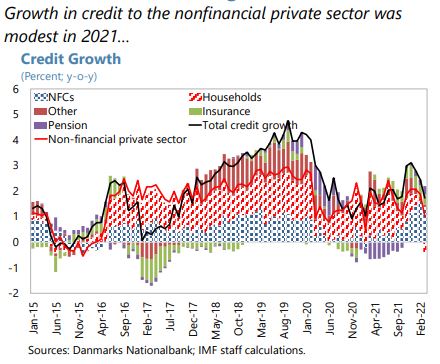
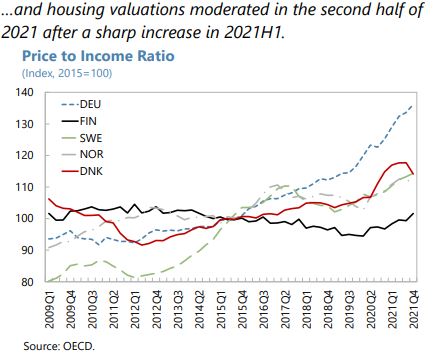
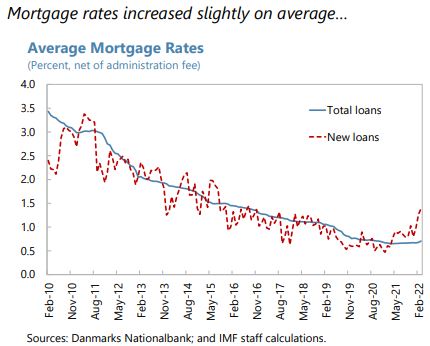
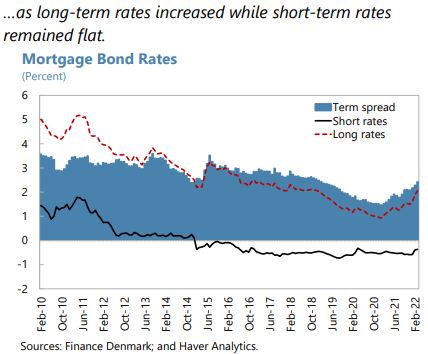
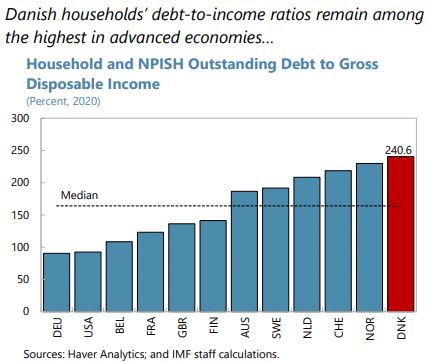
“Macrofinancial vulnerabilities remain elevated. Household leverage remains high by international standards and housing prices rose faster than incomes through the pandemic. Furthermore, a sizable share of newly-originated loans were interest-only loans, some with amortizing options that could be exercised by lenders if housing values fall. In addition, homeowners are increasingly taking out variable-rate mortgage loans and repaying fixed-rate loans which naturally increases the interest-rate sensitivity of homeowners. Thus, a domestic or regional house price correction, triggered possibly by a reassessment of fundamentals or a tightening of global financial conditions could reverberate in Denmark, weighing on the real estate market, private consumption, and investment. The impact could be amplified by the high interconnectedness of mortgage credit institutions (MCIs), pension funds, and insurance companies given their dependence on the housing sector. While the net impact is uncertain, high, and persistent inflation could weigh on bank profitability including through lower aggregate demand, or if highly-leveraged households cannot service their debt due to variable-rate mortgages resetting at higher rates.
(…)
They recognize that macrofinancial risks mainly stem from the housing market in combination with high household leverage and an increasing share of risky mortgages.
(…)
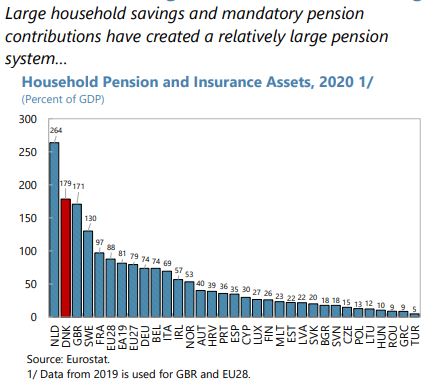
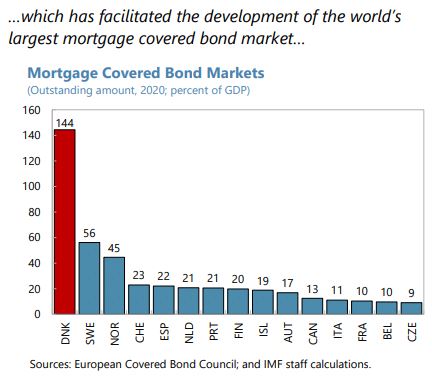
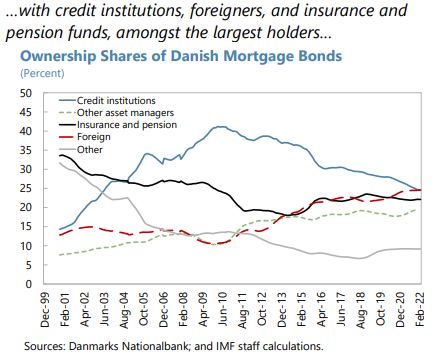
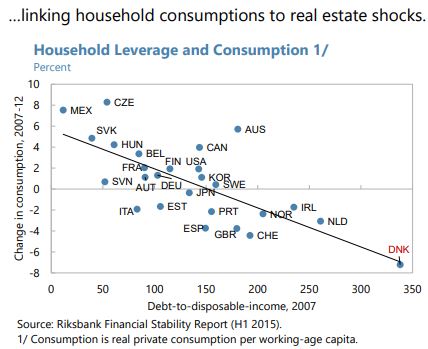
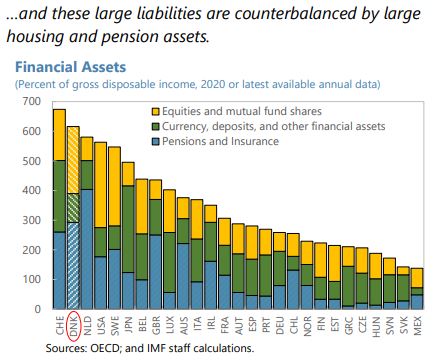
Macrofinancial vulnerabilities persist due to high leverage and an increasing share of risky mortgages. Following a prolonged period of low interest rates, high debt, combined with illiquid assets (concentrated in real estate via housing and pension assets), exposes households to price and interest rate shocks that can spill over to aggregate demand. Furthermore, many households have recently opted for interest-only mortgages with options for lenders to request amortization if housing prices fall, which could amplify adverse shocks. Many of these households would face markedly higher debt-servicing costs were they required to amortize their mortgages (DN 2021). A sharp revaluation could harm highly-leveraged households, particularly those who purchased in overvalued urban areas and low-income households. These vulnerabilities are compounded by the large and growing proportion of variable-rate mortgages, which are increasingly used to repay fixed-rate loans, exposing homeowners to higher interest rate risk. Moreover, MCIs and pension and insurance companies are highly interconnected and dependent on the health of the housing sector.
(…)
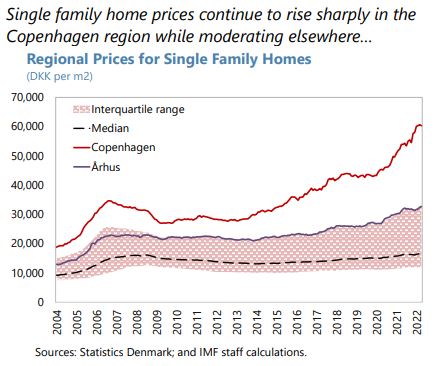
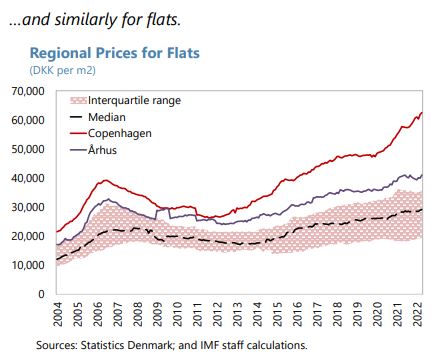
These developments warrant tightening prudential tools. Macroprudential tools aim to increase macrofinancial resilience and contain excessive risk taking. Staff recommend that new mortgages extended to highly-leveraged households be subject to minimum down-payment requirements or mandatory amortization until a minimum equity share is reached, regardless of maturity and type of interest rate fixation. As valuation-based measures can be less binding when housing prices appreciate rapidly (Chen et. al, 2020), the limits applying to ”highly-leveraged” borrowers should become binding if either DTI or loan-to-value (LTV) limit is breached, instead of the current joint requirement. Based on borrowers’ riskiness, differentiated limits on income-based measures and LTVs for interest-only and floating-rate mortgages should also be considered. In an environment of increasing mortgage rates, the “growth area guidelines” should be extended beyond Copenhagen and Aarhus and debt-service-to-income (DSTI) caps should be considered to protect against liquidity shocks. The proposed risk-based prudential framework should facilitate calibration of these measures, to account for risk differentiation across groups, e.g., first-time home buyers to improve affordability. National legislation should include borrower-based tools (limits on LTVs, DTIs, and DSTIs) in the policy toolkit (FSAP 2020).
To improve affordability, it is important to address features of the tax code and housing supply constraints that create price pressures. Incentives for the adequate supply of housing should be reviewed. Moreover, rent controls in Denmark are pervasive relative to peer countries. Once inflationary pressures abate, these should be relaxed to stimulate the rental market, while protecting the most vulnerable. Mortgage interest deductibility should be reduced as in other advanced economies, as this incentivizes larger housing purchases and higher indebtedness, pushing up prices (Gruber et. al, 2019). Linking property taxes to market valuations should be prioritized.”
From the IMF’s latest report on Denmark:
“Macrofinancial vulnerabilities remain elevated. Household leverage remains high by international standards and housing prices rose faster than incomes through the pandemic. Furthermore, a sizable share of newly-originated loans were interest-only loans, some with amortizing options that could be exercised by lenders if housing values fall. In addition, homeowners are increasingly taking out variable-rate mortgage loans and repaying fixed-rate loans which naturally increases the interest-rate sensitivity of homeowners.
Posted by at 12:07 PM
Labels: Global Housing Watch
Tuesday, June 14, 2022
Some Stock Market Benchmarks
From Conversable Economist:
“When I get the quarterly announcements for what my retirement account is now worth, and a drop in the stock market has caused the total in the account to decline, I find myself looking at some of the long-run patterns in stock market prices.
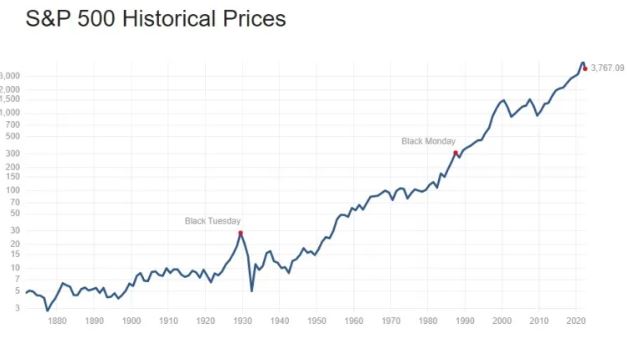
To set the stage, here’s the historical pattern of the S&P stock index since back in the 19th century. In interpreting the figure, notice that the vertical axis is a logarithmic axis showing proportional changes; for example, the tripling from 10 to 30 is the same size as the tripling from 100 to 300 and the same as the tripling from 1000 to 3000. (Without using a log scale, all the smaller values–like the stock market crash of 1929, would just be a little squiggle what would look like a nearly flat line on the far left of the figure.) You can see some of the well-known changes in the stock market over time: the run-up of the 1920s, the crash of 1929, the run-up of the 1960s, the comparatively flat market of the 1970s, a big jump in the dot-com market of the 1990s, the run-up since 2009, and the recent decline. Of course, whenever you consider the possibility that the
For a slightly different view, here is the same set of data, this time adjusted for inflation. Again, the vertical axis shows proportional change. Again, the main well-known changes are pretty visible, but they don’t all look the same. For example, after adjusting for inflation, the Black Tuesday stock market decline in the 1920s looks even more striking, and during the high-inflation 1970s, the real value of the S&P 500 index is falling.
Of course, stock market values should be affected by expectations of corporate earnings. Thus, the standard price-earnings measure of the stock market looks at stock prices divided by corporate earnings over the previous 12 months. Notice that the logarithmic scales have now gone away. Corporate earnings will rise over the long run both because of inflation and along with overall growth in the economy. Thus, one might expect to see the P/E ratio be roughly the same over time, of course with some fluctuations as economic events and market trends interact. Indeed, when you try to find the 1929 stock market crash in this data, it’s barely apparent: after all, if both stock prices and corporate earnings collapse at about the same time, then the ratio of the two may not move in an especially dramatic way.”
From Conversable Economist:
“When I get the quarterly announcements for what my retirement account is now worth, and a drop in the stock market has caused the total in the account to decline, I find myself looking at some of the long-run patterns in stock market prices.
To set the stage, here’s the historical pattern of the S&P stock index since back in the 19th century.
Posted by at 8:10 AM
Labels: Macro Demystified
Saturday, June 11, 2022
Dale W. Jorgenson: An Intellectual Biography
Profile by John Fernald (INSEAD and Federal Reserve Bank of San Francisco):
“Dale W. Jorgenson has been a central contributor to a wide range of economic and policy issues over a long and productive career. His research is characterized by a tight integration of economic theory, appropriate data that matches the theory, and sound econometrics. His groundbreaking work on the theory and empirics of investment established the research path for the economics profession. He is a founder of modern growth accounting: Official statistics in many countries, including the United States, implement Jorgenson’s methods. Relatedly, without Jorgenson’s unflagging efforts, consistent industry KLEMS datasets for many countries—which have been widely used in recent decades for growth accounting, econometrics, and other applications—would not exist. Jorgenson is also a pioneer in econometric modeling of producer and consumer behavior and of econometrically estimated, intertemporal general equilibrium modeling for policy analysis.”
Also, see an article in the Wall Street Journal by James R. Hagerty: “Harvard Economist Dale Jorgenson Found Better Ways to Gauge Productivity. Professor, who has died at age 89, removed much of the mystery from studies of what drives economic growth”.
Profile by John Fernald (INSEAD and Federal Reserve Bank of San Francisco):
“Dale W. Jorgenson has been a central contributor to a wide range of economic and policy issues over a long and productive career. His research is characterized by a tight integration of economic theory, appropriate data that matches the theory, and sound econometrics. His groundbreaking work on the theory and empirics of investment established the research path for the economics profession.
Posted by at 11:48 AM
Labels: Profiles of Economists
Friday, June 10, 2022
Housing Market in Canada
From the Bank of Canada:
“The vulnerability associated with elevated house prices (Vulnerability 2) increased further over the past year. Key developments in the housing market—strong demand relative to supply, driven partly by an increasing share of investors; prices reaching all-time highs in most regions; and expectations that these price increases will continue in most major cities—point to further imbalances in prices compared with a year ago.
A large misalignment of house prices relative to longer-term fundamentals could lead to an abrupt price correction in the future. Such a correction can, in turn, bring on financial stress for households because housing often represents their largest asset (see “A large decline in household income and house prices”).
It is too early to tell whether the recently observed decrease in resale activity and prices will be temporary or is the start of a deeper, lasting decline. A sudden reversal of the influx of housing investors seen during the pandemic could amplify downward pressure on prices (Box 2).
After months of exceptionally strong activity in the housing market, resales slowed considerably in March and April 2022 (Chart 7). Until the early months of 2022, demand—including from investors—was remarkably robust, supported by a desire for more housing space, record-low mortgage rates and the accumulation of extra savings. Resales are expected to soften as borrowing rates rise and the pandemic-induced demand for more housing space wanes. Recent monthly data reveal a large decline in resale activity. This could reflect a temporary echo effect from some homebuyers making their purchases earlier to avoid the latest mortgage rate increases, or it could signal the beginning of the end of the pandemic upswing.
Growth in house prices has been vigorous and regionally broad-based. In April 2022, house prices were up 24% nationally compared with April 2021, and up 53% relative to April 2020. Despite house prices increasing in nearly all areas, suburbs have experienced the strongest growth—as seen in the Toronto and Montréal regions (Figure 1).15 This dynamic is consistent with the pandemic-induced shift in preferences for more housing space, which is more affordable and widely available in suburban and rural areas than it is in city centres.
Part of the exceptional increase in house prices observed since the start of the pandemic may have reflected extrapolative price expectations. This happens when people come to expect that house prices will rise in the future simply because they have risen in the past. In such a situation, homebuyers may rush into the market out of fear of missing out or may hope to realize a sizable capital gain. Under these conditions, housing demand and prices can then become disconnected from underlying fundamentals, putting prices at risk of a correction in the future. Extrapolative expectations, particularly among investors, could amplify and accelerate price declines if a house price correction were to occur. Such a correction could dampen economic activity not only through confidence effects but also because it reduces household wealth and restricts access to credit (see “A large decline in household income and house prices”). Although house prices declined in April 2022, it is too early to tell whether this is the beginning of a substantial correction in prices.
Before the tightening of monetary policy in March, extrapolative expectations appeared to have broadened. The Canadian Survey of Consumer Expectations conducted in February revealed that many Canadians were expecting house prices to increase substantially over the next year. In fact, this is the highest rate for this response since the Bank introduced this survey question in 2016. These elevated expectations also appeared to be broadening. For the first time, the Bank’s House Price Exuberance Indicator characterized house prices in most major Canadian cities as exuberant in the first quarter of 2022 (Chart 8).16 However, these indicators were collected before the slowdown in housing activity and price growth in April. It remains to be seen whether data for the second quarter will support the same conclusion.
The share of Canadians buying homes as investment properties grew in 2021. The increased presence of investors in the real estate market can amplify the vulnerability associated with elevated house prices (Box 2).
Box 2: Vulnerabilities associated with investors in residential real estate
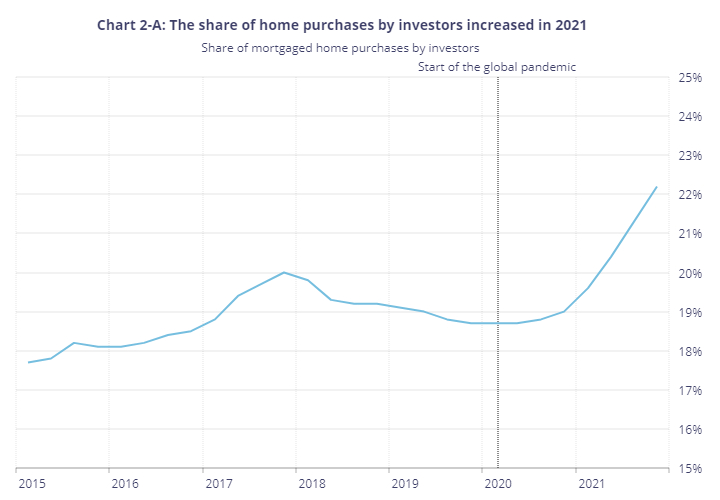
In an environment of low mortgage rates and rapid increases in house prices, expectations of a large capital gain can make houses an attractive asset for investors. For the purpose of this analysis, investors are defined as existing mortgage holders who obtain an additional mortgage to purchase a property. In 2021, they made purchases at a faster pace than first-time or repeat homebuyers. Investors accounted for over 22% of mortgaged purchases in the fourth quarter of 2021, up from 19% in 2019 (Chart 2-A).17
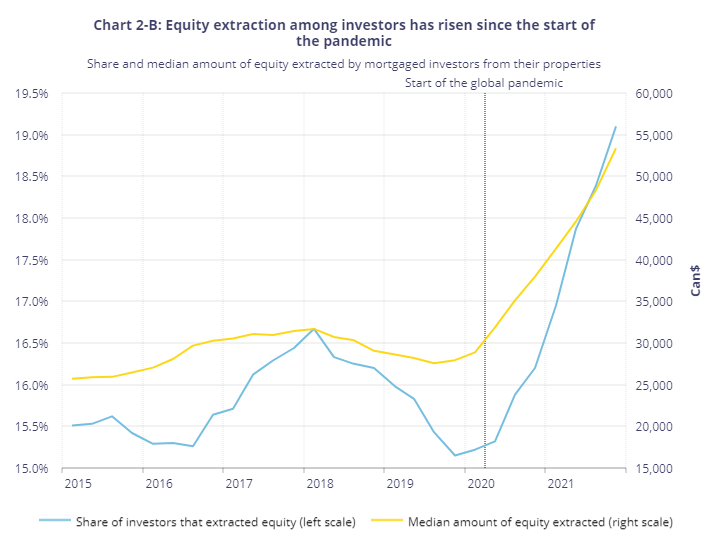
Investors are increasingly extracting equity from their existing properties to support new purchases. The share of investors who took out at least $5,000 in equity in the three months before they purchased an investment property rose substantially since the start of the pandemic (Chart 2-B). The amount of equity these investors took out through home equity lines of credit or mortgage refinancing also noticeably increased. For about one-third of these investors, the equity extracted was equal to or greater than the down payment on their subsequent purchase. This proportion is up from just over one-fifth in 2019. The increased use of equity gains to finance purchases highlights the feedback loop between rapid gains in house prices and the stronger demand for housing that investors generate.
Investors can amplify house price cycles. Investors can play an important role in the housing market if they make their property available to renters on a long-term basis. But investors can also increase vulnerabilities linked to higher house prices:18
- During housing booms, greater demand from investors can add to bidding pressures and intensify price increases.
- When prices are stable or declining or mortgage carrying costs are rising, holding real estate as an investment becomes less attractive. The incentive to sell may be greater for investors who risk falling into a negative equity position on one or more properties, also known as being “underwater.” A negative equity position can prevent the future sale of a property if the investor does not have enough liquid assets to cover the shortfall.
Although investors typically earn more income than non-investors, they tend to have higher loan-to-income ratios, once all the mortgages they hold are accounted for, and higher debt servicing costs.19, 20 If an income shock occurs—whether a reduction in employment or rental income because, for example, some tenants become unemployed—highly leveraged investors may need to sell one or more of their properties to recover some liquid assets. Although investors may not be considered as financially vulnerable as non-investor households given the amount of equity they have tied up in real estate, investors could intensify the effect of an economic slowdown by adding downward pressure on housing demand and prices.”
From the Bank of Canada:
“The vulnerability associated with elevated house prices (Vulnerability 2) increased further over the past year. Key developments in the housing market—strong demand relative to supply, driven partly by an increasing share of investors; prices reaching all-time highs in most regions; and expectations that these price increases will continue in most major cities—point to further imbalances in prices compared with a year ago.
A large misalignment of house prices relative to longer-term fundamentals could lead to an abrupt price correction in the future.
Posted by at 8:24 AM
Labels: Global Housing Watch
Subscribe to: Posts