Showing posts with label Global Housing Watch. Show all posts
Wednesday, February 16, 2022
Housing Market in North Macedonia
From the IMF’s latest report on North Macedonia:
“The authorities emphasized that the health and stability of the banking system has been preserved through the pandemic, and they continue to closely monitor risks. Regulatory flexibility, temporary restrictions on dividend payments, and economic policy support helped maintain credit to the economy during the pandemic. The NBRNM has strengthened the reporting frequency and data requirements for monitoring credit quality, introduced a comprehensive and consistent bottom-up stress testing, and increased the focus on risks such as cyber risks, which are being taken into account when setting bank-specific Pillar-II capital requirements. Given high growth in new mortgages and rising house prices, a targeted assessment is underway. Moreover, the NBRNM is closely monitoring deposit-driven euroization, which increased during the pandemic, against the plan set out in the denarization strategy.
(…)
Banking system strength has held up well during the pandemic, but continued vigilance is essential. The banking system overall remains well capitalized and profitable. Initiatives to improve the framework for stress tests of banks are welcome, together with intensified supervisory efforts to ensure that banks recognize any problem assets and provision adequately for potential loan losses on a forward-looking basis. Given the still high share of FX or FX-linked loans in household loans, with possibly limited hedging of borrowers, the NBRNM should maintain carefully calibrated measures to limit FX lending. Moreover, rising private sector debt, albeit from low levels, and the high growth in mortgage lending, coupled with an acceleration in house prices, warrant further scrutiny.”
From the IMF’s latest report on North Macedonia:
“The authorities emphasized that the health and stability of the banking system has been preserved through the pandemic, and they continue to closely monitor risks. Regulatory flexibility, temporary restrictions on dividend payments, and economic policy support helped maintain credit to the economy during the pandemic. The NBRNM has strengthened the reporting frequency and data requirements for monitoring credit quality, introduced a comprehensive and consistent bottom-up stress testing,
Posted by at 11:48 AM
Labels: Global Housing Watch
Housing Market in Spain
From the IMF’s latest report on Spain:
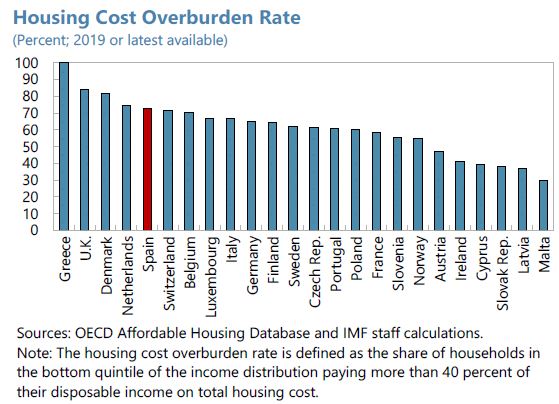
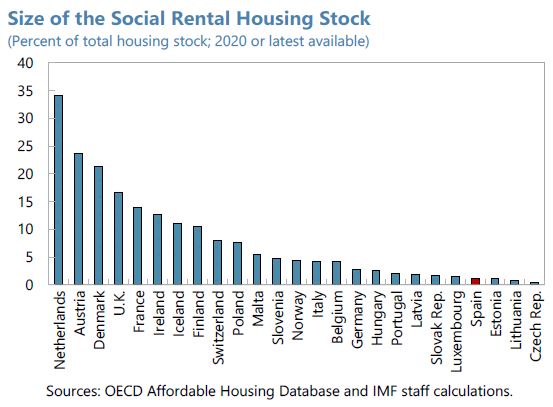
“Continued efforts to address housing affordability challenges would support growth, facilitate labor mobility across regions and reduce inequality. Prior to the pandemic, limited rental housing supply hampered by relatively inefficient building regulations contributed to a surge in rental prices, creating affordability problems and limiting labor mobility (especially for young people and other vulnerable groups). The draft housing law and the national housing plan aim to address the existing challenges. To limit increases in rent prices in stressed areas, the law introduces rent caps on large landlords and tax incentives for small landlords to keep rents low. While these may benefit tenants in the short term, rent caps could introduce inefficiencies and restrict the availability of properties for future tenants. Further evaluation of these measures would be useful to gauge their impact. The envisaged targeted rent support programs for vulnerable groups are welcome. However, they should be combined with effective supply measures to avoid further pressures on rent prices. The increase of taxes on empty properties and the expansion of the social housing stock, which are contemplated in the proposed reform, should help increase rent supply. The RTRP envisages €1 billion for the construction of new public social rental dwellings in 2022–23. Additional policies to increase housing supply could include simplifying land use regulations and accelerating licensing processes at the regional government level.”
From the IMF’s latest report on Spain:
“Continued efforts to address housing affordability challenges would support growth, facilitate labor mobility across regions and reduce inequality. Prior to the pandemic, limited rental housing supply hampered by relatively inefficient building regulations contributed to a surge in rental prices, creating affordability problems and limiting labor mobility (especially for young people and other vulnerable groups). The draft housing law and the national housing plan aim to address the existing challenges.
Posted by at 11:44 AM
Labels: Global Housing Watch
Saturday, February 12, 2022
Vulnerabilities in the residential real estate sectors of the EEA countries
From European Systemic Risk Board:
“In this report, the ESRB presents its medium-term assessment of vulnerabilities relating to the RRE sector across the EEA countries. In carrying out this assessment, the ESRB first performed an analysis of vulnerabilities across the EEA countries. For the 24 countries for which the vulnerabilities identified were more pronounced, an in-depth analysis was conducted. This analysis pointed also to the need to take into account or change other than macroprudential policies, for example by changing tax incentives or increasing the housing supply. A similar assessment was conducted by the ESRB in 2019, when 11 countries received either ESRB recommendations (Belgium, Denmark, Finland, Luxembourg, Netherlands and Sweden) or warnings (Czech Republic, Germany, France, Iceland and Norway).
The risk assessment concluded that, in five countries which received ESRB recommendations or warnings in 2019 (Denmark, Luxembourg, Netherlands, Norway and Sweden) the vulnerabilities relating to residential real estate markets remained high, while in six countries (Belgium, Czech Republic, Germany, Finland, France and Iceland) the vulnerabilities were assessed as medium. Among other EEA countries, 13 (Austria, Bulgaria, Estonia, Croatia, Hungary, Ireland, Liechtenstein, Lithuania, Malta, Poland, Portugal, Slovenia and Slovakia) were identified as facing medium risks.
The policy assessment found that in five countries which received ESRB recommendations or warnings in 2019 (Belgium, Czech Republic, France, Iceland and Norway), policies were assessed as appropriate and sufficient to mitigate the vulnerabilities identified. In two countries (the Netherlands and Sweden), policies were assessed as being appropriate but partially sufficient, while in four of the countries (Germany, Denmark, Finland and Luxembourg), policies were assessed as partially appropriate and partially sufficient. Among the rest of the EEA countries analysed in this report, in one country (Slovakia) policies were identified as appropriate and partially sufficient, while in five countries (Austria, Bulgaria, Hungary, Croatia and Liechtenstein) policies were found to be partially appropriate and partially sufficient.
In countries in which the policies were assessed as only partially sufficient to mitigate the identified vulnerabilities, the ESRB suggested various macroprudential measures to be considered by the national authorities. In particular, the ESRB pointed out that a number of countries should either introduce additional borrower-based measures or tighten existing ones to mitigate the existing vulnerabilities more effectively or prevent a further build-up of vulnerabilities. Countries with accumulated vulnerabilities should also ensure that capital is preserved until a possible materialisation of risks or consider (re)introducing capital-based measures once the economic recovery is on a firm footing. However, taking into account the economic uncertainty related to the pandemic, any policy actions should be carefully assessed to ensure that they contribute towards mitigating RRE vulnerabilities, while aiming to avoid procyclical effects on the real economy and the financial system. In the near term, it is particularly important for all countries that banks make adequate provision for expected losses. Finally, the analysis notes that, in some countries in which the systemic risk levels identified remain high, interventions in other policy areas may be required to complement macroprudential policy.”
From European Systemic Risk Board:
“In this report, the ESRB presents its medium-term assessment of vulnerabilities relating to the RRE sector across the EEA countries. In carrying out this assessment, the ESRB first performed an analysis of vulnerabilities across the EEA countries. For the 24 countries for which the vulnerabilities identified were more pronounced, an in-depth analysis was conducted. This analysis pointed also to the need to take into account or change other than macroprudential policies,
Posted by at 6:29 AM
Labels: Global Housing Watch
Friday, February 11, 2022
Housing View – February 11, 2022
On cross-country:
- Property ladder too high for central Europe’s first-time buyers – Reuters
On the US:
- The Housing Boom May Be About to Go Bust. A new generation of buyers is jumping into the market at what may be the worst possible time. – Bloomberg
- The Housing Party Is Starting to Wind Down. Builders are ramping up supply just as a record low percentage of Americans say it’s a good time to buy a home. – Bloomberg
- In Covid-19 Housing Market, the Middle Class Is Getting Priced Out. Surging demand and shrinking supply combine to make home buying more difficult, as affordability worsens for many – Wall Street Journal
- It’s Time to Put Cities at the Top of America’s Economic Agenda. The U.S. economy today is actually a collection of regional economies. We need a national place-based strategy that recognizes local differences. – Bloomberg
- National and Metro Housing Market Indicators – AEI
- Zillow: Our 2022 housing forecast is way off—home prices now set to spike 16% – Fortune
- Inequality in the Time of COVID-19: Evidence from Mortgage Delinquency and Forbearance – Philadelphia Fed
- Is the ‘American Dream’ of Homeownership a False Promise? In “Owned: A Tale of Two Americas,” director Giorgio Angelini traces the origins of a discriminatory housing market. – Bloomberg
- Record-High Prices and Record-Low Inventory Make It Increasingly Difficult to Achieve Homeownership, Particularly for Black Americans – NAR
- Want Affordable Housing? Strengthen Regional Governments. Most Americans live in metropolitan areas, and it takes a metropolitan regional government to coordinate the growth in housing, transit, and employment that makes the region livable. – The American Prospect
- The Housing Situation Is Dire. But Progress Is Still Possible. In the South Bronx, developers found ways to build an array of sleek, affordable apartments in two subsidized housing developments. Is this a way forward? – New York Times
- There are hardly any houses left to buy – Axios
- US Housing Supply Gap Expands in 2021 – Realtor.com
- Diverse neighborhoods are made of diverse housing – Brookings
- U.S. Housing Costs Surge, With No End In Sight. Locked out of the supply-constrained home-buying market, more households are crowding the rental market, driving up rents and stressing housing support programs. – Bloomberg
- How Rent Hikes Make Buying a House Even Harder. Rising rents are pushing many to buy a home even if the housing market is already tough – Wall Street Journal
- Where Are Rents Rising the Most? In 2021, rents rebounded from pandemic lows in nearly all of the 100 largest American cities. – New York Times
- What Freddie Mac is Doing About the Rental Affordability Crisis – Freddie Mac
- Millennial Demand is Driving up Prices in Family-Friendly Neighborhoods – Zillow
- How strip malls could help solve the housing shortage. There’s a lot of space for apartments above the commercial real estate on main suburban streets – Fast Company
- California’s Free-Market Housing Fix. A new state law allows landowners to build four units on most lots zoned currently for one unit. – Wall Street Journal
- They Rushed to Buy in the Pandemic. Here’s What They Would Change. A frenzied sellers’ market led some people to make harried decisions when buying their homes that they now regret. – New York Times
- Homeownership in old age and at the time of death – Economics Letters
- How New York’s housing market got even more ridiculous. For a brief moment, dream apartments seemed possible – but then it all came crashing down – The Guardian
- American Protectionism and Construction Materials Costs. Tariffs imposed by the U.S. government on materials used by the domestic construction sector cause a significant increase in the cost of those goods. – Cato Institute
- The Sustainable City Podcast: Where the Suburbs End. Join us as we discuss California’s audacious effort to deconstruct single-family zoning – New York Times
On China
- Chinese property group Shimao feels chill of sector’s liquidity crisis. Developer sucked into bond market sell-off following Evergrande collapse – FT
- China’s Taking on a Risky Bubble Deflation Experiment. Property investors, like Wile E. Coyote, may feel wobbly if they look down. – Bloomberg
- China Eases Property Loan Curbs as Housing Market Slumps. Loans to fund public rental housing become exempt from limits. PBOC’s move is latest softening of real estate clampdown – Bloomberg
On other countries:
- [Canada] Canadians Deepen Faith in Red-Hot Housing While Rate Hikes Loom. 64% expect real-estate prices to rise over next half year. Jump in sentiment comes amid central bank, regulatory warnings – Bloomberg
- [Iceland] Europe’s Hottest Housing Boom May Prompt Bigger Hike in Iceland. Central bank might raise key interest rate by 0.75% this week. House prices on Atlantic island have risen 150% since 2010 – Bloomberg
- [United Kingdom] Why are there so few homes for sale in the UK? A supply crunch has left many prospective buyers struggling to find the right property – FT
- [United Kingdom] Most Tory voters want more affordable housing stock, finds poll. YouGov study also finds most Conservative supporters in favour of higher taxes on second homes – The Guardian
- [United Kingdom] Residential rents rise at fastest pace in 13 years. Tenants under pressure to find affordable urban homes as workplaces reopen – FT
- [United Kingdom] U.K. Builder Says House Prices Outpacing Cost-Inflation Surge – Bloomberg
- [United Kingdom] These Are Britain’s Property Hotspots. The North-South divide is stark in a new analysis of property price growth over the past decade, with southern England values almost doubling in several places. – Bloomberg
On cross-country:
- Property ladder too high for central Europe’s first-time buyers – Reuters
On the US:
- The Housing Boom May Be About to Go Bust. A new generation of buyers is jumping into the market at what may be the worst possible time. – Bloomberg
- The Housing Party Is Starting to Wind Down. Builders are ramping up supply just as a record low percentage of Americans say it’s a good time to buy a home.
Posted by at 5:00 AM
Labels: Global Housing Watch
Tuesday, February 8, 2022
Residential mobility and unemployment in the UK
From a new paper by Monica Langella and Alan Manning:
“The UK has suffered from persistent spatial differences in unemployment rates for many decades. A low responsiveness of internal migration to unemployment is often argued to be an important cause of this problem. This paper uses UK census data to investigate how unemployment affects residential mobility using small areas as potential destinations and origins and four decades of data. It finds that both in- and out-migration are affected by local unemployment – but also that there is a very high ‘cost of distance’, so most moves are very local. We complement the study with individual longitudinal data to analyse individual heterogeneities in mobility. We show that elasticities to local unemployment are different across people with different characteristics. For instance, people who are better educated are more sensitive, the same applies to homeowners. Ethnic minorities are on average less sensitive to local unemployment rates and tend to end up in higher unemployment areas when moving.”
From a new paper by Monica Langella and Alan Manning:
“The UK has suffered from persistent spatial differences in unemployment rates for many decades. A low responsiveness of internal migration to unemployment is often argued to be an important cause of this problem. This paper uses UK census data to investigate how unemployment affects residential mobility using small areas as potential destinations and origins and four decades of data. It finds that both in- and out-migration are affected by local unemployment –
Posted by at 11:13 AM
Labels: Global Housing Watch
Subscribe to: Posts