Showing posts with label Global Housing Watch. Show all posts
Monday, February 28, 2022
The Coming Rise in Residential Inflation
From a new NBER working paper by Marijn A. Bolhuis, Judd N. L. Cramer & Lawrence H. Summers:
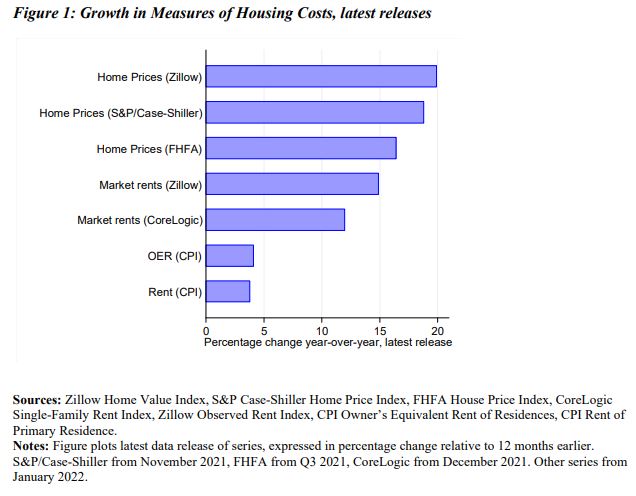
“We study how the recent run-up in housing and rental prices affects the outlook for inflation in the United States. Housing held down overall inflation in 2021. Despite record growth in private market-based measures of home prices and rents, government measured residential services inflation was only four percent for the twelve months ending in January 2022. After explaining the mechanical cause for this divergence, we estimate that, if past relationships hold, the residential inflation components of the CPI and PCE are likely to move close to seven percent during 2022. These findings imply that housing will make a significant contribution to overall inflation in 2022, ranging from one percentage point for headline PCE to 2.6 percentage points for core CPI. We expect residential inflation to remain elevated in 2023.”
From a new NBER working paper by Marijn A. Bolhuis, Judd N. L. Cramer & Lawrence H. Summers:
“We study how the recent run-up in housing and rental prices affects the outlook for inflation in the United States. Housing held down overall inflation in 2021. Despite record growth in private market-based measures of home prices and rents, government measured residential services inflation was only four percent for the twelve months ending in January 2022.
Posted by at 6:42 AM
Labels: Global Housing Watch
Friday, February 25, 2022
Housing View – February 25, 2022
On cross-country:
- Analysis: ECB has to fight housing bubble with its hands tied – Reuters
- Owner-occupied housing and inflation measurement – European Central Bank
- A New Angle on Excess Consumption Volatility in Emerging Countries: Does House Price Matter? – Journal of International Money and Finance
- House Prices, Housing Wealth and Financial Well-being – Journal of Urban Economics
On the US:
- Dysfunctional policies have broken America’s housing supply chain – Brookings
- Is There a Way Out of America’s Impossible Housing Mess? The first step, according to economist Jenny Schuetz, is recognizing there is more than one housing crisis. – Slate
- The Housing Boom’s Mortgage Rate Threat Is Worse Than It Seems. Soaring borrowing costs might hurt demand, but they’re not helping supply either. – Bloomberg
- Mortgage Rates Close In on 4%, Making Home Affordability Tougher. Average rate of 30-year fixed loan climbs to highest since May 2019 – Wall Street Journal
- Mortgage Rates Will Rain on This House Party. Housing indicators suggests strong demand and tight supply, but higher mortgage rates are likely to start showing in the data – Wall Street Journal
- Rents Have Soared Across the Country, But Home Prices Grew Even Faster – Harvard Joint Center for Housing Studies
- January Existing Home Sales: Defying Conventional Wisdom – Zillow
- U.S. existing home sales accelerate; investors elbowing out first-time buyers – Reuters
- Wall Street Is Buying Starter Homes to Quietly Become America’s Landlord. Private equity money is pouring into the Phoenix real estate market, turning first-time homebuyers into renters. – Bloomberg
- The Next Affordable City Is Already Too Expensive. In Spokane, Wash., home prices jumped 60 percent in the past two years. The increase is fueled by buyers fleeing the boom in cities like Austin. Who will have to flee next? – New York Times
- Housing: What Fed rate hikes mean for the real estate and rental markets – Yahoo Finance
- Share of all homes bought by investors – Axios
- First-time homebuyers are getting squeezed out by investors – NPR
- Online Real Estate Isn’t Worth the Chance. Even as the housing market booms in the U.S., dreams of online real-estate riches have faded in the stock market – Wall Street Journal
- America’s housing boom is also a backlog – Axios
- Waters Calls on Regulators and Industry to Hold Appraisers Accountable and Announces Plans for Legislation – US House Committee on Financial Services
- Commercial Real Estate Is Seen as an Inflation Hedge, but That Isn’t Always the Case. With inflation running its hottest in four decades, some investors are starting to question the strength of real estate’s defenses against higher prices – Wall Street Journal
- Addressing the Housing Affordability Crisis as COVID-19’s Impact Continues – St. Louis Fed
On China
- China’s Real-Estate Balancing Act. China’s government has emphasized that policies to address financial vulnerabilities and structural problems should not impede economic growth. But, when it comes to the real-estate sector, that will not be an easy balance to strike – and getting it wrong could have economy-wide repercussions. – Project Syndicate
- China Broadens Real Estate Lending Support to Bigger Cities. PBOC urged banks to accelerate property loans in Shanghai. Major banks in Guangzhou cut mortgage rates for homebuyers – Bloomberg
- Is There an Industrial Land Discount in China? A Public Finance Perspective. Local Chinese governments face a trade-off between supplying residential or industrial land, and this work reveals the importance of taxes and revenue streams over time in shaping those choices. – University of Chicago
- Heze Is First Chinese City to Cut Mortgage Down Payments, Local Media Reports. Major banks in Heze cut mortgage down payment ratio to 20%. More smaller cities may follow suit, research analyst says – Bloomberg
- Banks in nearly 90 Chinese cities cut mortgage rates – Reuters
- HSBC takes charge on Chinese real estate and warns of wealth slowdown. Outlook blemishes otherwise buoyant fourth-quarter earnings as profit doubles and targets boosted – FT
On other countries:
- [Australia] House prices and rents surge in regional Australia amid influx of arrivals from cities. Locals say they are being priced out as NAB reports 24 of the 25 largest regions have had double-digit housing growth – The Guardian
- [Colombia] Assessing the impact of recent Venezuelan immigration on housing rents in Colombia – Spatial Economic Analysis
- [Cyprus] Recent developments in housing markets and related policy challenges – Central Bank of Cyprus
- [India] Deepak Parekh Says India’s Real Estate Showing Uptrend Amid Global Jitters – Bloomberg
- [Ireland] Will the price of Irish houses just keep on rising? Cliff Taylor: key policy challenge is to provide a supply of homes at more affordable prices – The Irish Times
- [New Zealand] New Zealand’s homeless have been moved off the streets, but the crisis endures – The Guardian
- [Norway] Norway: boosting productivity and workforce participation while improving housing affordability will help maintain high living standards, says OECD – OECD
- [Spain] Effectiveness and supply effects of high-coverage rent control policies – Barcelona Institute of Economics
- [Taiwan] Long- and short-term price behaviors in presale housing markets in Taiwan – Economic Analysis and Policy
- [Turkey] Turkish builder touts land sales as inflation slows house deals – Reuters
- [United Kingdom] London housing market boosted by end of COVID rules, Rightmove says – Reuters
- [United Kingdom] The Guardian view on unaffordable homes: building injustice into the economy – The Guardian
On cross-country:
- Analysis: ECB has to fight housing bubble with its hands tied – Reuters
- Owner-occupied housing and inflation measurement – European Central Bank
- A New Angle on Excess Consumption Volatility in Emerging Countries: Does House Price Matter? – Journal of International Money and Finance
- House Prices, Housing Wealth and Financial Well-being – Journal of Urban Economics
On the US:
- Dysfunctional policies have broken America’s housing supply chain – Brookings
- Is There a Way Out of America’s Impossible Housing Mess?
Posted by at 5:00 AM
Labels: Global Housing Watch
Thursday, February 24, 2022
Housing Market in Poland
From the IMF’s latest report on Poland:
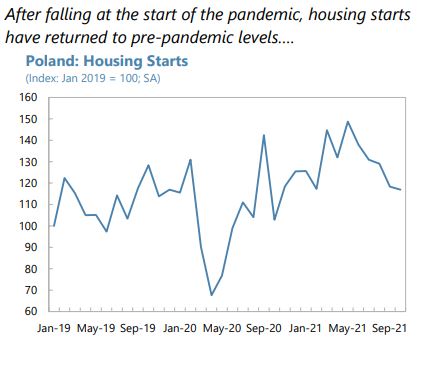
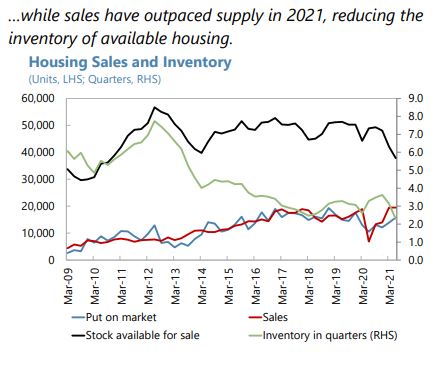
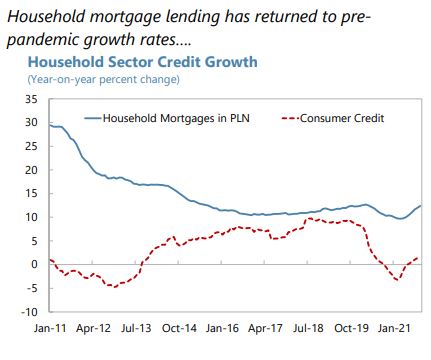
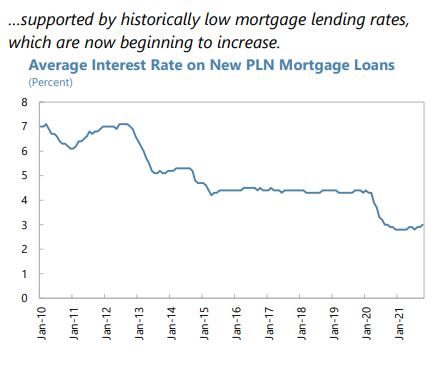
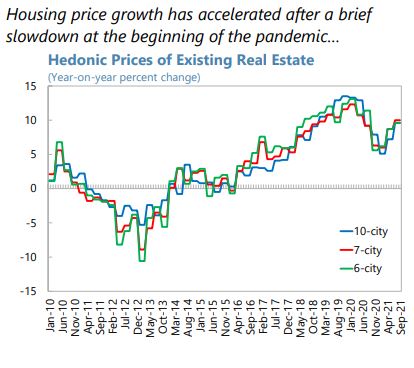
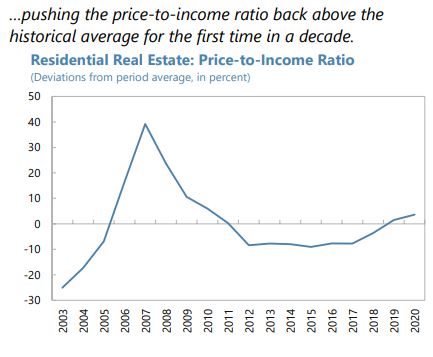
“The authorities’ proposals to increase housing affordability should consider the impact on the housing market and financial stability. The housing market has returned to pre-pandemic robust conditions (Figure 14). The state development bank plans to offer partial mortgage guarantees in lieu of mortgage down payments to support applicants for smaller mortgage loans, which could increase demand for mortgage loans and fuel further price growth. Mortgages are mostly floating rate, boosting housing affordability during the recent time of extraordinarily low interest rates. However, households could become overstretched as interest rates normalize, risking a deterioration in credit quality. To mitigate these risks, it is important that banks continue conservative creditworthiness assessments in line with supervisory guidelines, including an LTV limit at 80 percent, stressed DSTI at 40–50 percent with an interest rate buffer of 250–300 bps, and loan maturities capped at 25 years. Early signals suggest increasing policy interest rates are likely to dampen demand for mortgage credit.”
From the IMF’s latest report on Poland:
“The authorities’ proposals to increase housing affordability should consider the impact on the housing market and financial stability. The housing market has returned to pre-pandemic robust conditions (Figure 14). The state development bank plans to offer partial mortgage guarantees in lieu of mortgage down payments to support applicants for smaller mortgage loans, which could increase demand for mortgage loans and fuel further price growth.
Posted by at 6:44 AM
Labels: Global Housing Watch
Saturday, February 19, 2022
Recent developments in housing markets and related policy challenges
Speech by Governor Constantinos Herodotou, Central Bank of Cyprus:
“The fact that not all euro area countries receive relevant warnings and recommendations by the ESRB is an indication that the Residential Market in the euro area is characterised by heterogeneity. In the upper right quartile of the chart, we find a number of countries that registered an accumulated increase in residential property prices of at least 25% in the last three years. Other countries have recorded accumulated growth as low as 5%.
Using as a starting point the observed heterogeneity and by analysing the experiences of several countries, we can draw certain broad conclusions on the effectiveness of the macroprudential toolbox.
The design of Borrower and Capital Based Measures is a decision of authorities. For example, based on information from the ESRB, Belgium introduced a Loan-to-Value on both owner-occupied and buy-to-let properties. Cyprus, in order to deal with a specific sectoral exposure, further to the Loan-to-Value cap, recently introduced an even stricter Loan-to-Value for luxurious properties. However, by observing the real estate cycles registered in a number of countries, it is evident that even the idiosyncratic design of these measures does not always stop real estate cycles from materialising. The Netherlands and Slovenia are examples of countries that have recorded vulnerabilities despite the implementation of such measures.
Analysis performed at the Central Bank of Cyprus verifies this observation.
Using an econometric model, we explain the growth rates of housing loans and house prices considering the implementation of macroprudential measures.
The analysis indicates that the Loan-to-Value ratio seems to be effective in containing housing loans, for 10 out of 12 countries in our sample and effective in containing house prices in only in 3 out of the 12 cases. Income based measures (such as Debt-Service-to-Income) and Capital Based Measures were found to be effective in around half of the countries that use them.
We can therefore conclude, that there is no “one-size-fits-all” type of macroprudential tool.
One of the reasons why macroprudential tools are not always effective, could be that vulnerabilities are not necessarily driven by the credit cycles. In the cases examined, it is evident, that credit for house purchases is not always correlated with the trends in housing prices. For example, Slovenia and the Netherlands experienced a build-up in vulnerabilities in the residential real estate market without a corresponding excessive growth in housing loans.
Structural factors could explain the above observation as they affect both demand and supply of housing. More particularly,
*Net migration and population growth are factors that have continued to put pressure on house prices in countries such as Luxembourg, which experienced net population growth of 13,6% in 2020. Countries with low vulnerabilities in the housing market, such as Greece, experienced a negative population growth.
*Strong preference for home ownership could also be a driving factor for the observed vulnerabilities in Luxembourg and Slovakia. Homeowners represent 92,9% of the population of Slovakia whereas in France, a country with low identified real estate vulnerabilities, homeowners represent 65,2%.
From the above examples, we can conclude that in designing a macroprudential tool, idiosyncratic structural factors need to be identified and accounted for.”
Monetary policy also plays a role. Although macroprudential policy is the first line of defence, the ECB has recognised that Financial Stability is a precondition for price stability. It has also been acknowledged that monetary policy, can, in principle, influence asset prices such as real estate.
(…)
To sum up, the euro area residential real estate market is characterised by heterogeneity. Vulnerabilities in the real estate market are not necessarily cyclical in nature but structural factors also play a role. A single policy or measure cannot be enough to tackle the materialisation of risks from the residential market, although macroprudential authorities, as the first line of defence, have a significant toolbox in their hands, that can help in containing these risks.”
Speech by Governor Constantinos Herodotou, Central Bank of Cyprus:
“The fact that not all euro area countries receive relevant warnings and recommendations by the ESRB is an indication that the Residential Market in the euro area is characterised by heterogeneity. In the upper right quartile of the chart, we find a number of countries that registered an accumulated increase in residential property prices of at least 25% in the last three years.
Posted by at 3:08 PM
Labels: Global Housing Watch
Friday, February 18, 2022
Housing View – February 18, 2022
On cross-country:
- ECB ‘cannot ignore’ house price surge in inflation assessment, says executive. Property boom adds to risks of acting too late to tighten monetary policy, says Isabel Schnabel – FT
- Surging housing costs boosting overall euro zone inflation: ECB – Reuters
- Watchdog sounds alarm on financial risks of Europe’s property boom. Banks at risk from soaring prices, loosening lending standards and rising household debt levels – FT and European Systemic Risk Board
- Germany and Austria told to curb boom in home prices – Reuters
- The true cost of empty offices. Property investors are sitting on big losses – The Economist
- The Economics Implications of House Price Capitalization: A Synthesis – London School of Economics
- Inflation may push more families to become Airbnb hosts, chief says. Lodging platform touts ‘economic opportunity’ while investors worry about limited supply as travel rebounds – FT
- Private Cities: Implications for Urban Policy in Developing Countries – World Bank
On the US:
- How to fix America’s broken housing systems – Brookings
- Housing Supply May Remain Constrained – Bloomberg
- Lacker on Rising Rates and Housing Market. Rising interest and mortgage rates will put a damper on housing demand, and also potentially on the supply of new homes, according to former Richmond Fed President Jeffrey Lacker. – Bloomberg
- Lessons from a Modern Master of Low-Rise Housing. Cities looking to boost density and affordability should look to the work of architect Louis Sauer, who designed stylish modernist housing in the 1960s and ’70s. – Bloomberg
- Why your rent is going up – Axios
- Renting a Home Is Even Harder Than Buying One in Unrelentingly Hot U.S. Market. Rental prices for single-family homes grew 7.8% in 2021, an all-time high, according to CoreLogic. – Bloomberg
- Blackstone expands further into rental housing in the United States. The private equity firm said it would acquire Preferred Apartment Communities, a real estate investment trust, for $6 billion as it seeks a hedge against inflation. – New York Times
- U.S. Housing Affordability Worsens. Median sales price for single-family existing homes was higher in fourth quarter versus year ago in 181 of 183 metro areas – Wall Street Journal
- Out-of-Town Home Buyers Will Pay 30% More Than Locals in Hottest U.S. Markets. In cities including Nashville, Philadelphia, Atlanta and Miami, people migrating from elsewhere are willing to pay way more than asking price. – Bloomberg
- Real-Estate Investors Head South, Bid Up Sunbelt Apartment Buildings. Dallas and Atlanta see more investment than other U.S. cities, as landlords chase job growth – Wall Street Journal
- Renters across US face sharp increases – averaging up to 40% in some cities. Americans face having to move or pay much bigger slice of income to stay in their homes as prices outstrip wages – The Guardian
- Remote Work Opens Up Cheaper Housing Options. House hunters are searching to move from expensive larger cities to smaller cheaper ones. – New York Times
- How the Federal Government’s policies are crowding out lower income Americans out of the housing market. And how federal agencies and regulators are in the process of doubling down on failed policies, putting low-income and minority borrowers needlessly in harm’s way – AEI
- Where Did All the Homes Go? Here Are the Cities With the Most Places for Sale—and the Ones With the Fewest – Realtor.com
- U.S. mortgage rates jump to two-year high, further squeezing buyers – Reuters
- San Francisco is the latest city to consider tackling its housing crisis by taxing empty homes – Quartz
- Amid a housing crisis, renters challenge firms they say are being exploitative – NPR
- With evictions on the rise, House Democrats team up to push new housing protections – NPR
- Natural disasters can wipe out affordable housing for years. And when communities lose affordable housing, it’s harder for businesses—and the entire economy—to recover from those disasters. – Fast Company
- Landmark housing discrimination settlement with Fannie Mae sets key precedent – Reuters
- Home prices: high, but not rising – FT
- Buying a Home Is as Frustrating as You Think It Is. Housing prices continue to skyrocket as potential buyers feel increasingly insecure about their personal finances. It’s easy to feel a little hopeless. – Bloomberg
- Is GSE Reform Dead? – Harvard Joint Center for Housing Studies
- Will Rising Rents Push Up Future Inflation? – San Francisco Fed
- Where in the US are homes most affordable? – Quartz
On China
- Chinese developers selling off more London property to raise cash. Shanghai-based Greenland is latest to exit with £40mn sale of Ram Brewery site – FT
On other countries:
- [Australia] Australian families are giving up on the suburban dream – but are new apartments up to the job? More and more Australians are likely to live in flats as the price of houses soars beyond their means. But design standards have allowed too many substandard blocks to go up – The Guardian
- [Australia] Major banks predict 14% drop in house prices. They’re wrong – Yahoo Finance
- [Australia] Land and Housing Supply Indicators. A summary of research undertaken by the ABS investigating indicators to measure the relationship between land-use regulation and housing supply – Australian Bureau of Statistics
- [Hong Kong] Hong Kong Home Sellers Cut Asking Prices as Covid Curbs Tighten – Bloomberg
- [New Zealand] New Zealand’s housing crisis is worsening. That is bad news for a government which promised miracles – The Economist
- [New Zealand] House prices continue to increase, slowdown expected – RNZ
- [New Zealand] New Zealand homes sales and prices ease in January – Reuters
- [New Zealand] Tighter lending among factors slowing house price growth – REINZ – RNZ
- [Netherlands] Complex Methods in Economics: An Example of Behavioral Heterogeneity in House Prices – Central Bank of Netherlands
- [South Korea] As house prices soar, ordinary South Koreans learn to love stocks. Asia’s fourth-largest economy is overcoming a historical aversion to financial assets and embracing the stock market. – Al Jazeera
- [United Kingdom] House Prices 30 Years Ago Determine Who Gets U.K. Energy Rebates. Britons are relying on arcane system to get 150 pounds of aid. Millions who don’t need help will be eligible for the relief – Bloomberg
- [United Kingdom] UK needs 230,000 new rental homes to meet growing demand. With more people renting for longer, UK will face a shortfall in private rented property, analysis shows – The Guardian
On cross-country:
- ECB ‘cannot ignore’ house price surge in inflation assessment, says executive. Property boom adds to risks of acting too late to tighten monetary policy, says Isabel Schnabel – FT
- Surging housing costs boosting overall euro zone inflation: ECB – Reuters
- Watchdog sounds alarm on financial risks of Europe’s property boom. Banks at risk from soaring prices, loosening lending standards and rising household debt levels – FT and European Systemic Risk Board
- Germany and Austria told to curb boom in home prices – Reuters
- The true cost of empty offices.
Posted by at 5:00 AM
Labels: Global Housing Watch
Subscribe to: Posts