



Wednesday, October 19, 2016
Top 100 in global finance: two from the IMF make the cut
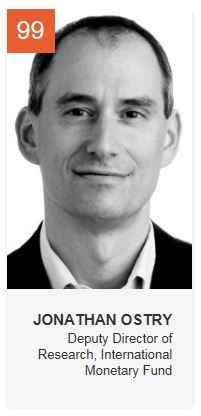
PATH TO POWER: Ostry earned his BA from Queen’s University in Canada when he was just 18 and went on to receive a BA and MA from Oxford, an MS from the London School of Economics and a PhD in economics from the University of Chicago. He joined the IMF in 1988 as an economist in the research and European departments, and has held a variety of roles in the years since, including heading up the group’s influential biannual World Economic Outlook survey. He became deputy director of research in 2006. Ostry writes prolifically for publications including The Economist, the Financial Times and the Wall Street Journal and has been cited in economic remarks by President Obama.
POWER PLAY: Ostry has been pursuing research seemingly at odds with IMF orthodoxy for years; in a 2014 Financial Times article, for example, he decried inequality and argued for “a more redistributive tax system.” But he made his biggest splash in June of this year when he coauthored a paper simply titled “Neoliberalism: Oversold?,” published in the IMF’s own Finance & Development magazine. In it, Ostry lays out a deeply researched argument against austerity and wholesale capital account liberalization, neoliberal policies that have been gospel at the IMF for decades. The month before the paper’s release, the IMF called for massive debt relief for Greece.
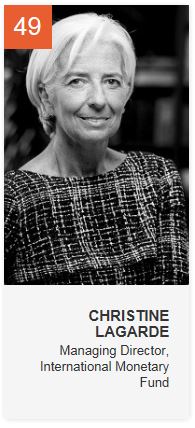
PATH TO POWER: The native Parisian specialized in antitrust law at Baker & McKenzie for 24 years before entering French politics in 2005. She began as a trade minister in Jacques Chirac’s cabinet, and was Nicolas Sarkozy’s agriculture and, later, finance minister. In 2011, she took over as managing director of the IMF from Dominique Strauss-Kahn, who stepped down after being charged with attempted rape.
POWER PLAY: Though Lagarde has been widely credited with restoring the IMF’s credibility following the scandalous exit of her predecessor and for being the voice of reason during the Greek debt crisis, she has been dogged by her role in the decade-old Bernard Tapie affair involving accusations of corruption in the sale of Adidas. Her decision as French finance minister in the 2008 case led to a 404-million-euro arbitration payout for Tapie, who had ties to Sarkozy. That payment was eventually annulled and Lagarde was absolved of wrongdoing, but a recent corruption probe into the incident has her facing negligence charges and up to one year in jail. Despite this distraction, the IMF appointed Lagarde to a second term in February, and she continues to receive its board’s support.
For the full list click here.
PATH TO POWER: Ostry earned his BA from Queen’s University in Canada when he was just 18 and went on to receive a BA and MA from Oxford, an MS from the London School of Economics and a PhD in economics from the University of Chicago. He joined the IMF in 1988 as an economist in the research and European departments, and has held a variety of roles in the years since,
Posted by at 6:44 AM
Labels: Profiles of Economists
Monday, October 17, 2016
Gone with the Wind: Estimating Hurricane Climate Change Costs in the Caribbean
A new IMF working paper by Sebastian Acevedo studies the economic costs of hurricanes in the Caribbean by constructing a novel dataset that combines a detailed record of tropical cyclones’ characteristics with reported damages. Acevedo estimates the relation between hurricane wind speeds and damages in the Caribbean; finding that the elasticity of damages to GDP ratio with respect to maximum wind speeds is three in the case of landfalls. The data show that hurricane damages are considerably underreported, particularly in the 1950s and 1960s, with average damages potentially being three times as large as the reported average of 1.6 percent of GDP per year. He document and show that hurricanes that do not make landfall also have considerable negative impacts on the Caribbean economies. Finally, he estimate that the average annual hurricane damages in the Caribbean will increase between 22 and 77 percent by the year 2100, in a global warming scenario of high CO2 concentrations and high global temperatures.
A new IMF working paper by Sebastian Acevedo studies the economic costs of hurricanes in the Caribbean by constructing a novel dataset that combines a detailed record of tropical cyclones’ characteristics with reported damages. Acevedo estimates the relation between hurricane wind speeds and damages in the Caribbean; finding that the elasticity of damages to GDP ratio with respect to maximum wind speeds is three in the case of landfalls. The data show that hurricane damages are considerably underreported,
Posted by at 10:30 AM
Labels: Energy & Climate Change
Saturday, October 15, 2016
Goodbye Gentle Jim: Links to Jim Gordon’s Contributions

Jim Gordon’s frank assessment of the IMF’s 2010 program in Greece was his most notable success in recent years. It received wide coverage in all the major newspapers—the New York Times, Wall Street Journal, Financial Times, The Guardian and The Telegraph—and praise from almost every quarter. It took all of Jim’s diplomatic and drafting skills to produce a report that was fair to his IMF colleagues who had worked on that program and also a fair description of what really happened. As an official IMF document, the assessment had to be written in Fund-ese but Jim (and his team) drafted it in a way that journalists were able to translate it quite easily into English, as The Guardian explicitly did.
A decade earlier, Jim had played a key role in the IMF program for Korea during the Asian Crisis of 1997-98. Though many Koreans have bitter memories of this time, that IMF program was actually a success in helping stabilize the Korean economy fairly rapidly. Jim described the program later in a 2009 article called “The Korean Crisis Ten Years Later: A Success Story”: I hope history will see it his way.
During his stint as the IMF’s representative in India, Jim did some of the early analysis (with Poonam Gupta) on understanding India’s services revolution and on the drivers of portfolio flows into India. These are among Jim’s most cited papers.
So successful was Jim at the IMF’s policy work that it is easy to forget the academic success of his early career. Between 1988 and 1991, Jim published an astonishing seven papers in good journals, including three in the Journal of Public Economics—the leading journal in that field. Many of these papers tackled the question of how best governments should tax and spend when some fraction of its population is prone to tax evasion (and when that fraction itself changes when governments change their policies).
These papers are extensively cited to this day, and their subject matter probably equipped Jim well for dealing with governments—and indeed with IMF departments when he later moved to the IMF’s budget office. I certainly bore the brunt of many a “Aw, come on, you can do better” from Jim as I tried to lie and cheat my way out of out some budget snafu when I was the Research Department’s budget manager.
I will miss Jim on the tennis court. He used his squash skills to hit shots that sailed just inches over the net and at impossible angles. We played outdoors well into the winter—largely at the urging of our crazy Canadian friend Dan Vincent—and Jim always grumbled pleasantly at how silly we all were to be giving in to Dan. One day, after I had been taking some lessons to improve my game at the net, he applauded my play, saying: “Prakash, you’ve become an intimidating presence at the net.” I responded: “Jim, that’s the first time anyone has used the word ‘intimidating’ about me in any context.” His laughter at that will stay in my mind for a long time. Goodbye, Gentle Jim.
Jim Gordon’s frank assessment of the IMF’s 2010 program in Greece was his most notable success in recent years. It received wide coverage in all the major newspapers—the New York Times, Wall Street Journal, Financial Times, The Guardian and The Telegraph—and praise from almost every quarter. It took all of Jim’s diplomatic and drafting skills to produce a report that was fair to his IMF colleagues who had worked on that program and also a fair description of what really happened.
Posted by at 11:52 AM
Labels: Profiles of Economists
Friday, October 14, 2016
Greenspan and I: My Memories of the Maestro
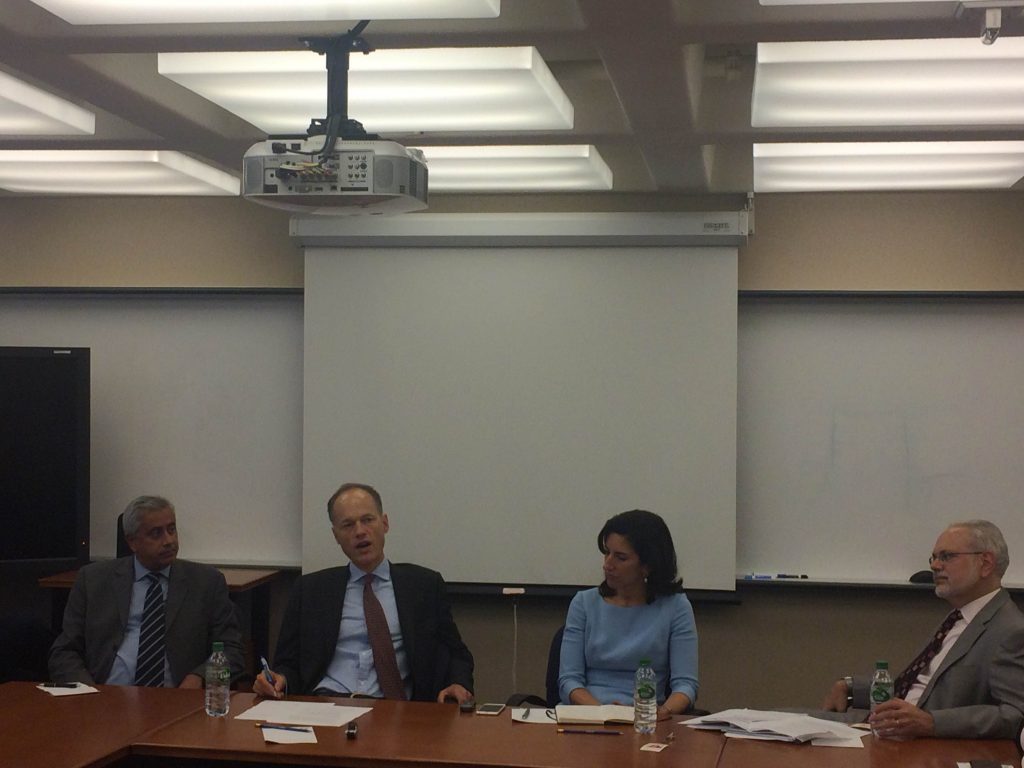
From left to right: Prakash Loungani, Sebastian Mallaby, Rana Foroohar, and David Wessel at an IMF Book Forum on Mallaby’s new biography of Greenspan
I had a few interactions with Greenspan in 1997-98 when I was one of the analysts for Asian economies at the Fed. One day in late-1997, he met with a group of us to think through what he should say in testimony to Congress on the Asian crisis. He started talking about the housing boom that had been underway in many of those countries. “It was a case of conspicuous construction,” I blurted out. He loved the phrase and used it in his testimony a couple of times.
My other interactions with him were all on Indonesia and I did not come out looking good in any of them. He had asked me for money supply for Indonesia. I gathered the data on the monetary base and the credit aggregate that he had asked for. But somehow when I added the two I was getting garbage numbers – some errors in my spreadsheet that I couldn’t figure out. Around 6.45 pm – it was a Friday — Greenspan called me himself and said “I’m still waiting …”. I told him what was going on. He said “Just bring up the base and credit numbers and I’ll add them myself over the weekend.” When I got home I told my wife “We’re not eating lunch in this town again. In fact, we’re never eating lunch again as the Fed chair is going to tell everyone I’m an incompetent.” My wife said I should just take the correct numbers on Monday morning because he probably wouldn’t get around to working on them over the weekend. Sure enough, that’s what happened: when I gave him the correct table on Monday, he said with a smile, “The weekend shaped up differently.”
Another time, he asked for detailed sectoral price data for Indonesia. A possible hyperinflation was looming and he wanted to study it in his spare time on the weekends. I dutifully photocopied pages from Indonesian statistical manuals in the Fed library. The names of the sectors were in Bahasa but in all cases but one it was easy to guess the English equivalents. I circled that sector’s name and wrote a note in the margin for my research assistant: “Find out which sector this is – old geezer will want to know.” Some instinct of self-preservation must have kicked in because I then crossed out “old geezer” quite thoroughly and wrote “Chairman”. Somehow the pages with my note still on there made it to Greenspan and came back with a note from him: “You’re right.”
My last interaction with him was while I was still at the Fed but had accepted a job at the IMF. He had asked a small group to brief him on the political situation in Indonesia. At one point he turned to me and asked, “Prakash, what do you think? Is Suharto going to survive?” (As an aside, my boss Tom Connors told me after the briefing: “The Chairman just learned to say your name and say it right. Are you sure you want to go the IMF?”) I had prepped up for Greenspan’s expected question by reading a ton material including all the State department cables. I confidently went in a long explanation of why Suharto would survive. A month later, Suharto was gone. But luckily, so was I.
From left to right: Prakash Loungani, Sebastian Mallaby, Rana Foroohar, and David Wessel at an IMF Book Forum on Mallaby’s new biography of Greenspan
I had a few interactions with Greenspan in 1997-98 when I was one of the analysts for Asian economies at the Fed. One day in late-1997, he met with a group of us to think through what he should say in testimony to Congress on the Asian crisis.
Posted by at 7:58 AM
Labels: Profiles of Economists
Tuesday, October 11, 2016
Does Growth Create Jobs? Evidence for Advanced and Developing Economies
Global job creation remains sluggish, prompting calls for policy actions to raise economic growth. Will growth create jobs? Recent IMF research documents a striking variation among countries in the extent to which employment responds to GDP growth over the course of a year. In some countries, labor markets are quite responsive: when growth picks up, employment goes up and unemployment falls; in other countries the response is quite muted. Thus, a pick-up in growth— through aggregate demand stimulus for instance—will result in more jobs, but the extent of job creation in the short run could vary sharply across countries. Some structural measures can thus serve as useful complementary policies, as also discussed in IMF research.
Continue reading IMF Research Bulletin.
Global job creation remains sluggish, prompting calls for policy actions to raise economic growth. Will growth create jobs? Recent IMF research documents a striking variation among countries in the extent to which employment responds to GDP growth over the course of a year. In some countries, labor markets are quite responsive: when growth picks up, employment goes up and unemployment falls; in other countries the response is quite muted. Thus, a pick-up in growth— through aggregate demand stimulus for instance—will result in more jobs,
Posted by at 9:14 PM
Labels: Inclusive Growth
Subscribe to: Posts