



Thursday, June 1, 2017
Is the United States Becoming Less of an Optimal Currency Area?
From a new Macro Musings Blog by David Beckworth:
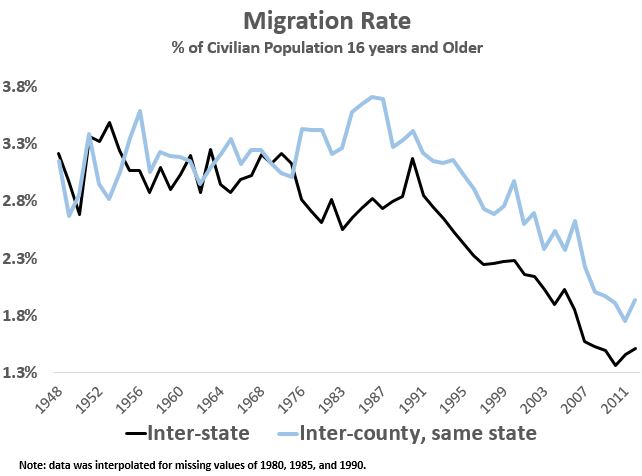
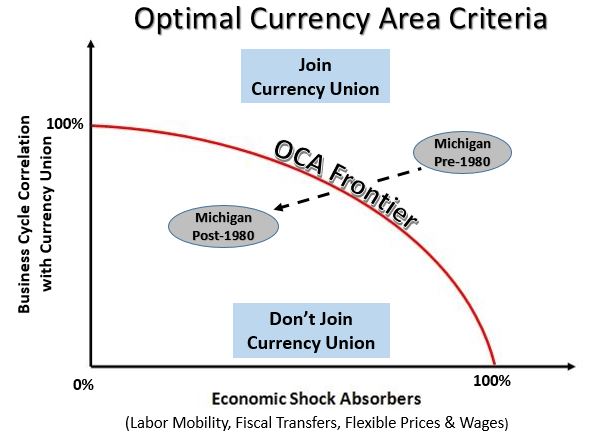
“It took the United States roughly 150 years to become an optimal currency area (OCA), according to economic historian Hugh Rockoff. This long journey meant that it was not until the late 1930s that a one-size-fits-all monetary policy made sense for the U.S. economy. Since then the U.S. economy has often been held up as the best example of a currency union that meets the OCA criteria. This especially was the case when comparisons have been made to the Eurozone, like in this classic Blanchard and Katz (1992) paper. But all is not well in this land of the OCA.
(…)
The policy implications seem clear. Policy makers at the local, state, and federal level need to push policies that increase labor market mobility. There is a lot of work to do on this front, but it is important to do so to keep the United States an OCA. The Schleichner paper provides some suggestions and is good starting point for discussion.”
Continue reading here.
From a new Macro Musings Blog by David Beckworth:
“It took the United States roughly 150 years to become an optimal currency area (OCA), according to economic historian Hugh Rockoff. This long journey meant that it was not until the late 1930s that a one-size-fits-all monetary policy made sense for the U.S. economy. Since then the U.S. economy has often been held up as the best example of a currency union that meets the OCA criteria.
Posted by at 9:18 AM
Labels: Inclusive Growth
Colombia’s Peace Agreement Can Give Fillip to Inclusive Growth
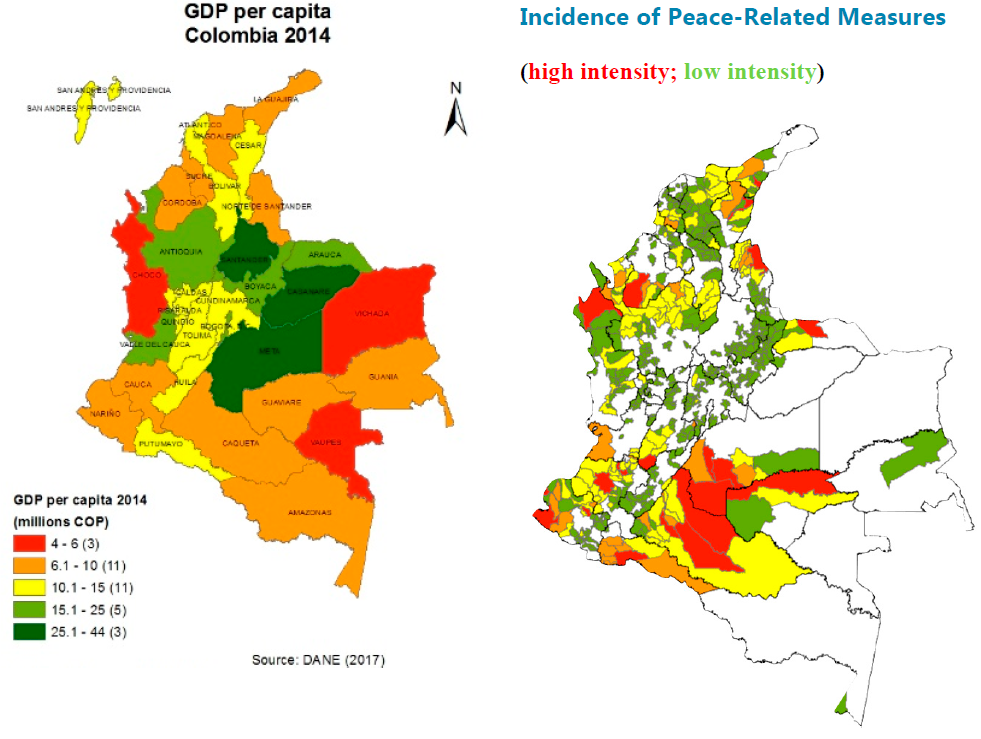
A new IMF annual assessment of the Colombian economy says that “The peace agreement will cement security gains achieved over the last decade and continue to bring more investment to the country. The implementation of the peace agreement will also focus on the regions where income per capita is relatively lower. The delivery of basic public goods and services to remote, poor, and conflict-ridden regions of the country—in addition to Colombia’s improved security conditions—will certainly make growth more inclusive over time.”
Continue reading here.
A new IMF annual assessment of the Colombian economy says that “The peace agreement will cement security gains achieved over the last decade and continue to bring more investment to the country. The implementation of the peace agreement will also focus on the regions where income per capita is relatively lower. The delivery of basic public goods and services to remote, poor, and conflict-ridden regions of the country—in addition to Colombia’s improved security conditions—will certainly make growth more inclusive over time.”
Posted by at 9:08 AM
Labels: Inclusive Growth
Wednesday, May 31, 2017
Inclusive Growth Framework
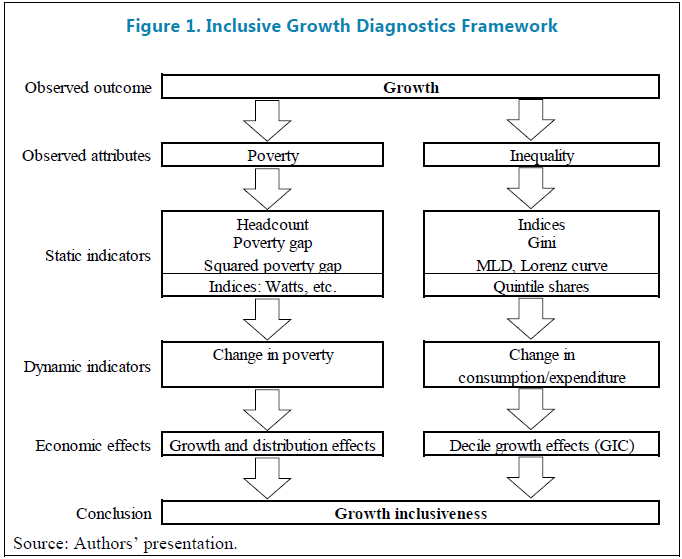
A new IMF working paper by Alexei Kireyev and Jingyang Chen suggests “an operationally usable framework for the evaluation of growth inclusiveness—the inclusive growth framework (IGF). Based on the data on growth, poverty, and inequality, the framework allows for the quantitative assessment of growth inclusiveness. The assessment relies on the decomposition of the change in poverty into growth, distribution, and decile effects, which can be calculated using the Distributive Analysis Stata Package (DASP). Availability of at least two household surveys is the main precondition for the use of the IGF. The application of the IGF is illustrated with two country cases of Senegal and Djibouti.”
Continue reading here.
A new IMF working paper by Alexei Kireyev and Jingyang Chen suggests “an operationally usable framework for the evaluation of growth inclusiveness—the inclusive growth framework (IGF). Based on the data on growth, poverty, and inequality, the framework allows for the quantitative assessment of growth inclusiveness. The assessment relies on the decomposition of the change in poverty into growth, distribution, and decile effects, which can be calculated using the Distributive Analysis Stata Package (DASP).
Posted by at 9:31 AM
Labels: Inclusive Growth
The Quest for Inclusive Cities
“Cities have the capability of providing something for everybody, only because, and only when, they are created by everybody”—this is a quote that appears before the introduction section of Richard Florida’s new book. Florida is concerned that cities are failing from been inclusive. The benefits of cities are not reaching everyone.
Florida is a University Professor and Director of Cities at the Martin Prosperity Institute at the University of Toronto’s Rotman School of Management. What follows is a review of the reviews of Florida’s new book: The New Urban Crisis: How Our Cities Are Increasing Inequality, Deepening Segregation, and Failing the Middle Class.
“The Rise of The Creative Class”
“Fifteen years ago he [Richard Florida] helped propel the U.S. urban revival”, says the Miami Herald. This refers to Florida’s 2002 book on The Rise of the Creative Class. The book argues that the key to the success of cities is to attract and retain talent, not just to draw in companies. And with talent, he refers to knowledge workers, techies, and artists, and other creative groups.
The book “(…) took the world of economic development by storm”, (Slate). It got great press, and Florida became a big-name in the urban and cities field. “When the University of Toronto recruited him a decade back, headlines trumpeted the arrival of an academic star”, (Globe and Mail).
Taking Stock
In his new book, Florida looks at how cities have performed since 2002, and finds that there is a “new urban crisis”. Recent developments in cities show that “Rents in the most dynamic cities have skyrocketed, pricing out many ordinary Americans. Cities have become more segregated by income and economic class. Mixed-income neighborhoods have been on the decline, replaced by concentrated pockets of wealth and poverty”, (Vox). Florida says that “the very same force that drives the growth of our cities and economy broadly also generates the divides that separate us and the contradictions that hold us back”, (Urban Toronto).
In his findings, what troubled Florida the most “(…) was the decline and disappearance of the great middle-class neighborhoods”, (Kirkus Review). He shows how “(…) over the last 20 years, the gap between the well-paid, technology-based and the low-paid, service-industry workers is widening into a troubling urban geography of small areas of affluence and larger areas of poverty”, (Winnipeg Free Press). He also shows “(…) maps of different metro areas that reveal the stark divides between where the creative class and service class live. Generally, the creative class lives within or just outside city boundaries, while the service class occupies suburbs. In Vancouver and Atlanta, there is a strong north-south divide, while in Austin, creatives settle to the west and the service class to the east. In Miami, creatives cluster in a tight strip along the waterfront, while service workers encompass a majority of the inland territory leading to the Everglades”, (Forbes).
A call for “new and better urbanism”
To address the “new urban crisis”, Florida discusses several policy prescriptions in the book, among them are the following:
- On combating segregation, Florida calls for building more middle-class housing. “His excoriation of NIMBYs—the exponents of a ‘Not In My Back Yard’ anticonstruction ideology—is delightful: He calls them ‘destructive’ urban rentiers who ‘have more to gain from increasing the scarcity of usable land than from maximizing its productive and economically beneficial uses.’ He coins a wonderful phrase, ‘The New Urban Luddism,’ to describe the antigrowth advocates who oppose not only home-building but all infrastructure, including the transit and subway lines required to move people around”, (Wall Street Journal).
- On housing and transportation, Florida proposes “building more affordable rental housing that is more adaptable to today’s economy”, and “investing in the infrastructure to support greater density and growth”, (Forbes).
- On jobs, “He radically suggests turning low-wage service jobs into middle-class work by raising minimum wage, encouraging unions and involving more government regulation. (…) Obviously this kind of investment in people and places will be costly, but Florida explains that a more equal, unsegregated and productive workforce make senses not only morally but economically in the long run”, (Winnipeg Free Press).
- On taxes, Florida proposes “(…) a land-value tax to encourage property owners to develop property intensively rather than let them languish as, say, mini-malls and parking lots”, (CP&DR).

Photo credit: Scott Webb
“Cities have the capability of providing something for everybody, only because, and only when, they are created by everybody”—this is a quote that appears before the introduction section of Richard Florida’s new book. Florida is concerned that cities are failing from been inclusive. The benefits of cities are not reaching everyone.
Florida is a University Professor and Director of Cities at the Martin Prosperity Institute at the University of Toronto’s Rotman School of Management.
Posted by at 5:43 AM
Labels: Global Housing Watch
Wednesday, May 24, 2017
Trading with China : Productivity Gains, Job Losses
From a new IMF working paper by JaeBin Ahn and Romain Duval:
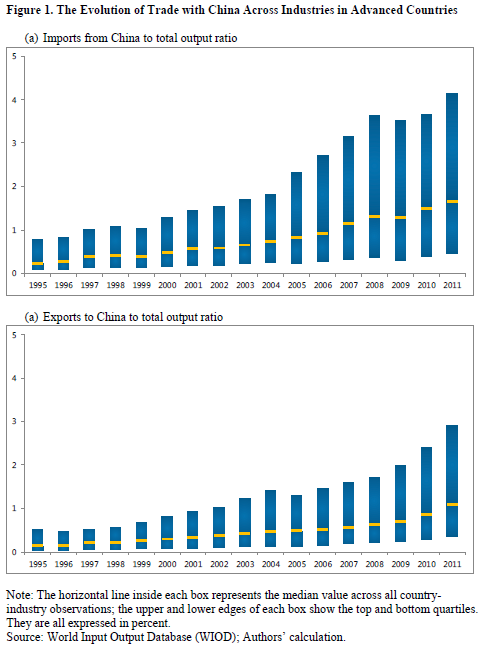
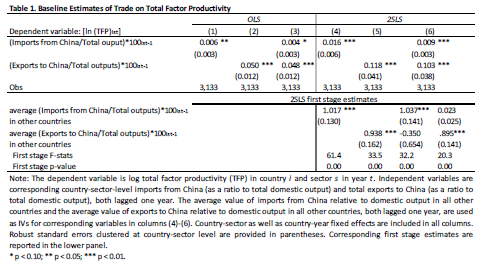
“We analyze the impact on productivity in advanced economies of fast-growing trade with China between the mid-1990s and late-2000s, separately identifying the export and import channels. We use country-sector-level data for 18 advanced economies and, similar to Autor, Dorn, and Hanson (2013), exploit exogenous variation in trade with China in a given country-sector by instrumenting imports from (exports to) China in a given country-sector with the average imports from (exports to) China in the same sector in other advanced economies. Our estimates point to large productivity gains from trading with China—the (exogenous) rise of China in global trade may have increased the level of total factor productivity by about 1.9 percent, or 12.3 percent of the overall increase over the sample period, in the median country-sector. By contrast, using a similar empirical strategy, we find adverse employment effects of Chinese imports in exposed country-industries, consistent with previous studies. Taken together, these findings point to large gains from free trade, while underscoring the scope for a more active policy role in redistributing them, particularly by easing workers’ transition between jobs and industries.”
Continue reading here.
From a new IMF working paper by JaeBin Ahn and Romain Duval:
“We analyze the impact on productivity in advanced economies of fast-growing trade with China between the mid-1990s and late-2000s, separately identifying the export and import channels. We use country-sector-level data for 18 advanced economies and, similar to Autor, Dorn, and Hanson (2013), exploit exogenous variation in trade with China in a given country-sector by instrumenting imports from (exports to) China in a given country-sector with the average imports from (exports to) China in the same sector in other advanced economies.
Posted by at 4:24 PM
Labels: Inclusive Growth, Macro Demystified
Subscribe to: Posts