



Thursday, May 17, 2018
IEO Releases an Update to its 2007 evaluation of Structural Conditionality in IMF-Supported Programs
The IEO just released an Evaluation Update Report revisiting its 2007 evaluation of Structural Conditionality in IMF-Supported Programs. The report was published along with a statement by the Managing Director.
“The evaluation found that, notwithstanding the streamlining initiative launched in 2000, structural conditionality was still used extensively and program documents were not sufficiently clear about the criticality of structural conditions. Moreover, the report concluded that most structural conditions had little structural depth, only about half were implemented on time, and compliance was only weakly correlated with subsequent progress in structural reforms.”
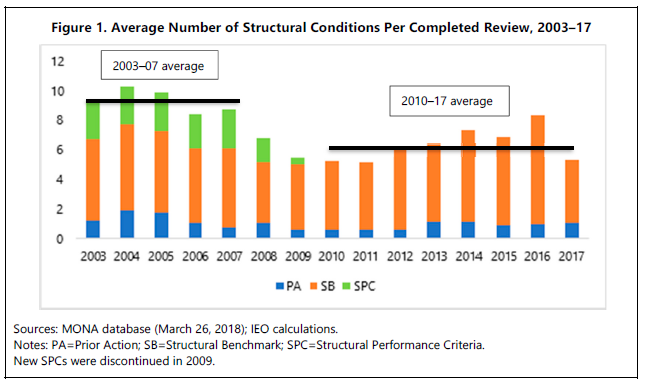
“Following the evaluation, use of IMF lending surged in the context of the global financial crisis in 2008 and the euro area crisis in 2010. Use of structural conditionality in euro area crisis programs raised issues related to working with regional partners. Fund program design and implementation over this period was informed by revisions to staff guidance in 2008, 2010, and 2014, and the Review of Conditionality completed in 2012.”
The IEO just released an Evaluation Update Report revisiting its 2007 evaluation of Structural Conditionality in IMF-Supported Programs. The report was published along with a statement by the Managing Director.
“The evaluation found that, notwithstanding the streamlining initiative launched in 2000, structural conditionality was still used extensively and program documents were not sufficiently clear about the criticality of structural conditions. Moreover, the report concluded that most structural conditions had little structural depth,
Posted by at 10:54 AM
Labels: Inclusive Growth
Tuesday, May 15, 2018
Poverty and inequality in Latin America
The new IMF Regional Economic Outlook says that “Latin America has made impressive progress in reducing inequality and poverty since the turn of the century, although it remains the most unequal region in the world. The declines in inequality and poverty were particularly pronounced for commodity exporters during the commodity boom. Much of the progress reflected real labor income gains for lower-skilled workers, especially in services, with a smaller but positive role for government transfers. With the commodity boom over, a tighter fiscal envelope, and poverty rates already edging up in some countries, policies will have to be carefully recalibrated to sustain social progress. Increasing personal income tax revenues while rebalancing spending could help maintain key social transfers and infrastructure spending. Better targeting of social transfers and reforming decentralization frameworks also have an important role to play.”
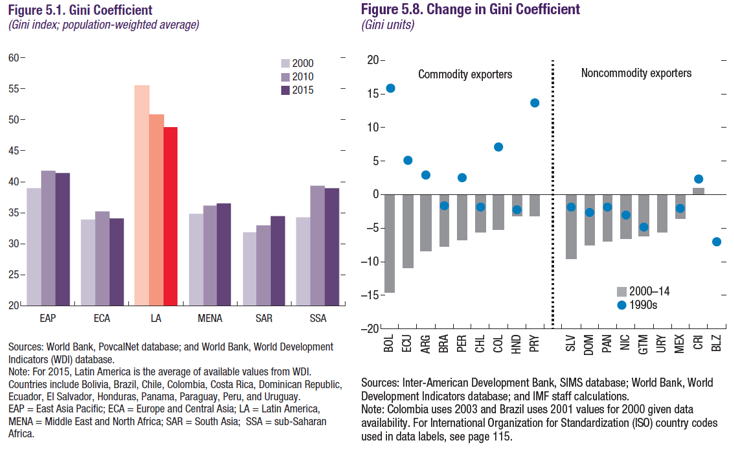
The new IMF Regional Economic Outlook says that “Latin America has made impressive progress in reducing inequality and poverty since the turn of the century, although it remains the most unequal region in the world. The declines in inequality and poverty were particularly pronounced for commodity exporters during the commodity boom. Much of the progress reflected real labor income gains for lower-skilled workers, especially in services, with a smaller but positive role for government transfers.
Posted by at 3:16 PM
Labels: Inclusive Growth
Fiscal Consolidation and Income Inequality in Latin America and the Caribbean
The new IMF Regional Economic Outlook finds that “Fiscal consolidations have very little effects on income inequality in LAC. Point estimates are positive but very small––the market Gini increases by 0.03 units after two years––and are not statistically significant (Figure 4.1.1, panel 1). This is despite a reduction in output of about 1 percent and an increase in unemployment of 0.3 of a percentage point, as demonstrated in the main text. Focusing on the distribution of disposable income does not affect these results, with the Gini coefficient being relatively insensitive to fiscal consolidation shocks.”
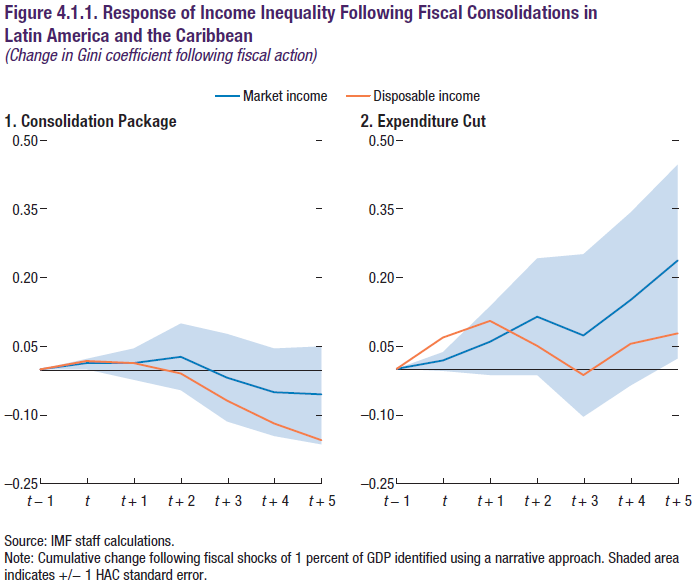
It also notes my previous works that “For advanced economies, there is evidence that fiscal consolidation tends to increase income inequality, with especially strong effects when the consolidation is spending-based (Ball and others 2013; Furceri, Jalles, and Loungani 2015; Woo and others 2017).”
Ball, Furceri, Leigh, and Loungani (2013) is available here. Furceri, Jalles, and Loungani (2015) is available here.
The new IMF Regional Economic Outlook finds that “Fiscal consolidations have very little effects on income inequality in LAC. Point estimates are positive but very small––the market Gini increases by 0.03 units after two years––and are not statistically significant (Figure 4.1.1, panel 1). This is despite a reduction in output of about 1 percent and an increase in unemployment of 0.3 of a percentage point, as demonstrated in the main text. Focusing on the distribution of disposable income does not affect these results,
Posted by at 2:48 PM
Labels: Inclusive Growth
The macroeconomic effects of fiscal consolidation in Latin America and the Caribbean
The new IMF Regional Economic Outlook finds that “fiscal multipliers in the region are estimated to lie between 0.5 and 1.1–suggesting that consolidation will be more contractionary than previously thought. Nevertheless, these estimates are small enough to suggest that consolidations will improve the region’s debt dynamics, even in the short run. Since expenditure multipliers vary according to the type of instrument used, consolidation plans should preserve public investment to support growth and employment.”

The new IMF Regional Economic Outlook finds that “fiscal multipliers in the region are estimated to lie between 0.5 and 1.1–suggesting that consolidation will be more contractionary than previously thought. Nevertheless, these estimates are small enough to suggest that consolidations will improve the region’s debt dynamics, even in the short run. Since expenditure multipliers vary according to the type of instrument used, consolidation plans should preserve public investment to support growth and employment.”
Posted by at 2:33 PM
Labels: Inclusive Growth
Strengthening natural disaster resilience a savings fund proposal
A new IMF country report says that “The Bahamas is disproportionately exposed to natural disasters – both in terms of frequency and associated costs. An appropriate disaster risk-management strategy should be wide ranging, from strengthening resilience through capital and infrastructure investments, having a multilayer disaster risk financing plan, and strengthening fiscal and external buffers. Along these lines, staff proposes the creation of a natural disaster savings fund of a target size of 2-4 percent of GDP.”
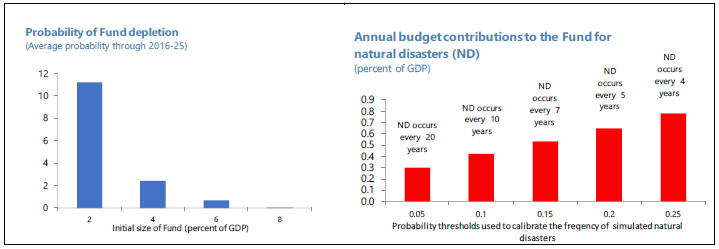
“The savings fund should be government by clear rules on inflows and outflows as well as transparency requirements. Clear objectives and disbursement rules and triggers based on verifiable criteria are critical. The fund should have prudent and transparent investment policies and should be consolidated with budgetary information to allow assessment of the overall fiscal situation. At a minimum, the fund balance should appear in financial statements, and drawdowns
should appear in budget execution reports.”
A new IMF country report says that “The Bahamas is disproportionately exposed to natural disasters – both in terms of frequency and associated costs. An appropriate disaster risk-management strategy should be wide ranging, from strengthening resilience through capital and infrastructure investments, having a multilayer disaster risk financing plan, and strengthening fiscal and external buffers. Along these lines, staff proposes the creation of a natural disaster savings fund of a target size of 2-4 percent of GDP.”
Posted by at 2:06 PM
Labels: Inclusive Growth
Subscribe to: Posts