



Tuesday, May 15, 2018
An overview of the Bahamian labor market
A new IMF country report says that “The Bahamas has experienced persistently high unemployment rates, averaging over 10 percent, in the past 2 decades. The youth unemployment rate has been stubbornly high, falling only to 22 percent in November 2017. […] It argues that labor market regulations do not appear to be the main culprit of high unemployment, whereas the narrow economic base, the insufficient skill sets among the young, and inefficient job placement services appear to be more important factors. Therefore, expanding vocational and apprenticeship programs should help reduce the youth unemployment rate. Improving skill databases and job placement services more generally should help improve the matching process between employers and job seekers. More broadly, enhancing the quality of general education should facilitate sustaining employment in the long term.”
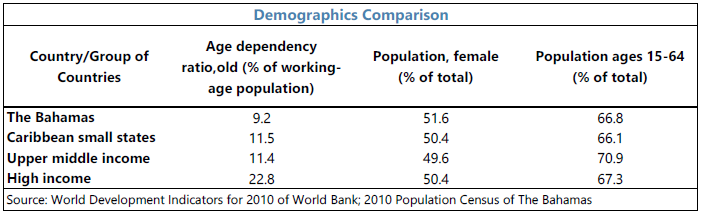
A new IMF country report says that “The Bahamas has experienced persistently high unemployment rates, averaging over 10 percent, in the past 2 decades. The youth unemployment rate has been stubbornly high, falling only to 22 percent in November 2017. […] It argues that labor market regulations do not appear to be the main culprit of high unemployment, whereas the narrow economic base, the insufficient skill sets among the young, and inefficient job placement services appear to be more important factors.
Posted by at 2:01 PM
Labels: Inclusive Growth
Monday, May 14, 2018
IMF Global Debt Database
A new IMF working paper “describes the compilation of the Global Debt Database (GDD), a cutting-edge dataset covering private and public debt for virtually the entire world (190 countries) dating back to the 1950s. The GDD is the result of a multiyear investigative process that started with the October 2016 Fiscal Monitor, which pioneered the expansion of private debt series to a global sample. It differs from existing datasets in three major ways. First, it takes a fundamentally new approach to compiling historical data. Where most debt datasets either provide long series with a narrow and changing definition of debt or comprehensive debt concepts over a short period, the GDD adopts a multidimensional approach by offering multiple debt series with different coverages, thus ensuring consistency across time. Second, it more than doubles the cross-sectional dimension of existing private debt datasets. Finally, the integrity of the data has been checked through bilateral consultations with officials and IMF country desks of all countries in the sample, setting a higher data quality standard.
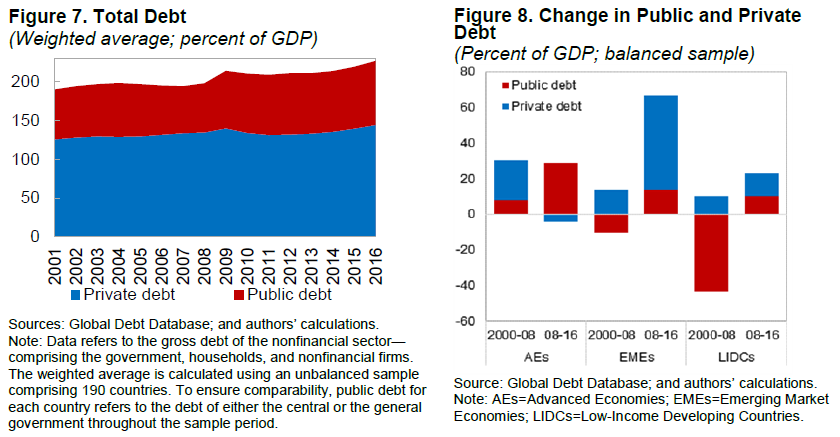
A new IMF working paper “describes the compilation of the Global Debt Database (GDD), a cutting-edge dataset covering private and public debt for virtually the entire world (190 countries) dating back to the 1950s. The GDD is the result of a multiyear investigative process that started with the October 2016 Fiscal Monitor, which pioneered the expansion of private debt series to a global sample. It differs from existing datasets in three major ways.
Posted by at 8:08 PM
Labels: Inclusive Growth
Friday, May 11, 2018
Housing View – May 11, 2018
On cross-country:
- Housing and the Business Cycle Revisited – University of Augsburg
- Prime Global Cities Index – Q1 2018 – Knight Frank
- How 3D printing is revolutionizing the housing industry – TechCrunch
On the US:
- Fueling a Frenzy: Private Label Securitization and the Housing Cycle of 2000 to 2010 – NBER
- The Great Housing Reset – Citylab
- Rising incomes, rising rents, and greater homelessness – McKinsey
- This is the Wrong Time to Cut Back on Public Housing – Institute for Policy Studies
- Tax Luxury Housing to Fund Social Housing – Inequality.org
- Black and White Homeownership Rate Gap Has Widened Since 1900 – Zillow
- 50 Years After the Fair Housing Act – Inequality Lingers – Trulia
- Government Remains the Biggest Obstacle to Fair Housing – The American Prospect
- Housing Confidence Hits New All-Time High – Fannie Mae
- Seattle Executives Join Opposition to New Tax to Fund Housing – Bloomberg
- Civil Rights Advocates Sue Ben Carson for Suspending Fair Housing Act Enforcement Rule – Slate
- Why Economists Don’t Like the Mortgage Interest Deduction – Federal Reserve Bank of St. Louis
- With the Foreclosure Crisis Behind Us, Have We Stopped Adding Single-Family Rentals? – Harvard Joint Center for Housing Studies
- How Recent Tax Reform Sounds a Clarion Call for Real Reform of Homeownership Policy – Tax Policy Center
On other countries:
- [Australia] A playful solution to the housing crisis – TED
- [Canada] High House Prices in Urban British Columbia: Foreign Buyer Fact or Fiction? – Kumtuks
- [Canada] Why High House Prices: Vancouver Academics vs Ottawa Economists – Kumtuks
- [Canada] Sam Sullivan blames government policies, not Chinese buyers, for high Vancouver housing prices – Straight
- [Canada] Montreal Is Canada’s Next Hot Housing Market – Bloomberg
- [China] North Korea Border Town Is Now China’s Hottest Property Market – Bloomberg
- [Colombia] Rental Housing in Bogota, Columbia: Challenges and Opportunities for Creating More Multifamily Properties – Cornell Real Estate Review
- [Spain] A Drone’s Eye View of Spain’s Housing Bubble – Citylab

Photo by Aliis Sinisalu
On cross-country:
- Housing and the Business Cycle Revisited – University of Augsburg
- Prime Global Cities Index – Q1 2018 – Knight Frank
- How 3D printing is revolutionizing the housing industry – TechCrunch
On the US:
Posted by at 5:00 AM
Labels: Global Housing Watch
Thursday, May 10, 2018
Gender Equality: Which Policies Have the Biggest Bang for the Buck?
A new IMF paper finds that “higher public spending on education, better sanitation facilities, low adolescent fertility, and narrower marriage age gaps are significantly related to narrower gender gaps in education. […] better infrastructure, a stronger institutional environment, more equal legal rights, and low adolescent fertility rates are strongly associated with higher female labor force participation. When labor market protection is low, an increase in protection is associated with a narrowing of labor force participation gaps between men and women. But when labor market protection levels are high, an increase in protection is associated with a widening in labor force participation gaps.”
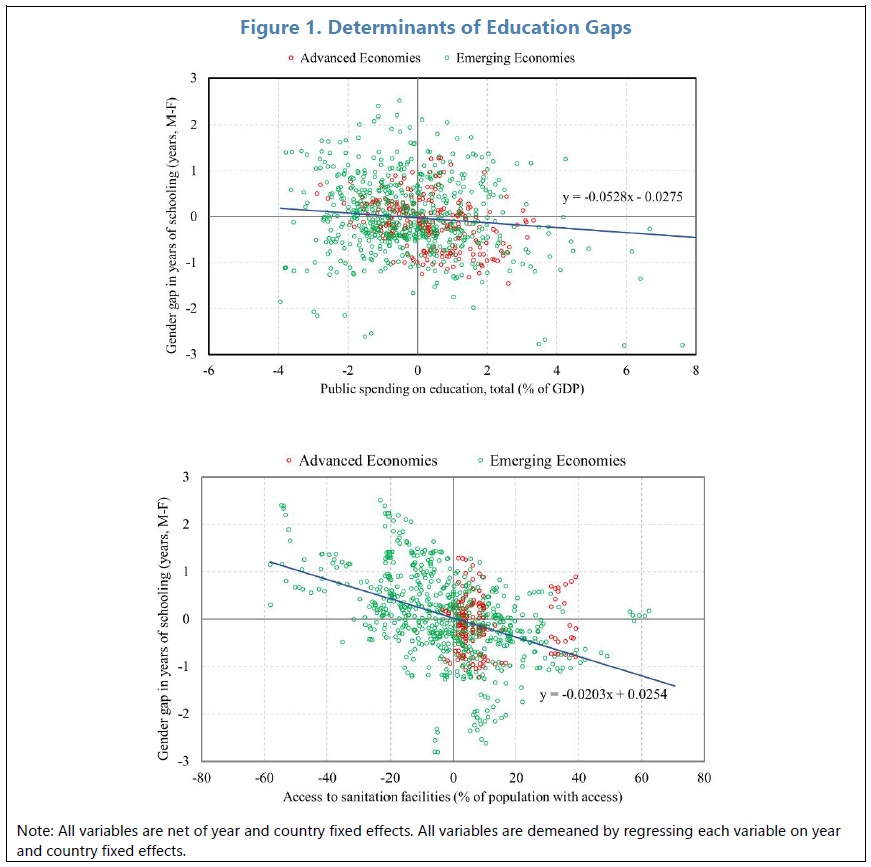
A new IMF paper finds that “higher public spending on education, better sanitation facilities, low adolescent fertility, and narrower marriage age gaps are significantly related to narrower gender gaps in education. […] better infrastructure, a stronger institutional environment, more equal legal rights, and low adolescent fertility rates are strongly associated with higher female labor force participation. When labor market protection is low, an increase in protection is associated with a narrowing of labor force participation gaps between men and women.
Posted by at 5:08 PM
Labels: Inclusive Growth
Remittances and labor market outcomes in LICs, MICs and Fragile States
From a new IMF working paper by Ralph Chami, Ekkehard Ernst, Connel Fullenkamp, and Anne Oeking”
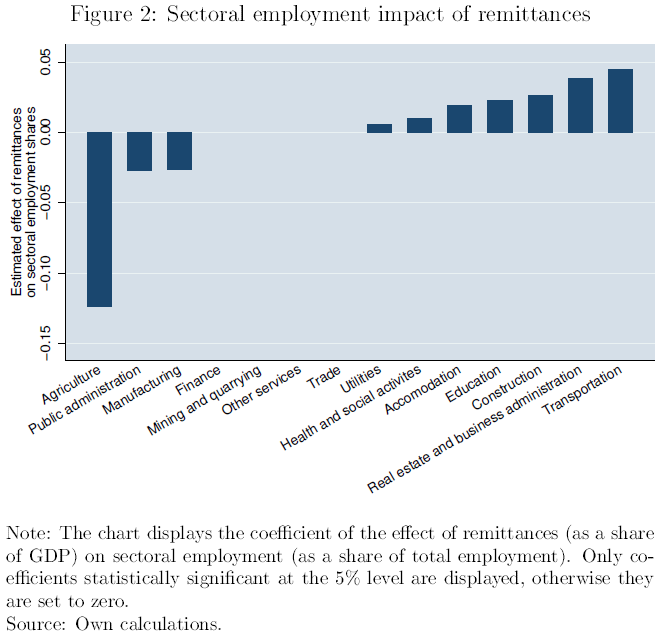
“We present cross-country evidence on the impact of remittances on labor market outcomes. Remittances appear to have a strong impact on both labor supply and labor demand in recipient countries. These effects are highly significant and greater in size than those of foreign direct investment or offcial development aid. On the supply side, remittances reduce labor force participation and increase informality of the labor market. In addition, male and female labor supply show significantly different sensitivities to remittances. On the demand side, remittances reduce overall unemployment but benefit mostly lower-wage, lower-productivity nontradables industries at the expense of high-productivity, high-wage tradables sectors. As a consequence, even though inequality declines as a result of larger remittances, average wage and productivity growth declines, the latter more strongly than the former leading to an increase in the labor income share. In fragile states, in contrast, remittances impose a positive externality, possibly because the tradables sector tends to be underdeveloped. Our findings indicate that reforms to foster inclusive growth need to take into account the role of remittances in order to be successful.”
From a new IMF working paper by Ralph Chami, Ekkehard Ernst, Connel Fullenkamp, and Anne Oeking”
“We present cross-country evidence on the impact of remittances on labor market outcomes. Remittances appear to have a strong impact on both labor supply and labor demand in recipient countries. These effects are highly significant and greater in size than those of foreign direct investment or offcial development aid. On the supply side, remittances reduce labor force participation and increase informality of the labor market.
Posted by at 11:30 AM
Labels: Inclusive Growth
Subscribe to: Posts