



Tuesday, May 22, 2018
Chart of the Week: Greenery and Prosperity
Economic growth has traditionally moved in tandem with pollution. But can countries break this link and manage to grow while lowering pollution?
Our research, based on joint work with Gail Cohen and Ricardo Marto, shows that yes, progress is being made. Our evidence is clear: advanced economies are starting to show signs of decoupling—increasing growth while reducing pollution—but emerging market economies not yet.
The chart summarizes our evidence on the link between the trend (long-run relationship) in greenhouse gas (GHG) emissions and the trend in incomes. Our analysis covers the world’s top twenty largest GHG emitters from 1990 to the present. Over this time, incomes have grown—the trend is positive—despite dips due to occasional recessions and financial crises. But what has happened to trend emissions?
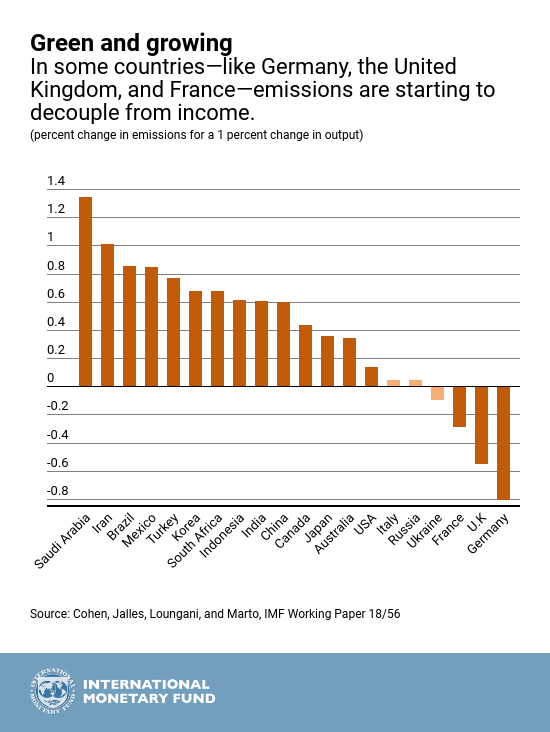
The bars in the chart show the percent increase in trend emissions for every 1 percent increase in trend incomes—economists refer to such estimates as elasticities. Look first at the three cases on the far right of the chart—Germany, the United Kingdom, and France. For this group the elasticity estimates are negative: emissions have fallen despite the increase in incomes. These countries have achieved decoupling of emissions and output. Our results show that this is due both to active policies by these countries aimed at decarbonizing their economies as well as the structural transformation of their economies towards a greater role for services.
Continue reading here.
Economic growth has traditionally moved in tandem with pollution. But can countries break this link and manage to grow while lowering pollution?
Our research, based on joint work with Gail Cohen and Ricardo Marto, shows that yes, progress is being made. Our evidence is clear: advanced economies are starting to show signs of decoupling—increasing growth while reducing pollution—but emerging market economies not yet.
The chart summarizes our evidence on the link between the trend (long-run relationship) in greenhouse gas (GHG) emissions and the trend in incomes.
Posted by at 10:51 AM
Labels: Energy & Climate Change
Labor Force Participation in U.S. States and Metropolitan Areas
A new IMF working paper “explores regional differences to shed light on drivers of participation rates at the state and metropolitan area levels. It documents a broad-based decline, especially pronounced outside metropolitan areas. Using novel measures of local vulnerability to trade and technology it finds that metropolitan areas with higher exposures to routinization and offshoring experienced larger drops in participation in 2000-2016. Thus, areas with different occupational mixes can experience divergent labor market trajectories as a result of trade and technology.”
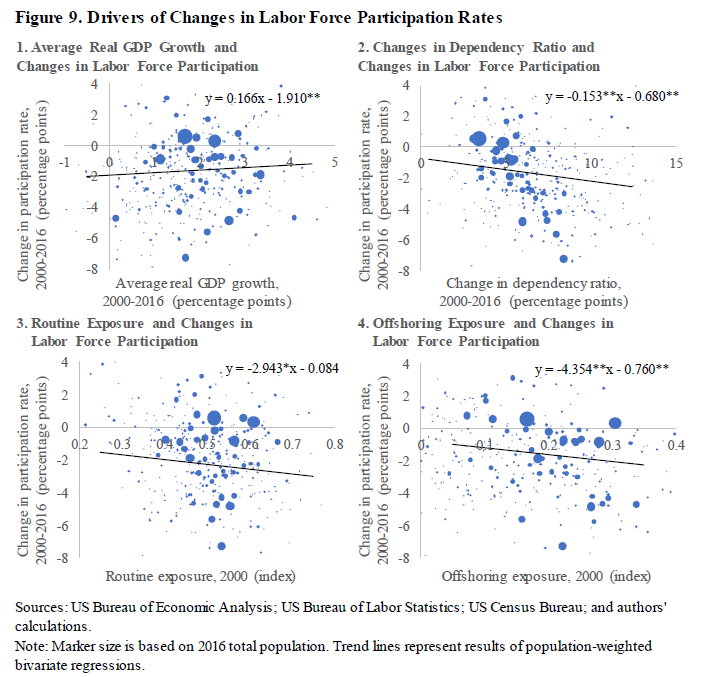
A new IMF working paper “explores regional differences to shed light on drivers of participation rates at the state and metropolitan area levels. It documents a broad-based decline, especially pronounced outside metropolitan areas. Using novel measures of local vulnerability to trade and technology it finds that metropolitan areas with higher exposures to routinization and offshoring experienced larger drops in participation in 2000-2016. Thus, areas with different occupational mixes can experience divergent labor market trajectories as a result of trade and technology.”
Posted by at 10:40 AM
Labels: Inclusive Growth
Uber and the labor market
A new report by Lawrence Mishel says that “Uber, and gig work more broadly, [does not] represent the future of work.” “Uber drivers earn low wages and compensation and the total hours and compensation in the gig economy represent a very small share of total hours and compensation in the overall economy. These findings—and the fact that many Uber and other workers who provide personal services via a digital platform do so on a part-time basis primarily as a way to earn supplementary income—argue for a change in perspective. There has been much hype around Uber and the gig economy. But in our assessment, in any conference on the future of work, Uber and the gig economy deserve at most a workshop, not a plenary.”

A new report by Lawrence Mishel says that “Uber, and gig work more broadly, [does not] represent the future of work.” “Uber drivers earn low wages and compensation and the total hours and compensation in the gig economy represent a very small share of total hours and compensation in the overall economy. These findings—and the fact that many Uber and other workers who provide personal services via a digital platform do so on a part-time basis primarily as a way to earn supplementary income—argue for a change in perspective.
Posted by at 10:35 AM
Labels: Inclusive Growth
Friday, May 18, 2018
Housing View – May 18, 2018
On cross-country:
- The Efficiency of Savings-linked Relationship Lending for Housing Finance – Journal of Housing Economics
- Do House Prices Sink or Ride the Wave of Immigration? – IZA Institute of Labor Economics
- Cultural similarities and housing market linkage: evidence from OECD countries – Springer
- ¿Es Airbnb realmente culpable de la subida de precios en los alquileres? – GQ
- ¿Cuáles son y en qué países están los barrios más caros de América Latina? – BBC
On the US:
- Homeownership and Housing Wealth (Presentation, Remarks, Blog ) – Federal Reserve Bank of New York
- The Links Between Affordable Housing and Economic Mobility – Terner Center
- Faced with a housing crisis, California could further restrict supply – Economist
- Boston Wants People To Build Tiny Houses In Their Yards – Citylab
- What the Future of Affordable Housing Already Looks Like – Citylab
- Why universities became big-time real estate developers – Slate
- Rent-Control Initiative Could Obliterate California’s Housing Markets – Reason
- Rising Home Prices Lead To Worries Of Another Housing Market Bubble – NPR
- Housing: High Prices, Few New Units – Mises Institute
- Ben Carson vs. the Fair Housing Act – New York Times
- Wall Street Is Pouring Money Into House Flipping – Slate
- Why Don’t People Who Can’t Afford Housing Just Move Where It’s Cheaper? – New York Times
- California Today: In San Francisco’s Housing Lottery, It’s the Luck of the Draw – New York Times
- Housing Tax Credit Qualified Action Plans Affect the Location of Affordable Housing – National Low Income Housing Coalition
- Rising Rates Vs. The Housing Market – NPR
- The Seattle Area Is Solving One of Housing’s Biggest Challenges – Slate
- How Will the Gig Economy Shape Mortgage Lending? – Fannie Mae
- The Impact of the Tax Cuts and Jobs Act on Local Home Values – Federal Reserve Bank of Cleveland
- The American Housing Crisis Might Be Our Next Big Political Issue – Citylab
On other countries:
- [Australia] Stricter lending restrictions threaten housing markets in Australia – Global Property Guide
- [Australia] Inquiry into social impact investment for housing and homelessness outcomes – Australian Housing and Urban Research Institute
- [Canada] Through the Roof: The High Cost of Barriers to Building New Housing in Canadian Municipalities – C.D. Howe Institute
- [Canada] The World’s Hottest Luxury-Property Market Is a Sleepy Canadian City – Bloomberg
- [Chile] Estudio demuestra que más de la mitad de los santiaguinos no puede comprar una vivienda – CNN
- [China] China’s property market to steadily cool in 2018 – government think tank – Reuters
- [Hong Kong] Could a Colonial-Era Golf Club Solve Hong Kong’s Housing Woes? – New York Times
- [India] Housing demand in Indian metros: a hedonic approach – Emerald
- [Ireland] Cost Rental Housing – A Model for Ireland? – NERI
- [Spain] Spain is cracking down on Airbnb, just in time for the tourist season – Quartz
- [United Kingdom] Britain’s housing supply is perking up at last – Economist
- [United Kingdom] How to make the case for community-led housing on public land – New Economics Foundation

Photo by Aliis Sinisalu
On cross-country:
- The Efficiency of Savings-linked Relationship Lending for Housing Finance – Journal of Housing Economics
- Do House Prices Sink or Ride the Wave of Immigration? – IZA Institute of Labor Economics
- Cultural similarities and housing market linkage: evidence from OECD countries – Springer
- ¿Es Airbnb realmente culpable de la subida de precios en los alquileres? – GQ
- ¿Cuáles son y en qué países están los barrios más caros de América Latina?
Posted by at 5:00 AM
Labels: Global Housing Watch
Thursday, May 17, 2018
Biggest fear for world growth is fear itself as markets fret
A new Bloomberg post by Anchalee Worrachate and David Goodman says that: “While policy makers insist the global economy’s low-inflation expansion looks intact despite a first quarter slowdown, investors are presenting challenges. Rising bond yields, a jump in the price of oil beyond $70 a barrel, skittish stocks and cracks in credit could all end up undermining growth.” “The worry is that unless markets start buying into the more optimistic outlook, their pessimism will become self-fulfilling by causing consumers and companies to lose confidence and slow spending. The Bank for International Settlements warned last year that the next recession will perhaps be triggered by a financial cycle bust, mirroring the events of 2001 and 2008.”
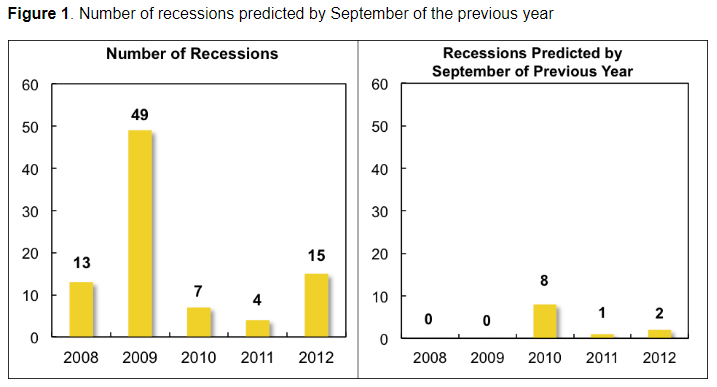
This post also notes my research that “the optimism of analysts may be cold comfort to some investors. A 2014 study by Prakash Loungani of the International Monetary Fund found that not one of 49 recessions suffered around the world in 2009 had been predicted by the consensus of economists a year earlier.”
Continue reading here. My Vox post is available here. My new paper on forecasting recessions is available here.
A new Bloomberg post by Anchalee Worrachate and David Goodman says that: “While policy makers insist the global economy’s low-inflation expansion looks intact despite a first quarter slowdown, investors are presenting challenges. Rising bond yields, a jump in the price of oil beyond $70 a barrel, skittish stocks and cracks in credit could all end up undermining growth.” “The worry is that unless markets start buying into the more optimistic outlook, their pessimism will become self-fulfilling by causing consumers and companies to lose confidence and slow spending.
Posted by at 11:08 AM
Labels: Forecasting Forum
Subscribe to: Posts