



Thursday, January 27, 2022
Housing Market in Czech Republic
From IMF’s latest report on Czech Republic:
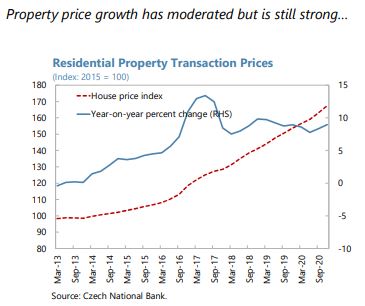
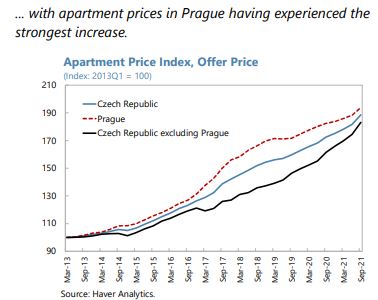
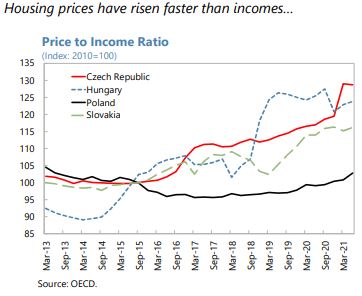
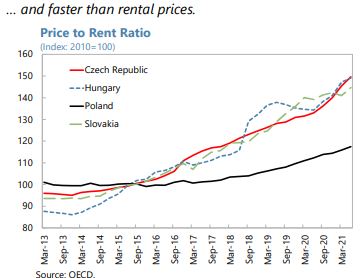
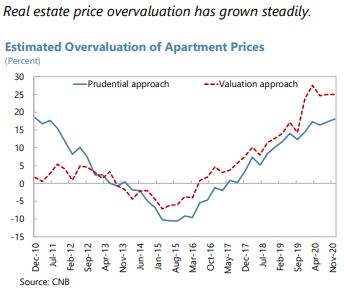
“Amid robust mortgage credit growth, property price-growth significantly accelerated from already elevated levels stretching valuations and worsening affordability. Property prices grew by about 8½ percent in 2020, down from about 9¼ percent in 2019, but accelerated to 14½ percent y-o-y in 2021:Q2. The Czech Republic has experienced one of the highest property price appreciation rates in the EU, reaching a cumulative growth rate of about 54 percent in the five years prior to 2021. The CNB estimates property prices to be overvalued by 25 percent on average (as of mid-2021). The steep property price increase has deteriorated affordability as reflected in price-to-income and price-to-rent ratios.
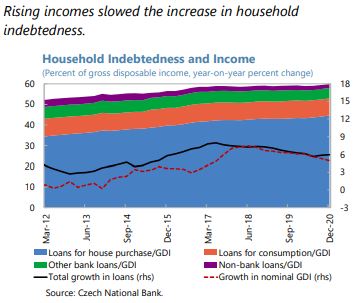
Macrofinancial vulnerabilities due to increasing risk-taking by lenders amid growing household leverage and high and rapidly rising property valuations warrant close monitoring. Although aggregate household indebtedness is still low compared to other EU countries, it increased robustly by 2½ percentage points to 34 percent of GDP during 2020. Fast increases in property prices, amid loosening credit standards and macroprudential policy during the pandemic, resulted in households/lenders taking larger and riskier mortgages (…). Significant increases in risk taking, in an environment of high and rapidly rising house prices, exposes households to price and interest rate shocks that could harm those who purchased in overvalued areas, who are highly levered, or low-income households—for which debt service is already burdensome. These vulnerabilities might be compounded by the large proportion of mortgages with fixation periods up to five years.
Recent developments warrant tightening prudential tools while deploying coordinated housing supply and tax policies. Properly calibrated income-based measures can improve risk taking incentives and support affordability. Staff welcomes the CNB’s decision in November 2021 (effective from April 2022) to tighten limits on mortgage loan ratios as follows: DTI (8.5), DSTI (45 percent) and LTV (80 percent). Close monitoring of market developments is necessary with a potential for further tightening down the road. Importantly, clear communication of macroprudential policy actions and adequate coordination of the overall policy mix are key to ensure a smooth stabilization. Proper calibration of macroprudential tools for lower risk groups—first-time home buyers and low-levered households—is warranted to safeguard proper access to financing. An improved risk-based prudential framework (Section D) could be combined with the macroprudential setup to facilitate calibration of these measures.
Housing Supply
Pre-existing housing supply shortages persisted throughout the pandemic, partly reinforced by temporary pauses in construction activity. A new construction law, aimed at simplifying the construction code and the reportedly cumbersome permitting process, through creation of a one-stopshop for construction companies, was adopted in July, 2021 but implementation of some of its provisions will take until 2023. The impact on the number of granted residential building permits has been limited so far.
Tax Policy
Revenues from property taxes are low in comparison to other countries and will further fall after the recent cancellation of the property transaction tax. Real estate property taxation should be based on current market valuations and not on floor space. While the recent reduction of the maximum deductible amount of mortgage interest from CZK 300,000 to CZK 150,000 per year starting in 2021 is welcome, this benefit could be eliminated completely as in other countries.
Staff welcomes the recent reform of the macroprudential framework that provides the CNB with the legal powers to implement macroprudential policy. In July 2021, the CNB was given powers to make macroprudential limits legally binding, which is consistent with international best practice.
Authorities’ Views
The authorities acknowledge the risks stemming from the heated property market and stand ready to tighten macroprudential policies as needed. They acknowledged the increasing risk taking by households amid high and rapid house price growth and stand committed to closely monitor market developments to decide on further policy actions. On the basis of new statutory powers, the CNB Bank Board decided on November 25, 2021 to reintroduce limits on DTI and DSTI ratios and to tighten the LTV limit.”
From IMF’s latest report on Czech Republic:
“Amid robust mortgage credit growth, property price-growth significantly accelerated from already elevated levels stretching valuations and worsening affordability. Property prices grew by about 8½ percent in 2020, down from about 9¼ percent in 2019, but accelerated to 14½ percent y-o-y in 2021:Q2. The Czech Republic has experienced one of the highest property price appreciation rates in the EU, reaching a cumulative growth rate of about 54 percent in the five years prior to 2021.
Posted by at 11:12 AM
Labels: Global Housing Watch
African history through the lens of economics
From a VoxEU post by Nathan Nunn, Stelios Michalopoulos, Elias Papaioannou, and Léonard Wantchékon:
“Since the 2000s, a vibrant stream of research on African political economy and economic history has emerged that has produced a plethora of insights and has uncovered the shadow that Africa’s past casts on contemporary economic, social, and political development. This column introduces a free online course on “African History through the Lens of Economics”, which will bring together the considerable volume of work in the economics literature of the past decades. The course is open to students with a background and interest in economics, political science, history, cultural anthropology, and psychology.
Views about Africa are, were, and most likely will continue to be highly polarising. Some economists, finance professionals, multinational executives, global entrepreneurs, and businesspeople are bullish, as there are investment opportunities in infrastructure, manufacturing, and technology, coupled with a young population that is increasingly more educated and confident. However, many are less optimistic, concerned about misgovernance, conflict, weak state capacity, corruption and poor infrastructure. Pessimists point to Africa’s dark past, including the atrocities and exploitation during colonisation, and the slave trades.
In 2000, The Economist called Africa “the hopeless continent”. A decade later, after strong growth and institutional advancement, it renamed it “the hopeful continent”. A few years later, in 2016, the magazine described it in more nuanced terms as a land of “1.2 billion opportunities” – a reference to the potential market that its huge population constituted. Economics research has followed a similar train. In the 1970s, 1980s, and 1990s, only a handful of papers were published outside specialised outlets. But, since the 2000s, a vibrant stream of research on African political economy and economic history has emerged. The new economic history approach departs greatly from prevailing thinking in important ways.
First, scholars realised that ill-conceived, post-independence urban-rural agriculture and trade policies, authoritarianism, conflict, corruption, and lack of structural transformation (the foci of pre-2000 studies) often had deep roots stemming from colonial extraction, enslavement, the artificial design of country borders, underinvestment, and cash-crop specialisation during colonisation.
Second, the new economics research became more interdisciplinary. For example, applied research started scrutinising influential ideas proposed by historians, political scientists, sociologists, and even cultural anthropologists.
Third, the studies began moving beyond purely economic outcomes and drivers of development. They examined, for example, the origins and the implications of the vast differences in social capital, civicism, cultural preferences, and values. This more evolutionary approach to economic history has led to a fruitful dialogue between economics and the other social sciences; albeit one not without tension.”
From a VoxEU post by Nathan Nunn, Stelios Michalopoulos, Elias Papaioannou, and Léonard Wantchékon:
“Since the 2000s, a vibrant stream of research on African political economy and economic history has emerged that has produced a plethora of insights and has uncovered the shadow that Africa’s past casts on contemporary economic, social, and political development. This column introduces a free online course on “African History through the Lens of Economics”,
Posted by at 10:54 AM
Labels: Macro Demystified
Younger generations and the lost dream of homeownership
From a VoxEU post by Gonzalo Paz-Pardo:
“Homeownership among younger households has been decreasing in several major advanced economies. This column shows that increases in labour income inequality and uncertainty are key drivers of this trend. Confronted with high house prices and low, risky incomes, many young households cannot or do not want to risk making such a big, illiquid investment. As a result, they accumulate less wealth.
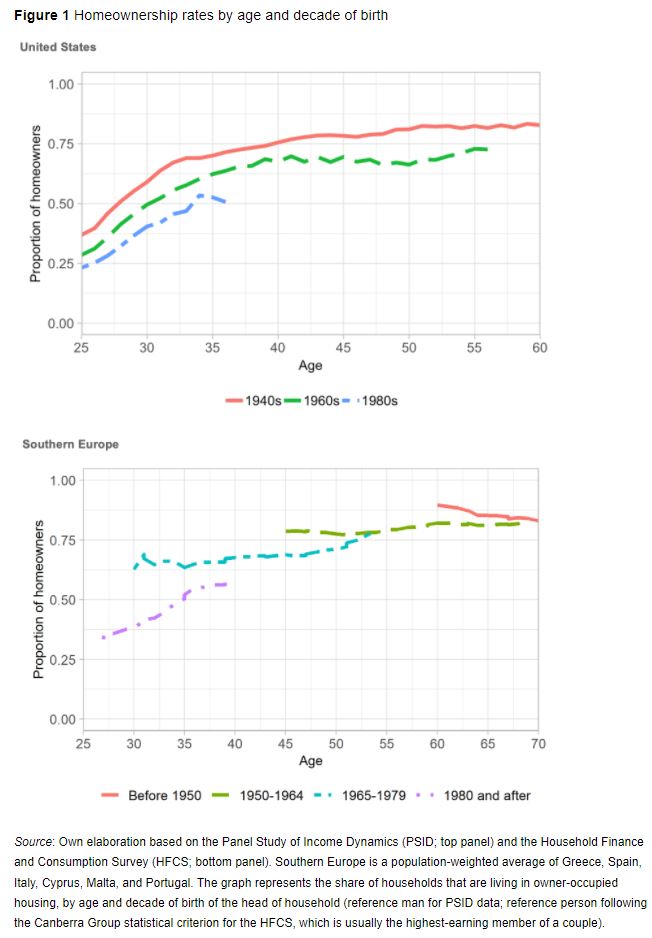
Figure 1 shows that, in the US, younger generations are less likely to be living in their own homes than older generations were at the same age. Among households headed up by someone born in the 1940s, 70% owned their homes by age 35. This figure dropped to 60% for those born in the 1960s and about 50% for the early ‘millennials’ born in the 1980s. In southern Europe, too, homeownership rates at age 35 have dropped – by over 10 percentage points when comparing those born from 1965 to 1979 with those born in the 1980s. At the same time, young people are taking longer to leave the parental home and live independently (Becker et al. 2008).
Homeownership is a frequent subject of political debate. Owning a house is crucial for the wealth accumulation of most households (Paz-Pardo 2021), and housing plays a role in a well-diversified portfolio (Chetty et al. 2017). Shutting young people out of housing markets may distort their marriage and childbearing decisions (Laeven and Popov 2017), and homeownership rates relate directly to the strength of local communities, social capital, and political engagement (Glaeser et al. 2002, Rohe et al. 2002).
What has driven these changes? To identify the key factors, I build a model of homeownership and portfolio choice over the life cycle with a rich structure of risks (Paz-Pardo 2021). According to the model, it’s not about younger generations not wanting to buy their homes anymore: changes in the economic environment fully explain the magnitude of the drop in homeownership rates.”
From a VoxEU post by Gonzalo Paz-Pardo:
“Homeownership among younger households has been decreasing in several major advanced economies. This column shows that increases in labour income inequality and uncertainty are key drivers of this trend. Confronted with high house prices and low, risky incomes, many young households cannot or do not want to risk making such a big, illiquid investment. As a result, they accumulate less wealth.
Figure 1 shows that,
Posted by at 10:51 AM
Labels: Global Housing Watch
Wednesday, January 26, 2022
Housing Market in France
From the IMF’s latest report on France:
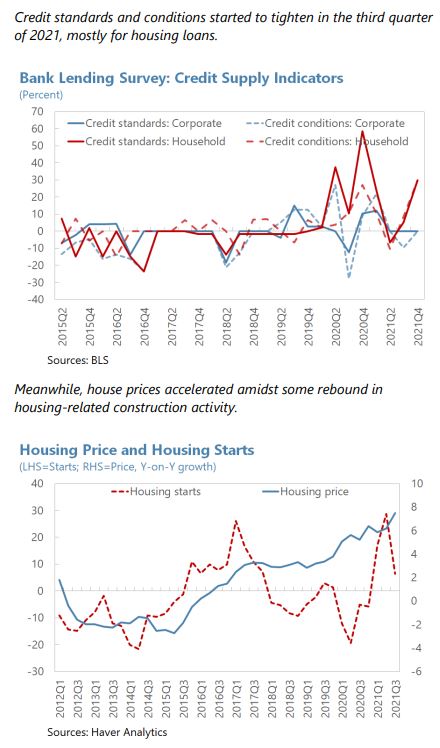
“Risks from real estate markets require continued vigilance. Over the last decade, household debt grew steadily from just below 60 percent to over 100 percent of disposable income and debt service to disposable income (DSTI) has increased. The deterioration reflects in part the need for higher debt to cover increasing housing prices, resulting in higher LTVs. Consequently, in 2019, the ESRB issued a warning related to medium-term vulnerabilities in the real estate sector, citing higher prices, weaker lending standards, elevated household debt, and rapid mortgage lending growth in France. While supervisory action by the High Council for Financial Stability (HCSF) has capped the deterioration in lending standards, low interest rates, a relatively inelastic housing supply and increased demand for home renovations continued to fuel real estate price growth in 2020 and 2021.
Several features in France can attenuate risks from market corrections to mortgage defaults, but banks’ profits could be at risk. Household repayment risks are contained because, among other factors, mortgage interest rates are fixed, and employment losses are protected by unemployment insurance. Banks are partially protected from potential losses predominantly through mortgage insurance, and borrowers’ legal obligations. However, profit margins on housing loans are estimated to be nil or even negative since 2017. Thus, the large volume of mortgages with long residual maturity and low fixed interest rate creates a persistent risk to bank profitability, which would intensify with selected defaults or increased funding costs of banks.
(…)
To limit excessive risk-taking by banks, borrower-based measures should be maintained and expanded. To shield banks from loan losses, the HCSF issued recommendations (declared legally binding as of January 1, 2022) that banks must limit mortgage length to 25 years and DSTI to 35 percent (up from 33 percent in the guidance)—with up to 20 percent of new mortgage loans excluded primarily for owner-occupied housing. As a result, banks have actively adjusted their lending practices, with falling DSTI. As of August 2021, the banking sector was within the flexibility margin. However, fueled by low interest rates and a relatively inelastic housing supply, house prices continued to increase and mortgage debt-to income remains elevated, reflecting the need to cover increasing housing prices. In addition, downside risks from structural factors remain, such as weak banking sector profitability due to persistently low rates and high cost-to-income ratios, banks’ high market risk exposure, wholesale funding risk, cyber security, and climate change risks. If these trends continue, fine tuning existing borrower-based measures or deploying complementary measures, such as the now available (sectoral) systemic risk buffer, may become appropriate to more broadly limit excessive risk-taking.”
From the IMF’s latest report on France:
“Risks from real estate markets require continued vigilance. Over the last decade, household debt grew steadily from just below 60 percent to over 100 percent of disposable income and debt service to disposable income (DSTI) has increased. The deterioration reflects in part the need for higher debt to cover increasing housing prices, resulting in higher LTVs. Consequently, in 2019, the ESRB issued a warning related to medium-term vulnerabilities in the real estate sector,
Posted by at 10:07 AM
Labels: Global Housing Watch
Keeping Public Debt Sustainable in an Equitable Way
Source: CESifo
In a new paper (2022), economists Davide Furceri, Prakash Loungani, Jonathan D. Ostry, and Pietro Pizzuto write about the challenges of ensuring sustainable levels of debt in the face of threats of rising inequality, low growth, and high unemployment, posed by the COVID-19 crisis.
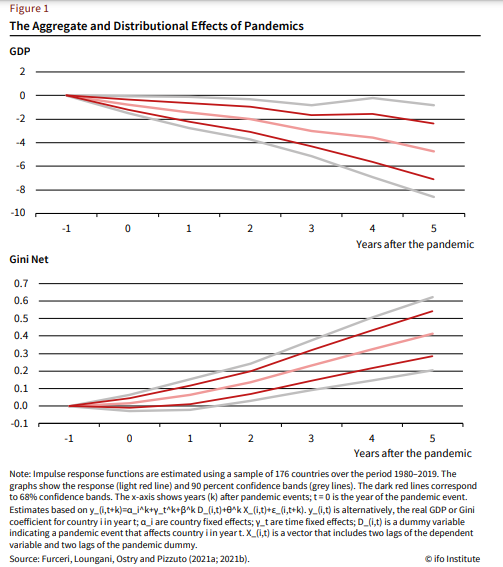
Studying five major epidemics since the 2000s, they demonstrate that real GDP falls in the aftermath of a pandemic while inequality (as measured by the Gini coefficient) shoots up (Figure 1). Subsequently, they discuss the role of fiscal policy in managing inequality and the need to avoid hastening or prolonging generous support beyond need using appropriate policy measures.
Source: CESifo
In a new paper (2022), economists Davide Furceri, Prakash Loungani, Jonathan D. Ostry, and Pietro Pizzuto write about the challenges of ensuring sustainable levels of debt in the face of threats of rising inequality, low growth, and high unemployment, posed by the COVID-19 crisis.
Studying five major epidemics since the 2000s, they demonstrate that real GDP falls in the aftermath of a pandemic while inequality (as measured by the Gini coefficient) shoots up (Figure 1).
Posted by at 9:53 AM
Labels: Inclusive Growth
Subscribe to: Posts