



Tuesday, May 31, 2022
Who Killed the Phillips Curve? A Murder Mystery
From a new working paper by David Ratner and Jae Sim:
“Is the Phillips curve dead? If so, who killed it? Conventional wisdom has it that the sound monetary policy since the 1980s not only conquered the Great Inflation, but also buried the Phillips curve itself. This paper provides an alternative explanation: labor market policies that have eroded worker bargaining power might have been the source of the demise of the Phillips curve. We develop what we call the “Kaleckian Phillips curve”, the slope of which is determined by the bargaining power of trade unions. We show that a nearly 90 percent reduction in inflation volatility is possible even without any changes in monetary policy when the economy transitions from equal shares of power between workers and firms to a new balance in which firms dominate. In addition, we show that the decline of trade union power reduces the share of monopoly rents appropriated by workers, and thus helps explain the secular decline of labor share, and the rise of profit share. We provide time series and cross sectional evidence.”
From a new working paper by David Ratner and Jae Sim:
“Is the Phillips curve dead? If so, who killed it? Conventional wisdom has it that the sound monetary policy since the 1980s not only conquered the Great Inflation, but also buried the Phillips curve itself. This paper provides an alternative explanation: labor market policies that have eroded worker bargaining power might have been the source of the demise of the Phillips curve.
Posted by at 10:34 AM
Labels: Macro Demystified
Friday, May 27, 2022
Housing View – May 27, 2022
On cross-country:
- Drivers of rising house prices and the risk of reversal – European Central Bank
- ECB warns a house price correction is looming as interest rates rise. Central bank says housing market reversal would hit low-income homes harder – FT
- Euro zone’s overpriced housing market may sag if rates rise, ECB says – Reuters
- Has COVID-19 Triggered an Urban Exodus? – OECD
- Asia’s advanced economies now have lower birth rates than Japan. The cost of housing may be the biggest factor – The Economist
- Housing policy and affordable housing – LSE
- Revisiting International House Price Convergence Using House Price Level Data – IDEAS
- Housing and the Labor Market – Oxford Research Encyclopedias
On the US:
- Conference: Housing & Urban Economics on September 7 – Stanford University
- Rising Interest Rates Concern Apartment-Building Owners, Renters. Returns fall below mortgage figures, with landlords needing higher rents to fill the gap – Wall Street Journal
- Housing Boom Is on Borrowed Time. Higher rates have only just begun to weigh on home sales and prices – Wall Street Journal
- The housing market boom has at least another year to run, Zillow economists predict – Fortune
- Fed Searches for the Magic Number to Cool a Red-Hot U.S. Housing Market. The central bank must decide on an interest rate that will cap sky-high price growth without triggering a painful economic slowdown – Wall Street Journal
- How Homeowners Can Lock in the Steep Rise in Home Values. For those who don’t want to sell, there are strategies to use to hedge against a future decline – Wall Street Journal
- In Battle for Workers, Companies Build Houses. Disney, meatpacker JBS and others launch plans to add affordable housing near job sites; a Vail, Colo., project draws opposition – Wall Street Journal
- April Rental Report: Sun Belt Metros Drive Sustained Growth in Nationwide Rents – Realtor
- Housing in America has become much harder to afford. High prices and soaring mortgage rates are putting some buyers off – The Economist
- Did the pandemic advance new suburbanization? – Brookings
- Effective Zoning Reform Isn’t as Simple as It Seems. The Biden administration’s housing plan will reward cities that change their land-use policies to promote density. But what kind of zoning reforms really work? – Bloomberg
- Fed Liquidity Facility Successfully Anchored Commercial Real Estate amid Pandemic – Dallas Fed
- Biden is doubling down on dense, affordable housing – Quartz
- Pandemic Housing Boom Hits a Wall With US Buyers Priced Out. Home values in the Sun Belt boomtowns spiked, but now rising mortgage rates, inflation, and recession fears are starting to pinch. – Bloomberg
- Amid a Housing Crunch, Homes Pop Up on the Fairway. With large expanses of grass and trees, former golf courses are being reconsidered for housing, but developers face challenges, including community resistance. – New York Times
- Housing and Access to Credit Are Two Sides of the Financial Inclusion Coin – San Francisco Fed
- The Household Mystery: Part II – Calculated Risk
- Wall Street’s housing grab continues. As rising rates deter families from buying, being a rentier looks as appealing as ever – The Economist
- US house prices never go down. I mean, they don’t, right? – FT
- Dissecting Housing Supply And Demand: Macro Man Podcast. Bloomberg’s Cameron Crise compares the current state of the housing market with the 2006 bubble peak and its aftermath. – Bloomberg
On China
- China cuts mortgage lending rate by record as lockdowns hit economy. Five-year loan prime rate slashed by most since before pandemic as government steps up stimulus – FT
- China’s property market woes expected to worsen in 2022, Reuters poll shows – Reuters
- China property market slumps on developers’ debt crisis, weak buyer sentiment – Reuters
- China’s Real Estate Slump: Underlying Issues. Although the current approach will ease some major indicators, such as property sales and prices, they will not necessarily resolve the core issues. – The Diplomat
On other countries:
- [Australia] Housing in the Endemic Phase – Reserve Bank of Australia
- [Australia] Australia’s housing boom to deflate as mortgage rates rise – Reuters
- [Canada] One of the World’s Frothiest Housing Markets Turned Into a Seller’s Headache Overnight. House hunters from Toronto to small Ontario suburbs are changing how they navigate the tight housing landscape with interest rates heading higher. – Bloomberg
- [Canada] How much will Canada’s block on foreign buyers help its housing crisis? – NPR
- [Hong Kong] New Hong Kong Leader’s Vow to Fix Housing Crisis Draws Skeptics. John Lee will focus on national security in wake of protests. Lack of policy, business experience could also hamper ability – Bloomberg
- [New Zealand] New Zealand banks predict 20% drop in house prices over next year. Economists say tighter credit conditions, higher mortgage rates and increased housing supply behind sinking prices – The Guardian
- [United Kingdom] Nationwide warns inflation surge will hit house prices. Profits double at UK’s largest building society on back of mortgage growth and higher interest margins – FT
- [United Kingdom] Slowdown ahead for UK housing market. Gap between equity-rich house owners and first-time buyers set to widen as cost of living crisis hits – FT
- [United Kingdom] Bridging loans surge as UK buyers scramble for property. Brokers urge caution in volatile market – FT
On cross-country:
- Drivers of rising house prices and the risk of reversal – European Central Bank
- ECB warns a house price correction is looming as interest rates rise. Central bank says housing market reversal would hit low-income homes harder – FT
- Euro zone’s overpriced housing market may sag if rates rise, ECB says – Reuters
- Has COVID-19 Triggered an Urban Exodus?
Posted by at 5:00 AM
Labels: Global Housing Watch
Wednesday, May 25, 2022
Housing Market in Europe
From the European Central Bank:
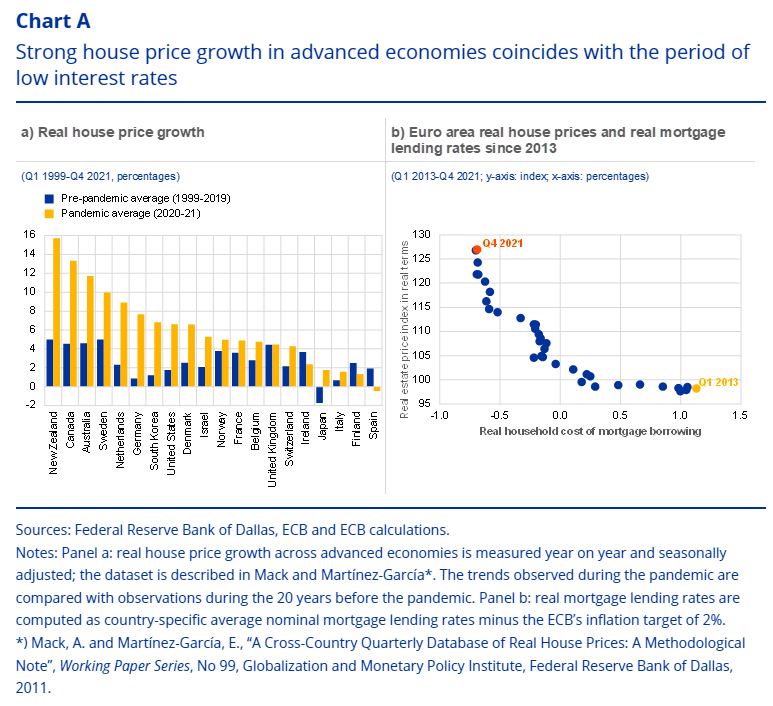
“House prices increased substantially during the pandemic, fuelling concerns about possible price reversals and their implications for financial stability. In many advanced economies, real house price growth exceeded 4% during the pandemic (Chart A, panel a), reaching 4.3% in the euro area in the fourth quarter of 2021[1] amid signs of exuberance in some countries.[2] At the same time, real mortgage lending rates in the euro area have fallen further to reach historic lows in the current low interest rate environment (Chart A, panel b).[3] Against this backdrop, this box discusses the main drivers of recent house price increases across advanced economies and in the euro area, and the associated risks of possible price reversals and the potential implications for financial stability.
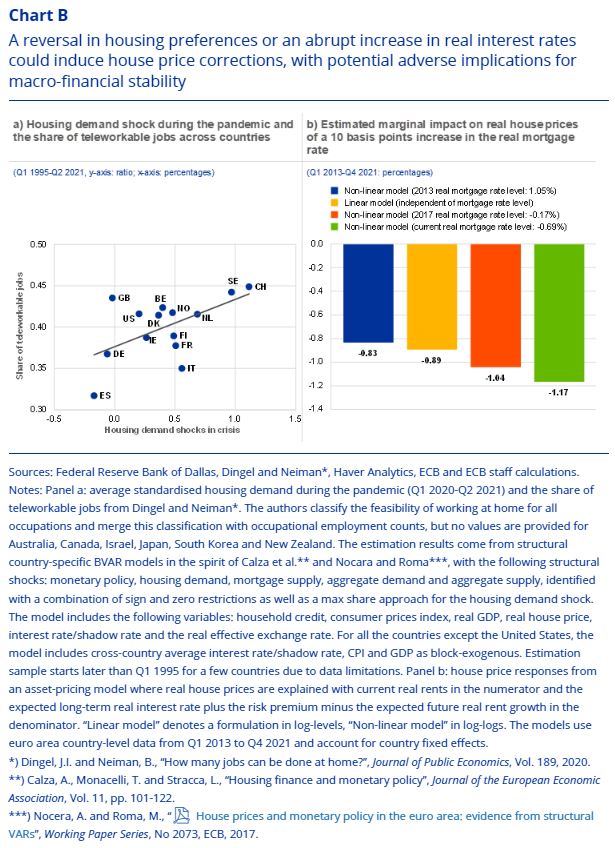
Shifts in housing preferences and low interest rates have been important drivers of recent strong house price growth across advanced economies. Estimates based on country-specific Bayesian vector autoregression (BVAR) models indicate that the house price increases across advanced economies during 2020-21 were mainly driven by increased demand for housing. There is a positive correlation between the magnitude of the estimated housing demand shock across countries and the share of teleworkable jobs, signalling that the housing demand shocks are related to a shift in housing preferences during the pandemic (Chart B, panel a), possibly reflecting a desire for more space coupled with less need for commuting.[4] Increased demand for housing could also be related to search-for-yield behaviour in the low-yield environment. In addition, monetary policy shocks combined with mortgage supply shocks contributed to the recent house price increases across advanced economies, including the euro area. Unlike housing demand shocks, monetary policy and mortgage supply shocks move interest rates and house prices in opposite directions.
In the current low interest rate environment, increased sensitivity of house price growth to changes in real interest rates makes substantial house price reversals more likely. Evidence for the euro area shows that a model with an interest rate-dependent sensitivity of real house prices to real interest rates outperforms a model with a constant sensitivity. Such a non-linear model is consistent with asset pricing theory and implies that the lower the level of the real interest rate, the larger should be the response of house prices for a given change in that rate.[5] Given the current low level of interest rates, therefore, potential reversals in residential real estate prices could be larger than several years ago, especially if interest rates increased sharply. In particular, the comparison between estimated linear and non-linear models (Chart B, panel b) for the euro area shows that the estimated house price response to a 0.1 percentage point increase in real mortgage rates from the current very low level is around 28 basis points stronger when accounting for non-linear relationships (Chart B, panel b).[6]
An abrupt repricing in the housing market – if the demand for housing were to go into reverse, for example, or real interest rates were to rise significantly – could produce spillovers to the wider financial system and economy. Such price reversals in housing markets could reflect a return to pre-pandemic work modalities or a strong increase in real interest rates. Other possible factors include a change in investor preferences for holding residential real estate assets, as well as a more general deterioration in risk sentiment related to an exacerbation of geopolitical risks or progressing climate change. The BVAR models described above indicate that a 1% drop in house prices due to a shift in housing demand could, on average across countries, generate a peak drop in real GDP of 0.2% after two years. However, the decline varies from country to country, with a fall of up to 0.9% in some advanced economies and wide uncertainty bands around these estimates. To cushion adverse financial stability implications of potential house price reversals, a tightening of macroprudential measures seems warranted in some countries, especially where strong house price growth has been accompanied by buoyant credit dynamics.[7]“
From the European Central Bank:
“House prices increased substantially during the pandemic, fuelling concerns about possible price reversals and their implications for financial stability. In many advanced economies, real house price growth exceeded 4% during the pandemic (Chart A, panel a), reaching 4.3% in the euro area in the fourth quarter of 2021[1] amid signs of exuberance in some countries.[2] At the same time,
Posted by at 11:00 AM
Labels: Global Housing Watch
Friday, May 20, 2022
Housing View – May 20, 2022
On the US:
- President Biden Announces New Actions to Ease the Burden of Housing Costs – The White House
- Biden Administration Targets Housing Supply Shortage. New regulatory moves aim to dent housing shortage of millions of U.S. homes – Wall Street Journal
- Five housing policies that wouldn’t drive up prices in Australia. If reforms to negative gearing and capital gains tax are a bridge too far, how about tackling supply? – The Guardian
- How Biden is taking action on the housing shortage – The Hill
- Biden green-lights a home-building boom. But there’s a catch. The Biden administration has a plan to fast-track housing construction. But much of it depends on Congress. – Fast Company
- U.S. housing market cooling as building permits tumble, starts fall – Reuters
- Bidding Wars Show Signs of Cooling as Mortgage Rates Bite. Fewer homes are receiving multiple offers as higher borrowing costs limit buyers, according to Redfin – Bloomberg
- These Are the Nation’s Most—and Least—Affordable Real Estate Markets – Realtor.com
- First-Time Buyers Were Undeterred by Rapid Home Price Appreciation in 2021 – New York Fed
- We’re not in a housing bubble, say Zillow economists – Fortune
- Housing Demand and Remote Work – NBER
- The Housing Market Is Cooling and 2 Other Takeaways From Real Estate Earnings – Barron’s
- How does the Consumer Price Index account for the cost of housing? – Brookings
- America still isn’t building enough homes – Quartz
On other countries:
- [Canada] Seven Slowdown in Canada’s Housing Sector Shows Risk of Higher Rates. Bank of Canada efforts to curb inflation threaten to end the country’s real-estate boom, which has been a strong driver of its economy – Wall Street Journal
- [Canada] Rate Hikes Hit Canada Housing With First Price Drop in Two Years. Sales plunge 12.6% as borrowing costs begin to rise sharply. Price declines are heaviest in smaller markets around Toronto – Bloomberg
On the US:
- President Biden Announces New Actions to Ease the Burden of Housing Costs – The White House
- Biden Administration Targets Housing Supply Shortage. New regulatory moves aim to dent housing shortage of millions of U.S. homes – Wall Street Journal
- Five housing policies that wouldn’t drive up prices in Australia. If reforms to negative gearing and capital gains tax are a bridge too far,
Posted by at 5:00 AM
Labels: Global Housing Watch
Subscribe to: Posts