



Friday, July 8, 2022
Housing View – July 8, 2022
On cross-country:
- Prime residential rents in global cities rising at fastest rate since 2010 – Knight Frank
- The Impact of Home Sharing on Housing Affordability. Evidence from Airbnb in Urban Cities in Europe – Jonkoping University
On the US:
- Written testimony for hearing by Jenny Schuetz: Where Have All the Houses Gone: Private Equity, Single Family Rentals, and America’s Neighborhoods – Brookings
- Home Sellers Are Slashing Prices in Sudden Halt to Pandemic Boom. The rapid rise in mortgage rates is cooling demand, jolting markets from coast to coast – Bloomberg
- Biden Administration Weighs Move to Trim Mortgage Costs as Home Prices Rise. Mortgage industry officials say insurance cut for FHA-backed loans would help entry-level buyers; Republicans say it could increase prices – Wall Street Journal
- Redfin’s chief economist says the housing market correction has begun—and things are going to get worse before they get better – Fortune
- Inflation is making homelessness worse – Washington Post
- Volatility in Home Sales and Prices: Supply or Demand? – Federal Reserve Board
- Pandemic-Induced Remote Work and Rising House Prices – NBER
- Construction Job Openings Leveling Off – NAHB
- Lessons Learned from Mortgage Borrower Policies and Outcomes during the COVID-19 Pandemic – Boston Fed
- Mortgage Rates Fall to 5.30%, Reflecting Recession Fears. Rates fell for a second straight week, though they are still up significantly this year – Wall Street Journal
On China
- My garlic for a home: China struggles to revive property sector. The real estate market is struggling to recover as zero-Covid policies and developer debt sap buyer demand – FT
- China Property Debt Crisis Is Just Beginning, Charlene Chu Says. Charlene Chu sees further problems for China real estate. Ex-Fitch analyst says debt weighing on China economic growth – Bloomberg
On other countries:
- [Austria] How Vienna took the stigma out of social housing. In some European cities living in social housing is a misfortune. In Austria’s capital it’s an indicator of high-quality urban life. – Politico
- [Australia] Australian house prices fall for second month as interest rates rise. CoreLogic’s home value index drops for the second month in a row, after declining 0.6% in June – The Guardian
- [United Kingdom] The signs are Britain is not heading for a property crash. It would be naive to rule out the possibility, but the evidence points to house prices dampening rather than tumbling – The Guardian
On cross-country:
- Prime residential rents in global cities rising at fastest rate since 2010 – Knight Frank
- The Impact of Home Sharing on Housing Affordability. Evidence from Airbnb in Urban Cities in Europe – Jonkoping University
On the US:
- Written testimony for hearing by Jenny Schuetz: Where Have All the Houses Gone: Private Equity, Single Family Rentals, and America’s Neighborhoods – Brookings
- Home Sellers Are Slashing Prices in Sudden Halt to Pandemic Boom.
Posted by at 5:00 AM
Labels: Global Housing Watch
Sunday, July 3, 2022
How the World Became Rich: The Historical Origins of Economic Growth
From Economic History Association:
“Mark Koyama and Jared Rubin. How the World Became Rich: The Historical Origins of Economic Growth. Cambridge, UK: Polity Press. x + 259 pp. $24.95 (paperback), ISBN 978-1509540235.
Reviewed for EH.Net by Joel Mokyr, Departments of Economics and History, Northwestern University.
Any scholar teaching economic history and wishing for an up-to-date survey of a large and important literature will find it useful to read this book to bone up on the recent research listed in the long and encompassing list of references. Furthermore, they should seriously consider having their students read it for their class. The book is a wide-ranging yet remarkably complete and accessible survey of the Great Enrichment, the emergence of modern and prosperous economies that provide us with a material standard of living that our ancestors could not have dreamed of. How and why modern economic growth occurred when and where it did, and how economists have tried to understand this phenomenon, is the theme of this book. It is written by two of the finest young senior scholars in our field, both with important contributions to the subject matter of this book.
Many of the issues this book raises are highly contentious in our profession, and for good reason: these are hard questions on which learned scholars can disagree and interpret the evidence in different ways. How much did institutions really matter? What was the role of culture in economic growth? Was geography destiny? What was the role of craft guilds in the economic development of early modern Europe? How to think about the role of imperialism and slavery in the Industrial Revolution and the subsequent growth of industrial powers? Were high wages good or bad for technological progress? Was war a positive factor in economic growth? Was the European Marriage Pattern a positive factor in the economic development of the Continent?
The ecumenical and balanced approach the authors take to these questions is much like the Rabbi in a famous Jewish story. According to the legend, a rabbi is holding court in front of a large audience of his pupils. A husband and wife appear before the rabbi, to discuss their troubled domestic life. First the husband gets to lay out his case, and he lists all the sins and vices of his wife. The Rabbi listens carefully and pronounces his verdict: the husband is in the right. Then his pupils appeal to him: you should hear the wife’s case as well. The Rabbi consents and listens to the woman lays out her powerful case against her lazy and violent husband. He then announces his second verdict: the wife is in the right. His best pupil protests: but Rabbi, how can they both be in the right? The Rabbi listens and pronounces: the pupil is right too.
Rubin and Koyama present balanced and fair surveys of made in the literature, but they are reluctant to take strong positions. Such an ecumenical approach sets them apart from Clark’s Farewell to Alms and McCloskey’s Bourgeois Dignity, where the authors take up similar issues but in a much stronger opinionated mode. That thoughtful and measured approach of the survey, its elegant and crystal-clear style, and the authors’ impressive knowledge of a large and complex literature make this book nothing short of ideal for teaching advanced courses on global economic history to economics students.
It is especially refreshing to see a book such as this that pays explicit attention to institutions and culture, two themes that until not so long ago were taboo in our field but now seem to play increasingly central roles. The book contains full chapters on each, and while the discussion is naturally far from exhaustive, the authors do an excellent job summarizing some of the best work in these areas. What remains, of course, unsolved is why different nations develop different institutions and how and why such institutions change over time and how exactly cultural beliefs help determine the institutions that society ends up with.”
Continue reading here.
From Economic History Association:
“Mark Koyama and Jared Rubin. How the World Became Rich: The Historical Origins of Economic Growth. Cambridge, UK: Polity Press. x + 259 pp. $24.95 (paperback), ISBN 978-1509540235.
Reviewed for EH.Net by Joel Mokyr, Departments of Economics and History, Northwestern University.
Any scholar teaching economic history and wishing for an up-to-date survey of a large and important literature will find it useful to read this book to bone up on the recent research listed in the long and encompassing list of references.
Posted by at 9:32 AM
Labels: Book Reviews, Macro Demystified
Friday, July 1, 2022
Housing View – July 1, 2022
On cross-country:
- 2nd Workshop on Rent Control: Slides of presentations – PPT and Video
- The Global Housing Inspection Report – 2022 Edition – Seeking Alpha
- Land speculation, booms, and busts with endogenous phase transitions: A model of economic fluctuations with rational exuberance – VoxEU
On the US:
- Can the Fed pull off a controlled slowdown of the housing market? The events of the early 1980s might provide a guide – The Economist
- ‘Coast to Coast’ Housing Correction Is Coming, Says Moody’s Chief Economist. US home prices will likely fall in the most overvalued markets, projects Mark Zandi. But it will fall short of a crash. – Bloomberg
- Cost of Owning a Home Surges Above the Cost of Renting One. A new report shows that having a mortgage is far more expensive than having a lease, a disparity that is helping to cool a red-hot housing market. – New York Times
- Demand Shifting from Owning to Renting – John Burns Real Estate Consulting
- As For-Sale Demand Weakens, Single-Family Rentals Outperform – John Burns Real Estate Consulting
- ‘Coast to Coast’ Housing Correction Is Coming, Says Moody’s Chief Economist. US home prices will likely fall in the most overvalued markets, projects Mark Zandi. But it will fall short of a crash. – Bloomberg
- Home Sellers Are Getting Anxious. ‘They Feel Like They Missed the Height of the Market.’ – Barron’s
- Bidding Wars Overheated the Home-Buyer Market, Now They’re Coming for Renters. Competition among renters means many tenants feel compelled to pay more each month than what the landlord is asking – Wall Street Journal
- Credit Conditions in the Pandemic Mortgage Market – San Francisco Fed
- Hottest US Housing Markets Now Have Bigger Share of Price Cuts – Bloomberg
- Transcript: Jonathan Miller – The Big Picture
- Highest Mortgage Rates Since 2008 Housing Crisis Cool Sales. As the Federal Reserve tries to fight high inflation, costly mortgage rates have begun to price people out of the housing market – New York Times
- Disquiet Over the Housing Market Is Only Growing. The Fed needs to remove the heat from demand without prompting an accident among mortgage financiers – Bloomberg
- Blackstone dealt legal setback after $5bn low-income housing deal. Private equity group says it is working to resolve litigation inherited with AIG property portfolio – FT
- Did Housing Affordability Worsen During the First Year of the Pandemic? – Joint Center for Housing Studies
- A Hot Housing Market Is a Financial Crisis Risk. The longer prices defy the Fed, the harder the Fed might try to break them. – Bloomberg
On China
- Empirical evidence of risk contagion across regional Chinese housing markets – Economic Modelling
- Chinese Property Titan Says Housing Market Has Reached Bottom – Bloomberg
On other countries:
- [Australia] House Prices, Monetary Policy, and Commodities: Evidence from Australia – University of Sydney
- [Japan] Japanese house prices rising strongly, but demand slowing – Global Property Guide
- [Portugal] Portugal Home Prices Rise Faster Than Ever on Lack of Supply – Bloomberg
- [Spain] How fiscal policy affects housing market dynamics: Evidence from Spain – Bulletin of Economic Research
- [United Kingdom] Covid couldn’t cool house prices, but the economic chill might. Data due this week will be closely scrutinised to discern whether the market’s remarkable resilience is faltering – The Guardian
- [United Kingdom] Short-term lets face stricter rules as review gauges impact on tourist hotspots. Concern over proliferation of Airbnb-style rentals in popular holiday destinations spurs action – FT
On cross-country:
- 2nd Workshop on Rent Control: Slides of presentations – PPT and Video
- The Global Housing Inspection Report – 2022 Edition – Seeking Alpha
- Land speculation, booms, and busts with endogenous phase transitions: A model of economic fluctuations with rational exuberance – VoxEU
On the US:
- Can the Fed pull off a controlled slowdown of the housing market?
Posted by at 5:00 AM
Labels: Global Housing Watch
Thursday, June 30, 2022
Housing Market in Portugal
From the IMF’s latest report on Portugal:
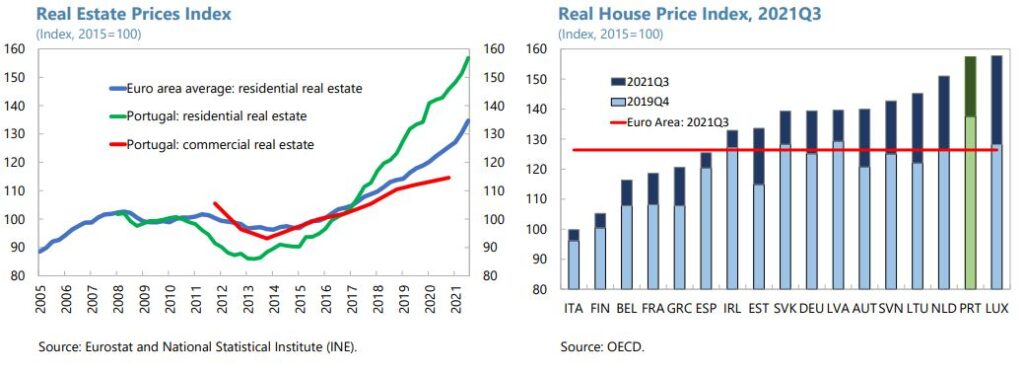
“Since 2015, Portuguese house price growth outpaced the EA average by almost 30 percentage points. This pace was sustained throughout the pandemic, with residential real estate prices gaining nearly 20 percentage points in real terms and relative to rents.
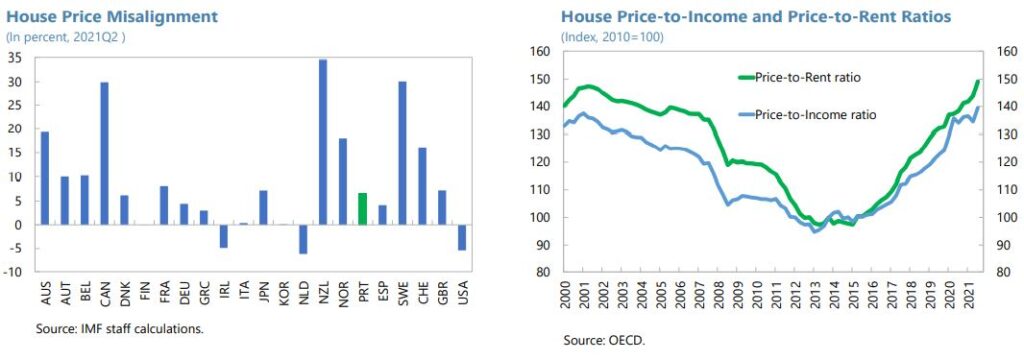
Available estimates suggest overvaluation of residential real estate. Based on indicators developed by the ECB, Banco de Portugal estimates point to an over-valuation of 8 to 16.5 percent (see Banco de Portugal, December 2021 Financial Stability Report). IMF model-based estimates of house price misalignments relative to fundamentals point to an overvaluation of 7 percent as of mid-2021. However, since mid-2021 house prices increased by 5.7 percent by end-2021. Price-to-rent and price-to income ratios have reached the highest levels since 2000.
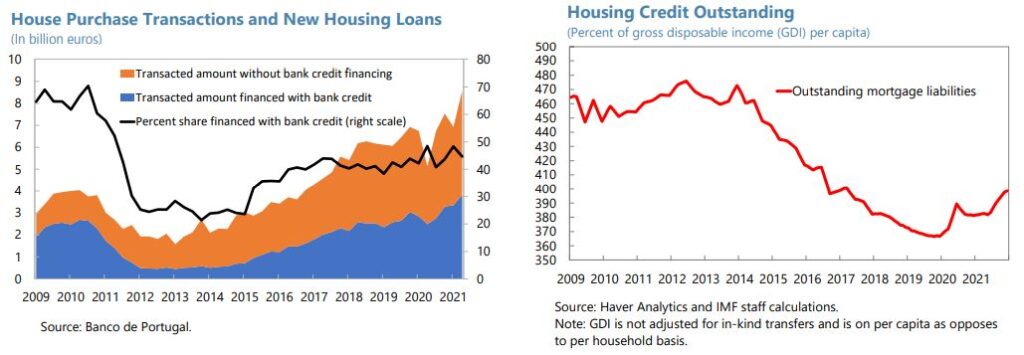
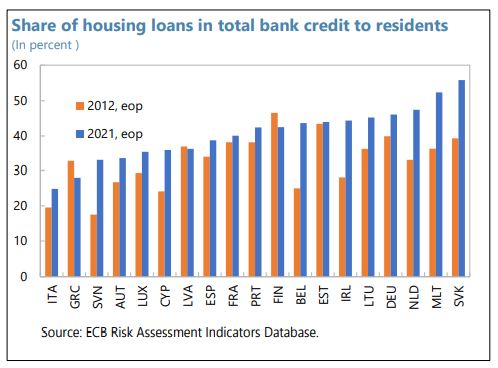
Domestic bank credit has not been a key driver of house prices yet. Even before the pandemic, Portugal had become one of EA’s most dynamic real estate markets partly reflecting tax incentives for foreigners and the Golden Visa program, whereby non-resident flows contributed to drive up housing prices. With households deleveraging since 2012–13, outstanding house credit to disposable incomes declined by 100 pp between 2014 and 2019. Housing credit growth turned positive only from 2019, driven by improved consumer confidence and low interest rates. While credit it still below historical averages, some estimates suggest small but positive credit gaps emerging in recent years. Housing supply shortages also played a role in boosting prices, with relatively subdued construction activity in the pre-pandemic years, although the construction sector remained resilient throughout the pandemic. Some cities (e.g., Lisbon) also saw a compression in price variation, with lower-end prices seeing steep gains.
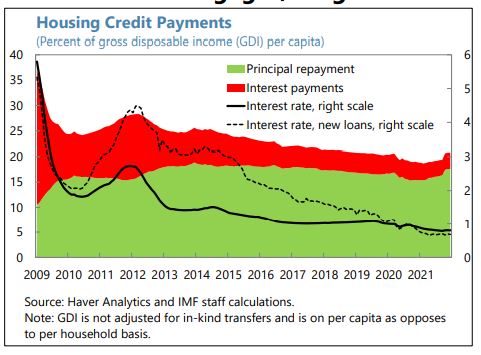
Although aggregate housing debt service as a share of disposable income was declining before the pandemic, this trend has slowed. On a per capita basis, average mortgage payments correspond to about 1/5th of household gross disposable income, marginally lower than the peak during the 2012–13 sovereign debt crisis. Also, mortgage interest payments declined from about 12 percent of disposable income in 2012H1 to about 3 percent in 2021. Principal repayments dipped temporarily due to moratoria.
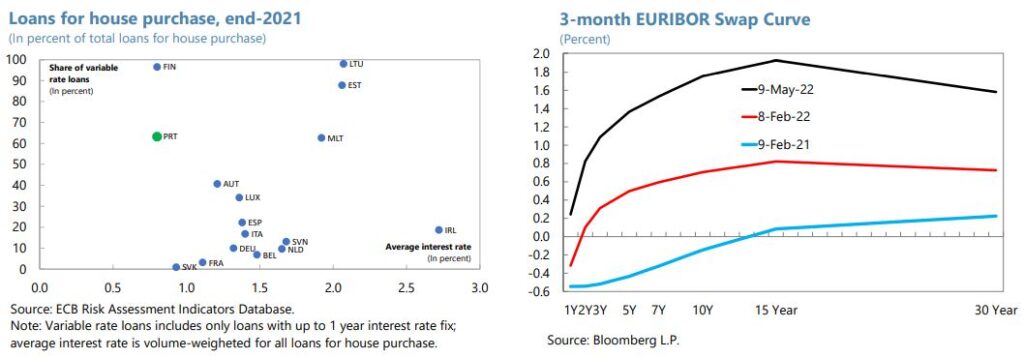
With house lending relying predominantly on variable rate mortgages, a significant increase in interest rates would quickly erode household incomes. Three quarters of housing loans have rate fixation of up to one year, with Euribor as the benchmark, while only a small fraction has fixed rates for longer than 10 years. Compared to early 2021, 2-year swap rates have widened by over 150 basis points reflecting expectations of ECB monetary tightening. With historic and euro-area’s lowest mortgage interest rates as of 2021Q4 – 0.7 percent for new mortgages and 0.8 percent for all outstanding –a 1 pp higher rate could raise household interest payments from 3.2 percent to about 7.2 percent of average household income, potentially also impacting aggregate demand. As per BdP’s borrower-based macroprudential policy measures, banks are recommended to consider a 300 basis point interest rate shock in the calculations of DSTIs for new mortgages.
The Bank of Portugal expanded its macroprudential toolkit in 2018, including measures on new credit agreements relating to residential property and consumer credit (also see Neugebauer and others 2021, Banco de Portugal Financial Stability Report, December 2021). Supervisory data indicate that borrower profiles improved in 2019, partly reflected in the increase in the share of mortgage credit granted to borrowers with net income above median. Nonetheless, the average maturity of new loans has not undergone gradual convergence towards 30 years, which prompted new macroprudential guidance from April 2022 on limits to maximum maturities. As regards the interest rate risk, and as mentioned above, the measures stipulate that banks should take into account the impact of higher interest rates in the calculations of DSTI, which is a mitigating factor. More generally, risks need to be closely monitored and consideration should be given on further strengthening capital positions, in accordance with the ESRB guidance, should vulnerabilities from the residential real estate sector continue increasing.
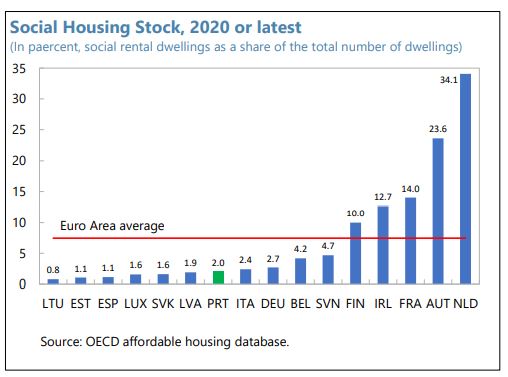
In view of rising house prices and limited social housing, housing affordability has also been a growing concern. House prices to disposable income are high among EA countries. Social housing is also limited, at about 2 percent of the total housing stock compared to EA average of 7.5 percent. In this context, the NGEU financed NRRP provides an opportunity for such investments to increase the stock of affordable rental housing for low-income families, which can also facilitate job mobility.”
From the IMF’s latest report on Portugal:
“Since 2015, Portuguese house price growth outpaced the EA average by almost 30 percentage points. This pace was sustained throughout the pandemic, with residential real estate prices gaining nearly 20 percentage points in real terms and relative to rents.
Available estimates suggest overvaluation of residential real estate. Based on indicators developed by the ECB, Banco de Portugal estimates point to an over-valuation of 8 to 16.5 percent (see Banco de Portugal,
Posted by at 12:37 PM
Labels: Global Housing Watch
Housing Market in Slovak Republic
From the IMF’s latest report on Slovak Republic:
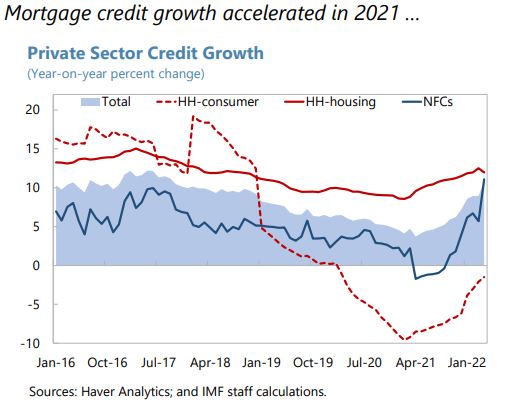
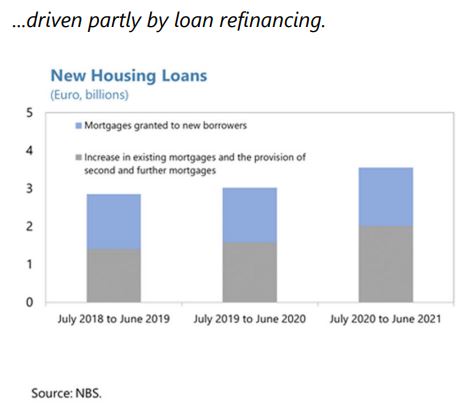
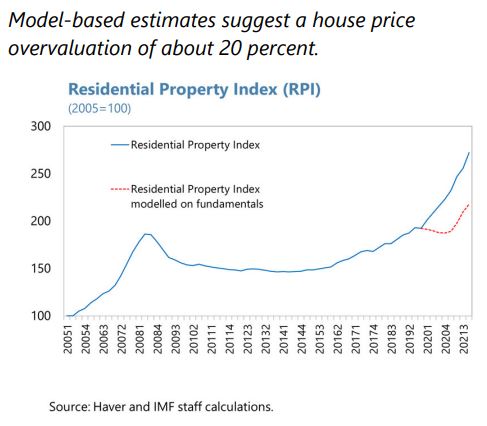
“House price growth has continued to accelerate amid rapid mortgage credit growth, driven by record low borrowing costs and looser credit standards. House price growth increased throughout 2021, reaching 22 percent y/y in 2022:Q1, with a wide gap between actual and model-predicted house prices. While housing affordability (as captured by the share of disposable income taken up by mortgage payments) remained quite high until mid-2021 given low interest rates and robust wage growth, and housing cost overburden for lower-income households is moderate from an international perspective, tightening financial conditions and higher inflation could quickly change this.
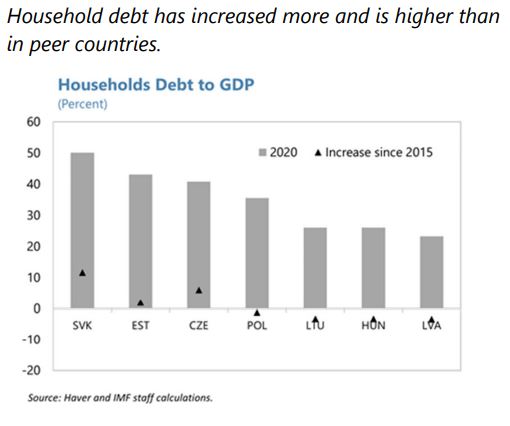
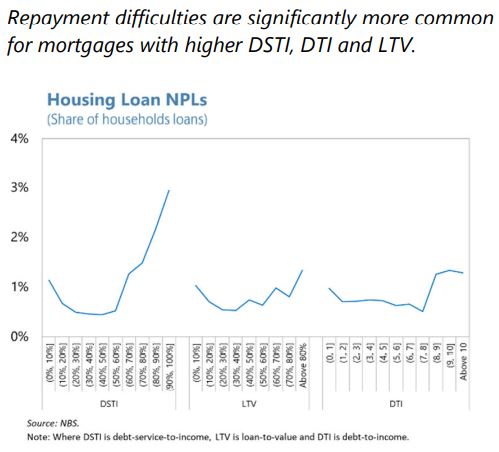
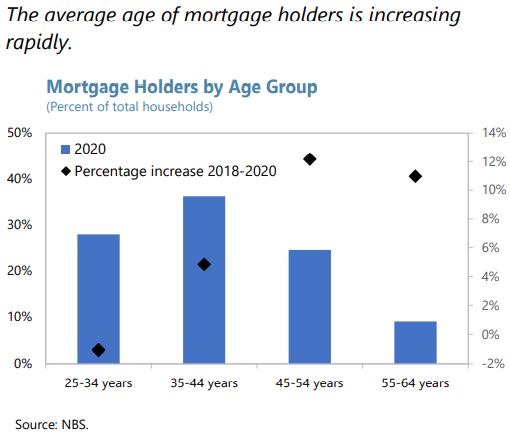
Macrofinancial vulnerabilities related to the housing market warrant close monitoring. Household debt relative to GDP has risen faster and is higher than in peer countries, due to the increase in homeowners with mortgages and the topping-up of existing mortgages. The active use of borrower-based measures has reduced the share of high LTV, DTI, and DSTI mortgages, but the cluster of mortgages right below regulatory limits is a potential source of vulnerability.16 There has also been an increase in mortgages with maturities extending beyond borrowers’ retirement age.
While the macroprudential stance is broadly adequate from a financial stability point of view, the authorities could consider introducing additional macroprudential policy measures to address housing market vulnerabilities if imbalances persist.17 As recommended in the 2021 IMF Staff Report and the ESRB, the NBS could consider introducing capital-based measures on mortgage exposures, including minimum risk weights, to strengthen banks’ resilience to adverse housing market shocks. The NBS could also explore applying the sectoral systemic risk buffer (SyRB) to target systemic risks from mortgage loans under the new Capital Requirements Directive (CRD V) flexibility, after conducting a cost-benefit analysis. To address pockets of vulnerability, such as the concentration of loans below regulatory limits and the rise in loans with maturities beyond retirement age, the authorities could consider adjusting borrower-based measures. For example, additional amortization requirements for new mortgages at the regulatory ceilings could reduce their clustering right underneath those ceilings. The proposal of a gradually falling DTI limit as borrowers approach retirement age would help limit overindebtedness of vulnerable pensioners, though it will be important to monitor its implementation and ensure that it does not reduce excessively access to credit to potentially credit-worthy older borrowers.
Addressing housing supply shortages and reforming property taxation could help alleviate property market pressures. Over the past decade, the overcrowding rate in Slovakia has declined but remains significantly higher than the EU average, especially among the younger population.18 The inflow of refugees might also raise housing demand. Improving housing supply will have social benefits as well as dampen house price growth and associated vulnerabilities. In that regard, the recently approved construction and spatial planning laws, which aim to simplify the construction code, shorten the lengthy building permit process and reduce bureaucracy are welcome. Developing the rental market could also help contain house price inflation. Finally, raising Slovakia’s property taxes would strengthen public finances and dampen overheating pressures.
Authorities’ Views
The authorities broadly concurred with staff’s assessment of housing market risks. They are open to expanding their macroprudential toolkit with capital-based measures, such as minimum risk weights, but a thorough cost-benefit analysis would be needed, especially given the sizable differences in mortgage risk-weights among IRB banks. They plan to introduce age-related DTI limits to address the rise in mortgages with maturities extending beyond retirement age. Their analysis suggests that the early adoption of such a precautionary measure would help limit excessive indebtedness and reduce the accumulation of risks, with only a slight reduction of credit growth. They also highlighted recent regulatory changes to bolster housing supply flexibility.”
From the IMF’s latest report on Slovak Republic:
“House price growth has continued to accelerate amid rapid mortgage credit growth, driven by record low borrowing costs and looser credit standards. House price growth increased throughout 2021, reaching 22 percent y/y in 2022:Q1, with a wide gap between actual and model-predicted house prices. While housing affordability (as captured by the share of disposable income taken up by mortgage payments) remained quite high until mid-2021 given low interest rates and robust wage growth,
Posted by at 12:13 PM
Labels: Global Housing Watch
Subscribe to: Posts