



Friday, March 30, 2018
Fostering Incentives for Women to Work to Promote Long-Term Growth in Iran
From a new IMF report on Iran’s female labor force participation:
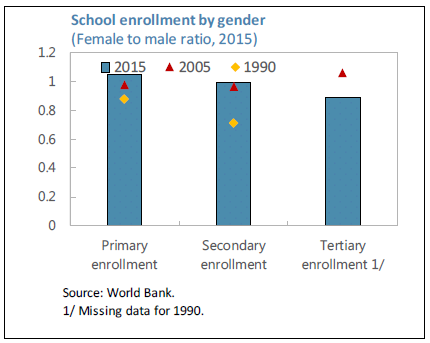
“Iran has made tremendous strides in eliminating gender gaps in education and health indicators. For about a decade now, there has been virtually no gap between male and female enrollment in primary and secondary education. The gender gap in tertiary education enrollment is small and, in some fields of studies such as engineering and science, women are now in the majority (IMF, 2016a). Years of schooling attained by women have expanded by 40 percent within in one generation (World Bank, 2016a) to reach an average of 9 years. The fertility rate in Iran has fallen sharply in the last 30 years and has been below two children per woman since the 2000s, and on par with the average of advanced economies. Life expectancy at birth for women is higher than men by 2 years (76.7 versus 74.5 years).
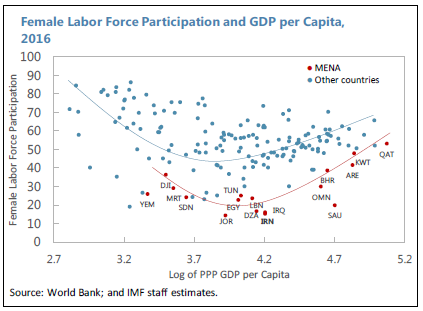
Despite these laudable achievements, female participation in the labor force is low. Female labor force participation (FLFP) was 16.2 percent in 2016, lower than countries with similar income per capita, including within the MENAP region. Some 83.8 percent of all females over the age of 10 are inactive and out of the labor force—the fourth highest rate in the world—3.2 percent of women were unemployed, and only 13 percent were working. Women represent 13.3 percent of legislators, senior officials and managers and hold 3.1 percent of seats in the parliament. Iran has two Vice Presidents who are women.
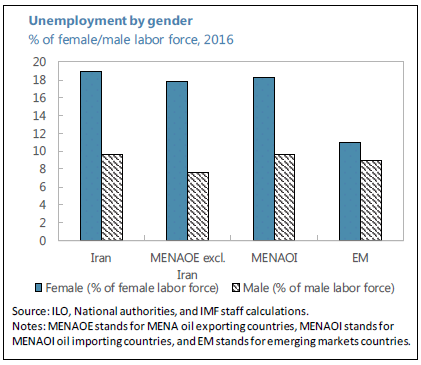
Once in the labor force, women in Iran are also more likely to be unemployed. In 2016, the female unemployment rate of 18.9 percent was twice as high as males. Although the average male and female unemployment rates are broadly in line with the MENAP region average, the female unemployment rate exceeds the emerging market average (EM) of 11 percent. Furthermore, a woman in Iran is likely to remain unemployed longer. While 30 percent of men remain unemployed for less than 3 months (versus only 11 percent of women), almost 48 percent of women remain unemployed for more than 19 months (versus only 28 percent of men).
Iran’s highly educated female population represents an untapped source growth and productivity gains. Increasing FLFP can significantly boost GDP, productivity, tax collections and alleviate the expected burden of aging (see IMF, 2016b). Section B presents several factors contributing to the low rate of FLFP in Iran. Section C analyzes the macroeconomic impact of reforms to reduce gender gaps in the labor market using an overlapping generations model. It examines the macroeconomic impact of three reforms: reducing the gender wage gap, reducing the obstacles for women to join the labor force, and subsidizing childcare costs to low- and mid-income female workers in the formal sector.”
Continue reading here.
From a new IMF report on Iran’s female labor force participation:
“Iran has made tremendous strides in eliminating gender gaps in education and health indicators. For about a decade now, there has been virtually no gap between male and female enrollment in primary and secondary education. The gender gap in tertiary education enrollment is small and, in some fields of studies such as engineering and science, women are now in the majority (IMF,
Posted by at 11:11 AM
Labels: Inclusive Growth
Expanding Iran’s Non-Oil Exports
From a new IMF report on Iran:
“The comparatively low share of oil exports to GDP reflects Iran’s relatively large and diversified economy. Natural resources dominate Iran’s exports representing almost 53 percent of total exports but account only for 12.3 percent of Iran’s GDP. Iran exports more products than the average of MENA countries but many of its products are closely related to the oil sector (such as plastic and rubber products).
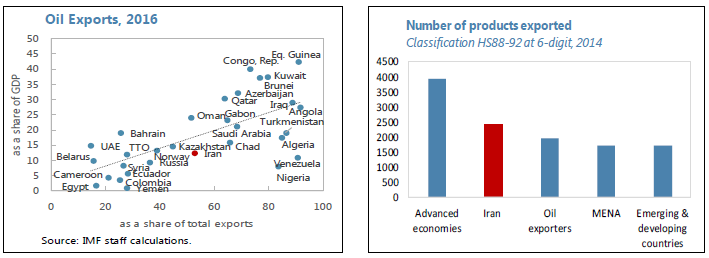
Iran needs to expand and intensify its trade with more partners if it is to increase non-oil exports and achieve the Sixth Development Plan target of growing non-oil exports to 15 percent of GDP by 2020. Examining Iran’s main exports in three broad goods categories highlights the opportunities for Iranian non-oil exports:
- Polyethylene (top export of plastic and rubber category, representing 11.6 percent of Iran’s non-oil exports). Iran mainly exports this good to China (84 percent) and Turkey (10 percent). However, the large European market—which imported US$ 9.5 billion of polyethylene in 2015 and accounted for 35 percent of the global market — is largely underexploited.
- Car parts (top export of the transportation category, representing 0.1 percent of Iran non-oil exports). Iran mainly exports car parts to a small set of countries in Europe, namely Turkey (72 percent), France (24 percent), and Russia (3 percent).
- Pistachios (top export of the vegetable category, representing 5.9 percent of Iran non-oil exports). Iran exports pistachios to a large share of world buyers.
“Improving Iran’s export competitiveness, attracting more foreign direct investments, removing barriers to trade and developing bilateral and multilateral trade agreements would aid Iran in reaching its targets for the development of the non-oil export sector.”
Continue reading here.
From a new IMF report on Iran:
“The comparatively low share of oil exports to GDP reflects Iran’s relatively large and diversified economy. Natural resources dominate Iran’s exports representing almost 53 percent of total exports but account only for 12.3 percent of Iran’s GDP. Iran exports more products than the average of MENA countries but many of its products are closely related to the oil sector (such as plastic and rubber products).
Posted by at 11:06 AM
Labels: Energy & Climate Change
Housing View – March 30, 2018
On cross-country:
- Mapping the literature of ‘policy transfer’ and housing – UK Collaborative Centre for Housing Evidence
- Mapping the literature on housing taxation in the UK and other OECD countries – UK Collaborative Centre for Housing Evidence
On the US:
- Mortgage Design in an Equilibrium Model of the Housing Market – NBER
- What to Expect From the Housing Market This Spring – New York Times
- California’s Housing Prices Need to Come Down – Citylab
On other countries:
- [Canada] Toronto’s Tale of Two Markets Is Hot Condos and Cold Houses – Bloomberg
- [China] China looks to Reits to ease housing woes – Financial Times
- [China] Does Housing Unaffordability Crowd Out Elites in Chinese Superstar Cities? – Shanghai University of Finance and Economics
- [Germany] Berlin loosens law for short-term home rentals – Reuters
- [Japan] Land ho, a sign of life in Japan – Financial Times
- [Netherlands] Revolutionary housing project brings Dutch youth together with refugees – UNHCR
- [Netherlands] Airbnb rentals in Netherlands are worsening the housing crisis – Global Property Guide
- [United Kingdom] High housing costs deter workers moving to London – Financial Times
- [United Kingdom] Brexit and the City: Tracking the fortunes of London’s financial districts – Reuters
- [United Kingdom] Brexit and the City – the real estate agent’s view – Reuters

Photo by Aliis Sinisalu
On cross-country:
- Mapping the literature of ‘policy transfer’ and housing – UK Collaborative Centre for Housing Evidence
- Mapping the literature on housing taxation in the UK and other OECD countries – UK Collaborative Centre for Housing Evidence
On the US:
- Mortgage Design in an Equilibrium Model of the Housing Market – NBER
- What to Expect From the Housing Market This Spring – New York Times
- California’s Housing Prices Need to Come Down – Citylab
Posted by at 5:00 AM
Labels: Global Housing Watch
Thursday, March 29, 2018
Monetary Policy, Labour Income, and Inequality
A new paper from the Bank of England finds that in UK, the impact of monetary policy on inequality depends on existing difference in income and wealth.“[…] younger households are estimated to have benefited most from higher income in cash terms, while older households gained more from higher wealth.”
The paper notes that “Furceri, Loungani, and Zdzienicka (2016) emphasise the importance of heterogeneity in the response of labour income to monetary policy as a key channel, noting evidence that those at the bottom of the income distribution are most affected by changes in economic activity.” Continue reading here.
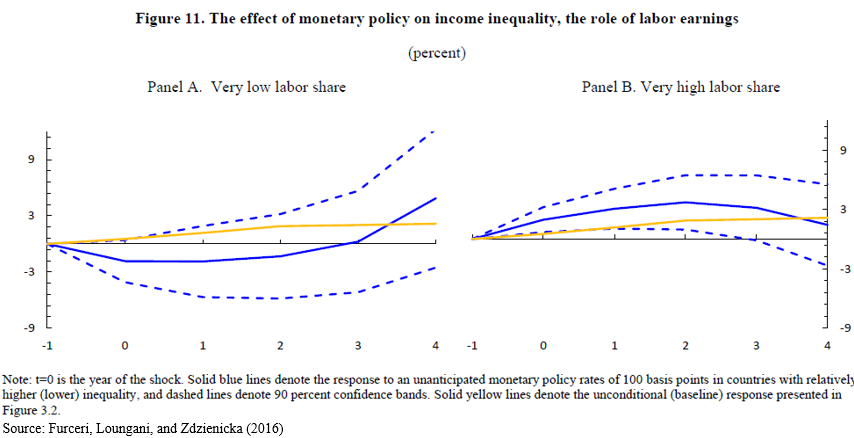
See my previous post on monetary policy and inequality here. The Furceri, Loungani, and Zdzienicka (2016) paper is available here.
A new paper from the Bank of England finds that in UK, the impact of monetary policy on inequality depends on existing difference in income and wealth.“[…] younger households are estimated to have benefited most from higher income in cash terms, while older households gained more from higher wealth.”
The paper notes that “Furceri, Loungani, and Zdzienicka (2016) emphasise the importance of heterogeneity in the response of labour income to monetary policy as a key channel,
Posted by at 2:22 PM
Labels: Inclusive Growth
Tuesday, March 27, 2018
The Gains from (Services) Trade
A new paper from the Bank of England says that “liberalising services trade, levelling up to the liberalisation seen in goods trade, could reduce excess global imbalances by around 40%. […] The potential rewards [of services trade liberalisation] are much broader. The great prize could be reinvigorating global growth.”
The paper notes that “seminal work by Baumol (1967) underpinned the ‘classical view’ of the contribution of services to growth. This view was unambiguously negative, indicating that services were largely non-tradable and exhibited little scope for productivity improvements. But services have changed significantly since then and evidence today suggests that services are widely traded across borders (Loungani et al (2017)) and that, when services productivity is correctly measured, historical services productivity growth has been as strong as manufacturing (Young (2014)). Many studies confirm positive linkages between service sector liberalisation and economic growth. There are three aspects to this: direct benefits for the services sector, downstream benefits for production in other sectors which use services, and the potential distribution benefits from services growth.” Continue reading here.
The Loungani et al paper and our new data set on services trade are available here.

Source: Loungani et al (2017).
A new paper from the Bank of England says that “liberalising services trade, levelling up to the liberalisation seen in goods trade, could reduce excess global imbalances by around 40%. […] The potential rewards [of services trade liberalisation] are much broader. The great prize could be reinvigorating global growth.”
The paper notes that “seminal work by Baumol (1967) underpinned the ‘classical view’ of the contribution of services to growth. This view was unambiguously negative,
Posted by at 8:25 PM
Labels: Inclusive Growth
Subscribe to: Posts