



T.N. Srinivasan towered over the field of Indian economics like a colossus. His death in Chennai on Sunday truly marks the end of an era.
Srinivasan, or TN, as he was widely known, initially trained to be a statistician. He studied at the Indian Statistical Institute in Kolkata. An uninspiring stint in Mumbai, doing statistical quality control at the textile mills, led him to write to Tjalling Koopmans at Yale University.
Koopmans, who would later win the 1975 Nobel Prize in economics, took the young Indian under his wing. Under the master, Srinivasan studied operations research and linear programming, skills that were especially important in the age of national planning, when resources were sought to be optimally allocated with minimal recourse to the price system. Srinivasan wrote his doctoral thesis on the choice of techniques. Amartya Sen was grappling with the same issue at the same time at Cambridge University, under the guidance of Joan Robinson.
TN returned to India to join the Indian Statistical Institute in New Delhi in 1962. He also worked with the Planning Commission at a time when the government was brimming with young economics talent, including Srinivasan, Sen, Jagdish Bhagwati, V.K. Ramaswami, Pranab Bardhan and B.S. Minhas in New Delhi; and Deena Khatkhate, Anand Chandavarkar, V.V. Bhatt and M. Narasimham in Mumbai.
Srinivasan found himself doing work for the perspective planning division headed by the formidable Pitambar Pant. Its task was to assess the economic needs of the country over the 15 years from 1961 to 1976. One of the products of the division, with Srinivasan playing an active role, was on an issue that has become resonant in our times—basic minimum income for all Indians. Srinivasan and Bardhan would later write in 1974: “The stage has come when we should sharply focus our efforts on providing an assured minimum income to every citizen of the country within a reasonable period of time. Progressively this minimum itself should be raised as development goes apace.”
The next few decades would see Srinivasan write a series of technical papers on statistics, trade theory, economic development, agriculture and microeconomics. As the economist V.N. Balasubramanyam wrote in an introduction to an interview with Srinivasan, few scholars can list among their publications both A Note On Approximation To Finite Sample Moments Of Estimation Whose Exact Sampling Distribution is Unknown and Destitution: A Discourse. No wonder he was a fellow of both the Econometric Society and the American Philosophical Society.”
Wednesday, November 14, 2018
Simple Rules for Climate Policy and Integrated Assessment
From a new working paper by Frederick van der Ploeg and Armon Rezai:
“A simple integrated assessment framework that gives rules for the optimal carbon price, transition to the carbon-free era and stranded carbon assets is presented, which highlights the
ethical, economic, geophysical and political drivers of optimal climate policy. For the ethics we discuss the role of intergenerational inequality aversion and the discount rate, where we show the importance of lower discount rates for appraisal of longer run benefit and of policy makers using lower discount rates than private agents. The economics depends on the costs and rates of technical progress in production of fossil fuel, its substitute renewable energies and sequestration. The geophysics depends on the permanent and transient components of
atmospheric carbon and the relatively fast temperature response, and we allow for positive feedbacks. The politics stems from international free-rider problems in absence of a global
climate deal. We show how results change if different assumptions are made about each of the drivers of climate policy. Our main objective is to offer an easy back-on-the-envelope analysis, which can be used for teaching and communication with policy makers.”
From a new working paper by Frederick van der Ploeg and Armon Rezai:
“A simple integrated assessment framework that gives rules for the optimal carbon price, transition to the carbon-free era and stranded carbon assets is presented, which highlights the
ethical, economic, geophysical and political drivers of optimal climate policy. For the ethics we discuss the role of intergenerational inequality aversion and the discount rate, where we show the importance of lower discount rates for appraisal of longer run benefit and of policy makers using lower discount rates than private agents.
Posted by at 2:01 PM
Labels: Energy & Climate Change
Monday, November 12, 2018
Inequality and Social Policies
An IMF country report analyzes the “income inequalities and government transfers using microdata from Mexico’s survey on household income and expenditures (ENIGH). It highlights the positive role played by government transfers in reducing inequalities over 2004-2016 and suggests that there is scope for better targeting existing social programs.”
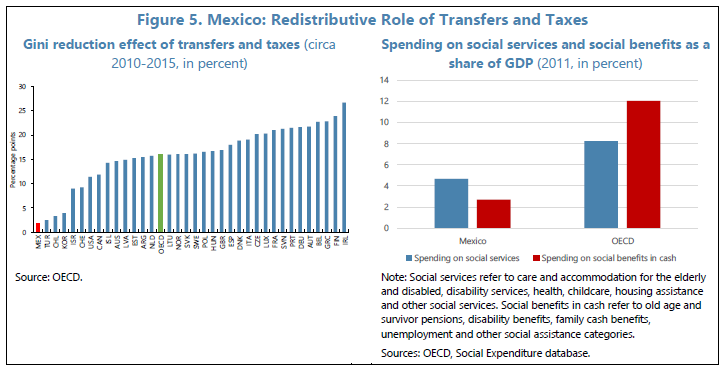 “Transfers and taxes play a much more limited role in alleviating inequalities in Mexico than in other OECD countries. The Gini reduction effect of transfers and taxes is lower in Mexico than in all OECD countries. This limited redistributive role of fiscal policies in Mexico may result from a tax system that is insufficiently progressive. It also reflects the low level of public social spending as a share of GDP, in particular on non-contributory cash transfers targeted at the poorest households.”
“After a modest increase over 2007-2015, public social spending as a share of GDP has
fallen in the last two years. Public social spending increased by 2.5 percent of GDP from 2007 to
2015, reaching a maximum of 12.1 percent of GDP, before shrinking to 10.4 percent in 2017. Social
assistance and education, the first two components of public social spending, absorb together more
than 60 percent of the total, while health expenditures amount to close to a fourth.”
“Mexico’s social assistance programs cover well households at the bottom of the income distribution. 31 percent of the households in the bottom income quintile benefit from Mexico’s conditional cash transfer program Prospera (formerly known as Oportunidades and initially launched as Progresa), which has served as a model for many countries around the world (Parker and Todd, 2017). Similarly, the share of households benefiting from old-age social assistance is three times higher in the first income quintile than in the fifth one. Prospera and old-age social assistance programs account for about ¾ of the decline in the Gini coefficient coming from government transfers, while they represent about half of the total government transfer amount received by an average household.”
An IMF country report analyzes the “income inequalities and government transfers using microdata from Mexico’s survey on household income and expenditures (ENIGH). It highlights the positive role played by government transfers in reducing inequalities over 2004-2016 and suggests that there is scope for better targeting existing social programs.”
“Transfers and taxes play a much more limited role in alleviating inequalities in Mexico than in other OECD countries. The Gini reduction effect of transfers and taxes is lower in Mexico than in all OECD countries.
Posted by at 9:42 PM
Labels: Inclusive Growth
Formality and Equality – Labor Market Challenges in Mexico
An IMF country report on Mexico documents “the composition, trends, and labor market implications of informality using data from the National Employment Survey (ENOE). Over half of the employed population has informal contractual relationships in Mexico both at formal and informal firms. Informality is found to be associated with lower levels of pay –even when accounting for worker composition differences– and lower wage growth over the life cycle.”
 “Future labor market reforms should take a holistic approach that addresses both distributional concerns and formality barriers. One alternative is to reduce dependence on payroll taxes that are biased towards formal salaried workers while transitioning towards a social insurance system that provides good-quality services for all, irrespective of their salaried/non-salaried status. Another is easing firing and hiring restrictions of salaried workers while increasing protections to the unemployed through a more universal unemployment insurance scheme. This type of profound long-term transformations should, of course, only be implemented after careful review of policy alternatives guided by experiences in other countries and detailed impact analysis.”
“Short-term reforms should build towards a system where the non-exclusive targets of boosting social protection and removing distortionary restrictions are achieved. Policy proposals, such as hikes in the minimum wage, should be gradual, viewed in the context of other distortionary polices, and carefully weigh equity benefits against the potential displacement of labor towards unproductive informality.”
An IMF country report on Mexico documents “the composition, trends, and labor market implications of informality using data from the National Employment Survey (ENOE). Over half of the employed population has informal contractual relationships in Mexico both at formal and informal firms. Informality is found to be associated with lower levels of pay –even when accounting for worker composition differences– and lower wage growth over the life cycle.”
“Future labor market reforms should take a holistic approach that addresses both distributional concerns and formality barriers.
Posted by at 9:37 PM
Labels: Inclusive Growth
The Price and Welfare Effects of The Value-Added Tax: Evidence from Mexico
From a new IMF working paper:
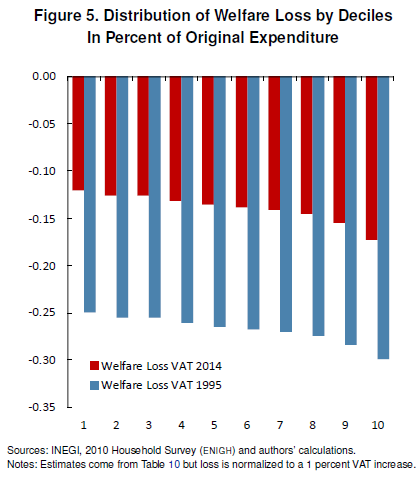
“In this paper we analyze the incidence of the VAT and its effects on the income distribution. To identify these effects, we rely on two tax reforms undertaken in Mexico that increased the VAT rate for a group of cities and left the rest unaffected. We compare the inflation rate of the affected cities with the exempted cities before and after the law changed. We find that the effect on prices is limited and conclude that the burden of the tax is indeed shared between producers and consumers. Regarding welfare, we find that the VAT is progressive in both absolute and relative terms to the overall expenditure. Finally, we show that an identical change in the VAT rate when inflation is high and persistent doubles its pass-through to inflation and its welfare loss for the average household.”
From a new IMF working paper:
“In this paper we analyze the incidence of the VAT and its effects on the income distribution. To identify these effects, we rely on two tax reforms undertaken in Mexico that increased the VAT rate for a group of cities and left the rest unaffected. We compare the inflation rate of the affected cities with the exempted cities before and after the law changed.
Posted by at 9:30 PM
Labels: Inclusive Growth
Sunday, November 11, 2018
T. N. Srinivasan: An economist for all seasons
From livemint:
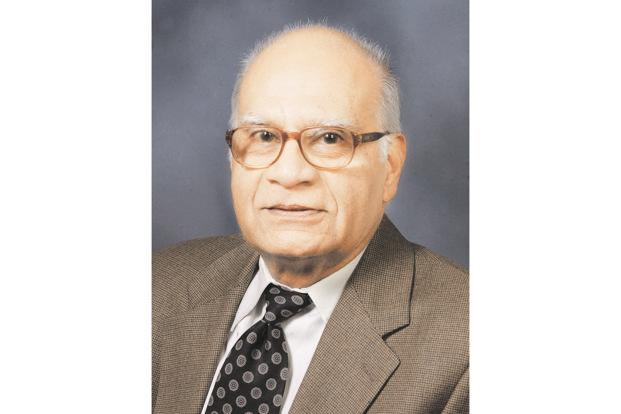
“The death of T. N. Srinivasan, the iconoclast who laid the intellectual groundwork for India’s economic reforms, marks the end of an era
Continue reading here.
From livemint:
“The death of T. N. Srinivasan, the iconoclast who laid the intellectual groundwork for India’s economic reforms, marks the end of an era
T.N. Srinivasan towered over the field of Indian economics like a colossus. His death in Chennai on Sunday truly marks the end of an era.
Srinivasan, or TN, as he was widely known, initially trained to be a statistician. He studied at the Indian Statistical Institute in Kolkata.
Posted by at 3:04 PM
Labels: Profiles of Economists
Subscribe to: Posts