



Monday, May 13, 2019
Housing Market in Luxembourg
From the IMF’s latest report on Luxembourg:
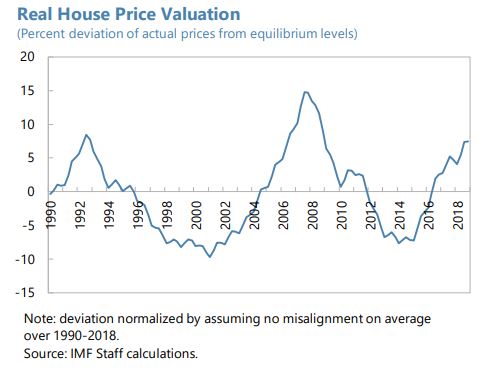
“Real house prices are estimated to be slightly overvalued in 2018. The percent deviation between the actual house price index and the predicted house price index suggests that real house prices were slightly overvalued, by about 7.5 percent in 2018.
Going forward, given supply constraints, Brexit-related immigration flows could add demand pressures and increase overvaluation of residential real estate (RRE) prices.
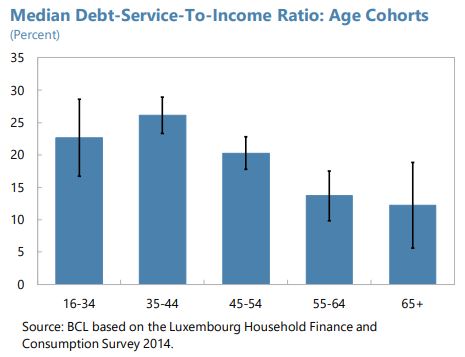
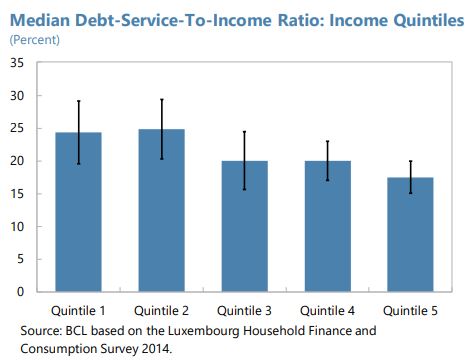
However, elevated household indebtedness indicates medium-term vulnerabilities, especially among younger age cohorts. Household debt remained high at about 170 percent of net disposable income in 2017, placing Luxembourg above the average of OECD countries. According to the latest available data from CSSF, 32 percent of households have a debt-service-to-income (DSTI) ratio greater than 45 percent. Disaggregated data from Household Finance and Consumption Survey (2014) indicates very high debt-to-income and DSTI ratios for younger cohorts (below 45 years old). The median and 75th percentile DSTI ratios were approaching 25 and 40 percent of disposable income, respectively. Classified by income quintiles, debt service burden is larger for poorer households (quintiles 1 and 2). In 2018, the share of adjustable rate mortgages in new mortgages remained stable at about 50 percent, indicating that some household balance sheets remain vulnerable to interest rate risks. These vulnerabilities would be exacerbated should monetary policy normalize faster than anticipated.
Rising RRE prices and elevated household indebtedness require continued monitoring of financial stability risks including banks’ ability to absorb price declines. Non-performing loans (NPLs) in the real estate sector remain low, with the ratio of total NPLs in RRE to total assets of the domestic banking system at 0.18 percent. However, borrower-based indicators point towards the need for closer monitoring of financial stability risks. Loan-to-value (LTV) ratios above 80 percent, for instance, are high at 31 percent of the outstanding mortgage stock. This is expected to increase further as one half of all new mortgage loans continue to have LTV ratios above 80 percent.”
From the IMF’s latest report on Luxembourg:
“Real house prices are estimated to be slightly overvalued in 2018. The percent deviation between the actual house price index and the predicted house price index suggests that real house prices were slightly overvalued, by about 7.5 percent in 2018.
Going forward, given supply constraints, Brexit-related immigration flows could add demand pressures and increase overvaluation of residential real estate (RRE) prices.
However,
Posted by at 10:40 AM
Labels: Global Housing Watch
Friday, May 10, 2019
Housing Market in Macao
From the IMF’s latest report on Macao:
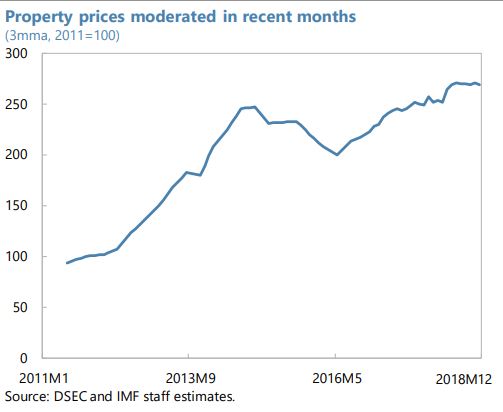
“The housing market has strongly recovered with the economic rebound that started in mid-2016, but the market appears to have cooled in the second half of 2018. After falling between mid-2014 and mid-2016, the residential property price index recovered fully between mid2016 and mid-2018 (in real terms), though it stayed flat in the second half of 2018. Even though residential property prices remained below trend in 2018, they appear to remain somewhat overvalued, for smaller units in particular (…).
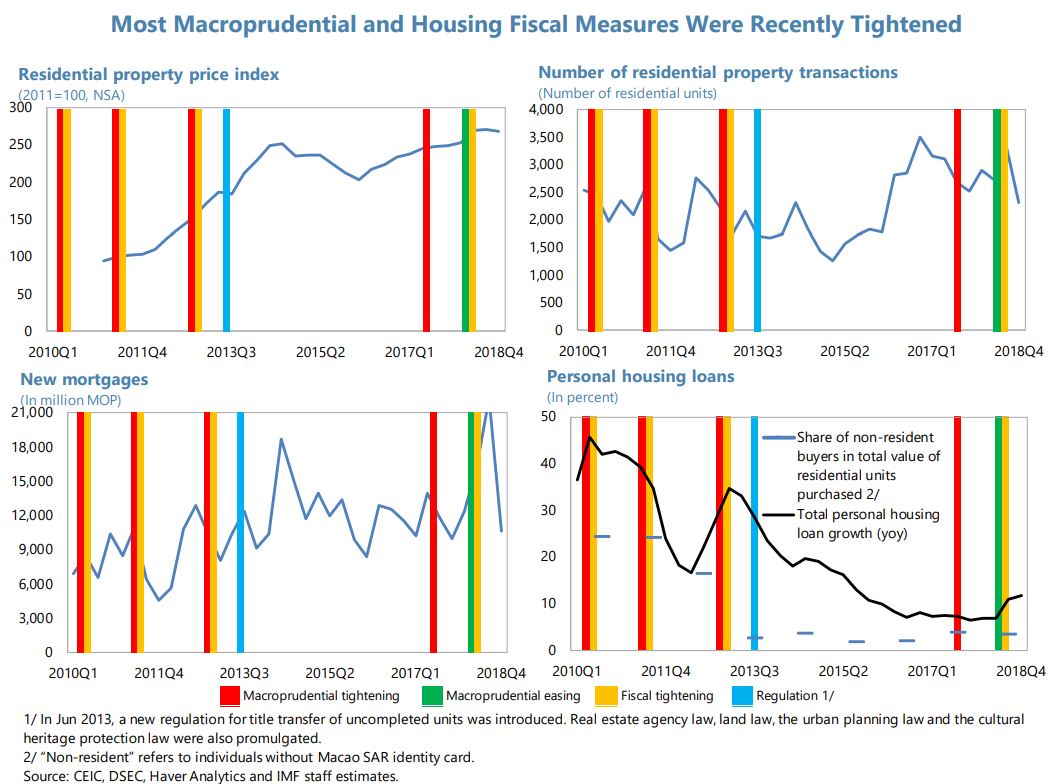
The current housing macroprudential stance and related fiscal measures appear broadly appropriate. Measures were put in place in 2017 and 2018:
- New measures were introduced to mitigate housing market risks via containment of demand. The loan-to-value limit for non-first-time homebuyers was tightened in May 2017. In February 2018, property tax exemptions on vacant properties were removed and a special stamp duty tax on the purchase of non-first residential property was introduced.
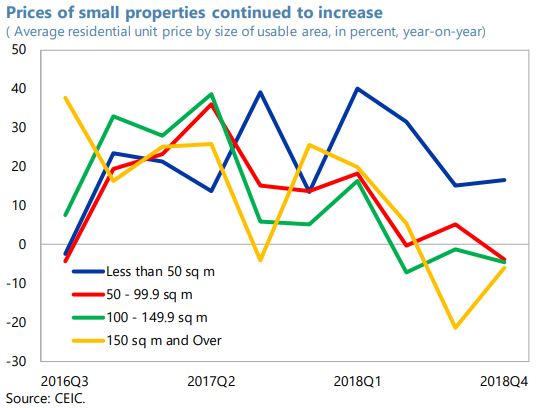
On the other hand, the AMCM eased loanto-value limits for young first-time homebuyers to help affordability in February 2018 that may have unintentionally boosted demand and prices in this segment. Systemic risks in the housing market appear broadly contained. The authorities should continue monitoring residential property prices and the effects of recent housing market measures, as they may usually play out with a lag. Further actions should take into account evolving market conditions, including the recent growth deceleration and leveling off in residential property prices. In the event that residential property prices resume strong growth and may pose a risk to financial stability, the authorities could consider tightening macroprudential and/or fiscal-based measures property transactions by nonresidents during the housing market boom in 2010-2011. The main objective was to put in place a preventive measure to strengthen banks’ risk management considering the spike in nonresident NPLs during the Asian Financial Crisis. In 2017, to curb financial stability risks from strong growth in residential property prices, the AMCM tightened LTV for residents and nonresidents simultaneously.
- To attain the same policy objective without differentiating between residents and nonresidents, the authorities could examine whether they can protect against greater credit risk from lending to nonresidents through the existing multi-tiered-LTV structure but without the residency-based feature or by linking the differentiation in LTV limits directly to banks’ risk assessment of loans and borrowers, supported by additional measures such as enhancing information requirements and enforcement across borders and requiring banks to take into account country transfer or legal risk in their risk assessment. Further strengthening supervisory capacity of banks’ mortgage lending, broadly in line with FSAP recommendations (…), will be important to help ensure that these alternative measures are feasible
A broader set of policies should support housing affordability, where continued efforts to boost housing supply will be key. The apparent cooling of the housing market is welcome and may contribute to improving housing affordability. However, remaining affordability concerns should be addressed by a broader set of supply policies:
- Planning, zoning, and other reforms affect supply and prices only with long lags, and underlying demand for housing is expected to remain robust. Housing supply reforms should, therefore, not be delayed. Building on the government’s recent efforts to boost housing supply, plans should advance regulatory policy within a transparent framework that supports private sector supply and boosts well-targeted public housing supply, including via higher infrastructure spending.
- A coordinated government strategy to foster public and private housing supply, including an urban planning framework and urban renewal plan, would help guide reform efforts. While completing needed environmental, design, transportation and other assessments, procedures should be expedited.
Authorities’ Views.
- Housing market and policies. The authorities agreed that the housing market cooled in 2018 but remained somewhat overvalued. They noted that they stand ready to take further actions dependent on market conditions. They considered that the 2018 LTV loosening (for young firsttime homebuyers) was effective in increasing credit for this group, but acknowledged its contribution to higher prices in the small-property segment. On the residency-based LTV, they took note of the recommendation to replace the differentiation between residents and nonresidents with alternative measures. They highlighted that the objectives of the LTV framework are to strengthen banks’ risk management, curb investment/speculation motives, and moderate risks to the financial sector. They explained that the LTV framework is key for Macao SAR’s stability in light of its open capital account and large spillovers from its real estate sector. They highlighted that the 2017 LTV tightening was not aimed at nonresidents as it was done for both residents and nonresidents. They may consider other alternative measures as suggested when appropriate.
- Housing affordability. They agreed that boosting housing supply is key to address affordability concerns. In terms of public housing, they noted that ongoing projects will satisfy public housing needs by 2026 (by when they plan to add 50,000 public housing units) and they will carry on research analysis on public housing demand (including post-2026). They also noted measures under consideration to make public housing more targeted to the vulnerable. They explained that there are authorities which coordinate the strategy on public and private housing and noted that a draft master plan (to be completed in 2019) will support private housing development.”
From the IMF’s latest report on Macao:
“The housing market has strongly recovered with the economic rebound that started in mid-2016, but the market appears to have cooled in the second half of 2018. After falling between mid-2014 and mid-2016, the residential property price index recovered fully between mid2016 and mid-2018 (in real terms), though it stayed flat in the second half of 2018. Even though residential property prices remained below trend in 2018,
Posted by at 1:31 PM
Labels: Global Housing Watch
Housing View – May 10, 2019
On cross-country:
- Is co-living an answer to the affordable housing crisis? – World Economic Forum
On the US:
- House Prices at Risk – Money & Banking
- How About Leaving Fannie Mae and Freddie Mac Alone? – Bloomberg
- Cost, crowding, or commuting? Housing stress on the middle class – Brookings Institute
- Housing trade-offs: Affordability not the only stressor for the middle class – Brookings Institute
- Since 2008, Only High-Income People Have Seen Their Housing Costs Drop – Citylab
- [Your city] has a housing crisis. The answer is [more/less] [building/money/regulation] – Brookings Institute
- Following the Money in Residential Real Estate – New York Times
- Does Gentrification Displace Poor Children? New Evidence from New York City Medicaid Data – NBER
- Racial Segregation in Housing Markets and the Erosion of Black Wealth – NBER
- Housing market and bank lending effects on young firms and local economies – VoxEU
- Consumers Temper Optimism on Housing Despite Improved Mortgage Rate Expectations – Fannie Mae
- Fulfilling the Dream of Homeownership: How Do Families and Others Play a Role? – Freddie Mac
- New Taxes and Higher Density Aren’t Fixing Vancouver’s Housing Problem – Citylab
On other countries:
- [Canada] Stephen S Poloz: Risk sharing, flexibility and the future of mortgages – Bank of Canada
- [Canada] Canada’s Housing Will Return to Growth, Central Bank Governor Says – Wall Street Journal
- [Canada] Risks Are Receding in Canada’s Housing Market, Agency Says – Bloomberg
- [Hong Kong] What do we know about Housing Supply? The case of Hong Kong – City University of Hong Kong
On cross-country:
- Is co-living an answer to the affordable housing crisis? – World Economic Forum
On the US:
- House Prices at Risk – Money & Banking
- How About Leaving Fannie Mae and Freddie Mac Alone? – Bloomberg
- Cost, crowding, or commuting? Housing stress on the middle class – Brookings Institute
- Housing trade-offs: Affordability not the only stressor for the middle class – Brookings Institute
- Since 2008,
Posted by at 5:00 AM
Labels: Global Housing Watch
Thursday, May 9, 2019
Snapshots of US Income Taxation Over Time
From Conversable Economist:
“As Americans recover from our annual April 15 deadline for filing income taxes, here are a series of figures about longer-term patterns of taxes in the US economy. They are drawn from a series of blog posts by the Tax Foundation over the last few months. The Tax Foundation is a nonpartisan group whose analysis typically leans toward side that taxes on those with high incomes are already high enough. However, the figures that follow are compiled from fairly standard data sources: IRS data, the Congressional Budget Office, and the like.
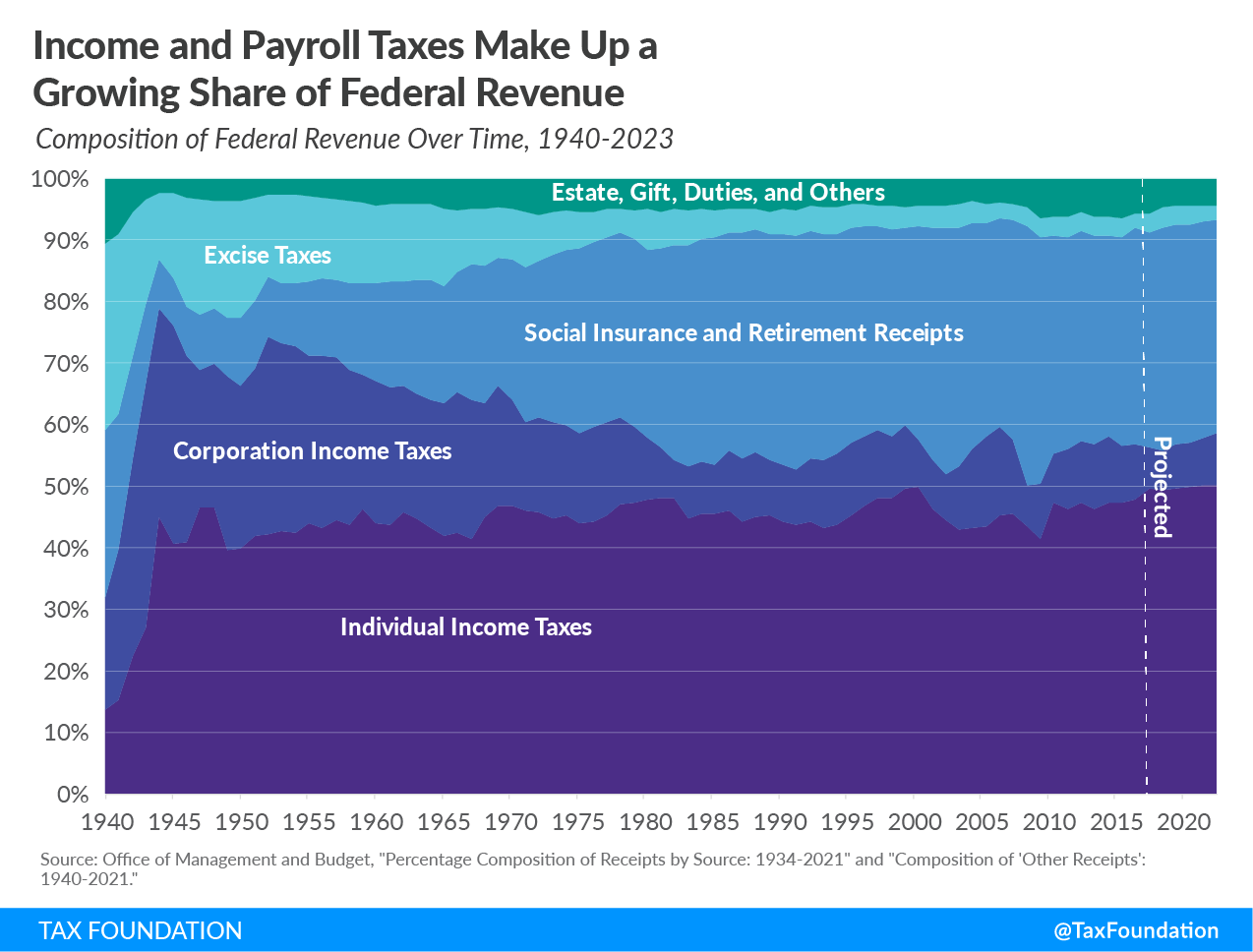
For example, here’s a figure showing what taxes are the main sources of federal income over time from Erica York. She writes: “Before 1941, excise taxes, such as gas and tobacco taxes, were the largest source of revenue for the federal government, comprising nearly one-third of government revenue in 1940. Excise taxes were followed by payroll taxes and then corporate income taxes. Today, payroll taxes remain the second largest source of revenue. However, other sources have shifted in relative importance. Specifically, individual income taxes have become a central pillar of the federal revenue system, now comprising nearly half of all revenue. Following an opposite trend, corporate income and excise taxes have decreased relative to other sources.”
From Conversable Economist:
“As Americans recover from our annual April 15 deadline for filing income taxes, here are a series of figures about longer-term patterns of taxes in the US economy. They are drawn from a series of blog posts by the Tax Foundation over the last few months. The Tax Foundation is a nonpartisan group whose analysis typically leans toward side that taxes on those with high incomes are already high enough.
Posted by at 9:14 AM
Labels: Macro Demystified
Tuesday, May 7, 2019
Is Something Different this Time about the Effect of Technology on Labor Markets?
From Conversable Economist:
“There’s a well-worn conversation about the relationship between new technology and possible job displacement which goes something like this:
Concerned person: “New developments in information technology and artificial intelligence are going to threaten lots of jobs.”
Skeptical person: “Economies in developed countries have been experiencing extraordinary developments and shifts in new technology for literally a couple of centuries. But as old jobs have been dislocated, new jobs have been created.”
Concerned person: “This time seems different.”
Skeptical person: “Every time is different in the specific details. But there’s certainly no downward pattern in the number of jobs in the last two centuries, or the last few decades.”
Concerned person: “Still, the way in which information technology and artificial intelligence replace workers seems different than the way in which, say, assembly lines replaced skilled artisan workers or combine harvesters replaced farm workers. ”
Skeptical person: “Maybe this time will be different. After all, it’s logically impossible to prove that something in the future will NOT be different. But based on the long-run historical pattern, the evidence that new technology leads to shifts in the labor market is clear-cut, while the evidence that it leads to permanent job loss for the population as a whole is nonexistent.”
Concerned person: “Still, this current wave of technology seems different.”
Skeptical person: “I guess we’ll see how it unfolds in the next decade or two.”
The most recent Spring 2019 issue of the Journal of Economic Perspectives has a symposium on “Automation and Employment.” Two of the articles in particular offer a concrete arguments about how something is different with how the current new technologies are interacting with labor markets.
Daron Acemoglu and Pascual Restrepo discuss “Automation and New Tasks: How Technology Displaces and Reinstates Labor.” They suggest a framework in which automation can have three possible effects on the tasks that are involved in doing a job: a displacement effect, when automation replaces a task previously done by a worker; a productivity effect in which the higher productivity from automation taking over certain tasks leads to more buying power in the economy, creating jobs in other sectors; and a reinstatement effect, when new technology reshuffles the production process in a way that leads to new tasks that will be done by labor.”
From Conversable Economist:
“There’s a well-worn conversation about the relationship between new technology and possible job displacement which goes something like this:
Concerned person: “New developments in information technology and artificial intelligence are going to threaten lots of jobs.”
Skeptical person: “Economies in developed countries have been experiencing extraordinary developments and shifts in new technology for literally a couple of centuries. But as old jobs have been dislocated,
Posted by at 11:12 AM
Labels: Inclusive Growth
Subscribe to: Posts