



Wednesday, October 2, 2019
To Tackle Housing Affordability in Canada, Build More Houses
From an IMF Blog by Michal Andrle, Cheng Hoon Lim and Troy Matheson:
“Policymakers across the world worry about affordable housing. They should. It represents the cost of a basic human need—shelter. Canada is no exception as it grapples to provide affordable housing in some cities, like Vancouver and Toronto, where rents are high, and for many, the dream of owning a home has faded.
People who can afford a down payment typically borrow as much as they can to get a foothold in the market—stretching themselves financially and contributing to Canada’s record-high levels of household debt.
So, how can governments help make housing affordable? Our latest staff report suggests boosting housing supply to meet demand.
Short-term fixes may not always work
Boosting Canada’s supply of affordable housing is no easy task. Countries like Canada, the Czech Republic, Sweden, and the United Kingdom that face problems with housing affordability in major cities have found that housing policies can quickly become politically contentious.
For this reason, policymakers often resort to short-term fixes to the problem. These include relaxing prudential regulations to enable households to borrow more (higher loan-to-income and loan-to-value ratios), increasing or introducing tax-deductibility of mortgage interest-rate costs, and subsidizing home purchases directly.
According to our research, we find that even well-meaning policies that aim to improve housing affordability by increasing households’ capacity to borrow may unintentionally raise house prices—ultimately resulting in homebuyers having to borrow more and leading to higher household debt.
Why? Because housing supply is fixed in the short term. So, any increase in households’ ability to borrow will increase demand for housing, increase house prices, and ultimately make houses less affordable than they otherwise would have been.
This is what we found when we compared the dynamics of house prices in eleven Canadian Census Metropolitan Areas with households’ ability to borrow—the so-called “attainable” house price.”
Continue reading here.
From an IMF Blog by Michal Andrle, Cheng Hoon Lim and Troy Matheson:
“Policymakers across the world worry about affordable housing. They should. It represents the cost of a basic human need—shelter. Canada is no exception as it grapples to provide affordable housing in some cities, like Vancouver and Toronto, where rents are high, and for many, the dream of owning a home has faded.
People who can afford a down payment typically borrow as much as they can to get a foothold in the market—stretching themselves financially and contributing to Canada’s record-high levels of household debt.
Posted by at 2:26 PM
Labels: Global Housing Watch
How Mexico’s Social Spending Reduced Poverty and Income Inequality
A new IMF paper by Frederic Lambert and Hyunmin Park highlights the role played by social spending to reduce poverty and inequality:
“We analyze microdata from Mexico’s survey on household income and expenditures (ENIGH) to study the evolution of income inequality in Mexico over 2004-16, identify its sources, and investigate how it was affected by government social policy. We find evidence of only a small decline in inequality over this period. The observed decline may be attributed to government transfers, notably targeted cash transfers (Prospera) and non-contributory pensions. In 2016, those two programs accounted for more than two thirds of the reduction in the Gini coefficient due to government transfers. Other transfer programs such as farmland subsidies (Proagro), government scholarships, and non-monetary transfers for medical expenditures have not been as effective.”
A new IMF paper by Frederic Lambert and Hyunmin Park highlights the role played by social spending to reduce poverty and inequality:
“We analyze microdata from Mexico’s survey on household income and expenditures (ENIGH) to study the evolution of income inequality in Mexico over 2004-16, identify its sources, and investigate how it was affected by government social policy. We find evidence of only a small decline in inequality over this period.
Posted by at 2:10 PM
Labels: Inclusive Growth
Monday, September 30, 2019
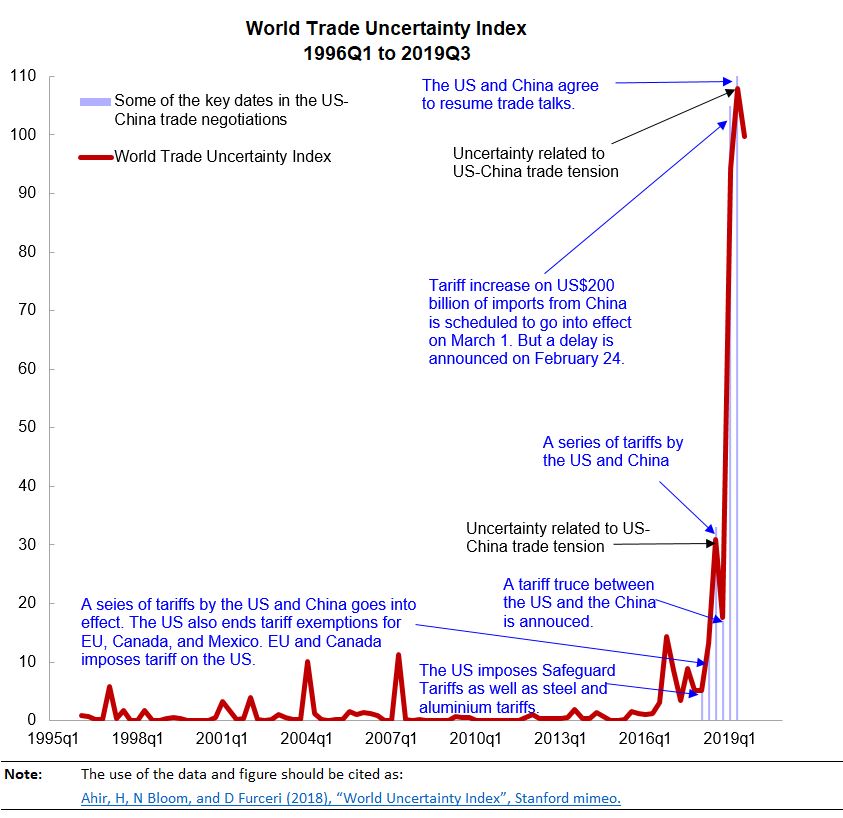
Tracking uncertainty across the globe
Below is the latest update of the World Uncertainty Index (figure 1) and World Trade Uncertainty Index (figure 2). These indexes are constructed by Hites Ahir (IMF), Nick Bloom (Stanford University) and Davide Furceri (IMF).
To read how the index is constructed, see the paper here and also see the dataset here. The dataset includes the aggregate index (the index at the global level, by income group, and by region), as well as the country specific index (143 countries) from 1996Q1 to 2019Q3. It also contains a beta version of the historical index for about 80 countries starting from the 1950s.
See the coverage of the index in the press: Bloomberg, The Economist, Financial Times, Reuters, and Wall Street Journal.
Figure 1.
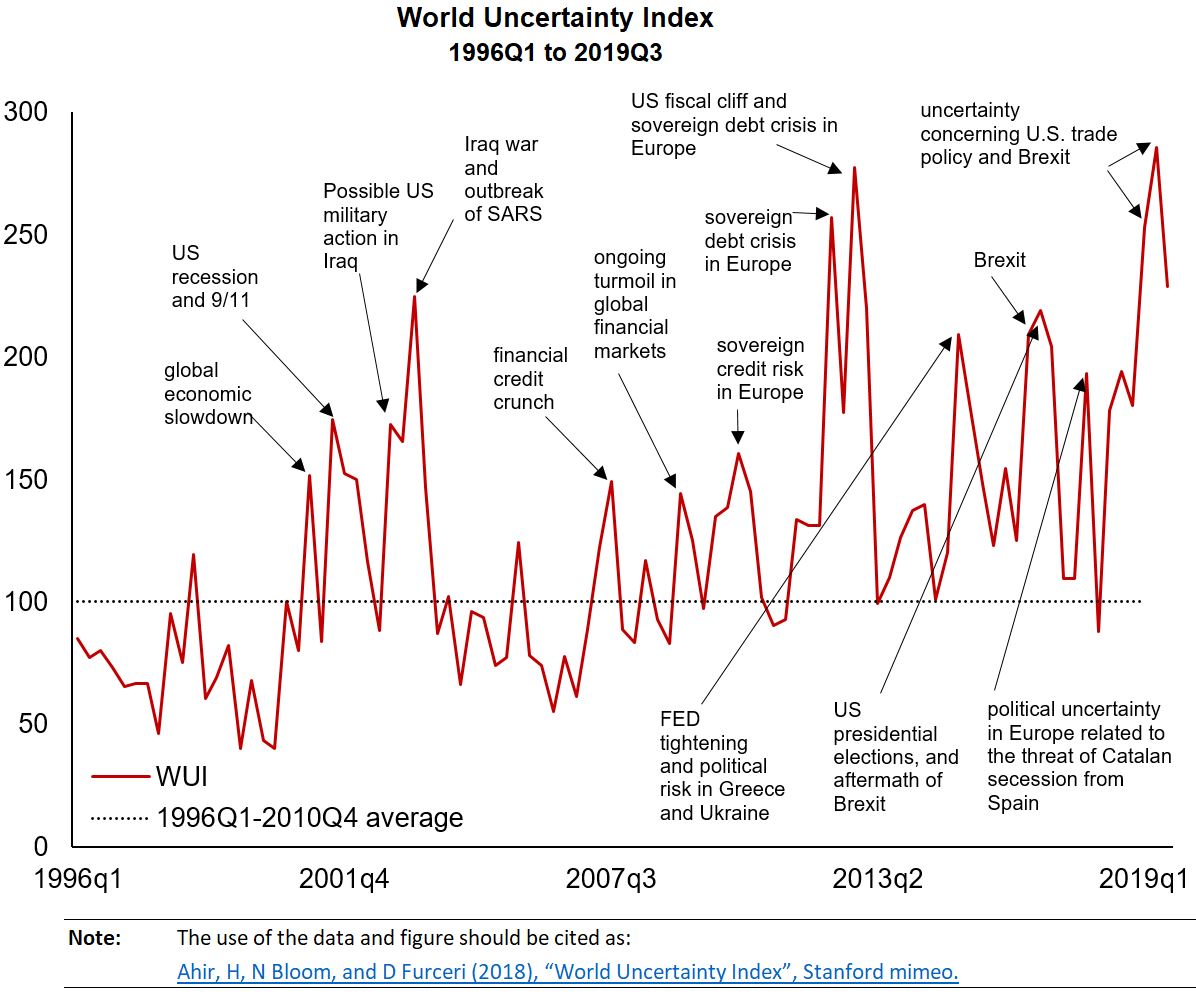
Figure 2.
Below is the latest update of the World Uncertainty Index (figure 1) and World Trade Uncertainty Index (figure 2). These indexes are constructed by Hites Ahir (IMF), Nick Bloom (Stanford University) and Davide Furceri (IMF).
To read how the index is constructed, see the paper here and also see the dataset here. The dataset includes the aggregate index (the index at the global level, by income group, and by region),
Posted by at 5:00 AM
Labels: Uncategorized
Saturday, September 28, 2019
The Phillips Curve: a Relation between Real Exchange Rate Growth and Unemployment
From a working paper by François Geerolf:
“The negative relationship between inflation and unemployment (also known as the Phillips curve) has been repeatedly challenged in the last decades: missing inflation in 2013-2019, missing deflation in 2007-2010, missing inflation in the late 1990s, stagflation in the 1970s, contrasting with always strong regional Phillips curves. Using data from multiple sources, this paper helps to solve many empirical puzzles by distinguishing between fixed and flexible exchange rate regimes: in fixed exchange rate regimes, inflation is negatively correlated with unemployment but this relationship does not hold in flexible regimes. By contrast, there is a negative correlation between real exchange rate appreciation and unemployment, which remains consistent in both fixed and flexible regimes. These crucial observations have important implications for identifying the source of business cycle fluctuations, for normative analysis, and imply a significant departure from rational-expectation-based solutions to Phillips curve puzzles.”
From a working paper by François Geerolf:
“The negative relationship between inflation and unemployment (also known as the Phillips curve) has been repeatedly challenged in the last decades: missing inflation in 2013-2019, missing deflation in 2007-2010, missing inflation in the late 1990s, stagflation in the 1970s, contrasting with always strong regional Phillips curves. Using data from multiple sources, this paper helps to solve many empirical puzzles by distinguishing between fixed and flexible exchange rate regimes: in fixed exchange rate regimes,
Posted by at 1:55 PM
Labels: Macro Demystified
Private Sector Job Creation in MENA: Prioritizing the Reform Agenda
From an IMF working paper by Benedicte Baduel; Carolin Geginat; and Gaëlle Pierre:
“This paper examines the extent to which firms in selected MENA countries reported being constrained by the business environment around the time of the Arab Spring and the extent to which these constraints affected their employment performance. The results suggest that small firms in MENA faced more structural constraints than similar firms in other regions. We also find that MENA firms’ weaker job creation can be explained in great part by the macroeconomic environment and structural constraints. Low GDP growth, falling external competitiveness, corruption, lack of access to finance and poor access to electricity are found to explain a significant part of the lack of employment growth in MENA firms compared to their peers.”
From an IMF working paper by Benedicte Baduel; Carolin Geginat; and Gaëlle Pierre:
“This paper examines the extent to which firms in selected MENA countries reported being constrained by the business environment around the time of the Arab Spring and the extent to which these constraints affected their employment performance. The results suggest that small firms in MENA faced more structural constraints than similar firms in other regions. We also find that MENA firms’ weaker job creation can be explained in great part by the macroeconomic environment and structural constraints.
Posted by at 1:50 PM
Labels: Inclusive Growth
Subscribe to: Posts