



Monday, December 6, 2021
Real-Time Forecasting with a (Standard) Mixed-Frequency VAR During a Pandemic
New Paper by Frank Schorfheide & Dongho Song
“We resuscitated the mixed-frequency vector autoregression (MF-VAR) developed in Schorfheide
and Song (2015, JBES) to generate macroeconomic forecasts for the U.S. during the COVID-19
pandemic in real time. The model combines eleven time series observed at two frequencies:
quarterly and monthly. We deliberately did not modify the model specification in view of the
COVID-19 outbreak, except for the exclusion of crisis observations from the estimation sample.
We compare the MF-VAR forecasts to the median forecast from the Survey of Professional
Forecasters (SPF). While the MF-VAR performed poorly during 2020:Q2, subsequent forecasts
were at par with the SPF forecasts. We show that excluding a few months of extreme
observations is a promising way of handling VAR estimation going forward, as an alternative of a
sophisticated modeling of outliers.”
Read more here.
New Paper by Frank Schorfheide & Dongho Song
“We resuscitated the mixed-frequency vector autoregression (MF-VAR) developed in Schorfheide
and Song (2015, JBES) to generate macroeconomic forecasts for the U.S. during the COVID-19
pandemic in real time. The model combines eleven time series observed at two frequencies:
quarterly and monthly. We deliberately did not modify the model specification in view of the
COVID-19 outbreak, except for the exclusion of crisis observations from the estimation sample.
Posted by at 6:54 PM
Labels: Forecasting Forum
Housing Market in Australia
From the IMF’s latest report on Australia:
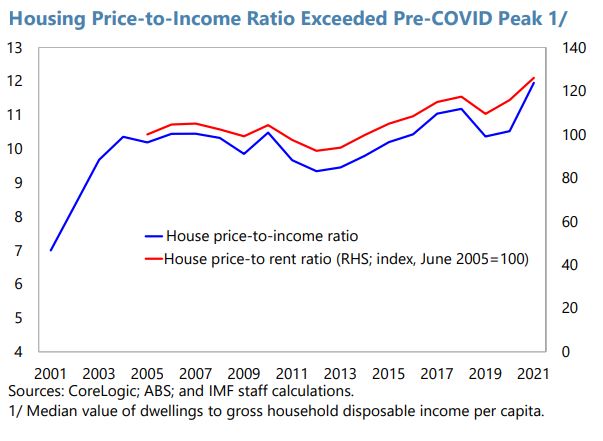
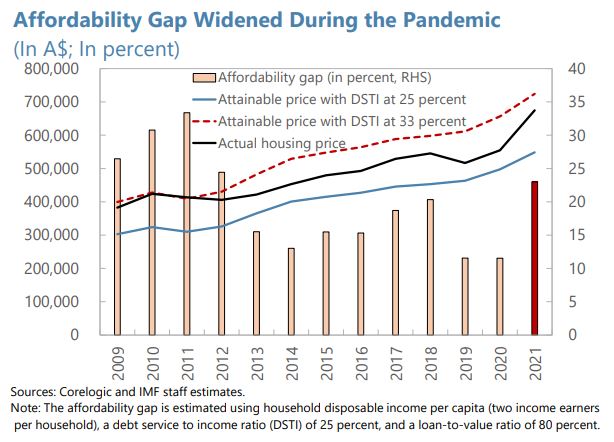
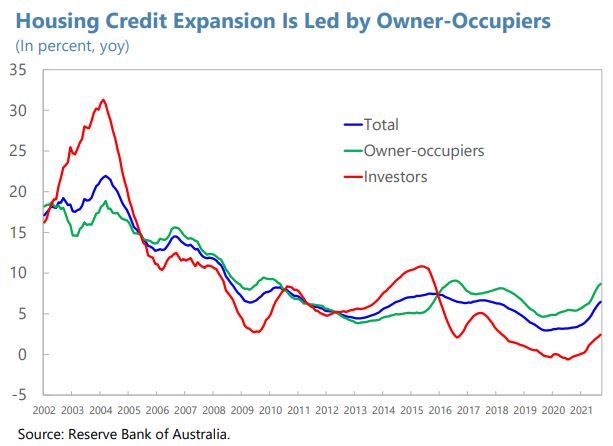
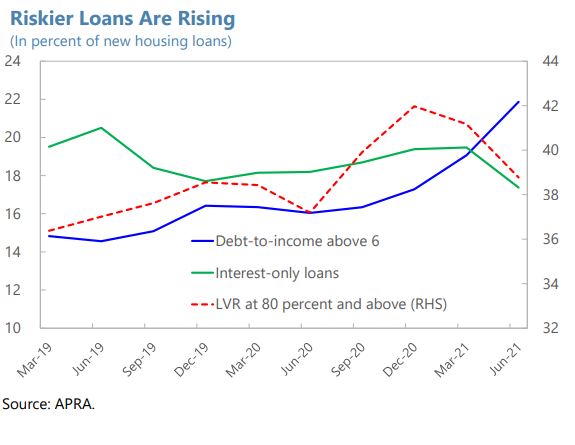
“Housing affordability has deteriorated, and financial risks are building. The housing price-to-income and price-to-rent ratios have risen and exceed pre-COVID peaks. The affordability gap has widened. Housing credit growth is accelerating, reaching 6.5 percent (y/y) in September, driven by owner-occupiers (8.7 percent), with investor loans picking up from a low base (2.4 percent). The risk profile of new loans is deteriorating, as the share of borrowers with high debt-to-income ratios surged from 16 percent pre-COVID to 22 percent.
Macroprudential policy has responded to the changing risk environment. In October 2021, APRA raised the minimum serviceability buffer from 2.5 to 3 percent, requiring lenders to use the higher interest rate spread in assessing borrowers’ ability to service their mortgage loans, thereby strengthening their repayment capacity in case of shocks, such as rising interest rates or income loss.
Staff’s Views
The recent tightening of macroprudential policy is appropriate, and additional measures should be considered if financial-stability risks continue rising. While the surge in house prices has been driven largely by owner-occupiers taking advantage of low mortgage rates and fiscal support programs, high debt-to-income mortgages are on the rise amid elevated household debt, and investor demand has begun to increase from low levels. Lending standards should be monitored closely. With about 70 percent of mortgages at variable rates, borrowers are exposed to rate increases with the expected monetary policy normalization in the medium term. Further macroprudential tightening may be warranted if housing debt continues to outpace income growth and the rise in housing prices leads to increased riskiness of mortgage lending. Options include instituting portfolio restrictions on debt-to-income (DTI) and loan-to-value ratios (LVR), with DTI restrictions likely more effective in curbing investor demand, while LVR restrictions would affect more liquidity-constrained owner-occupiers, in particular first home buyers.
Housing structural reforms are critical for supporting affordability. Supply-side reforms, including more efficient planning, zoning, and better infrastructure, could improve housing supply. Commonwealth and state/territory governments should consider providing more financial incentives for local governments to streamline zoning regulations and improve infrastructure. Promoting flexible work arrangements could allow workers to move away from capital cities, improving affordability. In addition, governments should focus on providing targeted fiscal support for low-income households and expand social housing. This could be complemented by tax reforms to discourage leveraged housing investment.
Authorities’ Views
The authorities stressed that rising risks in home lending motivated the recent macroprudential tightening. They noted that, while lending standards have generally remained prudent, rapid credit growth that outpaces household income growth could build financial vulnerabilities, while the strength of the house price cycle could give rise to more risk-taking and potential erosion of lending standards. They underscored that they would continue to closely monitor trends in residential mortgage lending and were prepared to take further measures if needed. They confirmed that other policy instruments, including DTI and LVR restrictions, could be deployed if necessary. The authorities thought that tax policy was not the right tool to address potential speculative behavior in housing markets, as negative gearing and the capital gains tax discount apply across investments and investments in residential housing are relatively highly taxed, and that macroprudential policy should instead be employed as needed to address financial stability risks.
The authorities agreed that housing supply reform would be important to improve affordability. They highlighted that the Commonwealth has provided funds to support state and local governments in infrastructure provision and concurred that more could be done to promote zoning and planning reforms to boost housing supply. Additional targeted support could also be provided to low-income households to address affordability issues, and the authorities concurred that adequate provision of social housing remained important.”
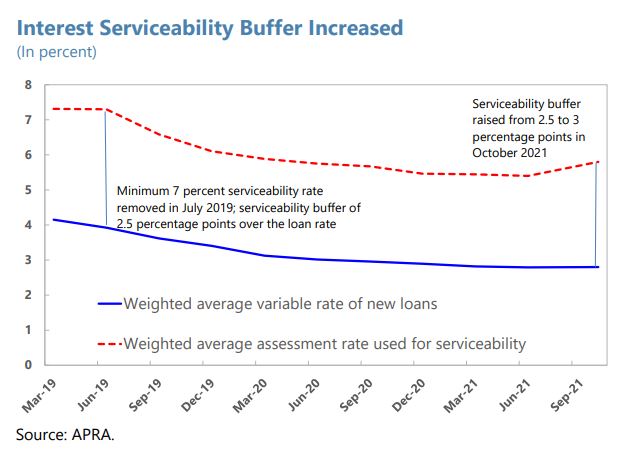
From the IMF’s latest report on Australia:
“Housing affordability has deteriorated, and financial risks are building. The housing price-to-income and price-to-rent ratios have risen and exceed pre-COVID peaks. The affordability gap has widened. Housing credit growth is accelerating, reaching 6.5 percent (y/y) in September, driven by owner-occupiers (8.7 percent), with investor loans picking up from a low base (2.4 percent). The risk profile of new loans is deteriorating, as the share of borrowers with high debt-to-income ratios surged from 16 percent pre-COVID to 22 percent.
Posted by at 6:03 PM
Labels: Global Housing Watch
Are Your Greenhouse Gas Emissions All About Location, Location, Location?
From the Energy Institute at Haas:
“New research examines the role of individuals versus places in determining household carbon emissions.
The average household in San Francisco emits 36 percent less CO2 from residential and transportation energy use than the average household in Houston. Within the San Francisco Bay Area, the top 10 Census tracts with the highest household carbon emissions emit, on average, 5.6 times more per capita than the 10 lowest emissions Census tracts. Researchers and policy makers have recently highlighted the tremendous spatial variation in household carbon emissions, both within and across cities. See e.g. here and here.
Some of these differences can be explained by household characteristics, such as household size and income; some can be explained by gas versus electric heating or type of automobile. The remaining variation has historically been attributed to characteristics of the places themselves and how various amenities (e.g., climate, density, public transit, walkability) correlate with average carbon footprints.
This spatial variability could present an opportunity – perhaps we can learn from these places with low carbon footprints to better design and implement similar policies and practices nationwide in a quest to decarbonize the US economy.
A new paper by the Energy Institute’s own Eva Lyubich, available here as a new Energy Institute working paper, explores these issues in detail. The starting point of her paper is to recognize that people make choices about where they live, so different types of people live in different types of cities. Some people want to live in cities where they can drive to work, others prefer to commute via public transit or bike or walking. Some people want to live in a 3-bedroom house with a yard and others prefer an apartment building near lots of other people and restaurants. Through this lens, one quickly starts to realize that a lot of the differences we see in household carbon emissions across the US come from a mix of the characteristics of a particular place and the characteristics and preferences of people who choose to live there.”
Continue reading here.
From the Energy Institute at Haas:
“New research examines the role of individuals versus places in determining household carbon emissions.
The average household in San Francisco emits 36 percent less CO2 from residential and transportation energy use than the average household in Houston. Within the San Francisco Bay Area, the top 10 Census tracts with the highest household carbon emissions emit, on average, 5.6 times more per capita than the 10 lowest emissions Census tracts.
Posted by at 12:04 PM
Labels: Global Housing Watch
Productivity and Pay in the US and Canada
Excerpts from the National Bureau of Economic Research’s (NBER) recent working paper (2021) by authors Jacob Greenspon and Lawrence H. Summers of the Harvard Kennedy School of Government and Anna M. Stansbury of MIT Sloan School of Management:
“We study the productivity-pay relationship in the United States and Canada along two dimensions. The first is divergence: the degree to which the levels of productivity and pay have diverged. The second is delinkage: the degree to which incremental increases in the rate of productivity growth translate into incremental increases in the rate of growth of pay, holding all else equal. We show that in both countries the pay of typical workers has diverged substantially from average labor productivity over recent decades, driven by both rising labor income inequality and a declining labor share of income. Even as the levels of productivity and pay have grown further apart, we find evidence for some linkage between productivity and pay in both countries: a one percentage point increase in the rate of productivity growth is associated with a positive increase in the rate of pay growth, holding all else equal. This linkage appears stronger in the US than in Canada. Overall, our findings lead us to tentatively conclude that policies or trends which lead to incremental increases in productivity growth, particularly in large relatively closed economies like the USA, will tend to raise middle-class incomes. At the same time, other factors orthogonal to productivity growth have been driving productivity and typical pay further apart, emphasizing that much of the evolution in middle-class living standards will depend on measures bearing on relative incomes.”
Click here to read the full paper.
Excerpts from the National Bureau of Economic Research’s (NBER) recent working paper (2021) by authors Jacob Greenspon and Lawrence H. Summers of the Harvard Kennedy School of Government and Anna M. Stansbury of MIT Sloan School of Management:
“We study the productivity-pay relationship in the United States and Canada along two dimensions. The first is divergence: the degree to which the levels of productivity and pay have diverged. The second is delinkage: the degree to which incremental increases in the rate of productivity growth translate into incremental increases in the rate of growth of pay,
Posted by at 9:18 AM
Labels: Inclusive Growth
Sunday, December 5, 2021
2022 AEA’s papers on housing
*Note that this post will be updated as links to papers and presentations become available. Last updated: January 9, 2022.
On Covid-19 and health
- Can Stay-at-Home Orders Create a Pandemic Housing Boom? – Paper and Presentation
- How Resilient is Mortgage Credit Supply? Evidence from the COVID-19 Pandemic – Paper and Presentation
- COVID-19, Housing Prices and Macroprudential Policies – Paper and Presentation
- Flattening the Curve: Pandemic-Induced Revaluation of Urban Real Estate – Paper and Presentation
- The Impact of the Coronavirus Pandemic on New York City Real Estate: First Evidence – Paper and Presentation
- Living On My Own: The Impact of an Epidemic on Housing Preferences – Paper and Presentation
- Cleanliness is Next to Income: The Impact of COVID-19 on Short-Term Rentals – Paper and Presentation
- The Impact of Medicaid Expansion on Those Lacking Housing Basics, 2010-19 – Paper and Presentation
- Marital Transitions, Housing, and Long-Term Care in Old Age – Paper and Presentation
- Stuck at Home: Housing Demand During the COVID-19 Pandemic – Paper and Presentation
- Housing as a Human Right: Alternative Institutional Structures and Covid-19 – Paper and Presentation
- Racial Heterogeneity in Mortgage Outcomes During the COVID-19 Pandemic – Paper and Presentation
- COVID-19 Rental Eviction Moratoria and Household Well-Being – Paper and Presentation
- Impact of COVID-19 on Residential Real Estate – Paper and Presentation
- The Effects of Free Housing on Children’s Health and Healthcare Use – Paper and Presentation
- Health Implications of Housing Programs: Evidence from a Population-Wide Weatherization Program – Paper and Presentation
- The Health Consequence of Rising Housing Prices in China – Paper and Presentation
On house prices
- Internal Migration and House Prices in Australia – Paper and Presentation
- Old Age Savings and House Price Shocks – Paper and Presentation
- The Economic Burden of Pension Shortfalls: Evidence from House Prices – Paper and Presentation
- The Effect of School Redistricting on Housing Markets – Paper and Presentation
- Match Quality and House Price Dispersion: Evidence from Norwegian Housing Auctions – Paper and Presentation
- The Effect of School Redistricting on Neighborhood Sorting and House Prices – Paper and Presentation
- House Prices, Investors, and Credit in the Great Housing Bust – Paper and Presentation
- House Price Contagion and United States City Migration Networks – Paper and Presentation
- Housing Market Segmentation – Paper and Presentation
- House Prices, Home Equity, and Entrepreneurship: Evidence from U.S. Census Micro Data – Paper and Presentation
- What Do Hedonic House Price Estimates Tell Us When CAP Rates Vary? – Paper and Presentation
On mortgage market
- Reinforcement Learning for Household Finance: Designing Optimal Policy for Mortgage Market – Paper and Presentation
- Reluctant Savers and Mortgage Subsidies – Paper and Presentation
- The Consumption Response to Borrowing Constraints in the Mortgage Market – Paper and Presentation
- The Industry Expertise Channel of Mortgage Lending – Paper and Presentation
- Can Time‐Varying Risk Premia and Household Heterogeneity Explain Credit Cycles? – Paper and Presentation
- Mortgage Pricing and Monetary Policy – Paper and Presentation
- Appraisal Inflation and Private Mortgage Securitization – Paper and Presentation
- Opioid Epidemic and Mortgage Default – Paper and Presentation
- The Impact of Interest Rate Declines on Distressed Borrowers: Evidence from the 2000s Housing Bust – Paper and Presentation
- The Mortgage Piggy Bank: Building Wealth through Amortization – Paper and Presentation
- Mortgage Delinquency and Default: A Tale of Two Options – Paper and Presentation
- Is There Crowd-Out in Mortgage Refinance? – Paper and Presentation
- Do Mortgage Lenders Compete Locally? Implications for Credit Access – Paper and Presentation
- How Costly is Noise? Data and Disparities in the United States Mortgage Market – Paper and Presentation
On rental market
- Are Housing Rental Markets that Competitive? A Dynamic Monopoly Approach – Paper and Presentation
- Objectified Housing Sales and Rent Prices in Representative Household Surveys: the Impact on Macroeconomic Statistics – Paper and Presentation
- Eviction Risk of Rental Housing: Does It Matter How Your Landlord Finances the Property? – Paper and Presentation
- Macroeconomic Statistics based on Surveys: Circumventing Subjectivity in Housing Sales and Rent Data – Paper and Presentation
- Late Payment Fees and Nonpayment in Rental Markets, and Implications for Inflation Measurement: Theoretical Considerations and Evidence – Paper and Presentation
On inequality
- Land Prices and the Persistent Effects of Wealth Inequality – Paper and Presentation
- Racial Disparities in Housing Returns – Paper and Presentation
- Housing Market Channels of Segregation – Paper and Presentation
- Using High Frequency Evaluations to Estimate Discrimination: Evidence from Mortgage Loan Officers – Paper and Presentation
- Boomtowns: Local Shocks and Inequality in 1920s California – Paper and Presentation
- Do Credit Policies Affect Racial Groups Differently? Evidence from the Mortgage Market – Paper and Presentation
- The Impact of Federal Housing Policies on Racial Inequality – Paper and Presentation
- A Field Experiment on Racial Discrimination in the Rental Housing Market of Hawaii – Paper and Presentation
- The Intergenerational Transmission of Housing Wealth – Paper and Presentation
- The Impact of Federal Housing Policies on Racial Inequality – Paper and Presentation
On climate change and natural disasters
- Tsunami Risk and Information Shocks: Evidence from the Oregon Housing Market – Paper and Presentation
- Mortgage Markets with Climate-Change Risk: Evidence from Wildfires in California – Paper and Presentation
- Who Benefits from Water Quality Control? The Unequal Impacts of Environmental Regulation on Housing Wealth and Consumption – Paper and Presentation
- Peer Effects in Residential Green Infrastructure Adoption – Paper and Presentation
On housing supply and affordability
- Why Are More Young Adults Living With Their Parents? A role for housing affordability – Paper and Presentation
- How to Reduce Housing Costs? Understanding Local Deterrents to Building Multi-Family Housing – Paper and Presentation
- How to Build Affordable Housing? The Role of Local Barriers to Building Multi-Unit Housing – Paper and Presentation
- Reclaiming Local Control: School Finance Reforms and Housing Supply Restrictions – Paper and Presentation
- Sorting into Neighborhoods: The Role of Minimum Lot Sizes – Paper and Presentation
- Student Housing, Gentrification and Affordability: The US context – Paper and Presentation
On other papers
- The Long-Run Effects of Low-Income Housing on Neighborhood Composition – Paper and Presentation
- The Housing Phillips Curve – Paper and Presentation
- Who’s Right, Weber or Glaeser? – Paper and Presentation
- Estimating Housing Rent Depreciation for Inflation Adjustments – Paper and Presentation
- Housing Exclusion in Westchester County, NY – Paper and Presentation
- Who Gains from Housing Market Stimulus? Evidence from Housing Assistance Grants with Threshold Prices – Paper and Presentation
- Overconfidence and Personal Bankruptcy: Evidence from Mispricing in Singapore’s Private Housing Markets – Paper and Presentation
- Heirs’ Property in an Urban Context – Paper and Presentation
- Price Diffusion across International Private Commercial Real Estate Markets – Paper and Presentation
- Corporate Real Estate Holdings, Firm Value, and Returns: Evidence from a Dynamic Partial Adjustment Model – Paper and Presentation
- Retirement, Housing Mobility, Downsizing and Neighbourhood Quality-A Causal Investigation – Paper and Presentation
- The Value of School Social Climate Information: Evidence from Chicago Housing Transactions – Paper and Presentation
- The Impact of Public Housing on Student Academic Outcomes – Paper and Presentation
- Does Airbnb Reduce Matching Frictions in the Housing Market? – Paper and Presentation
- The Nexus between Fuel, Income, and Housing Poverty: Evidence from Egypt – Paper and Presentation
- What Determines the Success of Housing Mobility Programs? – Paper and Presentation
- Mandatory Pension Saving and Homeownership – Paper and Presentation
- Dynastic Home Equity – Paper and Presentation
- The Amenity Effects of Low-Income Housing Development – Paper and Presentation
- Decoupling Homes and Schools: Assessing the Impact of Forced School Choice on Residential Change – Paper and Presentation
- Does Financial Distress Affect Workers’ Productivity? Evidence from Real Estate Agents – Paper and Presentation
- Impact of Institutional Investors on Real Estate Risk – Paper and Presentation
- Tax Subsidies and the Cost of Homeownership: Evidence from the Tax Cuts and Jobs Act – Paper and Presentation
- New Listing Alert: Alternative Theory of Housing Search – Paper and Presentation
- Zero Price Effect and Consumer Welfare: Evidence from Online Classified Home Service – Paper and Presentation
- Breaking the Commitment Device: The Effect of Home Equity Withdrawal on Consumption, Saving, and Welfare – Paper and Presentation
*Note that this post will be updated as links to papers and presentations become available. Last updated: January 9, 2022.
On Covid-19 and health
- Can Stay-at-Home Orders Create a Pandemic Housing Boom? – Paper and Presentation
- How Resilient is Mortgage Credit Supply? Evidence from the COVID-19 Pandemic – Paper and Presentation
- COVID-19, Housing Prices and Macroprudential Policies – Paper and Presentation
- Flattening the Curve: Pandemic-Induced Revaluation of Urban Real Estate – Paper and Presentation
- The Impact of the Coronavirus Pandemic on New York City Real Estate: First Evidence – Paper and Presentation
- Living On My Own: The Impact of an Epidemic on Housing Preferences – Paper and Presentation
- Cleanliness is Next to Income: The Impact of COVID-19 on Short-Term Rentals – Paper and Presentation
- The Impact of Medicaid Expansion on Those Lacking Housing Basics,
Posted by at 2:01 PM
Labels: Global Housing Watch
Subscribe to: Posts