



Tuesday, August 23, 2022
Housing Market in Latvia
From the IMF’s latest report on Latvia:
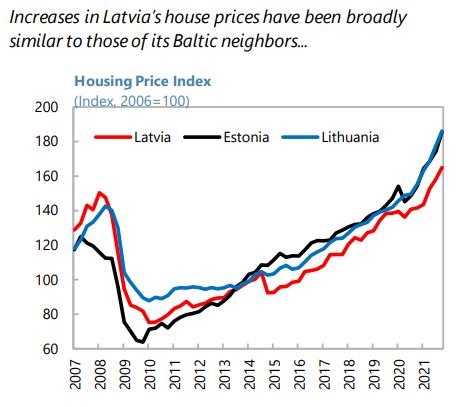
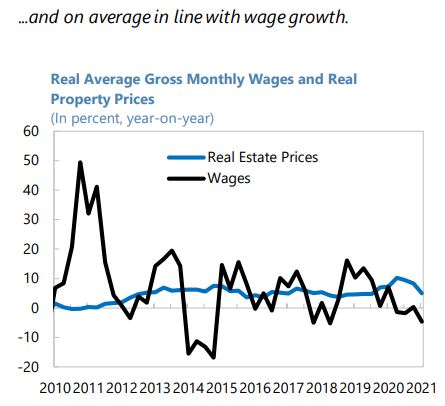
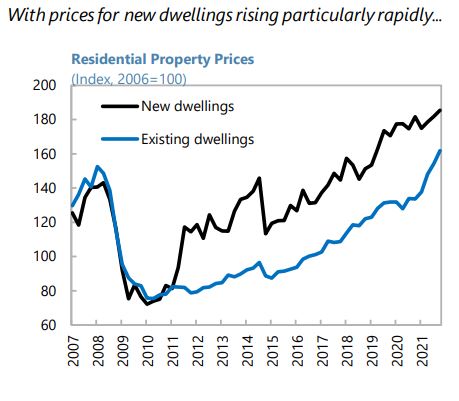
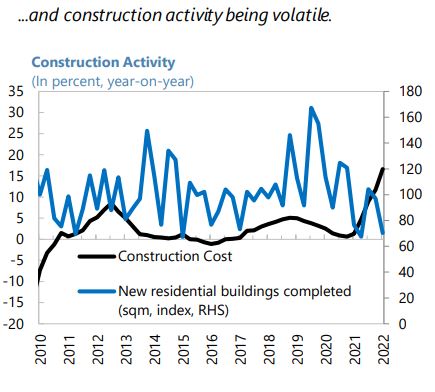
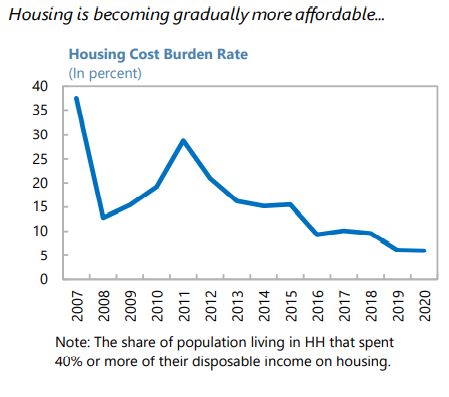
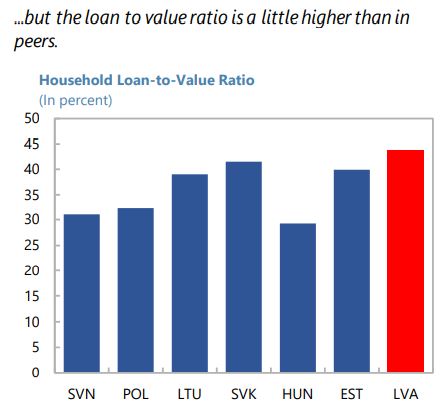
“Macroprudential policy should remain flexible considering high uncertainty. After augmenting their macro-prudential toolkit in mid-2020 with several borrower-based measures, the authorities broadened the scope of these tools to cover credit institutions of other EU countries operating in Latvia with or without local branches. Although real estate prices increased, they appeared to be in line with wage growth and remained less buoyant than in the other Baltic countries. However, housing prices could surge, if the already-low supply of housing is further constrained by the rising costs of capital, labor and materials, and delays in the construction sector due the spillovers of the war. A close monitoring of these developments is warranted, so that macroprudential policy can be re-calibrated accordingly in a timely manner. Credit risks could emerge due to the elevated share of high variable-interest loans to both households and non-financial corporations (87 and 94 percent of outstanding loans respectively).
(…)
Macroprudential policy should stand ready to respond to changing housing market conditions. Given the new risks caused by the war, the frequent reviews of macroprudential measures should continue to ensure the right balance between financial stability and the need for credit in the economy.”
From the IMF’s latest report on Latvia:
“Macroprudential policy should remain flexible considering high uncertainty. After augmenting their macro-prudential toolkit in mid-2020 with several borrower-based measures, the authorities broadened the scope of these tools to cover credit institutions of other EU countries operating in Latvia with or without local branches. Although real estate prices increased, they appeared to be in line with wage growth and remained less buoyant than in the other Baltic countries.
Posted by at 5:57 PM
Labels: Global Housing Watch
Monday, August 22, 2022
Four reasons why GDP is a useful number
From Noah Smith:
“A lot of people like to criticize GDP as a measure of living standards. Among many intellectuals, particularly in the UK and some parts of North Europe, talking about the limitations of GDP and trying to think of better measures is something of a cottage industry:
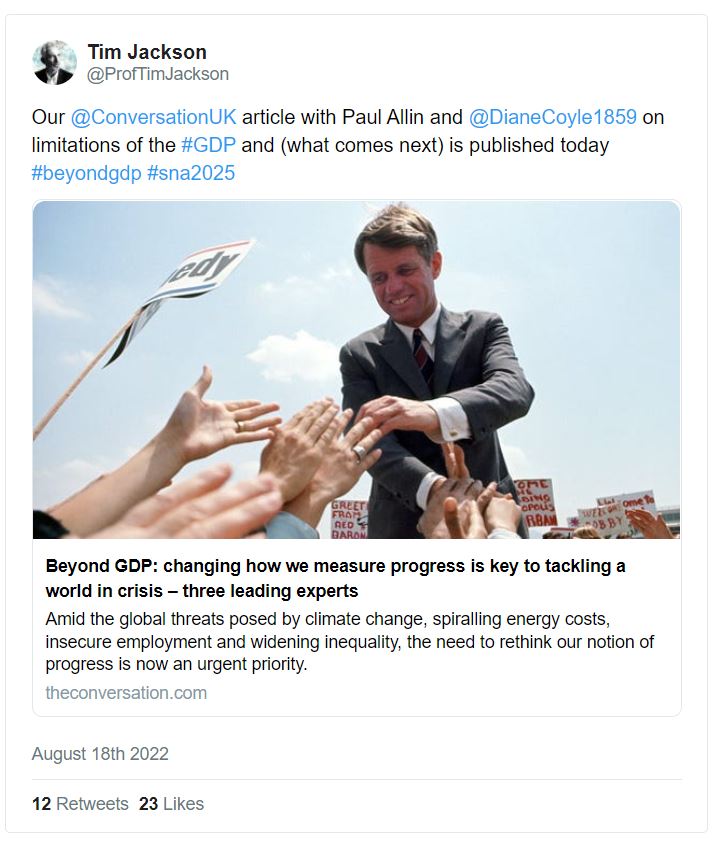
Now, there are important senses in which these critics are right. GDP leaves out some things that are very important to human well-being — for example, leisure time, baseline health, inequality, natural habitats, and the value of unpaid housework and child care. And there are things it includes that some people might not want to include — the amount that government spends on tanks and bombs, for instance, or the fees people pay to lose their money in DeFi scams. There are even a few economists who say we shouldn’t even pay attention to GDP and that we should only care about consumption.
For this reason and others, it’s important not to get too obsessed with one single measure of the economy — GDP or anything else. You have to look at a bunch of measures to get a clear picture of what’s happening (in a 2018 Bloomberg post, I suggested also looking at real median personal income, prime-age employment rate, median real weekly earnings, and the Supplemental Poverty Measure). And in fact, I think policymakers and media figures all over the world already look at lots of different numbers.
But today I just want to focus on GDP, because the critics have sorely overstated their case. In fact, GDP is an incredibly useful and important number, for a variety of reasons.
GDP is actually just a measure of income
First, I think that understanding what GDP actually is helps us understand why it’s important. Critics of the concept sometimes seem to lack a basic understanding of what the number even means.
GDP is a measure of the total amount of economic value produced in a country. We measure economic value by how much people pay for stuff. If you pay $100 for a new toaster, GDP goes up by $100. If the government pays $1M for a tank, GDP goes up by $1M.
Now, it can be hard to understand why we’d care about measuring things this way. Just because people pay $100 for something, does that mean it was really worth $100? And on top of that, it can get a little complicated, because there are some things we buy that aren’t included in GDP — intermediate goods (like parts to make a car), used goods, financial assets like stocks and bonds, etc. Explaining these things would take a whole economics lesson.
But instead, there’s an easier way to think about GDP and what it means. Really, it’s just a measure of people’s incomes.”
Continue reading here.
From Noah Smith:
“A lot of people like to criticize GDP as a measure of living standards. Among many intellectuals, particularly in the UK and some parts of North Europe, talking about the limitations of GDP and trying to think of better measures is something of a cottage industry:
Now, there are important senses in which these critics are right. GDP leaves out some things that are very important to human well-being — for example,
Posted by at 8:15 AM
Labels: Macro Demystified
Friday, August 19, 2022
Housing View – August 19, 2022
On cross-country:
- Reflections on the Evolution of the Housing Market in Latin America: Realities and Dreams – MIT
On the US:
- House Price Responses to Monetary Policy Surprises: Evidence from the U.S. Listings Data – Institute of Labor Economics
- Decline in Single-Family Permits in June 2022 – NAHB
- Why rent is damn high? – The Atlantic
- Renters Can’t Celebrate Softer Inflation Readings – Bloomberg
- New York City Rents Hit Record Highs Amid Nationwide Housing-Price Increases. Where would you pay over $4,000 a month for a one-bedroom? In 20 of New York City’s neighborhoods. – Wall Street Journal
- The Fed’s Damage to the Housing Market May Last Years. The central bank created major distortions in a market where many Americans have most of their wealth. Why? – Bloomberg
- U.S. Housing Affordability in June Was the Worst Since 1989. Record-high home prices combined with rising mortgage rates to push more buyers out of the market – Wall Street Journal
- Housing Slowdown Chills Investors Who Supercharged US Market. Institutional landlords and small flippers are starting to scale back as higher borrowing costs and slowing sales complicate their strategies. – Bloomberg
- 2 Reasons House Prices Will Start Falling Sooner Than Expected. Why house prices will be less “sticky” this time. – Real Estate Decoded
- Will Housing Prices Flatten — or Collapse? Home values are fast approaching the pace of gains that would be consistent with low inflation. But there’s a high risk of an overshoot. – Bloomberg
- Has COVID Reversed Gentrification in Major U.S. Cities? An Empirical Examination of Residential Mobility in Gentrifying Neighborhoods During the COVID-19 Crisis – Philadelphia Fed
- Rent Inflation Expected to Accelerate Then Moderate in Mid-2023 – Dallas Fed
- The Housing Market Is Bad but Not That Bad – New York Times
- Existing Home Sales Fall to Two-Year Low – NAHB
On China:
- The Bursting Chinese Housing Bubble Compounds Beijing’s Economic Woes. Home sales and prices are dropping in many cities across the country after rising for years, and the damage is spreading – Wall Street Journal
- What’s in Store for China’s Mortgage Market? – Carnegie Endowment for International Peace
- China Growth Slows Across All Fronts in July, Prompting Unexpected Rate Cut. Move comes after a month in which retail sales, property prices and youth unemployment worsened – Wall Street Journal
- China Home Prices Fall for 11th Month as Mortgage Crisis Deepens. Pace of decline widened to 0.11% after mortgage boycotts. Pressure on developers likely to remain due to covid lockdowns – Bloomberg
- China’s Housing Crisis Keeps Brewing in Beijing’s Weak Tea. There are reports of possible bond guarantees but no clear signs of any government action bold enough to revive the property market – Wall Street Journal
- As China’s Economy Stumbles, Homeowners Boycott Mortgage Payments. In a rare act of defiance, people across the country who bought property from indebted developers are refusing to repay loans on their unfinished apartments. – New York Times
On other countries:
- [Canada] Canadian Housing Correction Accelerates, Prices Seen Falling 25%. Desjardins updates forecasts after RBC warns of historic drop. Rate hikes drive rapid reversal of pandemic real-estate frenzy – Bloomberg
- [Denmark] Denmark’s Mortgage Market Is Luring Global Investors. Here’s Why – Bloomberg
- [Ireland] Irish house prices return to 2007 peak for first time – Reuters
- [New Zealand] RBNZ Chief Warns New Zealand Home Prices Will Keep Falling – Bloomberg
- [United Kingdom] Britain’s housing crisis — no longer a nation of homeowners? Four books look beyond the clichés of the property boom to examine the precarious reality of those forced to rely on an overgrown private rental market – FT
- [United Kingdom] Is the UK housing market at a turning point? Interest rates are rising to stem inflation and borrowing costs are increasing fast. Could this signal the end of spiralling house prices? – FT
- [United Kingdom] New UK lender plans 50-year fixed rate mortgages. Perenna secures licence from regulators to issue long-term home loans as inflation soars – FT
- [United Kingdom] UK house price growth slows sharply to 7.8% in June – ONS – Reuters
- [United Kingdom] UK house price growth slows to 7.8% in June, says ONS. Slower rate of increase skewed by tax break changes last year as housebuilder Persimmon warns of economic pressures on sector – FT
On cross-country:
- Reflections on the Evolution of the Housing Market in Latin America: Realities and Dreams – MIT
On the US:
- House Price Responses to Monetary Policy Surprises: Evidence from the U.S. Listings Data – Institute of Labor Economics
- Decline in Single-Family Permits in June 2022 – NAHB
- Why rent is damn high? – The Atlantic
- Renters Can’t Celebrate Softer Inflation Readings – Bloomberg
- New York City Rents Hit Record Highs Amid Nationwide Housing-Price Increases.
Posted by at 7:36 AM
Labels: Global Housing Watch
Wednesday, August 17, 2022
Housing Market in Saudi Arabia
Posted by at 8:41 AM
Labels: Global Housing Watch
Monday, August 15, 2022
A Fertility Patterns Flip-flop
From Conversable Economist:
“For some decades now, the world has been following the patterns of a demographic transition with life expectancies rising and birth rates falling, as we head for a world where the elderly are a much larger share of the global population. However, Matthias Doepke, Anne Hannusch, Fabian Kindermann, and Michèle Tertilt argue that it’s time for “The New Economics of Fertility” (IZA Discussion Paper #15224, April 2022). For a short readable overview of the main themes, you can check their shorter discussion at the VoxEU website (June 11, 2022).
From the abstract of the academic paper, the authors write:
In this survey, we argue that the economic analysis of fertility has entered a new era. First-generation models of fertility choice were designed to account for two empirical regularities that, in the past, held both across countries and across families in a given country: a negative relationship between income and fertility, and another negative relationship between women’s labor force participation and fertility. The economics of fertility has entered a new era because these stylized facts no longer universally hold. In high-income countries, the income-fertility relationship has flattened and in some cases reversed, and the cross-country relationship between women’s labor force participation and fertility is now positive.
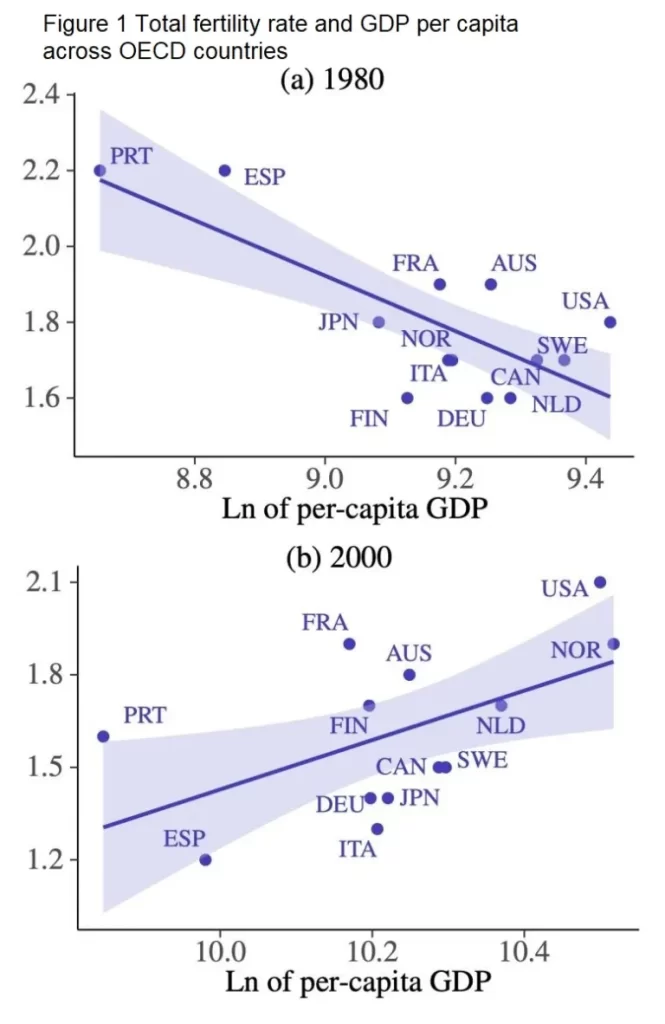
A couple of pictures may help, here. It used to be that countries with higher incomes had lower fertility rates, but among high-income countries, this pattern no longer holds. Here’s a figure taken from the VoxEU overview. The top panel shows that within the group of high-income countries in 1980, countries with higher per capita GDP had lower fertility, but by 2000, countries in this group with higher per capita income had higher fertility.”
Continue reading here.
From Conversable Economist:
“For some decades now, the world has been following the patterns of a demographic transition with life expectancies rising and birth rates falling, as we head for a world where the elderly are a much larger share of the global population. However, Matthias Doepke, Anne Hannusch, Fabian Kindermann, and Michèle Tertilt argue that it’s time for “The New Economics of Fertility” (IZA Discussion Paper #15224,
Posted by at 6:09 AM
Labels: Macro Demystified
Subscribe to: Posts