



Monday, September 5, 2011
Roubini ups his recession probability from 40% to 60%
The 40% prediction was made in a talk at the IMF in September 2010. Below is what he said a few days ago for the current scenario and few years back:
September 2006 (IMF)
“my view is that the risk of a hard landing is very high for the U.S. economy. I see essentially a recession coming by next year. I give it a very high likelihood. I argue that housing today, like the tech bust in 2000-2001 will have a macro effect; it is not going to be just a sectoral effect. I argue that U.S. consumers are now close to a ‘tipping over’ point given all the vulnerabilities I have discussed. I argue that the Fed easing will occur, so the next move is going to be a cut, but it is not going to prevent a recession. And, finally, I argue that the rest of the world is not going to be able to decouple from the U.S. even if it is not going to experience an outright recession like the United States. So on that cheerful note, I will stop.”
The 40% prediction was made in a talk at the IMF in September 2010. Below is what he said a few days ago for the current scenario and few years back:
August 2011 (Portfolio.com)
“We’ve reached a stall speed in the economy, not just in the U.S., but in the euro zone and the UK. We see probably a 60 percent probability of recession next year, Read the full article…
Posted by at 1:48 AM
Labels: Profiles of Economists
Tuesday, August 2, 2011
Presentation video on “Long-Term Unemployment- Causes, Costs, Cures”
See my presentation video on where do the industrialized nations stand in regard to the effect of long-term unemployment after the Great Recession of 2009-2011? And trends related to the effects of long-term unemployment on western industrialized nations.
See my presentation video on where do the industrialized nations stand in regard to the effect of long-term unemployment after the Great Recession of 2009-2011? And trends related to the effects of long-term unemployment on western industrialized nations.
Posted by at 4:03 PM
Labels: Inclusive Growth
Friday, July 15, 2011
How do Countries Rank in Energy Security?
My presentation at EMEE ranked countries’ energy security based on how diversified they were in the sources of their energy supplies.


My presentation at EMEE ranked countries’ energy security based on how diversified they were in the sources of their energy supplies.
Posted by at 6:17 PM
Labels: Energy & Climate Change
Tuesday, July 12, 2011
More on Structural Unemployment: Manufacturers Struggling to Find Skilled Workers
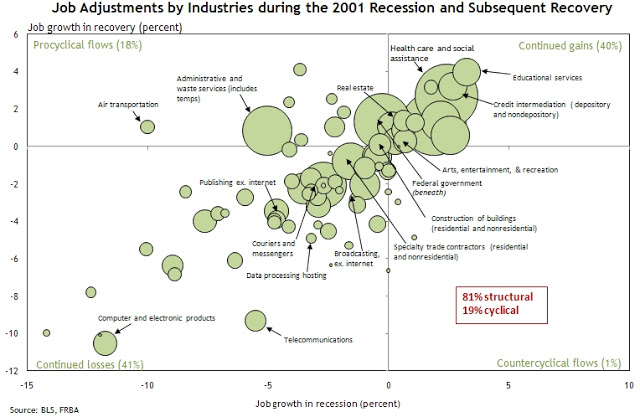
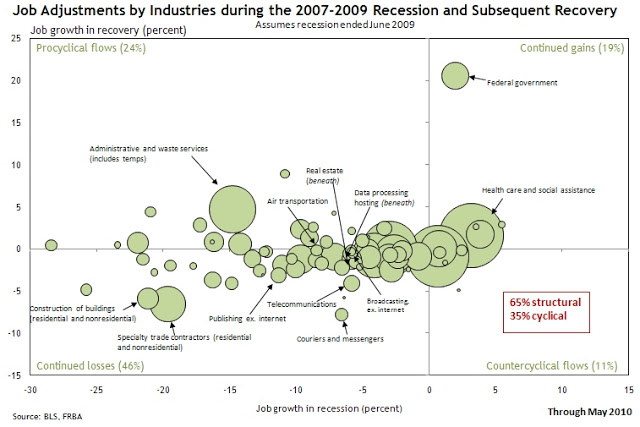
At the Joint Economic Committee (JEC) hearing, Georgetown University public policy professor Harry Holzer said that “the ratio of job vacancies to new hires in manufacturing is higher than we find in any other major industry group, suggesting that employers are having some difficulty filling their newly created jobs (…) On its own, our system of higher education will not produce enough skills needed by American workers to prosper. Our education and work force systems largely operate in isolation from one another.” Indeed, BTE Technologies President Chuck Wetherington concurred with Holzer who said that “my job is getting a bit more technical. There are some micro and macroeconomic issues. Occasionally we have to recruit from abroad. There is a mismatch between skills and workers.” See the full article on the New York Times website. Also, a webcast of the hearing is available at the Joint Economic Committee site.
At the Joint Economic Committee (JEC) hearing, Georgetown University public policy professor Harry Holzer said that “the ratio of job vacancies to new hires in manufacturing is higher than we find in any other major industry group, suggesting that employers are having some difficulty filling their newly created jobs (…) On its own, our system of higher education will not produce enough skills needed by American workers to prosper. Our education and work force systems largely operate in isolation from one another.” Indeed,
Posted by at 11:22 PM
Labels: Inclusive Growth
Overhaul Career and Technical Education
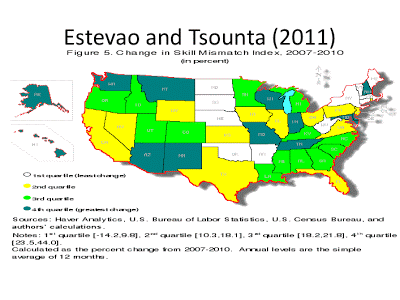
In an article for the Atlantic, Frederick Hess of the American Enterprise Institute links the problem of structural unemployment with the lack of quality job training/workforce development. He writes “economist Prakash Loungani of the International Monetary Fund has estimated that 25 percent of the unemployed are out of work today due to skill-job mismatches. Georgetown’s Harry Holzer has calculated that today’s unemployment rate of 9.1 percent would be nearer to 8 percent if a majority of these jobs were filled (…) Fact is, America’s community colleges, job training, and workforce development are a mess. Community colleges suck up nearly $36 billion in taxpayer subsidies to provide training of uncertain quality, retain a balky and inconvenient academic calendar, and frequently do a lousy job of linking their instruction to local workforce needs (…) it can be hard for workers seeking retraining to find convenient, cost-effective, high-quality options (..) Absent high-quality retraining, it’s easy for workers in dying industries to get stuck, for their skills to atrophy, and for their networks and work habits to erode.”
In an article for the Atlantic, Frederick Hess of the American Enterprise Institute links the problem of structural unemployment with the lack of quality job training/workforce development. He writes “economist Prakash Loungani of the International Monetary Fund has estimated that 25 percent of the unemployed are out of work today due to skill-job mismatches. Georgetown’s Harry Holzer has calculated that today’s unemployment rate of 9.1 percent would be nearer to 8 percent if a majority of these jobs were filled (…) Fact is,
Posted by at 7:04 PM
Labels: Inclusive Growth
Subscribe to: Posts