



Tuesday, October 2, 2012
Jobs and Growth: Can’t Have One Without the Other?
Emerging market and developing economies have enjoyed robust growth during the past decade and bounced back quickly from the Great Recession, in marked contrast to the more tepid recovery—and even renewed recession—in advanced economies. Similarly, although unemployment in emerging market and developing economies did go up during the Great Recession, by 2011 it was essentially back to precrisis levels.Is the observed correspondence between jobs and growth a surprise, or does it represent a systemic feature of emerging market and developing economies? In a joint work with Davide Furceri, we show that the short-term relationship between labor market developments and output growth has been fairly strong in many of these economies for the past 30 years. This is particularly the case in many emerging markets. Hence, although the emphasis on structural policies to lower long term unemployment and raise labor force participation remains appropriate, cyclical developments deserve adequate consideration as well. The short term relationship between jobs and growth suggests that macroeconomic policies to maintain aggregate demand also likely play an important role in labor market outcomes in many of these economies.
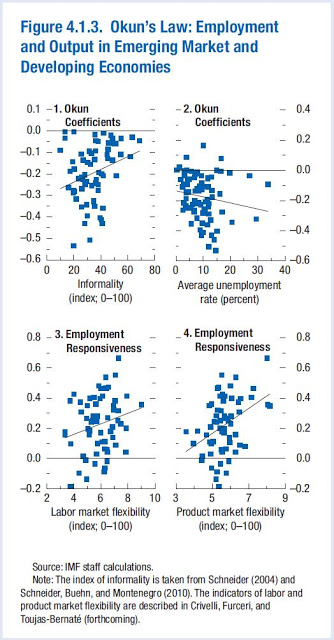
Preliminary work on Okun’s Law in advanced economies is available here.
Emerging market and developing economies have enjoyed robust growth during the past decade and bounced back quickly from the Great Recession, in marked contrast to the more tepid recovery—and even renewed recession—in advanced economies. Similarly, although unemployment in emerging market and developing economies did go up during the Great Recession, by 2011 it was essentially back to precrisis levels.Is the observed correspondence between jobs and growth a surprise, or does it represent a systemic feature of emerging market and developing economies?
Posted by at 6:04 PM
Labels: Inclusive Growth
Friday, September 21, 2012
House Prices in Korea
“Housing prices have peaked in Seoul but are rising in the rest of Korea,” according to a new report from the IMF. The report says that “following a protracted period of rising prices, housing prices in Seoul have remained weak due to a still large, albeit declining, inventory of unsold homes and limited expectation of price appreciation. The steady rise in housing prices outside Seoul (which have moderated recently) has been supported by contracting supply, a rapid increase in rents, and a rise in demand supported by strong non-bank lending. In response to the weakness in the Seoul housing market, the authorities have relaxed regulations in May 2012, including by raising loan-to-value (LTV) and debt-to-income (DTI) ratios applied to some high-house price districts.”
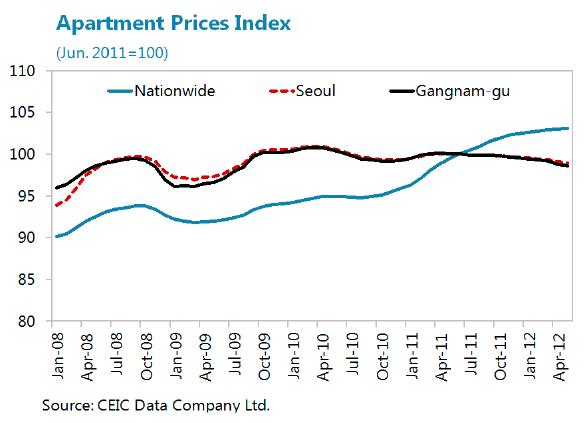
“Housing prices have peaked in Seoul but are rising in the rest of Korea,” according to a new report from the IMF. The report says that “following a protracted period of rising prices, housing prices in Seoul have remained weak due to a still large, albeit declining, inventory of unsold homes and limited expectation of price appreciation. The steady rise in housing prices outside Seoul (which have moderated recently) has been supported by contracting supply, a rapid increase in rents, and a rise in demand supported by strong non-bank lending.
Posted by at 1:46 PM
Labels: Global Housing Watch
Monday, September 17, 2012
Global House Prices Still Showing Down Trend
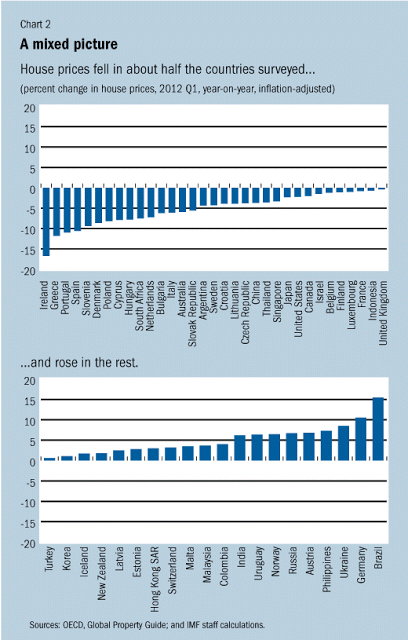
- Prices still falling in roughly half of 54 countries tracked around world
- Brazil, Germany among countries seeing house prices rise
- Within United States, housing picture varies considerably
Price trends vary widely between countries, with Ireland, Greece, Portugal, and Spain seeing the biggest falls in the past year and Brazil and Germany, substantial increases.
While overall the trend is mixed, there is no sign of an uptick in the global index of house prices, a weighted average of prices in 54 countries, according to our research. The index remained level during the second quarter of 2012—the latest quarter for which consistent data is available for a large group of countries—and the GDP-weighted index continued to decline. Continue reading here.
- Prices still falling in roughly half of 54 countries tracked around world
- Brazil, Germany among countries seeing house prices rise
- Within United States, housing picture varies considerably
House prices in the United States have started to pick up a little recently, but globally prices are still on a down trend, according to research by the International Monetary Fund (IMF).
Price trends vary widely between countries, Read the full article…
Posted by at 8:43 PM
Labels: Global Housing Watch
Thursday, September 13, 2012
The Construction Sector: Reeling or Rolling?
sector is looking optimistic. In 2012, total construction spending is expected
to grow by 3 to 9 percent. And the future looks even brighter; total
construction is expected to go up by 6 to 10 percent per year in 2013-2017.
September 6, Ken Simonson, Chief Economist of the Associated General
Contractors, gave a presentation on the economic outlook for construction at an
event hosted by the National Economist Club.
construction sector? Simonson said that office, retail, and lodging
constructions are up due to remodeling. In addition, the production of shale
gas (67 percent increase in 2007-10), and the expansion of the Panama Canal are
driving new activity. Shale gas has both direct and indirect impacts on
construction. For example, the direct impacts include the construction of
access road, site preparation, storage pond, support structures, and pipes for
each well. The indirect impacts include local spending by drilling firms,
workers, royalty holders, among others.
construction in the United States? The expansion of the Panama Canal will
require an upgrade of the ports in the United States to accommodate larger
ships. The upgrade of ports includes investing
in dredging, piers, cranes, and access road. The upgrade will also lead to
possible bridge, tunnel, and highway improvements, resulting in possible
changes in inland distribution and manufacturing. Overall, private
nonresidential and residential spending are leading the way forward for the
construction sector.
According to Simonson, apartments and multi-family housing should boom. On
the other hand, single family housing is growing, but with an uncertain future.
He noted that the apartment vacancy rate is now at a 10-year low and rents are
high.
sector? “Construction added 0 jobs in 2 years, but unemployment is down,”
said Simonson. Basically, workers are leaving for other sectors, going back to school,
and retiring. Simonson presented a chart that showed the change in construction
employment by state in the United States. The map was half or less in green,
meaning jobs available, and half or more in red.
The economic outlook for the construction
sector is looking optimistic. In 2012, total construction spending is expected
to grow by 3 to 9 percent. And the future looks even brighter; total
construction is expected to go up by 6 to 10 percent per year in 2013-2017.
On
September 6, Ken Simonson, Chief Economist of the Associated General
Contractors, gave a presentation on the economic outlook for construction at an
event hosted by the National Economist Club. Read the full article…
Posted by at 3:34 PM
Labels: Forecasting Forum, Global Housing Watch
Monday, September 10, 2012
House Prices in Ireland
The new IMF report on Ireland says that “the correction in house prices, one of the largest in recent history, has continued. The decline in nominal residential property prices slowed to 14.4 percent y/y in June 2012. The index has halved since its peak in 2007, eclipsing recent U.K. and U.S. house price declines and comparable to the Japanese and Nordic experiences of the 1990s. As yet, clear signs of stabilization are limited to Dublin house prices (excluding apartments), which, after dropping by 55 percent, have been flat in H1 2012. Rural areas, in contrast, still show signs of oversupply.”
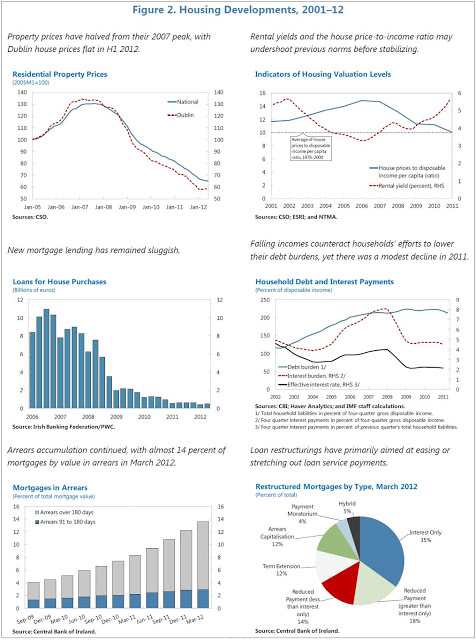
The new IMF report on Ireland says that “the correction in house prices, one of the largest in recent history, has continued. The decline in nominal residential property prices slowed to 14.4 percent y/y in June 2012. The index has halved since its peak in 2007, eclipsing recent U.K. and U.S. house price declines and comparable to the Japanese and Nordic experiences of the 1990s. As yet, clear signs of stabilization are limited to Dublin house prices (excluding apartments), which, after dropping by 55 percent,
Posted by at 4:51 PM
Labels: Global Housing Watch
Subscribe to: Posts