



Tuesday, June 28, 2016
State of Global House Prices: An Update from the Experts
From Global Housing Watch Newsletter: June 2015
Global house prices remain “two-tiered”, says Global Property Guide. The “two-tiered” is reflected in house price increases in Europe and North America, while there is a sharp slowdown in Asia and the Middle East.
Looking in more detail, during the first quarter of this year, “house prices rose in 31 out of the 45 world’s housing markets (…). [Also,] only 21 housing markets showed stronger upward momentum, while 24 housing markets showed weaker momentum. Momentum is a measure of the “change in the change”; simply put, momentum has increased if a property market has risen faster this year than last (or fallen less)”, according to the analysis done by Global Property Guide.
The “two-tiered” view is also seen in the performance of house prices in advanced vs. emerging markets. Analysis by Scotiabank says that there is positive momentum in most housing markets internationally. However, momentum in general favours advanced nations over emerging markets.
Moreover, Knight Frank says that “Aside from Turkey, emerging markets have seen prices enter a period of flat or low growth since mid-2014 (…). The BRIC nations recorded annual price growth of 3% on average in the 12 months to March 2016, while four years ago this figure was closer to 11%. Capital flight, currency shifts (partly due to the US rate rise), volatile equity markets and slowing wages are hampering demand.”
Developments by region
Asia and the Pacific: House prices are weakening in Asia, except China. House prices rose in China, Japan, Korea, Philippines, Thailand, and Vietnam. Meanwhile house prices are falling in Hong Kong, Indonesia, Mongolia, Singapore, and Taiwan (Global Property Guide). “China’s housing recovery is broadening, with roughly two-thirds of major centres reporting annual price growth through April. However, authorities face a tough policy balancing act in their attempt to cool skyrocketing prices in top-tier cities while at the same time support the nascent recovery in oversupplied smaller centres”, according to Scotiabank.
Europe: In Europe, house price booms continue. Six of the ten strongest housing markets in the global survey are in Europe. Overall, house prices rose in 18 of the 22 European housing markets (Global Property Guide). However, conditions remain uneven, with strengthening labour markets supporting solid price gains in some member countries, notably Ireland, Spain and Germany, while other markets, including France and Italy, continue to languish alongside a more tepid economic recovery (Scotiabank). Separately, the National Association of Home Builders (NAHB) has looked into the impact of negative rates on housing markets in the Euro area. It finds that “(…) the balance of evidence to date suggests that a slightly negative policy rate has supported mortgage lending.”
On the UK EU referendum result, “For both residential and commercial property, there will be short-term market volatility. Potentially, and in selective instances, pricing could come under pressure (…) However, for both residential and commercial property, the long term market dynamics remain unchanged. Low supply will continue to be a day-to-day market reality”, says Knight Frank. Meanwhile, the Financial Times reports that on one end, buyers are pulling out of purchases amid house price and job security fears, while at the other end, overseas buyers race to secure London property bargains. Other experts have looked into what Brexit means for the U.S. housing market (Capital Economics, Housing Wire, NAHB, Trulia, and Washington Post).
Middle East and Central Asia: housing markets are weakening. All of the three Middle Eastern housing markets included in the survey performed worse in Q1 2016 than the previous year (Global Property Guide).
Western Hemisphere: North America’s housing markets remain healthy. The US housing market has now regained enough momentum to provide an engine of growth for the US economy, according to the latest The State of the Nation’s Housing report by Harvard Joint Center for Housing Studies. Meanwhile, Latin America’s housing markets are mixed. Brazil’s housing market remains depressed, while Mexico’s housing market grew stronger (Global Property Guide).
Developments in prime residential markets
Prime residential prices are moderating. Prime residential prices across the 35 cities increased on average by 3.6 percent in the 12 months to March 2016, according to analysis done by Knight Frank. Knight Frank’s narrative of overall moderate growth in prime residential prices is also in line with the view of Scotiabank. “Sales of high-end luxury properties have cooled in a number of large markets over the past year, including New York, Hong Kong and London”, says Scotiabank.
What explains the slowdown in prime residential prices? Scotiabank says that the “softening in demand mirrors the economic slowdowns in China and the Middle East, and deep recessions in Russia and Brazil, all key source markets of luxury foreign buyers.” Meanwhile, Knight Frank adds that “new regulation in the form of measures to improve transparency, new taxes or fees for foreign buyers are increasing in number. However, the impact on the market of such measures is largely dependent on market fundamentals and where each market is in relation to its property market cycle.”
From Global Housing Watch Newsletter: June 2015
Global house prices remain “two-tiered”, says Global Property Guide. The “two-tiered” is reflected in house price increases in Europe and North America, while there is a sharp slowdown in Asia and the Middle East.
Looking in more detail, during the first quarter of this year, “house prices rose in 31 out of the 45 world’s housing markets (…).
Posted by at 5:00 AM
Labels: Global Housing Watch
Thursday, June 23, 2016
UK’s Housing Market
“Housing and mortgage markets have re-accelerated since mid-2015 (…) However, the recent acceleration in housing markets could partly be a temporary response to tax changes (…) Macroprudential policies will need to be tightened later this year if the acceleration does not prove temporary (…) The buy-to-let (BTL) segment, which has grown rapidly in recent years, needs to be put on an equal regulatory footing with the owner-occupied segment (…) Efforts should also continue to address supply constraints (…)”, says the IMF’s latest report on the United Kingdom.
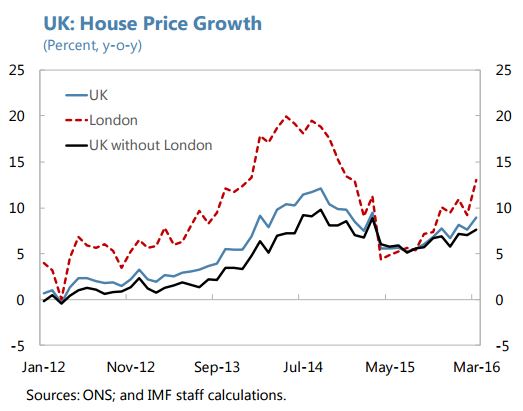
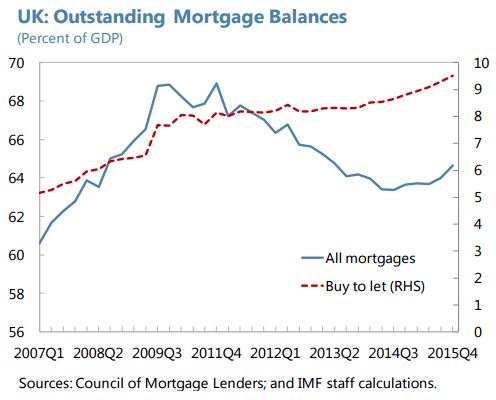
Also, see further discussion on recent developments in UK’s property market here.
“Housing and mortgage markets have re-accelerated since mid-2015 (…) However, the recent acceleration in housing markets could partly be a temporary response to tax changes (…) Macroprudential policies will need to be tightened later this year if the acceleration does not prove temporary (…) The buy-to-let (BTL) segment, which has grown rapidly in recent years, needs to be put on an equal regulatory footing with the owner-occupied segment (…) Efforts should also continue to address supply constraints (…)”,
Posted by at 5:00 AM
Labels: Global Housing Watch
Thursday, June 16, 2016
Canada’s Housing Market
Below is an extract from the IMF’s latest report on Canada:
The oil shock has caused housing market trends to “trifurcate” (…). So far, there has been no contagion risk between the diverging markets.
Resource provinces (Alberta and Saskatchewan, accounting for 23 percent of national GDP)
- Alberta’s economy has contracted by an estimated 4 percent in 2015 and is projected to shrink by another 1.6 percent in 2016.
- House prices in Calgary and Regina have fallen by 3– 4 percent from their peak in 2014 and rental vacancies have quadrupled within the span of one year (October 2014–2015). The decline in house prices followed a massive housing market boom in the mid-2000s when house prices soared by 200 percent (2004–07). With little prospect for a quick recovery in oil prices in the near term, house prices in these regions are likely to continue to trend downward.
- Alberta and Saskatchewan account for 21 percent of total household debt (2012–14) and uninsured mortgages are non-recourse loans. 2 So far, strategic defaults have not occurred in any significant way. Consumer insolvencies have increased by 40 percent over the past year but remain small as a share of total loans (Figure 5).
Non-resource provinces (British Columbia and Ontario, accounting for 49 percent of national GDP)
- British Columbia and Ontario are expected to grow by 2–3 percent this year.
- House prices have been growing by 10–20 percent year-on-year, fueled by cheap borrowing costs, demographic pressures, land supply constraints and foreign demand. Ad hoc survey data suggest that in 2015 Chinese investors accounted for 14 percent of total sales volume ($9 billion) in Toronto and 33 percent of total sales ($12.7 billion) in Vancouver.
Both British Columbia and Ontario account for 55 percent of total housing debt. Rest of Canada (accounting for 28 percent of national GDP)
- In Quebec where the economy has been growing at about 1 percent, house prices (Montreal) have been rising at a more moderate pace of 1–2 percent. Quebec and the Atlantic provinces account for 24 percent of total household debt.
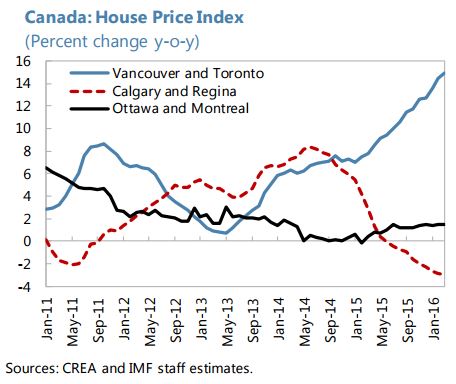
The IMF’s report on Canada also includes the following:
- Figures: Housing Sector Vulnerabilities Have Increased (pg. 40)
- Table: Heat Maps of Regional Housing Markets (pg. 50)
- Annex: Housing-Related Measures to Safeguard Financial Stability (pg. 62)
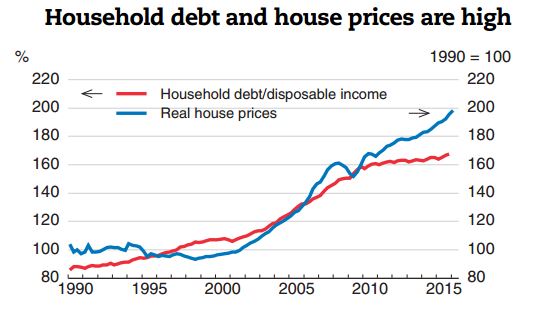
A separate new report from the OECD points out that “vulnerabilities related to housing and household debt are still increasing, albeit at a slower pace.” According to the report, “Low interest rates have encouraged further increases in household credit, with household debt continuing to edge up from already high levels. Canadian house prices have risen sharply, especially in Vancouver and Toronto, and housing investment is unusually high as a share of GDP, posing vulnerabilities and squeezing middle-class families in these high-priced markets. In response to these developments, the authorities have deployed some targeted macro-prudential measures, but further regionally focused measures should be considered.”
Below is an extract from the IMF’s latest report on Canada:
The oil shock has caused housing market trends to “trifurcate” (…). So far, there has been no contagion risk between the diverging markets.
Resource provinces (Alberta and Saskatchewan, accounting for 23 percent of national GDP)
- Alberta’s economy has contracted by an estimated 4 percent in 2015 and is projected to shrink by another 1.6 percent in 2016.
Posted by at 5:00 AM
Labels: Global Housing Watch
Tuesday, May 31, 2016
Housing: Microdata, macro problems
Global Housing Watch Newsletter: May 2016
*Below is a conference summary prepared by Philippe Bracke (Bank of England).
On May 4-5, the Bank of England hosted the conference Housing: Microdata, macro problems (program here) in London, organised by Philippe Bracke (Bank of England), Jonathan Halket (Cemmap and Essex) and Lars Neshiem (Cemmap, UCL, and IFS). The conference was co-sponsored by the Bank of England, CeMMAp and the Brevan Howard Centre for Financial Analysis; it also benefitted from a Transformative Research Grant by the UK Economic and Social Research Council.
First day
Alex Brazier, director of Financial Stability at the Bank of England, gave the opening remarks. His speech stressed the importance of academic research and, in particular, micro data analysis to inform policy decisions.
Morris Davis (Rutgers Business School) started the academic presentations by talking about his research with Erwan Quintin (Wisconsin Business School) on Default when Current House Values are Uncertain. People’s evaluation of their own house lags aggregate price trends as measured by the Case-Shiller indices. The authors construct a model based on this empirical finding to replicate aggregate default numbers in the US. The discussant Colin Caines (University of British Columbia) highlighted the need for having more data on who defaulted in 2007-2009 and recommended the insertion of an unemployment shock in the model.
Allen Head (Queen’s University) presented Default, Mortgage Standards and Housing Liquidity, a joint work with Hongfei Sun (Queen’s University), and Chenggang Zhou (University of Waterloo). Their quantitative model with directed housing search and mortgages, replicates the empirical association between debt level and asking price/time to sell, highlighted by the previous literature. Households’ decision to sell may be triggered by either a relocation shock or a financial-distress shock. In his discussion, Erwan Quintin suggested a greater emphasis on what search models one can add (persistence/propagation of shocks) on top of standard non-search setups.
Aaron Hedlund (University of Missouri) presented Failure to Launch: Housing, Debt Overhang, and the Inflation Option During the Great Recession, where he sets up a general equilibrium model to evaluate the effects of an inflation increase (assuming policy makers are able to make this happen). The model predicts three effects: (1) inflation reduces the burden of debtors (standard Fisher effect); however, (2) the Fisher effect is offset by banks tightening credit to avoid a loss in profits; (3) the housing market becomes more liquid because of less indebted homeowners. The discussant Wei Cui (UCL) focused on the role of nominal rigidities in mortgage markets and the broader debate on the effects of monetary policy on housing markets.
Kurt Mitman (Stockholm University) presented Consumption and House Prices in the Great Recession, joint with Greg Kaplan (Princeton) and Gianluca Violante (NYU). Their quantitative model allows for three kinds of shocks: credit conditions, productivity, and beliefs in future house price movements. They find that beliefs in future house price movements are the most important driver of house prices booms and busts. This is consistent with other recent papers which (a) stress the need to incorporate nonstandard house price expectations in quantitative models, and (b) admit that the credit channel is perhaps less important than we used to think. The discussant Ralph Luetticke (University of Bonn) suggested that the authors explore a bit more the differences in boom-bust amplitude between US states to say something more about the role of the different shocks.
Ethan Ilzetsky (LSE) presented Interest Rates, Debt and Intertemporal Allocation: Evidence from Notched Mortgage Contracts in the UK, co-authored with Michael Best (Stanford), James Cloyne (Bank of England) and Henrik Kleven (LSE). This paper exploits a feature of the UK housing market whereby salient LTV thresholds (such as 90%) are associated with discrete jumps in the interest rate paid (which applies to the entire loan). The authors can estimate the elasticity of intertemporal substitution by looking at how many people decide to stop below the threshold as compared with a counterfactual “smooth” LTV distribution. The discussant Ben Etheridge (Essex University) asked for more information on the dynamics in the data, in particular on the remortgaging, and equity extraction patterns.
Mariassunta Giannetti (Stockholm School of Economics) presented her work with Giovanni Favara (FED Board) Forced Asset Sales and the Concentration of Outstanding Debt: Evidence from the Mortgage Market, which addresses the question of why banks do not renegotiate more with their mortgage borrowers, since defaults are so costly. This paper shows that banks are more willing to renegotiate when they hold a higher fraction of total mortgages in a given area, i.e. when they can internalize the default externality. The discussant David Miles (Bank of England) focused on the different definitions of concentration in the mortgage market, and whether these are based on flows of new loans or the stock of outstanding mortgages.
Jonathan Halket presented his joint work with Lars Neshiem and Florian Oswald (Sciences Po) The Housing Stock, Housing Prices, and User Costs: The Roles of Location, Structure and Unobserved Quality on why some properties are more likely to end up in the rental market or the owner-occupied market. Motivated by data from the English Housing Survey, where properties are less likely to be owner occupied if they are smaller and closer to the city centre, the authors construct a selection model with observable and unobservable housing features which they bring to London properties and interpret the results through a user-cost framework.
Second day
Anthony De Fusco (Northwestern) kicked off the second day with his presentation Homeowner Borrowing and Housing Collateral: New Evidence from Expiring Price Controls in which he empirically disentangles the two mechanisms behind the observed relation between house prices and household indebtedness: wealth effect and collateral effect. He exploits a rule in Montgomery Country (Maryland) where people who bought houses at an affordable discounted price cannot resell their property at full market value before a certain date; up to that date, banks can only lend against the discounted price. The identification stems from the jump in collateral value at this pre-established date, and the absence of a corresponding jump in lifetime wealth. The discussant Orazio Attanasio (UCL) suggested that future iterations of this paper on this line of research should include a theoretical model of the mechanisms at work.
Global Housing Watch Newsletter: May 2016
*Below is a conference summary prepared by Philippe Bracke (Bank of England).
On May 4-5, the Bank of England hosted the conference Housing: Microdata, macro problems (program here) in London, organised by Philippe Bracke (Bank of England), Jonathan Halket (Cemmap and Essex) and Lars Neshiem (Cemmap, UCL, and IFS). The conference was co-sponsored by the Bank of England,
Posted by at 5:00 AM
Labels: Global Housing Watch
Monday, May 23, 2016
House Prices in Colombia
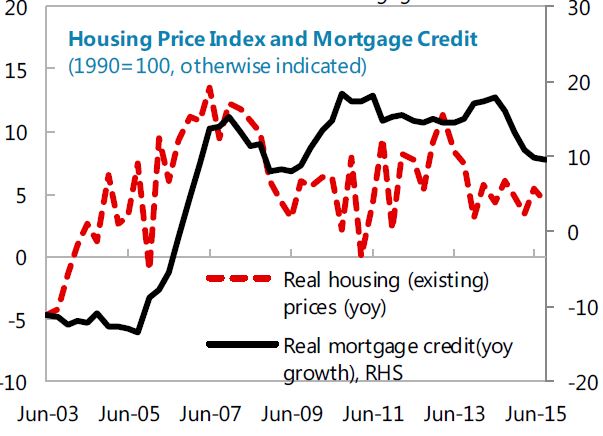
“Housing prices growth have moderated amid a slowdown in mortgage credit”, according to the latest IMF report on Colombia. The report also notes that “Similarly, risks from weaker household balance sheets have risen marginally and remain contained. Risks from rising house prices are mitigated by low loan-to-value ratios (51.4 percent) and small mortgage portfolios of banks (12.3 percent of total loans).”
“Housing prices growth have moderated amid a slowdown in mortgage credit”, according to the latest IMF report on Colombia. The report also notes that “Similarly, risks from weaker household balance sheets have risen marginally and remain contained. Risks from rising house prices are mitigated by low loan-to-value ratios (51.4 percent) and small mortgage portfolios of banks (12.3 percent of total loans).”
Posted by at 4:47 PM
Labels: Global Housing Watch
Subscribe to: Posts