



Friday, July 8, 2016
OPEC’s Strategic Actions and the 2014 Oil Price Crash
A new IMF working paper notes: “In November 2014, OPEC announced a new strategy geared towards improving its market share. Oil-market analysts interpreted this as an attempt to squeeze higher-cost producers including US shale oil out of the market. Over the next year, crude oil prices crashed, with large repercussions for the global economy. We present a simple equilibrium model that explains the fundamental market factors that can rationalize such a “regime switch” by OPEC. These include: (i) the growth of US shale oil production; (ii) the slowdown of global oil demand; (iii) reduced cohesiveness of the OPEC cartel; (iv) production ramp-ups in other non-OPEC countries. We show that these qualitative predictions are broadly consistent with oil market developments during 2014-15. The model is calibrated to oil market data; it predicts accommodation up to 2014 and a market-share strategy thereafter, and explains large oil-price swings as well as realistically high levels of OPEC output.”
A new IMF working paper notes: “In November 2014, OPEC announced a new strategy geared towards improving its market share. Oil-market analysts interpreted this as an attempt to squeeze higher-cost producers including US shale oil out of the market. Over the next year, crude oil prices crashed, with large repercussions for the global economy. We present a simple equilibrium model that explains the fundamental market factors that can rationalize such a “regime switch”
Posted by at 6:06 AM
Labels: Energy & Climate Change
Thursday, July 7, 2016
The Role of Productivity Growth in Reducing Regional Economic Disparities in Poland
Below are extracts from a report written by IMF colleagues: Krzysztof Krogulski, Robert Sierhej, and Aaron Thegeya.
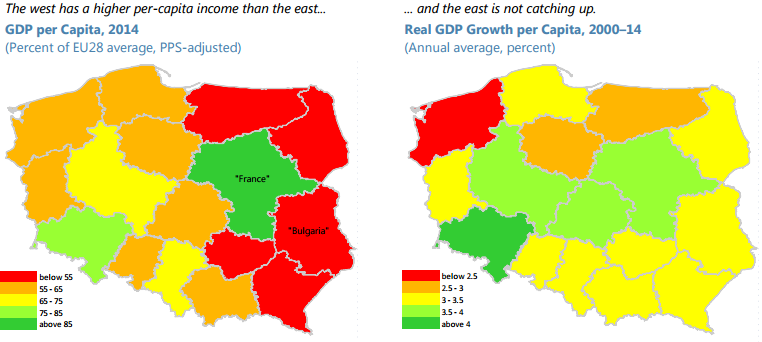
Although Poland has enjoyed strong growth and steady income convergence with the EU over the last two decades, important disparities persist at the regional level. Per-capita income is higher in the west—which is integrated into the German supply chain and enjoys higher levels of FDI—than in the east—where the economy depends more on less productive agriculture. Despite strong overall economic growth, the east has not been catching up to the west. This chapter identifies policies to increase productivity in the east, reduce regional income disparities, and promote overall income convergence. This would require improving educational attainment and reducing skill mismatches in the east, scaling up public infrastructure to attract investment to less productive regions, and facilitating labor mobility.
Despite strong economic performance over the last two decades, there are significant and enduring income disparities between western and eastern regions of Poland. These disparities are strongly correlated with labor productivity differences. While labor productivity growth in poorer eastern regions has been driven significantly by structural transformation, in wealthier western regions it has been driven by higher investment and integration with the German supply chain. Education and labor market conditions had a significant impact on labor productivity growth across regions. Similar growth rates in labor productivity across regions have prevented eastern regions from catching up to western regions.
The analysis of regional productivity determinants points to policies that could be conducive to regional productivity convergence.
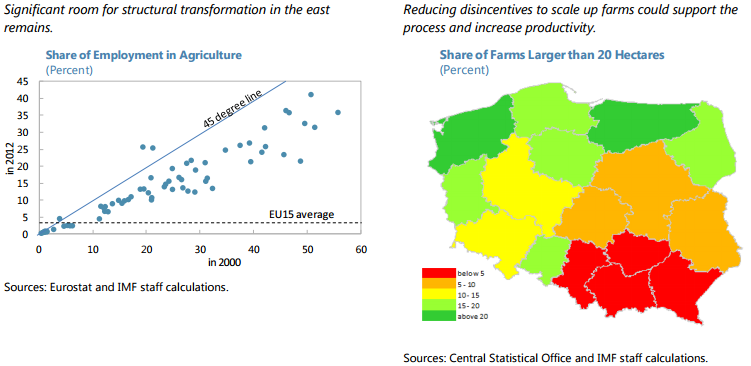
- Support structural transformation and boost productivity in agriculture: Significant room remains to boost labor productivity growth within poorer regions by supporting the reallocation of labor from low-productivity agriculture to higher-productivity industry and service sectors. To unleash the potential for such structural transformation, a review of incentives pertaining to employment in agriculture would be appropriate to identify mechanisms that may encourage people to stay in low productivity farms. In particular, the highly subsidized pension scheme for farmers could be reformed to gradually align it with the regular system to discourage inefficient farming motivated by pension arbitrage. The more productive farms in western regions tend to be larger, so there may be merit in promoting consolidation of agricultural production also in the poorer eastern regions to exploit the economies of scale. In this regard, moving from the current agricultural taxation based on farm size and quality of land to an income-based tax would reduce disincentives to scale up farms and help define the base for social security contributions. To facilitate structural transformation, such reforms should be accompanied with measures to address skill mismatches and bottlenecks in labor mobility, as described below.
- Encourage labor mobility and reduce structural unemployment: Decomposition of productivity growth shows that the contribution from reallocating labor across regions has been relatively minor. This suggests bottlenecks in labor market mobility that could be addressed with proper policies, for example, by improving the functioning of the housing rental market. Currently, the rental housing market in Poland is shallow, discouraging labor relocation. Econometric analysis also suggests that high structural unemployment negatively affects regional productivity growth. While a declining working age population should generally reduce the unemployment rate, addressing high structural unemployment in less productive regions would require greater investment in active labor market policies to improve job searching efficiency across regions, upgrade skills, and reduce skill mismatches.
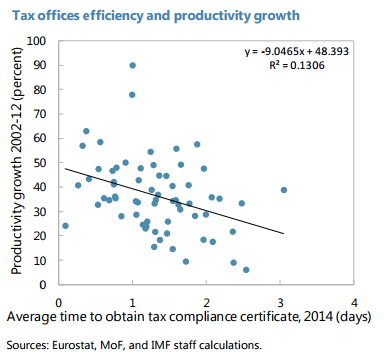
- Attract investments to less productive regions: Empirical findings show that higher FDI is associated with faster regional productivity growth. FDI is more prevalent in wealthier regions, and this pattern needs to change to support regional productivity catch-up. Some factors important for investors could be altered by government policies to support such a change. Specifically, strengthening transportation networks in poorer regions would help, and better targeting of EU funds could support this process. Furthermore, investor surveys suggest that access to skilled labor is important for location of projects. In this context, investing in education and tailoring it to local development needs is important; aligning vocational curricula closely to the needs of industry would facilitate the absorption of new production methods and technologies. While local governments’ role in boosting productivity appears less statistically significant, it does not imply that quality of local administration is irrelevant. For example, data suggest a positive correlation between regional productivity and the efficiency of local tax administration.
Below are extracts from a report written by IMF colleagues: Krzysztof Krogulski, Robert Sierhej, and Aaron Thegeya.
Although Poland has enjoyed strong growth and steady income convergence with the EU over the last two decades, important disparities persist at the regional level. Per-capita income is higher in the west—which is integrated into the German supply chain and enjoys higher levels of FDI—than in the east—where the economy depends more on less productive agriculture.
Posted by at 11:13 AM
Labels: Inclusive Growth
Wednesday, July 6, 2016
Norway: The Transition from Oil and Gas
By IMF colleague: Giang Ho
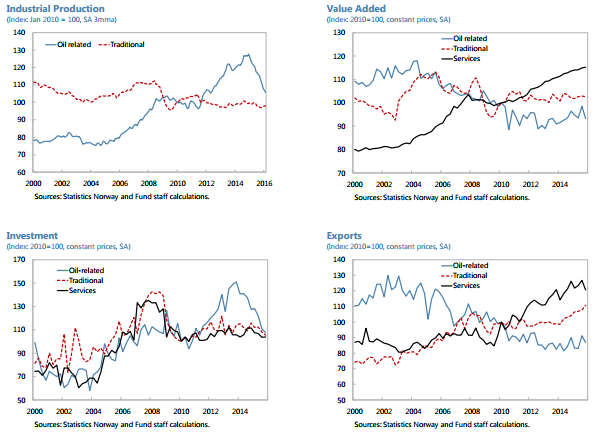
“As offshore investment drops from its peak and oil prices retreat from their high in 2014, the Norwegian economy is going through a transition away from oil dependence,” according to an IMF report. “The transition from oil and gas is a gradual process, and more time would be required before a credible assessment can be made of its progress. The preliminary data show an ongoing marked decline in oil-related production and investment, whereas activity in the traditional goods sector is holding up but not sufficiently to pick up the slack. The divergent performance is perhaps most pronounced within manufacturing between oil-related industries (i.e. machinery and equipment, ships, boats and oil platforms) and nonoil industries. Overall, although the real value added share of the oil-related sector has shrunk from over 36 percent on average during 2000–13 to about 29 percent during 2014–15, much of this appears to have been picked up by the business services sector. The traditional goods producing sector remains a relatively small part of the economy, with value added share at a little over 7 percent and hours worked share declining to 11 percent.”
By IMF colleague: Giang Ho
“As offshore investment drops from its peak and oil prices retreat from their high in 2014, the Norwegian economy is going through a transition away from oil dependence,” according to an IMF report. “The transition from oil and gas is a gradual process, and more time would be required before a credible assessment can be made of its progress. The preliminary data show an ongoing marked decline in oil-related production and investment,
Posted by at 9:02 AM
Labels: Energy & Climate Change
Housing Market in Germany
“Housing prices in the most dynamic cities deserve close monitoring, but concerns about across-the-board excesses in the mortgage market look premature. (…) Housing price inflation also reflects a tepid response of housing supply to a swell in demand”, notes the IMF’s latest report on Germany.
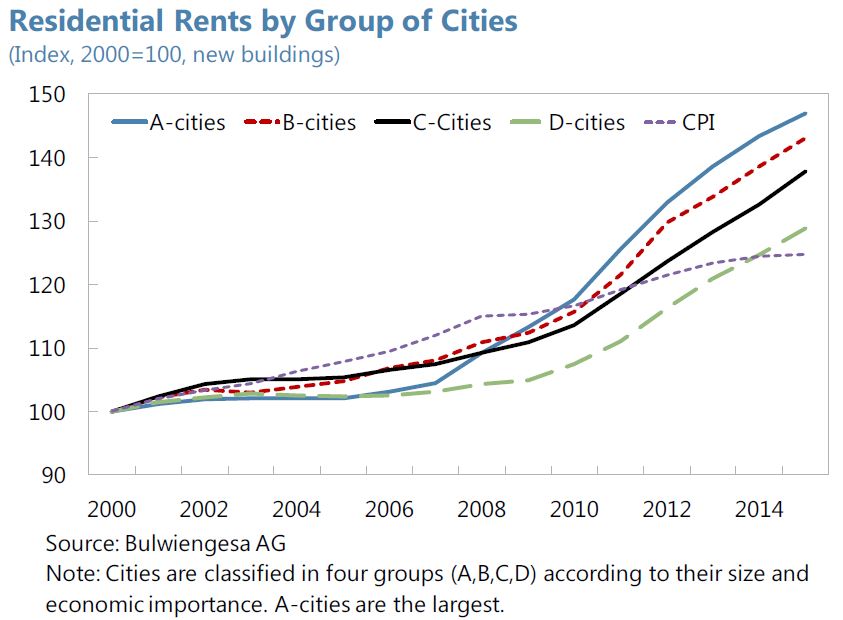
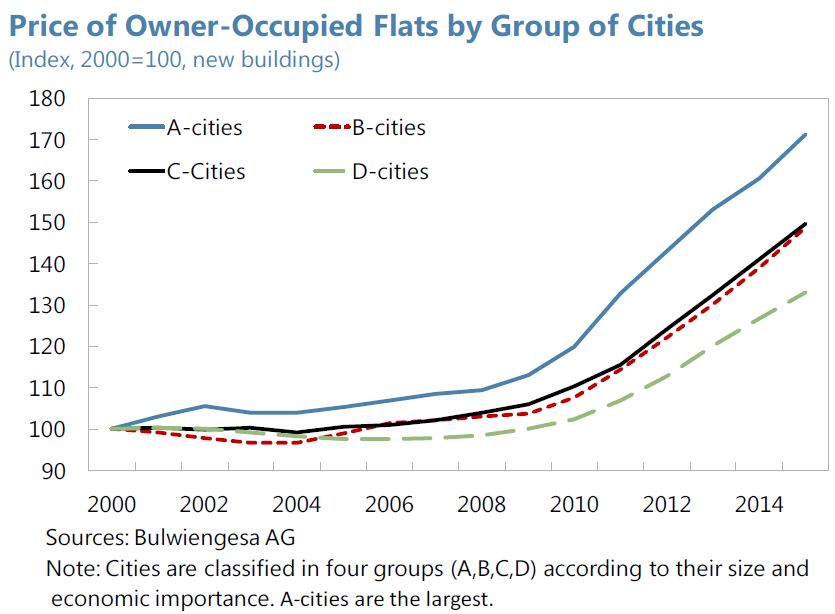
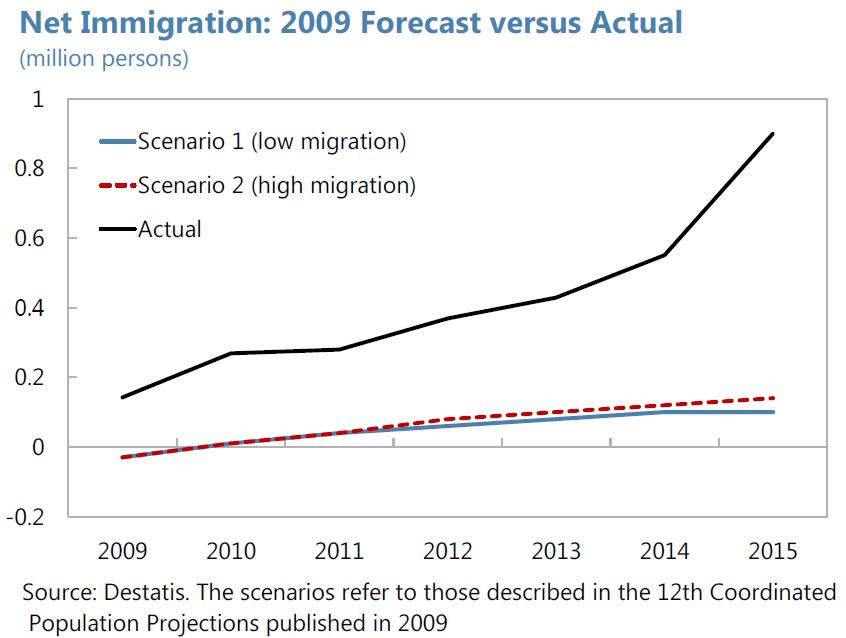
In a separate report, Jérôme Vandenbussche (IMF) points out that residential prices and rents have increased steeply since 2009, particularly in big cities. This is due to an unexpected surge in housing demand that is explained by stronger than expected net immigration in recent years. In 2009, net immigration was expected to rise from near zero to about 100,000 persons in 2014. However, the actual figure turned out to be 550,000. In his analysis, Vandenbussche takes a look at the housing supply response to changes in house prices and finds “(…) evidence that the supply response to changes in housing prices has declined over the past several years (…).”
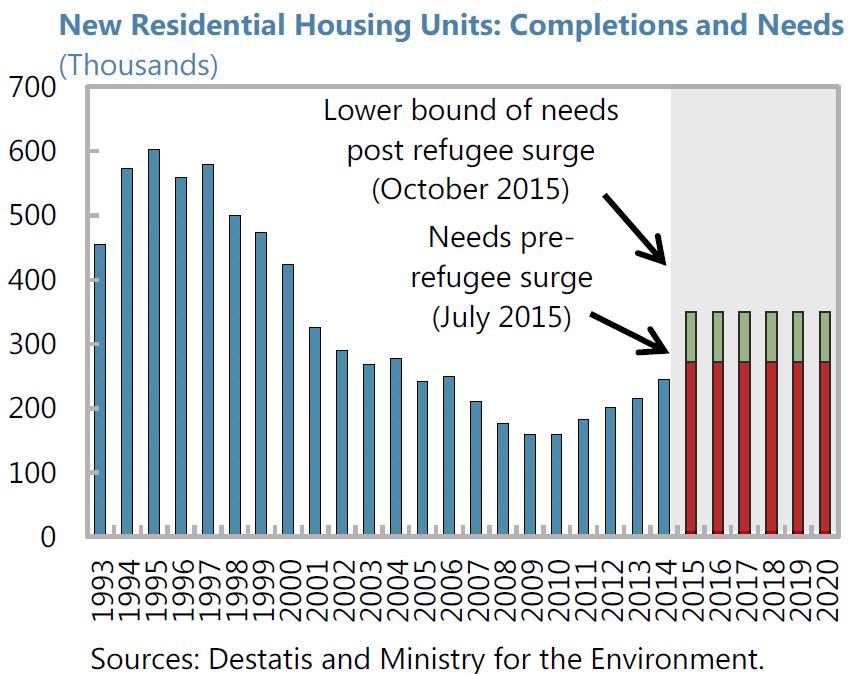
In terms of policies to boost the supply response, Vandenbussche discusses the 10-point action program to stimulate residential construction. He also says that “(…) several other factors, including stricter rent regulation and higher taxation of real estate transactions, are likely to have played a role in the recent decline of the price elasticity of residential investment [This includes] Two tightening rent control measures were taken in recent years (…) The real estate transfer tax rate has been continuously creeping up since 2006 (…) Other factors likely include inadequate staffing at planning and building authorities, and growing shortages of skilled worker in the finishing trade.”
“Housing prices in the most dynamic cities deserve close monitoring, but concerns about across-the-board excesses in the mortgage market look premature. (…) Housing price inflation also reflects a tepid response of housing supply to a swell in demand”, notes the IMF’s latest report on Germany.
In a separate report, Jérôme Vandenbussche (IMF) points out that residential prices and rents have increased steeply since 2009,
Posted by at 5:00 AM
Labels: Global Housing Watch
Monday, July 4, 2016
The Danish Housing Market: An Update
“Rapid house price increases call for early policy action—including loosening housing supply restrictions, eliminating adverse tax incentives, and developing and timely implementing well-targeted macro prudential tools”, says IMF’s latest report on Denmark. The report points out that “Following speculative pressures on the exchange rate in early 2015, Denmark’s Nationalbank (DN) lowered its deposit policy rate—which first broke through the zero bound in 2012—deeper into negative territory (…). In the resulting environment of historically low mortgage rates, real house prices rose over 6 percent in 2015.”
In two separate reports, Giang Ho (IMF) provides a deeper analysis on house price and supply developments in Denmark.
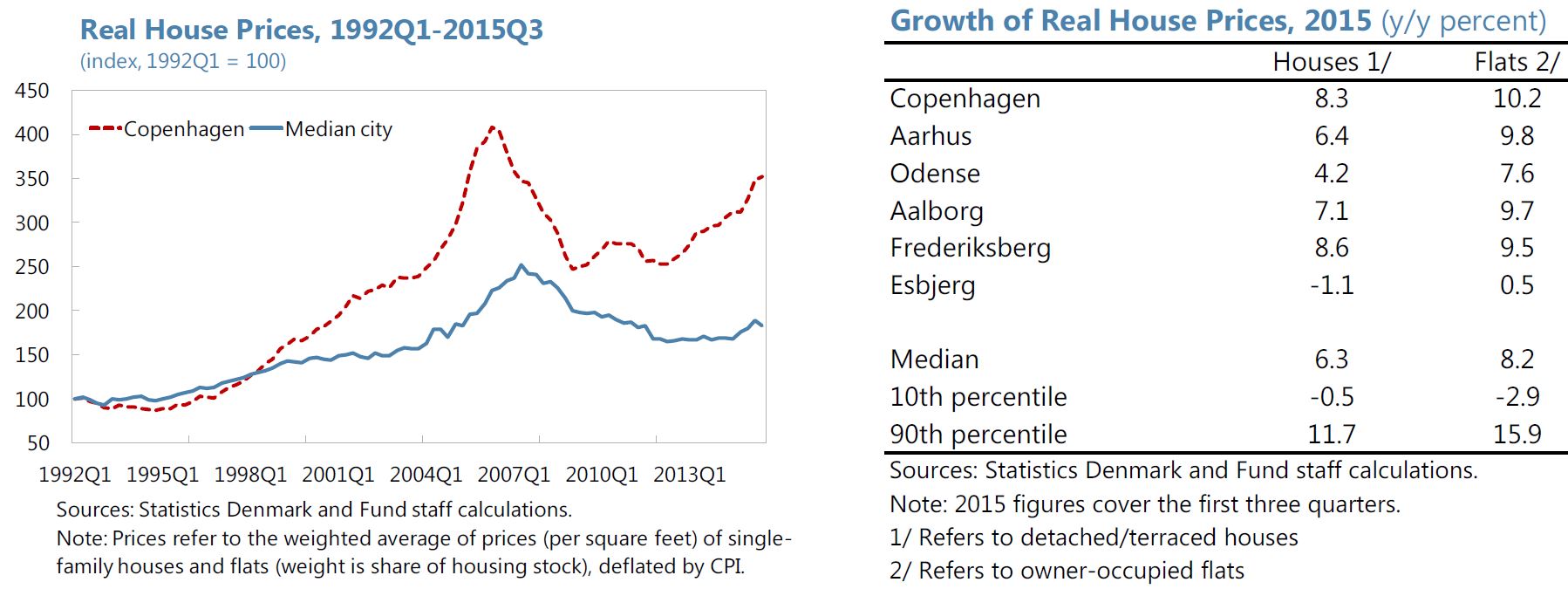
On house prices, Ho says that price developments have been characterized by a “growing divergence” between different parts of the country. Big cities such as Copenhagen has experienced much more rapid price increases than other parts. A similar development is also seen in the market for owner-occupied flats (experincing larger price increases) compared to single-family homes. These regional house price differences are explained by a number of demand and supply factors: demographic trends, rising income and employment, favorable user cost of housing, and housing supply lagging behind demand. Ho’s analysis also points to “emerging overvaluation in Copenhagen and Frederiksberg’s housing markets—particularly in the market for owner-occupied flats.”
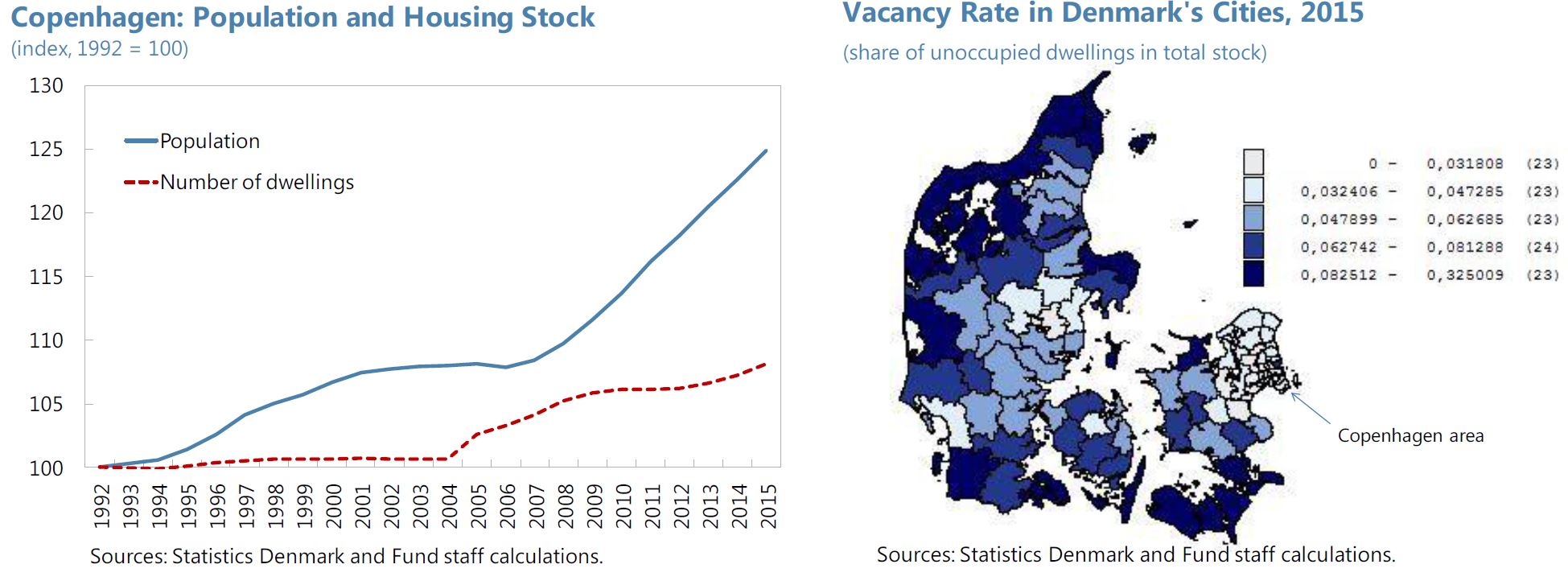
On housing supply, “Cities such as Copenhagen where the stock of housing is relatively inflexible and responds slowly to changes in housing demand could see higher price growth (…) the potential price impact of supply constraint can be economically significant”, says Ho. So how the supply constraints can be addressed? “While natural land constraints are difficult to overcome, distortions in the housing markets could be reduced to alleviate the supply shortage in high-stress urban areas such as Copenhagen. For example, there is scope for relaxing zoning regulations in certain areas. In addition, reducing rental controls to allow freely determined rents to apply to a larger fraction of the housing stock, and creating the incentives for municipalities and/or private developers to put land to good use would also be helpful. This is particularly relevant in the current juncture, given the low interest rate environment as well as the recent influx of asylum seekers putting additional pressure on the demand for housing”, according to Ho.
In another report on macroprudential policy, Jiaqian Chen (IMF), notes that given high household debt and other mortgage characteristics–like variable rates and interest only loans–financial stability concerns could emerge if house price growth continues. She estimates the potential effects of tightening macro prudential policies. She finds that “First, the overall impact from macroprudential policies on the real economy appears limited, while the effect on debt levels can be significant. Second, out of the various modeled policies, amortization requirements seem to have the strongest impact on household debt, suggesting the importance of limiting the growth of deferred amortization mortgages.”
“Rapid house price increases call for early policy action—including loosening housing supply restrictions, eliminating adverse tax incentives, and developing and timely implementing well-targeted macro prudential tools”, says IMF’s latest report on Denmark. The report points out that “Following speculative pressures on the exchange rate in early 2015, Denmark’s Nationalbank (DN) lowered its deposit policy rate—which first broke through the zero bound in 2012—deeper into negative territory (…). In the resulting environment of historically low mortgage rates,
Posted by at 5:00 AM
Labels: Global Housing Watch
Subscribe to: Posts