



Tuesday, April 4, 2017
Corruption and Growth in Ukraine
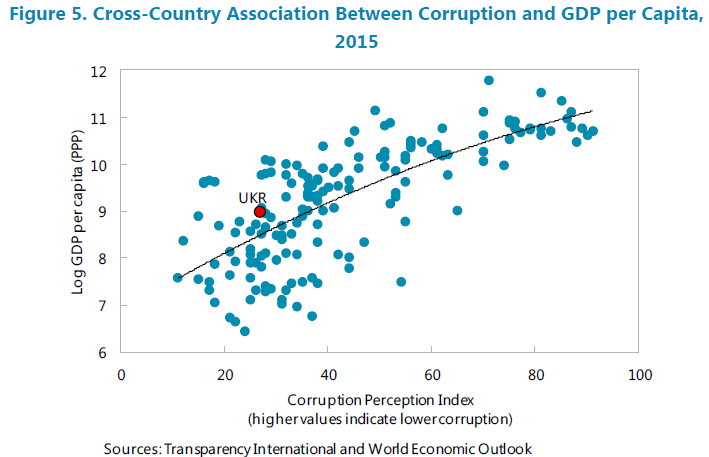
An IMF report says “The level of corruption in Ukraine is exceptionally high. This can severely undermine economic growth prospects, in particular by hindering private investment. Reducing corruption is therefore essential to speed up the process of economic convergence to the rest of Europe. Regional comparisons help identifying best practices in reducing corruption. The Ukrainian authorities have recently adopted important measures that follow some of these best practices. They are, however, facing a number of specific challenges, including the concentration of political and economic powers in a small group of people which may hamper effective anti-corruption efforts.”
Continue reading here.
An IMF report says “The level of corruption in Ukraine is exceptionally high. This can severely undermine economic growth prospects, in particular by hindering private investment. Reducing corruption is therefore essential to speed up the process of economic convergence to the rest of Europe. Regional comparisons help identifying best practices in reducing corruption. The Ukrainian authorities have recently adopted important measures that follow some of these best practices.
Posted by at 12:00 PM
Labels: Inclusive Growth
Monday, April 3, 2017
Housing Market in Netherlands
The IMF’s latest report on Netherlands points out the following:
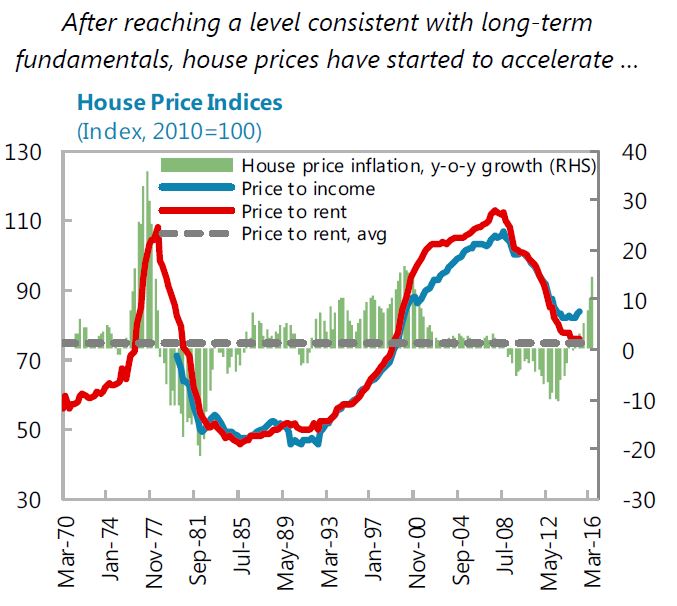
- “House prices have been accelerating and close monitoring may be warranted in the country’s main cities. After turning a corner in 2014, house prices have been steadily accelerating and transaction volumes have doubled in 2016. At the aggregate level, real house prices are broadly consistent with long-term equilibrium (priceto-income, price-to-rent ratios, Figure 3) but developments have been uneven across regions, with prices for apartments in Amsterdam 15 percent higher than a year ago. After plummeting by 20 percent during the crisis, commercial real estate has only started to recover recently.”
- “Households remain highly leveraged, with a sizeable share of mortgages in negative equity.”
- “Staff recommends accelerating the implementation of macro-prudential and other measures aimed at lessening household financial vulnerabilities. The authorities should build on recent initiatives, (…) They should accelerate the phasing down of mortgage interest deductibility (MID), by at least 1 percentage point per year ultimately bringing it to a neutral level relative to the taxation of other assets. (…) The authorities should continue to gradually lower the maximum limit on LTV ratios by at least 1 percentage point per year to no more than 90 percent by 2028 and to 80 percent thereafter. (…) The authorities should introduce prudential ceilings on debt service-to-income caps by income category that could not be relaxed during periods of strong growth.”
- “The private rental market needs to be deregulated and placed on a more even footing with owner-occupied homes and social housing.”
The IMF’s latest report on Netherlands points out the following:
- “House prices have been accelerating and close monitoring may be warranted in the country’s main cities. After turning a corner in 2014, house prices have been steadily accelerating and transaction volumes have doubled in 2016. At the aggregate level, real house prices are broadly consistent with long-term equilibrium (priceto-income, price-to-rent ratios, Figure 3) but developments have been uneven across regions,
Posted by at 2:32 PM
Labels: Global Housing Watch
Friday, March 31, 2017
The Power of Two: Inclusive Growth and the IMF
A partial summary of the IMF’s work on inclusive growth (partial to my work).
A partial summary of the IMF’s work on inclusive growth (partial to my work).
Posted by at 10:24 AM
Labels: Inclusive Growth
Thursday, March 30, 2017
Das House-Kapital: A Long Term Housing & Macro Model
From a new IMF working paper:
“There are, by now, several long term, time series data sets on important housing & macro variables, such as land prices, house prices, and the housing wealth-to-income ratio. However, an appropriate theory that can be employed to think about such data and associated research questions has been lacking. We present a new housing & macro model that is designed specifically to analyze the long term. As an illustrative application, we demonstrate that the calibrated model replicates, with remarkable accuracy, the historical evolution of housing wealth (relative to income) after World War II and suggests a further considerable increase in the future. The model also accounts for the close connection of house prices to land prices in the data. We also compare our framework to the canonical housing & macro model, typically employed to analyze business cycles, and highlight the main differences.”
From a new IMF working paper:
“There are, by now, several long term, time series data sets on important housing & macro variables, such as land prices, house prices, and the housing wealth-to-income ratio. However, an appropriate theory that can be employed to think about such data and associated research questions has been lacking. We present a new housing & macro model that is designed specifically to analyze the long term.
Posted by at 6:17 PM
Labels: Global Housing Watch
Build It and They Will Come: A New Data Set on Services Exports
 Build a new data set and the users will come. At least that’s what my co-authors and I hope will be the case with this new data set on services exports that we released yesterday. More to come on this topic in coming days.
Build a new data set and the users will come. At least that’s what my co-authors and I hope will be the case with this new data set on services exports that we released yesterday. More to come on this topic in coming days.
Posted by at 6:06 PM
Labels: Inclusive Growth
Subscribe to: Posts