



Thursday, November 9, 2017
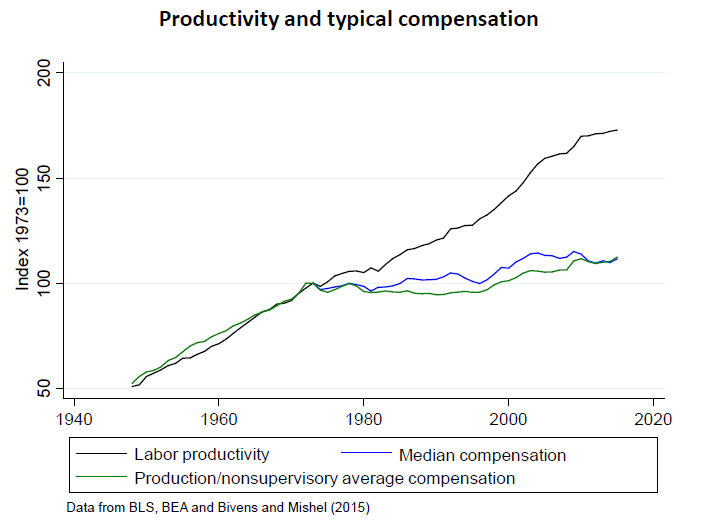
Productivity and Pay: Is the Link Broken?
Interesting presentation by Stansbury and Summers.
Posted by at 3:40 PM
Labels: Inclusive Growth
Roads or Schools: A Critical Tradeoff
Roads or schools? It’s a question akin to the “guns or butter” choice that governments around the world confronted in the 20th century: How to spend a nation’s finite resources to produce the maximum benefit for its people. A new IMF working paper finds that low-income countries tend to spend less on schools than on roads as a share of GDP.
“In the presence of distortionary taxation and debt aversion, the different pace at which roads and schools contribute to economic growth turns out to be central to this decision. Specifically, while costs are front-loaded for both types of investment, the growth benefits of schools accrue with a delay. To put things in perspective, with a ‘big push’, even assuming a large (15 percent) return differential in favor of schools, the government would still limit the fraction of the investment scale-up going to schools to about a half. Besides debt aversion, political myopia also turns out to be a crucial determinant of public investment composition. A ‘big push’, by accelerating growth outcomes, mitigates myopia—but at the expense of greater risks to fiscal and debt sustainability. Tied concessional financing and grants can potentially mitigate the adverse effects of both debt aversion and political myopia”
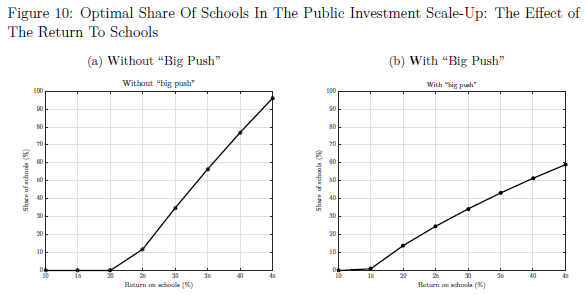
Roads or schools? It’s a question akin to the “guns or butter” choice that governments around the world confronted in the 20th century: How to spend a nation’s finite resources to produce the maximum benefit for its people. A new IMF working paper finds that low-income countries tend to spend less on schools than on roads as a share of GDP.
“In the presence of distortionary taxation and debt aversion, the different pace at which roads and schools contribute to economic growth turns out to be central to this decision.
Posted by at 1:45 PM
Labels: Inclusive Growth
Friday, November 3, 2017
Housing View – November 3, 2017
On cross-country:
- Mortgaging Europe’s periphery – London School of Economics
- The World Bank and the Globalisation of Housing Finance – University of York
- Quarterly Review of European Mortgage Markets – European Mortgage Federation
- Inclusive City Development: City-Wide Slum Upgrading and Housing Development – World Resources Institute
- House Prices Are Up 70 Percent But Experts Don’t Think There’s a Bubble – Bloomberg
- An Urban Equilibrium Model with Rent Controls Applied to Paris Urban Area – Institut d’Economia de Barcelona
On the US:
- Homebuilders hit after Republicans propose cap on mortgage-interest deduction – Financial Times, HousingWire
- The mortgage rate conundrum – VOX
- Immigrants and Housing Demand – Cato Institute
- Mortgage Debt, Consumption, and Illiquid Housing Markets in the Great Recession – Federal Reserve Bank of St. Louis
- Trends in Housing Problems and Federal Housing Assistance – Urban Institute
- Stuck in Place, U.S. Homeowners Hunker Down as Housing Supply Stays Tight – Wall Street Journal
- Are house prices a new bubble? – Calculated Risk
- America isn’t in a housing bubble, but some cities might be – Urban Institute
- A crisis caused by housing policies, not lack of regulation – American Enterprise Institute
- Where Evictions Hurt the Most – Citylab
- Sand castles on Jersey Shore: property boom defies US flood risk – Financial Times
- How will Hurricanes Harvey and Irma affect housing markets in Texas and Florida? – Urban Institute
- As Lenders Digitize, Borrowers Still Want the “Human Touch” – Fannie Mae
- Home Builders Will Oppose Republican Tax Bill – Wall Street Journal
- Job Growth Slows Where Housing Costs a Lot – Bloomberg
- Mapping Homeowners’ Associations: Who lives in them and How do they Affect Housing Values? – University of California, Irvine
On other countries:
- [Australia] Australia’s Housing Boom Is ‘Officially Over,’ UBS Says – Bloomberg
- [Australia] Quarterly Housing & Economic Review – October 2017 Release – CoreLogic
- [Australia] As Dwelling Construction Surges Housing Turnover Falls – CoreLogic
- [Canada] Foreign buyers inch back into Vancouver housing market – Reuters
- [China] The Conventional View of China’s Problems May Be All Wrong: Q&A – Bloomberg
- [Ireland] Revised mortgage measures – a six-month snapshot – Central Bank of Ireland
- [New Zealand] New Zealand’s Foreign Home Ownership Ban Won’t Cause Price Collapse-Trade Min – New York Times, Quartz
- [United Kingdom] Home values and firm behaviour – Bank of England
- [United Kingdom] Inside London’s Huge Experiment in Predicting the Housing Future – Bloomberg
- [United Arab Emirates] Dubai: Service Me This – REIDIN

Photo by Aliis Sinisalu
On cross-country:
- Mortgaging Europe’s periphery – London School of Economics
- The World Bank and the Globalisation of Housing Finance – University of York
- Quarterly Review of European Mortgage Markets – European Mortgage Federation
- Inclusive City Development: City-Wide Slum Upgrading and Housing Development – World Resources Institute
- House Prices Are Up 70 Percent But Experts Don’t Think There’s a Bubble – Bloomberg
- An Urban Equilibrium Model with Rent Controls Applied to Paris Urban Area – Institut d’Economia de Barcelona
Posted by at 5:00 AM
Labels: Global Housing Watch
Tuesday, October 31, 2017
Inequality in Brazil: A Regional Perspective
From a new IMF working paper: “In this study, we document the decline in income inequality and a convergence in consumption patterns in Brazilian states in a new database constructed from micro data from the national households’ survey. We adjust the state-Gini coefficients for spatial price differences using information on households’ rental prices available in the survey. In a panel regression framework, we find that labor income growth, formalization, and schooling contributed to the decline in inequality during 2004−14, but redistributive policies, such as Bolsa Família, have also played a positive role. Going forward, it will be important to phase out untargeted subsidies, such as public spending on tertiary education, and contain growth of public sector wages, to improve budgetary efficiency and protect gains in equality.”
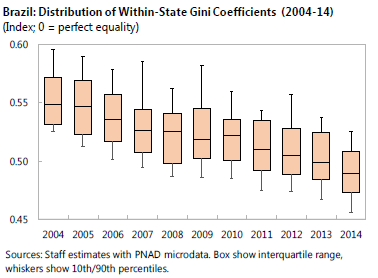
From a new IMF working paper: “In this study, we document the decline in income inequality and a convergence in consumption patterns in Brazilian states in a new database constructed from micro data from the national households’ survey. We adjust the state-Gini coefficients for spatial price differences using information on households’ rental prices available in the survey. In a panel regression framework, we find that labor income growth, formalization, and schooling contributed to the decline in inequality during 2004−14,
Posted by at 5:50 PM
Labels: Inclusive Growth
Building Resilience to Natural Disasters: An Application to Small Developing States
From a new IMF working paper: “We present a dynamic small open economy model to explore the macroeconomic impact of natural disasters. In addition to permanent damages to public and private capital, the disaster causes temporary losses of productivity, inefficiencies during the reconstruction process, and damages to the sovereign’s creditworthiness. We use the model to study the debt sustainability concerns that arise from the need to rebuild public infrastructure over the medium term and analyze the feasibility of ex ante policies, such as building adaptation infrastructure and fiscal buffers, and contrast these policies with the post-disaster support provided by donors. Investing in resilient infrastructure may prove useful, in particular if it is viewed as complementary to standard infrastructure, because it raises the marginal product of private capital, crowding in private investment, while helping withstand the impact of the natural disaster. In an application to Vanuatu, we find that donors should provide an additional 50% of pre-cyclone GDP in grants to be spent over the following 15 years to ensure public debt remains sustainable following Cyclone Pam. Helping the government build resilience on the other hand, reduces the risk of debt distress and at lower cost for donors.”
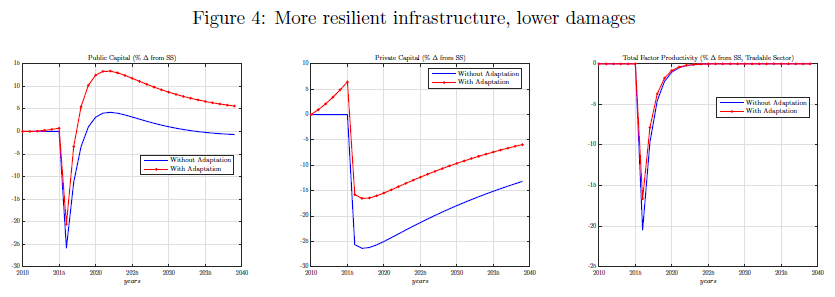
From a new IMF working paper: “We present a dynamic small open economy model to explore the macroeconomic impact of natural disasters. In addition to permanent damages to public and private capital, the disaster causes temporary losses of productivity, inefficiencies during the reconstruction process, and damages to the sovereign’s creditworthiness. We use the model to study the debt sustainability concerns that arise from the need to rebuild public infrastructure over the medium term and analyze the feasibility of ex ante policies,
Posted by at 9:40 AM
Labels: Energy & Climate Change
Subscribe to: Posts