



Saturday, May 5, 2018
Spring 2018 Journal of Economic Perspectives is Online
From a new post by Timothy Taylor:
“I was hired back in 1986 to be the Managing Editor for a new academic economics journal, at the time unnamed, but which soon launched as the Journal of Economic Perspectives. The JEP is published by the American Economic Association, which back in 2011 decided–to my delight–that it would be freely available on-line, from the current issue back to the first issue. Here, I’ll start with Table of Contents for the just-released Spring 2018 issue, which in the Taylor household is known as issue #124. Below that are abstracts and direct links for all of the papers. I will blog more specifically about some of the papers in the next week or two, as well.”

From a new post by Timothy Taylor:
“I was hired back in 1986 to be the Managing Editor for a new academic economics journal, at the time unnamed, but which soon launched as the Journal of Economic Perspectives. The JEP is published by the American Economic Association, which back in 2011 decided–to my delight–that it would be freely available on-line, from the current issue back to the first issue.
Posted by at 1:15 PM
Labels: Macro Demystified
Friday, May 4, 2018
The IMF’s Fight Against Corruption
From a new post by Frank Vogl:
“The International Monetary Fund is awakening from a long sleep with regard to combating corruption. If the IMF’s new policy announcements are followed by tough action, then the global fight against corruption could make real headway.
The IMF and the world’s leading central banks as well as finance ministries across the globe have been laggards in that fight. They have too often ignored corruption, even when it has been a direct cause of national economic disaster.
For many years, the IMF argued that its charter precludes it from getting involved in politics and that it had to focus exclusively on economics. That was always a lame excuse.
Devoted as it officially is to promoting sustainable economic growth, it has come to the realization that massive income inequality is due in large measure to corruption, as well as direct plunder of state coffers by leading public officials and politicians. Letting that practice fester, however, runs directly counter to achieving sustainable economic growth.
A more intrusive IMF
That is why the IMF’s Board of Directors has now at long last approved an anti-corruption “framework” to guide the work of the Fund’s staff. IMF Managing Director Christine Lagarde has issued a clear warning to governments everywhere: “We are going to be more intrusive.”
The last time the Fund firmly challenged a government on the issue of corruption was in the late 1990s when the Asian financial crisis hit. As Indonesia’s economy fell off a cliff, the government of then-president Suharto and the nation’s rotten banking system were in the IMF’s crosshairs.
Thereafter, as Argentina and Greece sought IMF rescue packages, the Fund seemed to have forgotten about corruption. This was all the more perplexing as cheating the national tax collector was a leading popular sport in both countries.”
Continue reading here.
From a new post by Frank Vogl:
“The International Monetary Fund is awakening from a long sleep with regard to combating corruption. If the IMF’s new policy announcements are followed by tough action, then the global fight against corruption could make real headway.
The IMF and the world’s leading central banks as well as finance ministries across the globe have been laggards in that fight.
Posted by at 8:55 AM
Labels: Inclusive Growth
Housing View – May 4, 2018
On the US:
- Nine rules for better housing policy – Brookings
- Can more housing supply solve the affordability crisis? Evidence from a neighborhood choice model – Regional Science and Urban Economics
- Land Use Regulations, Migration and Rising House Price Dispersion in the U.S. – University of Southern California
- Priced out of the American dream – Financial Times
- America Can’t Afford Ben Carson’s Housing Cuts – Bloomberg
- Getting it Right: Examining the Local Land Use Entitlement Process in California to Inform Policy and Process – Berkeley: Center for Law, Energy & the Environment
- Learning from Hurricane Sandy? Rising Seas and Housing Values in New York – ECONOFACT
On other countries:
- [Australia] Is Australia’s Housing Boom (Finally) Coming to an End? – Wall Street Journal
- [Canada] Mortgage Growth in Canada Hasn’t Been This Weak Since 2001 – Bloomberg
- [Canada] Canada’s Economy and Household Debt: How Big Is the Problem? – Bank of Canada
- [China] China’s Dandong property prices jump on Korea talks – Financial Times
- [Hong Kong] What Could End Hong Kong’s Property Boom? Here Are Some Triggers – Bloomberg
- [Israel] Housing Market in Israel – IMF
- [New Zealand] Loan-to-Value Ratio Restrictions and House Prices – Reserve Bank of New Zealand
- [New Zealand] Housing Leverage and Consumption Expenditure – Evidence from New Zealand Microdata – Reserve Bank of New Zealand
- [New Zealand] Land Use Regulation, The Redevelopment Premium and House Prices – University of Auckland
- [United Kingdom] Is innovation the answer to the chronic under-supply of housing in the UK? – Cambridge Centre for Housing & Planning Research

Photo by Aliis Sinisalu
On the US:
- Nine rules for better housing policy – Brookings
- Can more housing supply solve the affordability crisis? Evidence from a neighborhood choice model – Regional Science and Urban Economics
- Land Use Regulations, Migration and Rising House Price Dispersion in the U.S. – University of Southern California
- Priced out of the American dream – Financial Times
- America Can’t Afford Ben Carson’s Housing Cuts – Bloomberg
- Getting it Right: Examining the Local Land Use Entitlement Process in California to Inform Policy and Process – Berkeley: Center for Law,
Posted by at 5:00 AM
Labels: Global Housing Watch
Thursday, May 3, 2018
Learning from Hurricane Sandy? Rising Seas and Housing Values in New York
From ECONOFACT:
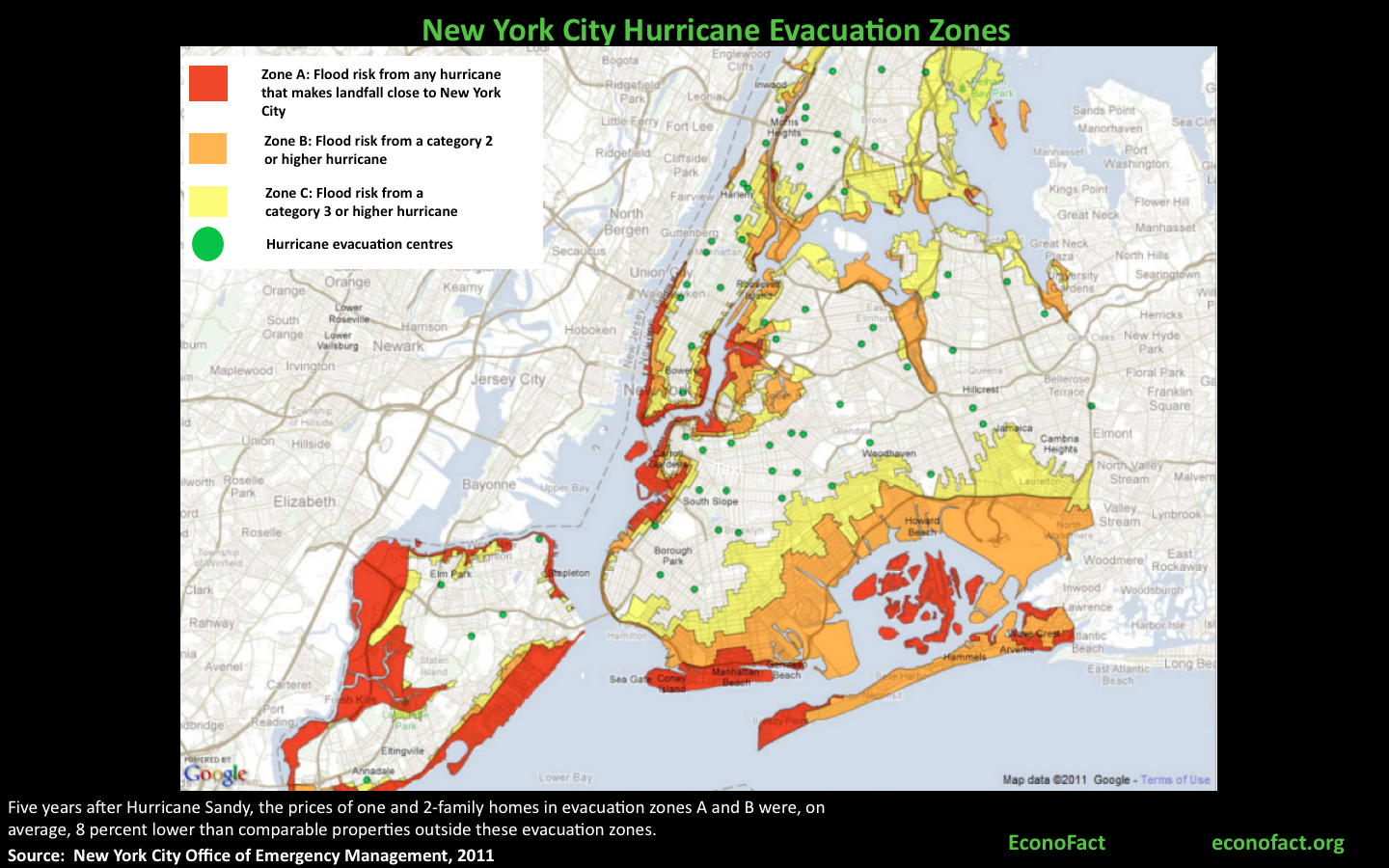
The Issue:
“The chance of large-scale coastal flooding episodes is increasing. In the last few decades, sea levels have been rising steadily at about 3 centimeters per decade and many estimates expect that this rate will accelerate going forward. At the same time, the population living in coastal counties in the United States grew by 40 percent between 1970 and 2010 and is projected to continue rising. Are people considering the increased risk of flooding associated with sea level rise in their housing decisions? Looking at what happened to property values in New York City after Hurricane Sandy gives us a first look at how those on the front lines may be responding.”
The Facts:
- “Past research has found the response of homebuyers towards flooding risks and the threat of other climate-related hazards to be short-lived. While a region’s exposure to hurricanes or flooding does not vary greatly from one year to the next, many studies have found that homebuyers tend to take these risks much more into account immediately following hurricanes and other catastrophic events. However, these effects tend to be short-lived —very often vanishing completely within five years (see here and here). Flood insurance take-up rates, for instance, have tended to spike the year after a flooding event and then gradually decline to the levels that prevailed before the flood. This response happened not only in the flooded zones but – to a lesser extent — also in non-flooded areas in the same television media markets according to one study. While the risk of flooding remains objectively the same, people may be more aware of it following a flood and then tend to forget about it with the passage of time. It is also possible that, as time goes by, new people who have had less direct exposure to the risk move into the area. These facts suggest a gap between objective probabilities of flood risk and households’ perceptions of this risk. In addition to the psychological biases mentioned, coordination problems, misguided policies, and the expectation of financial assistance by the government in case of disaster might contribute to a mismatch between home prices and damage risk.”
- “Hurricane Sandy was a climatic event of unprecedented proportions that impacted the Greater New York region. The storm hit New York on October 29, 2012. At the time, Sandy was the largest Atlantic hurricane on record and the second costliest in U.S. history (behind Hurricane Katrina), with damages amounting to over $19 billion. Hurricane Sandy flooded 17 percent of New York City (or nearly 90,000 buildings).”
Continue reading here.
From ECONOFACT:
The Issue:
“The chance of large-scale coastal flooding episodes is increasing. In the last few decades, sea levels have been rising steadily at about 3 centimeters per decade and many estimates expect that this rate will accelerate going forward. At the same time, the population living in coastal counties in the United States grew by 40 percent between 1970 and 2010 and is projected to continue rising.
Posted by at 3:31 PM
Labels: Global Housing Watch
Retail Apocalypse Postponed Not Cancelled
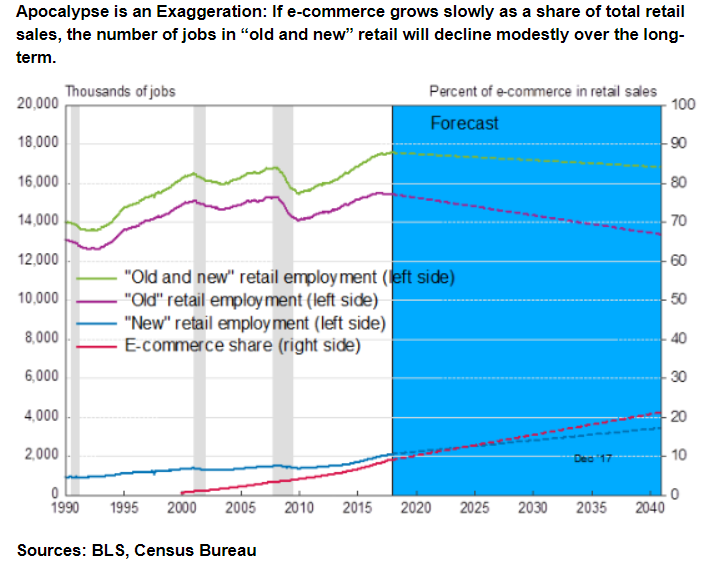
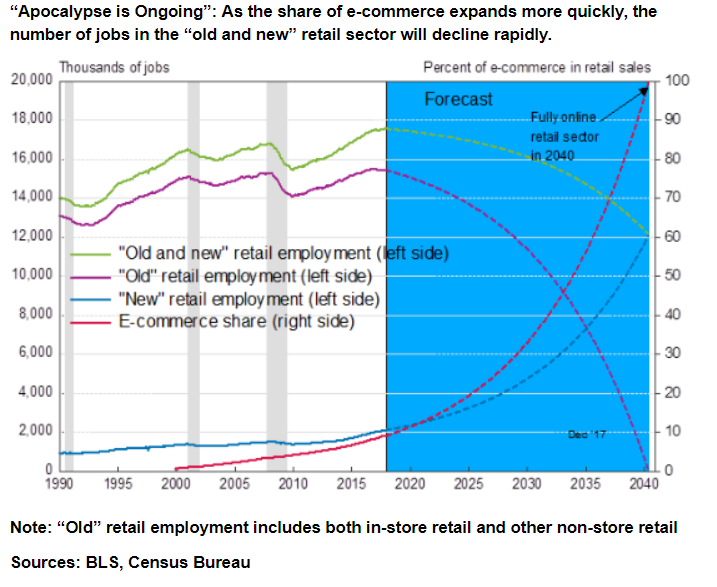
A new post by Brian Schaitkin says that “Economist Michael Mandel of the Progressive Policy Institute tells a reassuring story about what will happen to retail employment. Jobs behind retail counters and stocking store aisles will simply be replaced by jobs at warehouses, e-commerce facilities, and as delivery drivers.” How quickly will this happen? He provides forecasts under the “Apocalypse is an Exaggeration” and “Apocalypse is Ongoing” scenarios:
“[…] Under an “Apocalypse is an Exaggeration” scenario, e-commerce will grow at a modest pace as a share of total retail sales because many of the lowest hanging e-commerce fruit have already been plucked. Therefore, the transformation from in-store retail to e-commerce would take quite a long time. The logistical challenge of shipping books to individual customers is orders of magnitude less complicated than delivering groceries. The “in-store” experience also provides special value to some consumers, especially when the ability to touch and feel merchandise and consult with experts is part of the value proposition stores and their workers provide. Firms will learn how to adapt to the challenge of e-commerce in less easily adapted industries, but because of these challenges, growth in the e-commerce share may increase by only 6.8 percent every 13 years, as happened between 2005 and 2017. Under this scenario, the share of e-commerce in retail sales would be 21 percent by the end of 2040, and the “old and new” retail sector will employ 16.8 million workers, compared to 17.6 million today. A disappointing job trajectory to be sure, but hardly apocalyptic.”
“The 2005 to 2017 period though lights the way to a bolder, yet in my view more likely “Apocalypse is Ongoing” scenario. This scenario assumes that exponential growth of the e-commerce share will continue as it did from 2005 to 2017 meaning that the e-commerce share of retail will double every 6.5 years. Incentives for firms to adapt new sectors to e-commerce will be tremendous due to the convenience and efficiency commerce without stores can provide. Companies can apply the lessons from developing one form of e-commerce to new product areas with knowledge of the pitfalls they are likely to encounter. Under this scenario, e-commerce would represent 18 percent of retail sales by the middle of 2024, 36 percent by the end of 2030, and 100 percent by the middle of 2040. Initially, job losses resulting from the shift to e-commerce would be small in “old and new” retail with 738,000 jobs disappearing between now and the end of 2025. By 2040, however, only 12.1 million workers, all employed by “new” retail sectors, would be able to manage all retail sales activities, a loss of 5.5 million jobs.”
Continue reading here.
A new post by Brian Schaitkin says that “Economist Michael Mandel of the Progressive Policy Institute tells a reassuring story about what will happen to retail employment. Jobs behind retail counters and stocking store aisles will simply be replaced by jobs at warehouses, e-commerce facilities, and as delivery drivers.” How quickly will this happen? He provides forecasts under the “Apocalypse is an Exaggeration” and “Apocalypse is Ongoing” scenarios:
“[…] Under an “Apocalypse is an Exaggeration” scenario,
Posted by at 10:13 AM
Labels: Forecasting Forum, Inclusive Growth
Subscribe to: Posts