



Monday, February 18, 2019
Economics for Inclusive Prosperity (EfIP)
From Dani Rodrik’s weblog:
“We launched today a new initiative for academic economists that we hope will make the discipline of Economics more relevant to today’s pressing policy problems. The initiative consists of a network called Economics for Inclusive Prosperity (EfIP) with an initial set of 10 policy briefs. The briefs open with an introductory statement of our philosophy and go on to specific policy recommendations for finance, trade, labor markets, social policy, technology policy, and political institutions. The network is co-directed by Suresh Naidu, Gabriel Zucman, and me, and has 11 additional founding members. We hope to expand the group and we will add more policy briefs in the months ahead.
As we state in our introduction, we believe
mainstream economics – the kind of economics that is practiced in the leading academic centers of the country – is indispensable for generating useful policy ideas. Much of this work is already being done. In our daily grind as professional economists, we see a lot of policy ideas being discussed in seminar rooms, policy forums, and social media. There is considerable ferment in economics that is often not visible to outsiders. At the same time, the sociology of the profession – career incentives, norms, socialization patterns – often mitigates against adequate engagement with the world of policy, especially on the part of younger academic economists.
The problem is compounded by the lousy reputation Economics has acquired among proponents of an inclusive economy. Too often the discipline is viewed as the source of the policies that have produced the excesses and fragilities of our time. Mainstream economics and neoliberalism are viewed as one and the same.
We beg to differ:
Many of the dominant policy ideas of the last few decades are supported neither by sound economics nor by good evidence. Neoliberalism – or market fundamentalism, market fetishism, etc. — is a perversion of mainstream economics, rather than an application thereof. And contemporary economics research is rife with new ideas for creating a more inclusive society. But it is up to us economists to convince their audience about the merits of these claims.”
From Dani Rodrik’s weblog:
“We launched today a new initiative for academic economists that we hope will make the discipline of Economics more relevant to today’s pressing policy problems. The initiative consists of a network called Economics for Inclusive Prosperity (EfIP) with an initial set of 10 policy briefs. The briefs open with an introductory statement of our philosophy and go on to specific policy recommendations for finance,
Posted by at 3:40 PM
Labels: Inclusive Growth
Saturday, February 16, 2019
Inequality of Opportunity, Inequality of Income and Economic Growth
From a new IMF working paper by Shekhar Aiyar and Christian Ebeke:
“We posit that the relationship between income inequality and economic growth is mediated by the level of equality of opportunity, which we identify with intergenerational mobility. In economies characterized by intergenerational rigidities, an increase in income inequality has persistent effects—for example by hindering human capital accumulation—thereby retarding future growth disproportionately. We use several recently developed internationally comparable measures of intergenerational mobility to confirm that the negative impact of income inequality on growth is higher the lower is intergenerational mobility. Our results suggest that omitting intergenerational mobility leads to misspecification, shedding light on why the empirical literature on income inequality and growth has been so inconclusive.”
From a new IMF working paper by Shekhar Aiyar and Christian Ebeke:
“We posit that the relationship between income inequality and economic growth is mediated by the level of equality of opportunity, which we identify with intergenerational mobility. In economies characterized by intergenerational rigidities, an increase in income inequality has persistent effects—for example by hindering human capital accumulation—thereby retarding future growth disproportionately. We use several recently developed internationally comparable measures of intergenerational mobility to confirm that the negative impact of income inequality on growth is higher the lower is intergenerational mobility.
Posted by at 2:44 PM
Labels: Inclusive Growth
Friday, February 15, 2019
Housing View – February 15, 2019
On cross-country:
- Urban Futures – 2019 – Knight Frank
- Global affordable housing gap reaches $740 billion – Guardian
On the US:
- America Isn’t Building Enough New Housing – Bloomberg
- Housing Indicators to Watch in 2019 – Federal Reserve Bank of St. Louis
- Renting the American Dream: Why homeownership shouldn’t be a prerequisite for middle-class financial security – Brookings
- When Wall Street Is Your Landlord – The Atlantic
On other countries:
- [Ireland] Ireland’s rising house prices lead to tough choices – Financial Times
- [Malta] The Evolution of the Housing Stock in Malta – Central Bank of Malta
- [Netherlands] Knot Sounds Alarm Over the Impact of Dutch House-Price Swings – Bloomberg
- [United Kingdom] New stamp duty land tax surcharge for non-UK resident homebuyers to be introduced – UK
- [United Kingdom] A lack of affordable homes is forcing young Britons to live with their parents – World Economic Forum
On cross-country:
- Urban Futures – 2019 – Knight Frank
- Global affordable housing gap reaches $740 billion – Guardian
On the US:
- America Isn’t Building Enough New Housing – Bloomberg
- Housing Indicators to Watch in 2019 – Federal Reserve Bank of St. Louis
- Renting the American Dream: Why homeownership shouldn’t be a prerequisite for middle-class financial security – Brookings
- When Wall Street Is Your Landlord – The Atlantic
Posted by at 7:20 AM
Labels: Global Housing Watch
Wednesday, February 13, 2019
Housing Market in Croatia
From the IMF’s latest report on Croatia:
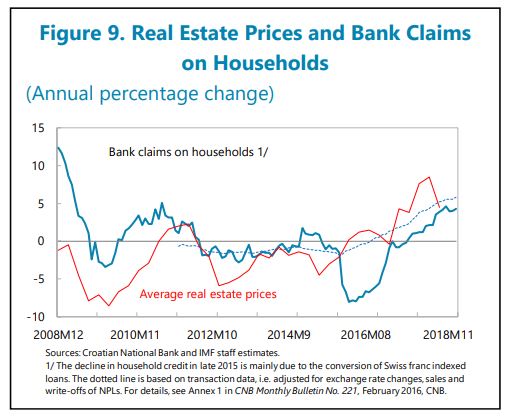
“The real estate market is also picking up, albeit from a low base and the recovery is rather segmented. Should both household borrowings and real estate prices further accelerate, additional macro prudential measures may need to be considered, including a comprehensive debt-service-to-income ratio capturing all debts, not just debts related to housing loans. Since May 2018, new loans are no longer reported to the credit register run by the Croatian Banking Association due to concerns of some banks about the implementation of the General Data Protection Regulation (GDPR). Staff recommended to shortly resolve these legal issues.”
“Macroprudential policies can contain possible pressure points. If real estate prices accelerate or high growth of cash loans persists, authorities could consider the introduction of additional measures to prevent excessive household borrowing (e.g., more comprehensive use of debt-service-to-income limits). Enhancements to the efficiency of bankruptcy procedures (e.g., by facilitating out-of-court settlements) would help further private sector deleveraging. Despite recent changes in the bankruptcy legislation, a comprehensive review to ensure that the insolvency framework aligns with best practices merits strong consideration.”
From the IMF’s latest report on Croatia:
“The real estate market is also picking up, albeit from a low base and the recovery is rather segmented. Should both household borrowings and real estate prices further accelerate, additional macro prudential measures may need to be considered, including a comprehensive debt-service-to-income ratio capturing all debts, not just debts related to housing loans. Since May 2018, new loans are no longer reported to the credit register run by the Croatian Banking Association due to concerns of some banks about the implementation of the General Data Protection Regulation (GDPR).
Posted by at 9:40 AM
Labels: Global Housing Watch
Tuesday, February 12, 2019
Housing Market in the Netherlands
From the latest IMF report on the Netherlands:
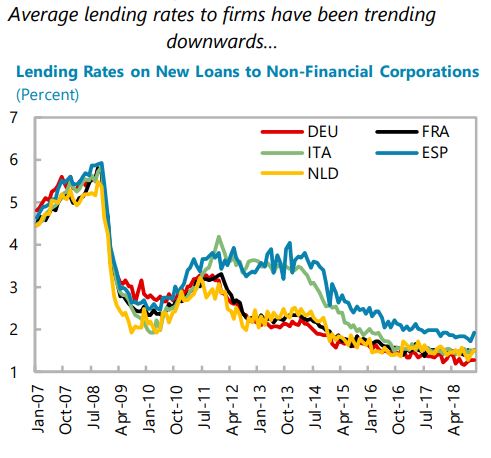
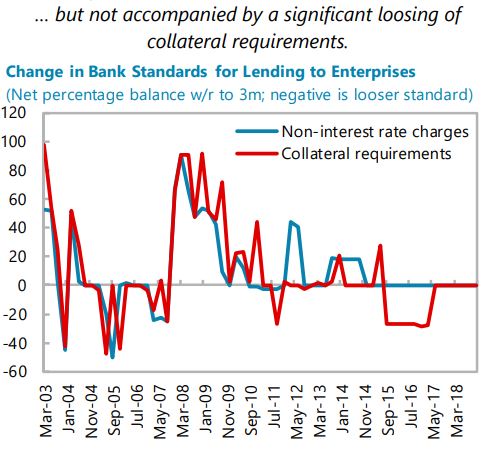
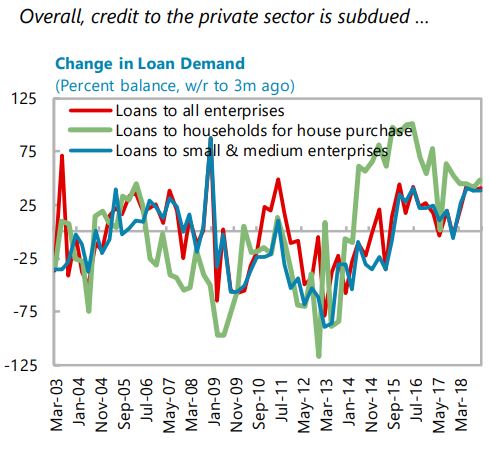
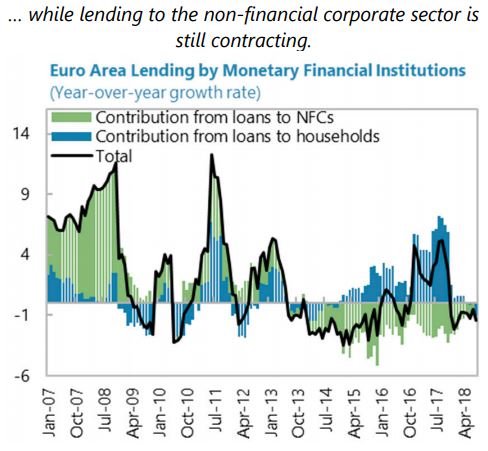
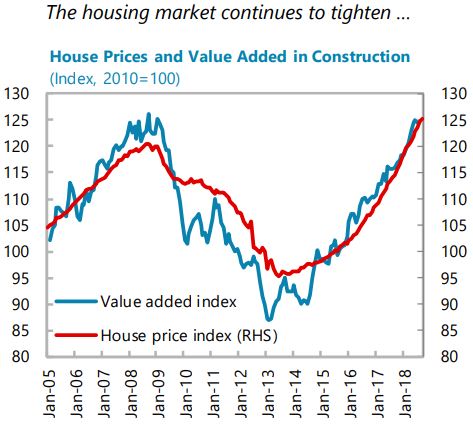
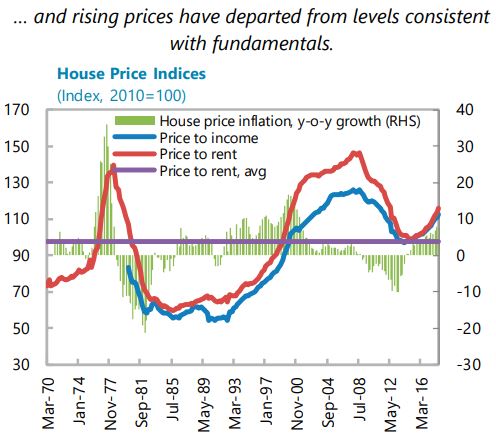
“The housing market is dominated by social housing (with a wait time exceeding a decade in some cases) and owner-occupied houses with significant shortages. The absence of a robust private rental market leaves young households, in particular, with little alternative to purchasing owner-occupied housing with high leverage and thin financial buffers. Rent controls, regulations, and inadequate means-testing result in long waiting lists for social housing. Elevated demand for owner-occupied houses was encouraged by generous mortgage interest deductibility (MID) in the past, which also boosted house prices. As macro-prudential policies were tightened recently, households’ debt has stabilized at about 250 percent of net disposable income, but it remains the second highest among OECD countries. Overborrowing on mortgages has contributed to the accumulation of household debt. When housing prices declined sharply after the global financial crisis (GFC), many mortgages were underwater and private consumption contracted sharply as households attempted to rebuild their net worth. Nevertheless, household overborrowing on mortgages is not a significant source of systemic risk in the financial sector even though it is a threat to the macro-economy
To reduce household debt and improve housing affordability, it is necessary to increase housing supply, tighten macro-prudential policies, and further reduce the debt bias in the tax system. Liberalizing rent controls for higher-income households and improving means-testing for social housing would help optimize allocation and improve housing supply. In addition, private investment should be encouraged by relaxing restrictions on zoning plans and simplifying administrative procedures for building permits. Lowering the maximum loan-to-value (LTV) ratio to no more than 90 percent (from 100 percent currently) and capping the debt service to income (DSTI) ratio to limit its procyclicality should be considered. The authorities plan to accelerate the phasing down of MID by 3 percentage points per year starting from 2020 until the basic rate of 37.05 percent is reached is a welcome step. Further phasing down of MID, to bring it at a neutral level compared with taxation of investment in other type of assets, would not only generate additional revenues but also help address the current debt bias of households.
The authorities emphasized that the focus is currently on increasing housing supply, while giving due consideration to possible tighter macro-prudential policies. To increase supply, the authorities are taking actions to improve coordination among the main stakeholders, including the relevant ministries, subnational governments, and private investors to reduce building preparation time, stimulate the transformation of suitable areas like outdated industrial areas for housing, and increase the amount of new construction plans. The authorities noted that the coalition agreement does address previous IMF recommendations to lower the MID but does not follow the previous IMF and Financial Stability Committee (FSC) recommendation to further lower LTV limits beyond the 100 percent ratio. The authorities noted that a lower LTV limit would make it more difficult, especially for younger households, to buy a house, while the middle-range rental market is already tight. The Dutch Central Bank and the Financial Market Authority noted that the current DSTI framework has procyclical elements. Increasing risk weights on mortgages in banks’ balance sheets and activating the countercyclical buffer could be considered if household debt continues to rise due to further tightening of the housing market.”
From the latest IMF report on the Netherlands:
“The housing market is dominated by social housing (with a wait time exceeding a decade in some cases) and owner-occupied houses with significant shortages. The absence of a robust private rental market leaves young households, in particular, with little alternative to purchasing owner-occupied housing with high leverage and thin financial buffers. Rent controls, regulations, and inadequate means-testing result in long waiting lists for social housing.
Posted by at 2:27 PM
Labels: Global Housing Watch
Subscribe to: Posts