



Friday, February 21, 2020
Housing View – February 21, 2020
On cross-country:
- Property price dynamics: domestic and international drivers – Bank for International Settlements
- Forget London House Prices. Take a Look at Paris – Bloomberg
On the US:
- Victims of NIMBYism, Unite – The Atlantic
- Technology is poised to upend America’s property market – Economist
- The cost of buying and selling homes is too high – Economist
- When California’s housing crisis slammed into a wealthy suburb, one public servant became a convert to a radically simple doctrine – New York Times
- Discriminatory housing practices are leading to the devaluation of Black Americans – Brookings
- The Distributional Impact of the Sharing Economy on the Housing Market – Harvard University
- Amid Climate And Housing Crises, Cities Struggle To Place Housing Near Transit – NPR
- Corporate Landlords Aren’t the Real Culprit – The Atlantic
- 10 Surprising Facts from America’s Rental Housing 2020 – Harvard Joint Center for Housing Studies
- Black Homeownership Shows Signs of Healing From the Wounds of the Great Recession – Zillow
- Supply Shock Versus Demand Shock: The Local Effects of New Housing in Low-Income Areas – Philadelphia Fed
- California Housing Crisis Podcast: Presidential candidates want to make housing affordable – Los Angeles Times
- California Housing Market is Coming Back (Podcast) – Bloomberg
- Offering renters longer leases could improve their financial health and happiness – Brookings
- Home Value Growth Expected to Re-Accelerate Just in Time For Home Shopping Season – Zillow
On other countries:
- [Australia] The Distributional Effects of Monetary Policy: Evidence from Local Housing Markets – Reserve Bank of Australia
- [Canada] Canada tweaks mortgage stress test in move that could boost housing market – Reuters
- [China] China’s Real-Estate Market Is Coronavirus Latest Victim – Wall Street Journal
- [Czech Republic] Prague’s unaffordable Old Town sends homebuyers to the suburbs – Financial Times
- [Ireland] Irish house prices grow at slowest rate in six years – Reuters
- [Ireland] Ireland’s political mess rooted in QE house price fallout – Financial Times
- [Netherlands] What is fuelling the Dutch house price boom? – Bruegel
- [South Africa] How Cape Town’s drought led to a housing market downturn – Financial Times
- [United Kingdom] How to fix Britain’s housebuilding problem – Financial Times
On cross-country:
- Property price dynamics: domestic and international drivers – Bank for International Settlements
- Forget London House Prices. Take a Look at Paris – Bloomberg
On the US:
- Victims of NIMBYism, Unite – The Atlantic
- Technology is poised to upend America’s property market – Economist
- The cost of buying and selling homes is too high – Economist
- When California’s housing crisis slammed into a wealthy suburb,
Posted by at 5:00 AM
Labels: Uncategorized
Wednesday, February 19, 2020
The accuracy of long-term growth forecasts by economics researchers
From a new VOX post on long-term growth forecasts:
“Although long-term macroeconomic forecasts substantially affect the sustainability of government debt and the social security system, they cannot avoid significant uncertainty. This column assesses whether academic researchers in economics make accurate long-term growth forecasts, comparing ten-year growth forecasts made by Japanese economists in 2006–2007 with the realised figures. Even excluding the years affected by the Global Crisis, the results show that forecasts tend to be biased upwards and involve significant uncertainty, even for economics researchers specialising in macroeconomics or economic growth.”
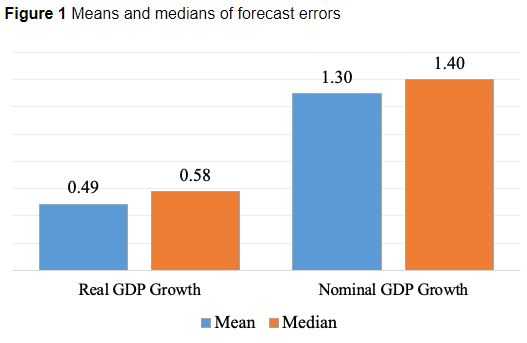
“Figure 1 shows the means and medians of forecast errors. Forecasts by the researchers in economics have an optimistic bias, similar to the findings for the forecasts by the government agencies. Even after removing the two years affected by the Global Crisis to calculate annual growth rates, a non-negligible upward bias remains: about 0.5-0.6 percentage points for real GDP growth and about 1.3-1.4 percentage points for nominal GDP growth. ”
From a new VOX post on long-term growth forecasts:
“Although long-term macroeconomic forecasts substantially affect the sustainability of government debt and the social security system, they cannot avoid significant uncertainty. This column assesses whether academic researchers in economics make accurate long-term growth forecasts, comparing ten-year growth forecasts made by Japanese economists in 2006–2007 with the realised figures. Even excluding the years affected by the Global Crisis, the results show that forecasts tend to be biased upwards and involve significant uncertainty,
Posted by at 2:55 PM
Labels: Forecasting Forum
Distributional Implications of Labor Market Reforms: Learning from Spain’s Experience
From a new IMF working paper by Ara Stepanyan and Jorge Salas
“Spain’s structural reforms, implemented around 2012, have arguably contributed to a faster and stronger economic recovery. In particular, there is strong evidence that the 2012 labor market reforms increased wage flexibility, which helped the Spanish economy to regain competitiveness and create jobs. But the impact of these labor reforms on income inequality and social inclusion has not been analyzed much. This paper aims to shed light on this issue by employing an econometric decomposition procedure combined with the synthetic control method. The results indicate that the 2012 labor reforms have helped improve employment and income equality outcomes with no substantial impact on the overall risk of poverty. Nevertheless, the reforms appear to have induced a deterioration of average hours worked, in-work poverty, and possibly also of involuntary part-time employment.”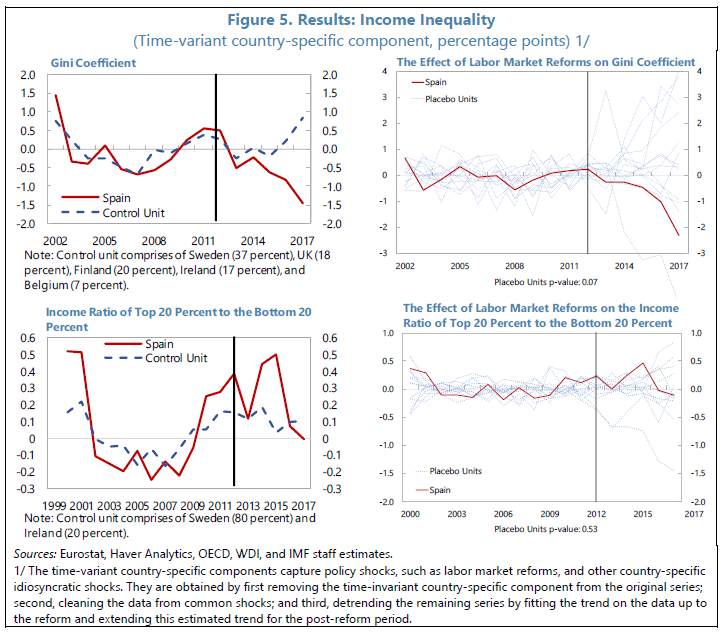
From a new IMF working paper by Ara Stepanyan and Jorge Salas
“Spain’s structural reforms, implemented around 2012, have arguably contributed to a faster and stronger economic recovery. In particular, there is strong evidence that the 2012 labor market reforms increased wage flexibility, which helped the Spanish economy to regain competitiveness and create jobs. But the impact of these labor reforms on income inequality and social inclusion has not been analyzed much.
Posted by at 1:31 PM
Labels: Inclusive Growth
House prices in Croatia
From the IMF’s latest report on Croatia:
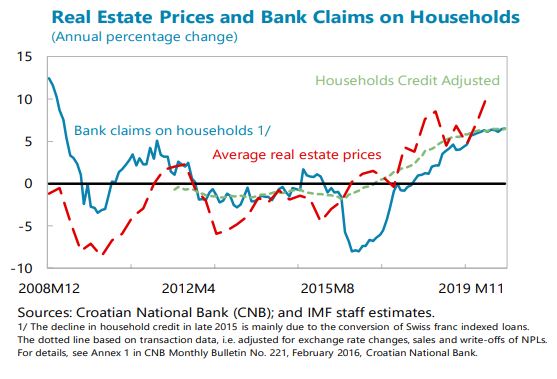
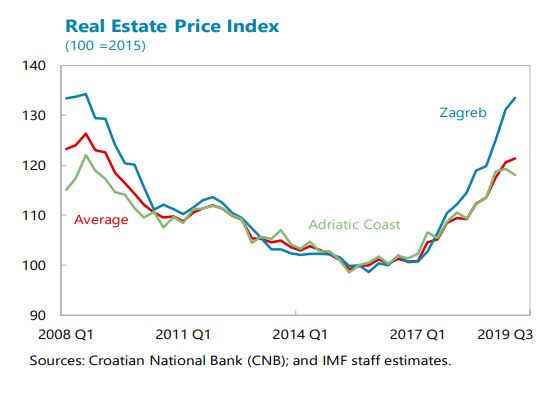
“Housing prices have begun to accelerate, mainly in the capital and coastal areas. Average housing prices grew 8.0 percent, but 12.2 percent in Zagreb (yoy, September 2019). This increase should be seen in context of higher real wages, better employment prospects, growing consumer confidence, as well as declining interest rates. Tourism is the main driver of real estate price developments in Zagreb and the coast. Investment properties for short-term rentals have grown rapidly. This is facilitated by a favorable flat-tax on short-term rentals compared to higher taxation on long-term rentals. Market observers note that some of these purchases are not loan-financed, but they still assume that the majority is financed by bank loans. The market has also been supported by the government’s housing loan subsidy program for young first-time house buyers introduced in 2017 and the reduction of the real estate transfer tax since 2019. According to the CNB’s housing price index, real estate prices are now beginning to reach pre-crisis levels. Staff recommended that housing prices should be monitored with a holistic approach taking into account mortgage lending, general purpose loans that might be diverted to real estate, as well as government housing subsidies on the demand side. Also, the impacts that the current tourism boom and tourism rental taxation policies have on the supply of housing for purchase need to be taken into consideration. The mission welcomed current research efforts of the CNB to better gauge housing affordability.”
From the IMF’s latest report on Croatia:
“Housing prices have begun to accelerate, mainly in the capital and coastal areas. Average housing prices grew 8.0 percent, but 12.2 percent in Zagreb (yoy, September 2019). This increase should be seen in context of higher real wages, better employment prospects, growing consumer confidence, as well as declining interest rates. Tourism is the main driver of real estate price developments in Zagreb and the coast.
Posted by at 10:03 AM
Labels: Global Housing Watch
Tuesday, February 18, 2020
Property price dynamics: domestic and international drivers
From BIS:
“Although residential and commercial real estate prices are increasingly moving in sync and the role of international investors is growing, this does not mean that there is a global real estate market, a report by the Committee on the Global Financial System finds.
Property price dynamics: domestic and international drivers documents recent trends in residential and commercial property prices in over 20 countries, gives an overview of key drivers of price developments and describes policy initiatives used to manage associated risks to the economy and financial stability.
Property prices have been rising, reaching record highs in many countries. As prices appear high in comparison to simple rule-of-thumb valuation benchmarks, such as rents and incomes, some central banks are concerned about the consequences of a potential correction. In many cases, however, current price developments can be largely explained by fundamental drivers such as interest rates and income, the report finds.
“A key takeaway is that even if prices (both residential and commercial) have become more synchronised over the past decade, this doesn’t imply that we now have a global real estate market,” said Study Group Chair Paul Hilbers, Director of Financial Stability at the Netherlands Bank.
“Significant differences in cross country price dynamics reflect the strength of local drivers. Some drivers are more important in some countries than in others.”
A third highlight is evidence of the growing role of international investors in many markets. Policymakers have found they need alternative tools to deal with foreign buyers. These investors do not fund their purchases through local banks, so fiscal tools like higher stamp studies may be more effective than macroprudential policy.
The CGFS is a central bank forum for the monitoring and analysis of broad financial system issues. It supports central banks in the fulfilment of their responsibilities for monetary and financial stability by contributing appropriate policy recommendations.”
From BIS:
“Although residential and commercial real estate prices are increasingly moving in sync and the role of international investors is growing, this does not mean that there is a global real estate market, a report by the Committee on the Global Financial System finds.
Property price dynamics: domestic and international drivers documents recent trends in residential and commercial property prices in over 20 countries,
Posted by at 9:15 AM
Labels: Global Housing Watch
Subscribe to: Posts