



Wednesday, December 1, 2021
A new survey-based measure of economic uncertainty
Economists Christian Gayer and Andreas Reuter of the European Commission (EC) and Fiona Morice of the French National Institute of Statistics and Economic Studies write about the EC’s new index of uncertainty in a recent column for the VoxEU blog.
For the lack of a better indicator, economists have often resorted to measuring uncertainty using proxies like deviation of agents’ views on economic outlooks or forecast errors. However, this new index aims to study the evolution of uncertainty in response to the Covid-19 pandemic and related stringent restrictions based on the EU-wide Programme of Business and Consumer Surveys. It also compares the indicator to survey-based indicators of economic confidence, as well as to other existing uncertainty gauges, and offers a glimpse of the rich set of geographical, sectoral, and sub-sectoral breakdowns of the new data.
The column dives deeper into the levels of analysis possible using disaggregated data on various parameters that it presents, such as at the industrial and sub-sectoral level, for consumers grouped by several socio-economic categories etc., and then discusses some key insights.
Click here to read the full blog.
Economists Christian Gayer and Andreas Reuter of the European Commission (EC) and Fiona Morice of the French National Institute of Statistics and Economic Studies write about the EC’s new index of uncertainty in a recent column for the VoxEU blog.
For the lack of a better indicator, economists have often resorted to measuring uncertainty using proxies like deviation of agents’ views on economic outlooks or forecast errors. However, this new index aims to study the evolution of uncertainty in response to the Covid-19 pandemic and related stringent restrictions based on the EU-wide Programme of Business and Consumer Surveys.
Posted by at 7:27 AM
Labels: Inclusive Growth
Monday, November 29, 2021
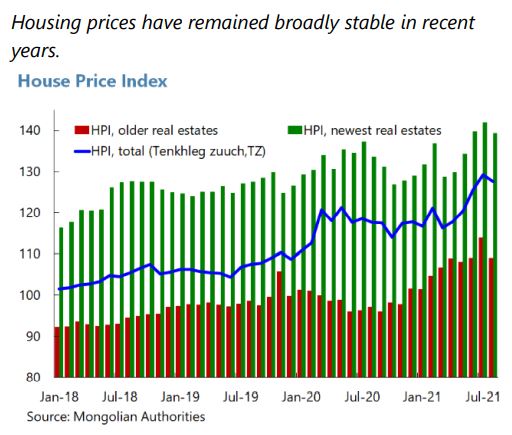
House Prices in Mongolia
Posted by at 6:16 PM
Labels: Global Housing Watch
The Economic Middle Class and Welfare Policy Implications
Discussions about welfare and development often revolve around the usage of income thresholds to analyze changes in living standards and the well-being of individuals. While many studies emphasize the growing gap between those falling under the upper and lower tails of the income distribution table, it is the middle that is often dismissed in such development stories, and perhaps wrongfully so.
In a recent column for the Brookings Institution (2021), economists Kimberly Blair Bloch and Luis F. Lopez-Calva bring this issue into the spotlight and discuss considering median, rather than the mean income, as an insightful estimate of the “middle”. Their findings highlight three major points- (a) the mean and median incomes have risen steadily over the years in all countries (2002-2019); (b) median income has grown more rapidly than mean income in all countries; (c) and, the ratio of mean to median income has fallen in all countries.
Thus, they observe that income distributions in all countries are gradually tending towards a more normal distribution than a positively skewed one, which has the very important policy implication that the “middle” class can simply not be ignored by policymakers any longer.
Click here to read the full article.
Discussions about welfare and development often revolve around the usage of income thresholds to analyze changes in living standards and the well-being of individuals. While many studies emphasize the growing gap between those falling under the upper and lower tails of the income distribution table, it is the middle that is often dismissed in such development stories, and perhaps wrongfully so.
In a recent column for the Brookings Institution (2021), economists Kimberly Blair Bloch and Luis F.
Posted by at 10:05 AM
Labels: Inclusive Growth
Saturday, November 27, 2021
Kaushik Basu explains the Global Inflation Conundrum
Former chief economist of the World Bank and chief economic adviser to the Government of India, Dr. Kaushik Basu, wrote for a recent column at Project Syndicate about countries’ widely disparate experiences with inflation today.
“From the US and Brazil to Turkey and India, growing price pressures are leaving policymakers facing some difficult decisions. Unlike in many previous global inflationary episodes, what is remarkable this time is how different the cross-country experiences have been.“
He observes that the world’s recent collective brush with inflation today is very different from the past because even while recovery from Covid-19 led disruptions is a common feature of all economies, their diverse responses to the crisis have churned out diverse economic scenarios.
Click here to read the full article.
Former chief economist of the World Bank and chief economic adviser to the Government of India, Dr. Kaushik Basu, wrote for a recent column at Project Syndicate about countries’ widely disparate experiences with inflation today.
“From the US and Brazil to Turkey and India, growing price pressures are leaving policymakers facing some difficult decisions. Unlike in many previous global inflationary episodes, what is remarkable this time is how different the cross-country experiences have been.
Posted by at 1:06 PM
Labels: Inclusive Growth
Demographia United States Housing Affordability: 188 Markets Rated
From New Geography:
“The Urban Reform Institute has published the 2021 edition of Demographia United States Housing Affordability, which rates middle-income housing affordability in the third quarter 2020. Demographia United States Housing Affordability is a supplement to Demographia International Housing Affordability, which covers 92 major housing markets (1,000,000 or more population) in 8 nations (Australia, Canada, China [Hong Kong only], Ireland, New Zealand, Singapore, the United Kingdom and the United States). The Demographia United States Housing Affordability provides ratings in 188 markets, including the 56 major metropolitan areas included in the earlier report.
Over the past year, housing affordability has deteriorated. Urban Reform Institute President Charles Blain noted: “It is not surprising that housing affordability — given the large influx of new buyers, particularly in suburban and outlying areas — has continued to deteriorate. As a result, many low-income and middle-income households who already have suffered the worst consequences from housing inflation will see their standards of living further decline.”
Rating Housing Affordability (The Median Multiple)
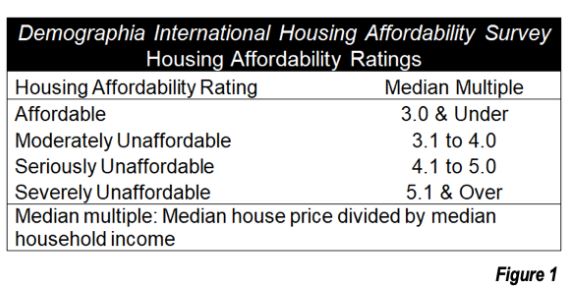
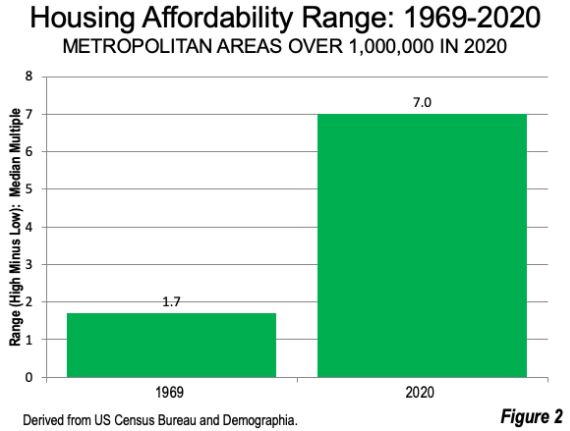
Demographia rates middle-income housing affordability in four categories, ranging from the most affordable (“affordable”) to the least affordable (“severely unaffordable”), as is indicated in Figure 1. As late as the 1990s price-to-income ratios were at or below 3.0 in Australia, Ireland, New Zealand, the United Kingdom and the United States, in markets rated “affordable. Since then, there has been a substantial divergence in affordability between major markets, which research has associated with stronger land use regulation (especially urban containment). The range between least affordable and most affordable markets rose by more than four times from 1969 to 2020 (Figure 2).”
Continue reading here.
From New Geography:
“The Urban Reform Institute has published the 2021 edition of Demographia United States Housing Affordability, which rates middle-income housing affordability in the third quarter 2020. Demographia United States Housing Affordability is a supplement to Demographia International Housing Affordability, which covers 92 major housing markets (1,000,000 or more population) in 8 nations (Australia, Canada, China [Hong Kong only],
Posted by at 7:06 AM
Labels: Global Housing Watch
Subscribe to: Posts