


Tuesday, January 11, 2022
A Measurement of Aggregate Trade Restrictions and their Economic Effects
Source: IMF Working Paper (2022)
In this paper, the authors have developed a new measure of aggregate trade restrictions (MATR) using data from the IMF’s Annual Report on Exchange Arrangements and Exchange Restrictions. It covers an unbalanced panel of 157 countries annually between 1949 and 2019, and is correlated with existing measures of openness and trade policy.
“MATR aggregates the multitude of ways that countries restrict the international trade of goods and services. The underlying variables cover tariffs, non-tariff barriers, and restrictions on requiring, obtaining, and using foreign exchange for current transactions. More precisely, MATR is based on the IMF’s AREAER binary variables related to: (i) exchange measures; (ii) arrangements for payments and receipts; (iii) imports and imports payments; (iv) exports and exports proceeds; and (v) payment and proceeds from invisible transfers and current transfers.”
In the second half of the paper, they establish its efficiency as a measure by using it to investigate the aftermath of trade restrictions across parameters like region, time, income groups etc.
Source: IMF Working Paper (2022)
In this paper, the authors have developed a new measure of aggregate trade restrictions (MATR) using data from the IMF’s Annual Report on Exchange Arrangements and Exchange Restrictions. It covers an unbalanced panel of 157 countries annually between 1949 and 2019, and is correlated with existing measures of openness and trade policy.
“MATR aggregates the multitude of ways that countries restrict the international trade of goods and services.
Posted by at 9:29 AM
Labels: Macro Demystified
Monday, January 10, 2022
Prime Real Estate Newsletter – January 2022
[embeddoc url=”https://unassumingeconomist.com/wp-content/uploads/2022/01/PR_2022_01-5.docx”] Read the full article…
Posted by at 4:12 PM
Labels: Global Housing Watch
Clubs and Networks in Economics Reviewing
Source: NBER Working Paper (2022)
“Results show that clubs and networks play a large role in influencing both editor and reviewer decisions. Authors who attended the same PhD program, were ever colleagues with, are affiliates of the same NBER program(s), or are more closely linked via coauthorship networks as the handling editor are significantly more likely to avoid a desk rejection. Likewise, authors from the same PhD program or who previously worked with the reviewer are significantly more likely to receive a positive evaluation. We also find that sharing “signals” of ability, such as publishing in “top five”, attending a high ranked PhD program, or being employed by a similarly ranked economics department significantly influences editor decisions and/or reviewer recommendations.”
Source: NBER Working Paper (2022)
“Results show that clubs and networks play a large role in influencing both editor and reviewer decisions. Authors who attended the same PhD program, were ever colleagues with, are affiliates of the same NBER program(s), or are more closely linked via coauthorship networks as the handling editor are significantly more likely to avoid a desk rejection. Likewise, authors from the same PhD program or who previously worked with the reviewer are significantly more likely to receive a positive evaluation.
Posted by at 11:37 AM
Labels: Macro Demystified
Macroeconomic Research, Present and Past
From a new NBER paper by Philip J. Glandon, Kenneth Kuttner, Sandeep Mazumder & Caleb Stroup:
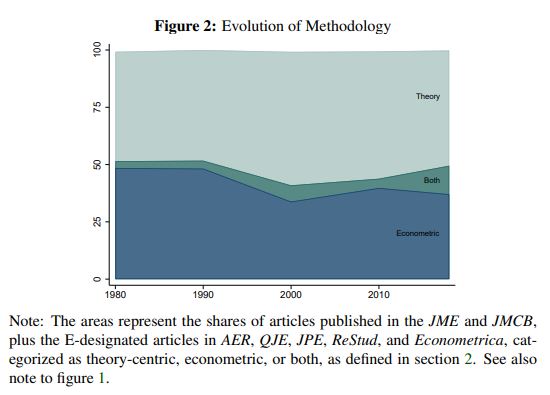
“How is macroeconomic research conducted and what is it trying to accomplish? We explore these questions using information gleaned from 1,894 articles published in ten leading journals. We find that over the past 40 years there has been a growing emphasis on increasingly sophisticated quantitative theory, such as DSGE modeling, and papers employing these methods now account for the majority of articles in macro journals. The shift towards quantitative theory is mirrored by a decline in the use of econometric methods to test economic hypotheses. Econometric techniques borrowed from applied microeconomics have to a large extent displaced time series methods, and empirical papers increasingly rely on micro and proprietary data sources. Market imperfections are pervasive, and the amount of research involving financial frictions has increased significantly in the past ten years. The frequency with which non-macro JEL codes appear in macro articles indicates a great deal of overlap between macroeconomics and other fields.”
From a new NBER paper by Philip J. Glandon, Kenneth Kuttner, Sandeep Mazumder & Caleb Stroup:
“How is macroeconomic research conducted and what is it trying to accomplish? We explore these questions using information gleaned from 1,894 articles published in ten leading journals. We find that over the past 40 years there has been a growing emphasis on increasingly sophisticated quantitative theory, such as DSGE modeling, and papers employing these methods now account for the majority of articles in macro journals.
Posted by at 11:14 AM
Labels: Macro Demystified
Elite Capture of Foreign Aid: Evidence from Offshore Bank Accounts
Source: Journal of Political Economy
“Do elites capture foreign aid? This paper documents that aid disbursements to highly aid-dependent countries coincide with sharp increases in bank deposits in offshore financial centers known for bank secrecy and private wealth management but not in other financial centers. The estimates are not confounded by contemporaneous shocks—such as civil conflicts, natural disasters, and financial crises—and are robust to instrumenting using predetermined aid commitments. The implied leakage rate is around 7.5% at the sample mean and tends to increase with the ratio of aid to GDP. The findings are consistent with aid capture in the most aid-dependent countries.”
Click here to read the full paper and here to join the discussion on it.
Source: Journal of Political Economy
“Do elites capture foreign aid? This paper documents that aid disbursements to highly aid-dependent countries coincide with sharp increases in bank deposits in offshore financial centers known for bank secrecy and private wealth management but not in other financial centers. The estimates are not confounded by contemporaneous shocks—such as civil conflicts, natural disasters, and financial crises—and are robust to instrumenting using predetermined aid commitments. The implied leakage rate is around 7.5% at the sample mean and tends to increase with the ratio of aid to GDP.
Posted by at 9:16 AM
Labels: Inclusive Growth
Subscribe to: Posts