



Tuesday, March 15, 2022
The Shrinking Share of Middle-Income Jobs
From EconoFact:
“The Issue:
Over the past four decades, less-educated workers, particularly non-college men, have experienced an actual fall in their real earnings (that is, after adjusting for inflation). An important reason for this decline in the earnings among low-income workers is the shifting structure of occupations, with a hollowing-out of what had been middle-income jobs. This is especially true in urban and metropolitan areas, places where there had been good job opportunities for those without a college education but, increasingly, the jobs available to those with a high school education in these places are in low-paid occupations with little opportunity for upward mobility.
The Facts:
- Rising wage inequality is a well-documented characteristic of the U.S. labor market over the past 40 years; but such divergence in earnings was not a feature of the preceding decades. The post-World War II period can be divided into three eras with respect to the distribution of wages. The period from immediately after World War II until 1972 was a time when wages were rising evenly for people with all levels of education. In contrast, the period that began with the first oil shock in 1973 through the end of the 1970s saw inflation-adjusted earnings stagnate across the board. Subsequently, beginning in 1980 and continuing to the present there has been rising wage inequality, with wages rising robustly for the most educated and falling, in real terms, for the least educated. This is especially striking because the supply of highly-educated workers has increased while that of less-educated workers has declined; the share of hours worked by those without a college degree fell from 75 percent in 1963 to less than 40 percent in 2017 while over the same period the share of hours worked by those with a bachelor’s or post-college degree rose from less than 15 percent to more than 35 percent.
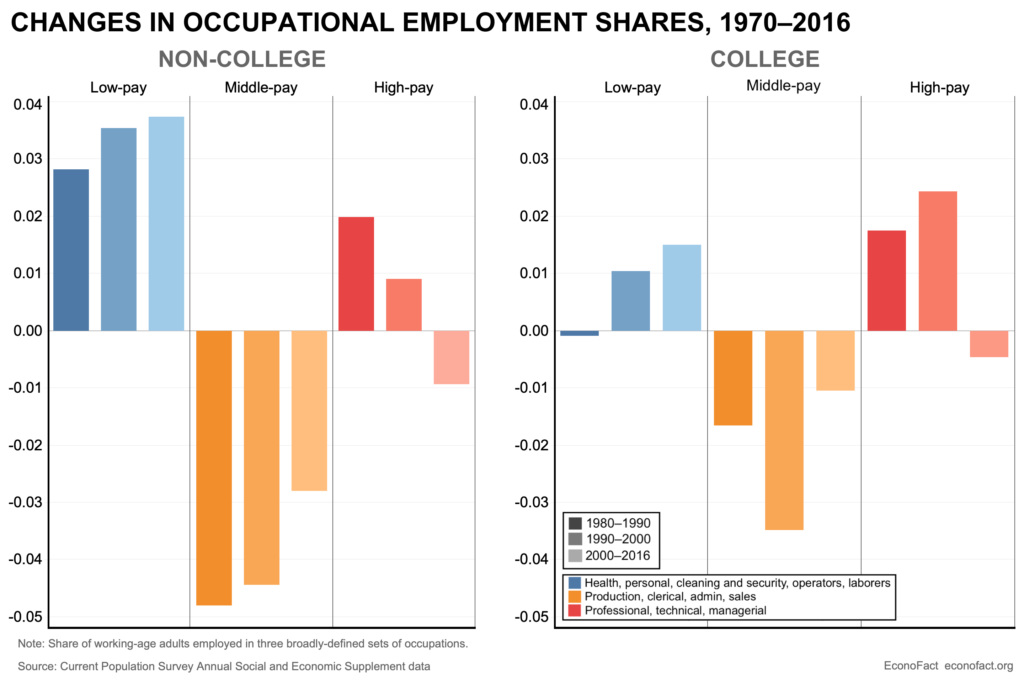
- An important source of these shifts in wages and hours is the hollowing out of middle-income jobs. While there are a range of reasons for the decline in wages and hours worked for those with less than a college education (including eroding union power, rising trade in manufacturing goods from low-labor-cost countries, and falling real values of minimum wages), an important reason that has not had as much attention is the decline in jobs that had provided middle-class wages for those with less than a college education. The shrinking share of these middle-income jobs appears as a “barbell effect” with the decline of middle-paid jobs contrasted by the rise in the employment share for both lower- and higher-paid jobs (see chart). Employment can be sorted into three broadly defined sets of occupations: those with typically low pay and education requirements that require little specialized skills or training (health aids and personal services, cleaning and security, and operators and laborers); middle-paid occupations that do not necessarily demand a four-year college degree but do require specialized skills (production workers, office/administrative workers, and sales workers); and high-paid occupations that typically require a four-year degree (technicians, professionals, and managers). In 1980, non-college workers were evenly split between low- and medium-paid occupations (at 42 percent and 43 percent, respectively) and the remaining one-seventh of workers without college degrees were in traditionally high-paid occupations. By 2016, the share of non-college educated workers in mid-pay occupations had fallen to 29 percent, with about 12 of the overall 14 percentage point decline representing a shift to the low-paid category and less than a 1.5 percentage point increase in the high-pay category. Over this same period, there was a more modest barbell effect for college-educated workers, with those in the mid-pay occupations declining from 27 to 20 percent, those in high-pay occupations rising from 57 to 61 percent, and those in low-paying occupations rising from 16 to 19 percent.
- There are technological, global and institutional reasons why this “barbell effect” was concentrated among workers in urban and metropolitan areas. In the 1950s and 1960s, workers in urban areas who did not have college degrees disproportionately held middle-education, middle-income, blue-collar production jobs and white-collar office, administrative and clerical jobs as compared to workers in suburban and rural areas. These jobs involved close collaboration with more highly-educated professional, managerial and technical workers who oversaw factories and offices. This collaboration benefited workers holding these middle-income jobs since their value to their companies was enhanced by high-education coworkers. But starting in the 1970s, the demand for mid-education urban workers declined due to rising automation in factories, greater use of computers and information technology in offices, and greater pressure from international trade. Workers without a college degree moved from middle-income occupations to those that traditionally require less education and offer lower wages – and because middle-income jobs for those without a college degree were more prevalent in urban and metropolitan areas, this had a proportionally bigger effect in those places. “
Continue reading here.
From EconoFact:
“The Issue:
Over the past four decades, less-educated workers, particularly non-college men, have experienced an actual fall in their real earnings (that is, after adjusting for inflation). An important reason for this decline in the earnings among low-income workers is the shifting structure of occupations, with a hollowing-out of what had been middle-income jobs. This is especially true in urban and metropolitan areas, places where there had been good job opportunities for those without a college education but,
Posted by at 7:22 PM
Labels: Macro Demystified
Monday, March 14, 2022
Tackling Gender Gaps in Data
Ironically, in the big data age of today, a significant barrier to women’s inclusion in formal economies is made up of the lack of sex-disaggregated data at the high level. Within this, the lack of more granular data to base models and policies on, the lack of data on related services like internet access, use of bank accounts, feature phones and smartphones, or even inclusion in the national identification process is hard to come by.
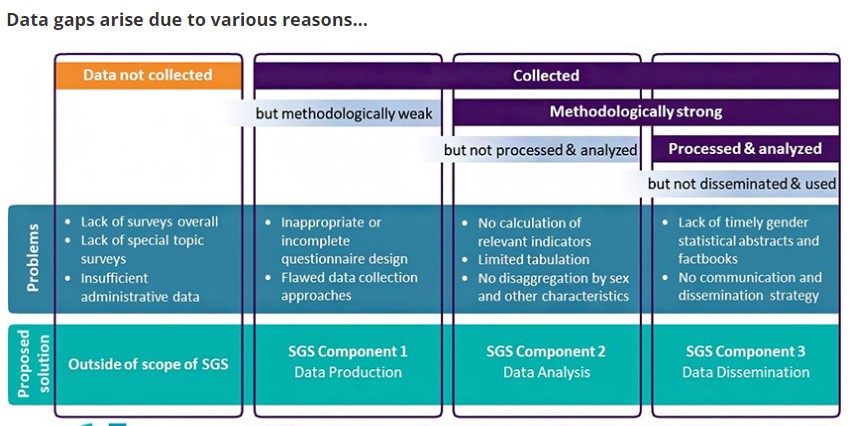
In a recent blog detailing ideas for their new project, Strengthening Gender Statistics, officials from the World Bank Group write about challenges to accessing quality gendered data and how to tackle them. They try to understand the vast variety of challenges by grouping them into three categories- challenges to data production, analysis, and dissemination.
Read also:
Making Women and Girls Visible: Gender Data Gaps and Why They Matter (2018), UN Women
Closing gender data gaps in the world of work- role of the 19th ICLS standards (2020), ILO
Ironically, in the big data age of today, a significant barrier to women’s inclusion in formal economies is made up of the lack of sex-disaggregated data at the high level. Within this, the lack of more granular data to base models and policies on, the lack of data on related services like internet access, use of bank accounts, feature phones and smartphones, or even inclusion in the national identification process is hard to come by.
Posted by at 3:07 PM
Labels: Inclusive Growth
Sunday, March 13, 2022
The Wobbly Economy: Global Dynamics with Phase and State Transitions
Source: NBER Working Paper
Standard macroeconomic models that explain business cycles in the economy, like the real business cycle or Solow model, usually propound the existence of a momentary economy-wide equilibrium, a long-run steady-state equilibrium, and a unique convergent path to arrive at that steady-state equilibrium. However, in this paper for NBER, economists Tomohiro Hirano and Joseph Stiglitz demonstrate using the life cycle model with production a situation where multiple equilibria can exist. They suggest that this multiplicity of equilibria can give rise to “wobbly macro-dynamics”, i.e. a dynamic situation for the economy wherein it can bounce around infinitely without converging, all the time doing so in ways perfectly consistent with rational expectations. They further go on to add, “this wobbly macro-dynamics is driven by people’s beliefs or sentiments, and doesn’t even have regular periodicity”. “As a result, laissez-faire market economies can be plagued by repeated periods of instabilities, dynamic inefficiencies, and unemployment.”
Source: NBER Working Paper
Standard macroeconomic models that explain business cycles in the economy, like the real business cycle or Solow model, usually propound the existence of a momentary economy-wide equilibrium, a long-run steady-state equilibrium, and a unique convergent path to arrive at that steady-state equilibrium. However, in this paper for NBER, economists Tomohiro Hirano and Joseph Stiglitz demonstrate using the life cycle model with production a situation where multiple equilibria can exist.
Posted by at 1:57 PM
Labels: Macro Demystified
Friday, March 11, 2022
Housing View – March 11, 2022
On cross-country:
- What happened to global house prices in 2021? – Knight Frank
- Demographia International Housing Affordability 2022 – Demographia
On the US:
- The impact of Treasury’s pilot program on stemming the tide of dirty money into US real estate – Brookings
- Early signs of Russian pullback in real estate – Axios
- The Threat of Environmental Hazards to the Rental Stock – Harvard Joint Center for Housing Studies
- Home mortgage and insurance systems encourage development in climate-risky places, and we all pay the price – Brookings
- U.S. Housing Wealth Skewed Even More Toward Affluent Over Past Decade. From 2010 to 2020, about 71% of increase in housing wealth was gained by high-income households, says National Association of Realtors report – Wall Street Journal
- Stagflation Is Already Here in the Housing Market. Soaring prices and low inventory are causing headaches for homebuilders and buyers but benefiting owners — and therein lies the Fed’s predicament as it seeks to lower inflation. – Bloomberg
On China
- China’s Banking Regulator Welcomes Home Price Adjustments. Guo says current moves are good as long as not too volatile. Home prices have fallen for five months amid industry crisis – Bloomberg
- Shanghai homebuyers looking to capitalise on eased credit policies have to act fast amid expectations of price rise. Eased credit has prompted potential homebuyers to actively chase flats, property agent says. Average price of secondary homes sold last month was 0.5 per cent higher than in January, and 8.5 per cent higher year on year – South China Morning Post
On other countries:
- [Norway] Coming of Age: Renovation Premiums in Housing Markets – SSRN
- [Singapore] Pricey Singapore rents go through the roof even as population dips – Reuters
- [United Kingdom] Help to Buy’s legacy: higher prices and richer builders. Now is a good time to pick over the bones of the UK government’s controversial equity loan scheme – FT
- [United Kingdom] Goodbye Londongrad: Russian Oligarchs Put Pressure on U.K. Property Market. Russian oligarchs stormed London’s high-end property market. Now they are under pressure and so is the city’s real-estate sector. – Wall Street Journal
- [United Kingdom] Cost versus availability of loans: which matters more for mortgagors? – Bank of England
On cross-country:
- What happened to global house prices in 2021? – Knight Frank
- Demographia International Housing Affordability 2022 – Demographia
On the US:
- The impact of Treasury’s pilot program on stemming the tide of dirty money into US real estate – Brookings
- Early signs of Russian pullback in real estate – Axios
- The Threat of Environmental Hazards to the Rental Stock – Harvard Joint Center for Housing Studies
- Home mortgage and insurance systems encourage development in climate-risky places,
Posted by at 5:00 AM
Labels: Global Housing Watch
Thursday, March 10, 2022
Housing market risks in the wake of the pandemic
From a new paper by Deniz Igan, Emanuel Kohlscheen and Phurichai Rungcharoenkitkul:
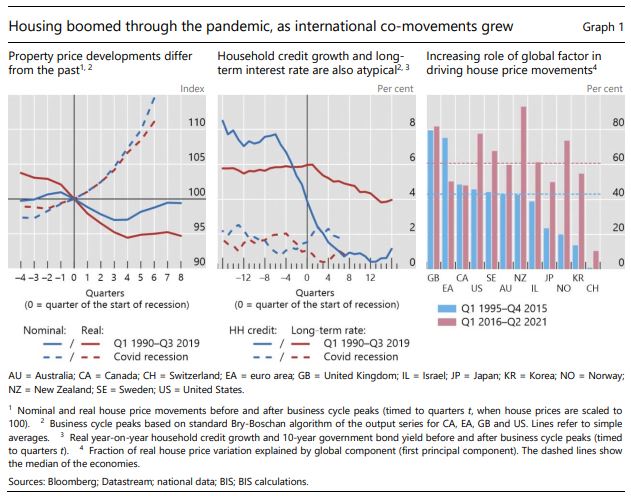
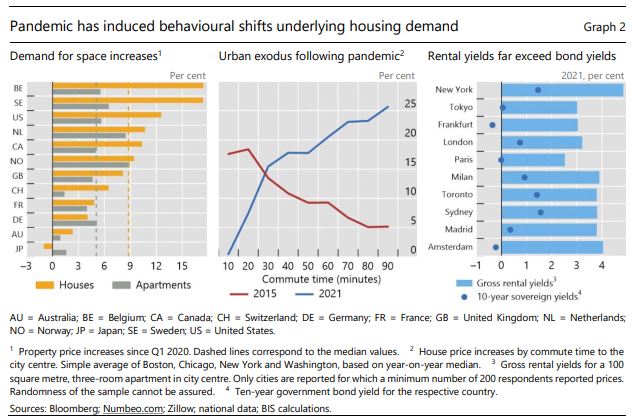
“House prices rose strongly in advanced economies during the pandemic, breaking with typical post-recession patterns. These developments support domestic demand in the short term but carry risks to the outlook if they reverse. Rapid economic recovery, fiscal support and high saving rates amid negative real interest rates explain part of the strong housing demand. Pandemic-induced demand for space, structural supply constraints and increased demand from investors provide additional support for house prices. The monetary policy response to inflationary pressures will be a relevant factor when assessing housing market risks. Moderate increases in interest rates could help forestall speculative demand.”
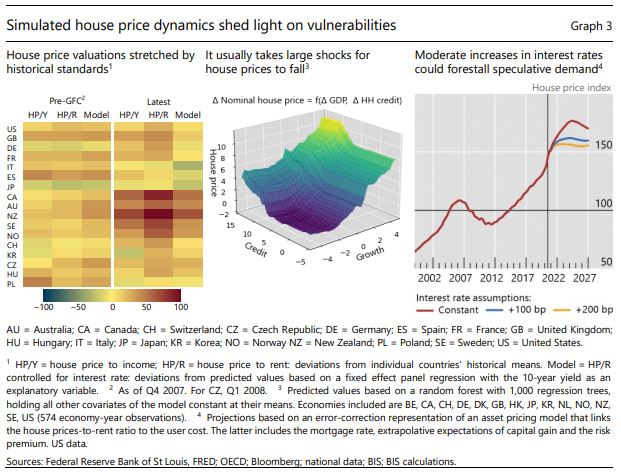
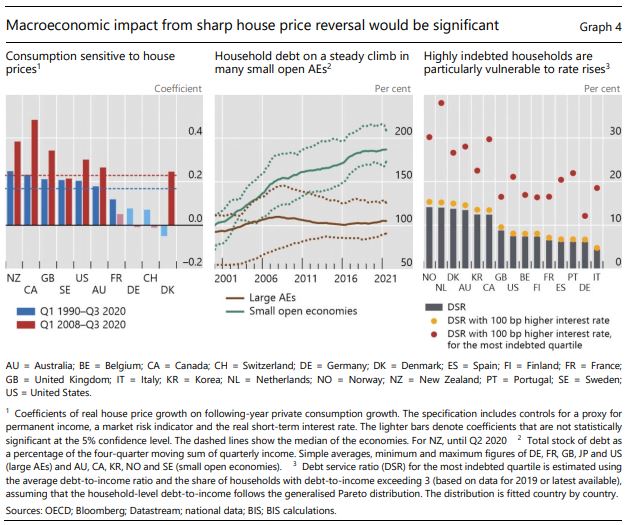
From a new paper by Deniz Igan, Emanuel Kohlscheen and Phurichai Rungcharoenkitkul:
“House prices rose strongly in advanced economies during the pandemic, breaking with typical post-recession patterns. These developments support domestic demand in the short term but carry risks to the outlook if they reverse. Rapid economic recovery, fiscal support and high saving rates amid negative real interest rates explain part of the strong housing demand. Pandemic-induced demand for space, structural supply constraints and increased demand from investors provide additional support for house prices.
Posted by at 1:50 PM
Labels: Global Housing Watch
Subscribe to: Posts