



Friday, February 18, 2022
The Inaccuracy of Inflation Expectations
New post by Timothy Taylor on Conversable Economist posted on 17th February.
“The question of whether a burst of inflation turn into permanent inflation should depend, at least in part, on expectations about inflation. If workers and firms expect higher inflation, then the workers are more likely to press for higher wages to compensate–and firms are more likely to be amenable to such increases. An inflationary cycle can emerge where expectations of higher inflation lead to more price and wage increases, and those price and wage increases lead to higher inflation.”
Read more by clicking here.
New post by Timothy Taylor on Conversable Economist posted on 17th February.
“The question of whether a burst of inflation turn into permanent inflation should depend, at least in part, on expectations about inflation. If workers and firms expect higher inflation, then the workers are more likely to press for higher wages to compensate–and firms are more likely to be amenable to such increases. An inflationary cycle can emerge where expectations of higher inflation lead to more price and wage increases,
Posted by at 9:30 AM
Labels: Forecasting Forum
Housing View – February 18, 2022
On cross-country:
- ECB ‘cannot ignore’ house price surge in inflation assessment, says executive. Property boom adds to risks of acting too late to tighten monetary policy, says Isabel Schnabel – FT
- Surging housing costs boosting overall euro zone inflation: ECB – Reuters
- Watchdog sounds alarm on financial risks of Europe’s property boom. Banks at risk from soaring prices, loosening lending standards and rising household debt levels – FT and European Systemic Risk Board
- Germany and Austria told to curb boom in home prices – Reuters
- The true cost of empty offices. Property investors are sitting on big losses – The Economist
- The Economics Implications of House Price Capitalization: A Synthesis – London School of Economics
- Inflation may push more families to become Airbnb hosts, chief says. Lodging platform touts ‘economic opportunity’ while investors worry about limited supply as travel rebounds – FT
- Private Cities: Implications for Urban Policy in Developing Countries – World Bank
On the US:
- How to fix America’s broken housing systems – Brookings
- Housing Supply May Remain Constrained – Bloomberg
- Lacker on Rising Rates and Housing Market. Rising interest and mortgage rates will put a damper on housing demand, and also potentially on the supply of new homes, according to former Richmond Fed President Jeffrey Lacker. – Bloomberg
- Lessons from a Modern Master of Low-Rise Housing. Cities looking to boost density and affordability should look to the work of architect Louis Sauer, who designed stylish modernist housing in the 1960s and ’70s. – Bloomberg
- Why your rent is going up – Axios
- Renting a Home Is Even Harder Than Buying One in Unrelentingly Hot U.S. Market. Rental prices for single-family homes grew 7.8% in 2021, an all-time high, according to CoreLogic. – Bloomberg
- Blackstone expands further into rental housing in the United States. The private equity firm said it would acquire Preferred Apartment Communities, a real estate investment trust, for $6 billion as it seeks a hedge against inflation. – New York Times
- U.S. Housing Affordability Worsens. Median sales price for single-family existing homes was higher in fourth quarter versus year ago in 181 of 183 metro areas – Wall Street Journal
- Out-of-Town Home Buyers Will Pay 30% More Than Locals in Hottest U.S. Markets. In cities including Nashville, Philadelphia, Atlanta and Miami, people migrating from elsewhere are willing to pay way more than asking price. – Bloomberg
- Real-Estate Investors Head South, Bid Up Sunbelt Apartment Buildings. Dallas and Atlanta see more investment than other U.S. cities, as landlords chase job growth – Wall Street Journal
- Renters across US face sharp increases – averaging up to 40% in some cities. Americans face having to move or pay much bigger slice of income to stay in their homes as prices outstrip wages – The Guardian
- Remote Work Opens Up Cheaper Housing Options. House hunters are searching to move from expensive larger cities to smaller cheaper ones. – New York Times
- How the Federal Government’s policies are crowding out lower income Americans out of the housing market. And how federal agencies and regulators are in the process of doubling down on failed policies, putting low-income and minority borrowers needlessly in harm’s way – AEI
- Where Did All the Homes Go? Here Are the Cities With the Most Places for Sale—and the Ones With the Fewest – Realtor.com
- U.S. mortgage rates jump to two-year high, further squeezing buyers – Reuters
- San Francisco is the latest city to consider tackling its housing crisis by taxing empty homes – Quartz
- Amid a housing crisis, renters challenge firms they say are being exploitative – NPR
- With evictions on the rise, House Democrats team up to push new housing protections – NPR
- Natural disasters can wipe out affordable housing for years. And when communities lose affordable housing, it’s harder for businesses—and the entire economy—to recover from those disasters. – Fast Company
- Landmark housing discrimination settlement with Fannie Mae sets key precedent – Reuters
- Home prices: high, but not rising – FT
- Buying a Home Is as Frustrating as You Think It Is. Housing prices continue to skyrocket as potential buyers feel increasingly insecure about their personal finances. It’s easy to feel a little hopeless. – Bloomberg
- Is GSE Reform Dead? – Harvard Joint Center for Housing Studies
- Will Rising Rents Push Up Future Inflation? – San Francisco Fed
- Where in the US are homes most affordable? – Quartz
On China
- Chinese developers selling off more London property to raise cash. Shanghai-based Greenland is latest to exit with £40mn sale of Ram Brewery site – FT
On other countries:
- [Australia] Australian families are giving up on the suburban dream – but are new apartments up to the job? More and more Australians are likely to live in flats as the price of houses soars beyond their means. But design standards have allowed too many substandard blocks to go up – The Guardian
- [Australia] Major banks predict 14% drop in house prices. They’re wrong – Yahoo Finance
- [Australia] Land and Housing Supply Indicators. A summary of research undertaken by the ABS investigating indicators to measure the relationship between land-use regulation and housing supply – Australian Bureau of Statistics
- [Hong Kong] Hong Kong Home Sellers Cut Asking Prices as Covid Curbs Tighten – Bloomberg
- [New Zealand] New Zealand’s housing crisis is worsening. That is bad news for a government which promised miracles – The Economist
- [New Zealand] House prices continue to increase, slowdown expected – RNZ
- [New Zealand] New Zealand homes sales and prices ease in January – Reuters
- [New Zealand] Tighter lending among factors slowing house price growth – REINZ – RNZ
- [Netherlands] Complex Methods in Economics: An Example of Behavioral Heterogeneity in House Prices – Central Bank of Netherlands
- [South Korea] As house prices soar, ordinary South Koreans learn to love stocks. Asia’s fourth-largest economy is overcoming a historical aversion to financial assets and embracing the stock market. – Al Jazeera
- [United Kingdom] House Prices 30 Years Ago Determine Who Gets U.K. Energy Rebates. Britons are relying on arcane system to get 150 pounds of aid. Millions who don’t need help will be eligible for the relief – Bloomberg
- [United Kingdom] UK needs 230,000 new rental homes to meet growing demand. With more people renting for longer, UK will face a shortfall in private rented property, analysis shows – The Guardian
On cross-country:
- ECB ‘cannot ignore’ house price surge in inflation assessment, says executive. Property boom adds to risks of acting too late to tighten monetary policy, says Isabel Schnabel – FT
- Surging housing costs boosting overall euro zone inflation: ECB – Reuters
- Watchdog sounds alarm on financial risks of Europe’s property boom. Banks at risk from soaring prices, loosening lending standards and rising household debt levels – FT and European Systemic Risk Board
- Germany and Austria told to curb boom in home prices – Reuters
- The true cost of empty offices.
Posted by at 5:00 AM
Labels: Global Housing Watch
Thursday, February 17, 2022
Productivity and Pay in the US and Canada
Source: VoxEU CEPR
Abstract:
The real pay of typical workers has grown much more slowly than productivity over recent decades in several developed economies. This column uses data from the US and Canada to examine whether productivity growth actually benefits typical workers by raising their pay. The authors find strong evidence of linkage between productivity and pay in the US but more mixed evidence for Canada, possibly due to it being a smaller, more internationally open economy. Overall, the findings suggest that measures to boost productivity growth are important for raising pay for the average and typical worker.
Source: VoxEU CEPR
Abstract:
The real pay of typical workers has grown much more slowly than productivity over recent decades in several developed economies. This column uses data from the US and Canada to examine whether productivity growth actually benefits typical workers by raising their pay. The authors find strong evidence of linkage between productivity and pay in the US but more mixed evidence for Canada, possibly due to it being a smaller,
Posted by at 12:59 PM
Labels: Inclusive Growth, Macro Demystified
Wednesday, February 16, 2022
Housing Market in North Macedonia
From the IMF’s latest report on North Macedonia:
“The authorities emphasized that the health and stability of the banking system has been preserved through the pandemic, and they continue to closely monitor risks. Regulatory flexibility, temporary restrictions on dividend payments, and economic policy support helped maintain credit to the economy during the pandemic. The NBRNM has strengthened the reporting frequency and data requirements for monitoring credit quality, introduced a comprehensive and consistent bottom-up stress testing, and increased the focus on risks such as cyber risks, which are being taken into account when setting bank-specific Pillar-II capital requirements. Given high growth in new mortgages and rising house prices, a targeted assessment is underway. Moreover, the NBRNM is closely monitoring deposit-driven euroization, which increased during the pandemic, against the plan set out in the denarization strategy.
(…)
Banking system strength has held up well during the pandemic, but continued vigilance is essential. The banking system overall remains well capitalized and profitable. Initiatives to improve the framework for stress tests of banks are welcome, together with intensified supervisory efforts to ensure that banks recognize any problem assets and provision adequately for potential loan losses on a forward-looking basis. Given the still high share of FX or FX-linked loans in household loans, with possibly limited hedging of borrowers, the NBRNM should maintain carefully calibrated measures to limit FX lending. Moreover, rising private sector debt, albeit from low levels, and the high growth in mortgage lending, coupled with an acceleration in house prices, warrant further scrutiny.”
From the IMF’s latest report on North Macedonia:
“The authorities emphasized that the health and stability of the banking system has been preserved through the pandemic, and they continue to closely monitor risks. Regulatory flexibility, temporary restrictions on dividend payments, and economic policy support helped maintain credit to the economy during the pandemic. The NBRNM has strengthened the reporting frequency and data requirements for monitoring credit quality, introduced a comprehensive and consistent bottom-up stress testing,
Posted by at 11:48 AM
Labels: Global Housing Watch
Housing Market in Spain
From the IMF’s latest report on Spain:
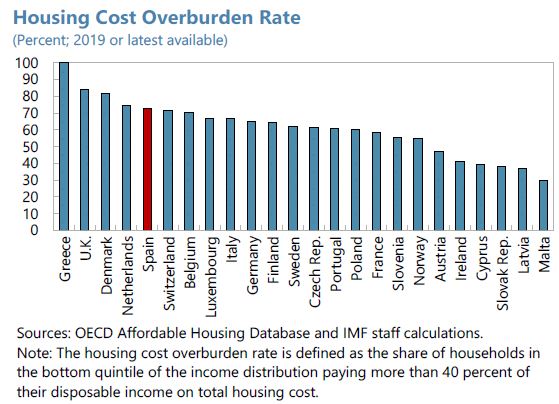
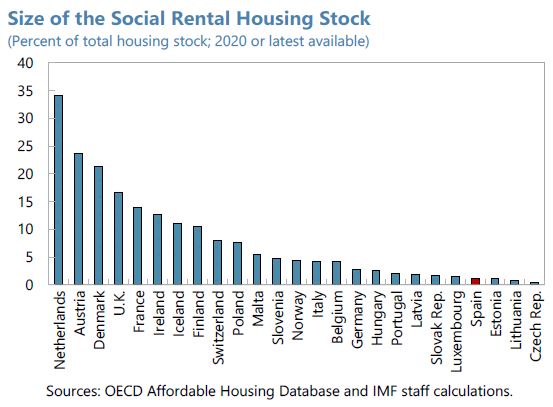
“Continued efforts to address housing affordability challenges would support growth, facilitate labor mobility across regions and reduce inequality. Prior to the pandemic, limited rental housing supply hampered by relatively inefficient building regulations contributed to a surge in rental prices, creating affordability problems and limiting labor mobility (especially for young people and other vulnerable groups). The draft housing law and the national housing plan aim to address the existing challenges. To limit increases in rent prices in stressed areas, the law introduces rent caps on large landlords and tax incentives for small landlords to keep rents low. While these may benefit tenants in the short term, rent caps could introduce inefficiencies and restrict the availability of properties for future tenants. Further evaluation of these measures would be useful to gauge their impact. The envisaged targeted rent support programs for vulnerable groups are welcome. However, they should be combined with effective supply measures to avoid further pressures on rent prices. The increase of taxes on empty properties and the expansion of the social housing stock, which are contemplated in the proposed reform, should help increase rent supply. The RTRP envisages €1 billion for the construction of new public social rental dwellings in 2022–23. Additional policies to increase housing supply could include simplifying land use regulations and accelerating licensing processes at the regional government level.”
From the IMF’s latest report on Spain:
“Continued efforts to address housing affordability challenges would support growth, facilitate labor mobility across regions and reduce inequality. Prior to the pandemic, limited rental housing supply hampered by relatively inefficient building regulations contributed to a surge in rental prices, creating affordability problems and limiting labor mobility (especially for young people and other vulnerable groups). The draft housing law and the national housing plan aim to address the existing challenges.
Posted by at 11:44 AM
Labels: Global Housing Watch
Subscribe to: Posts