Showing posts with label Global Housing Watch. Show all posts
Tuesday, April 10, 2018
Housing as a Financial Asset
From IMF’s Global Financial Stability Report – April 2018:
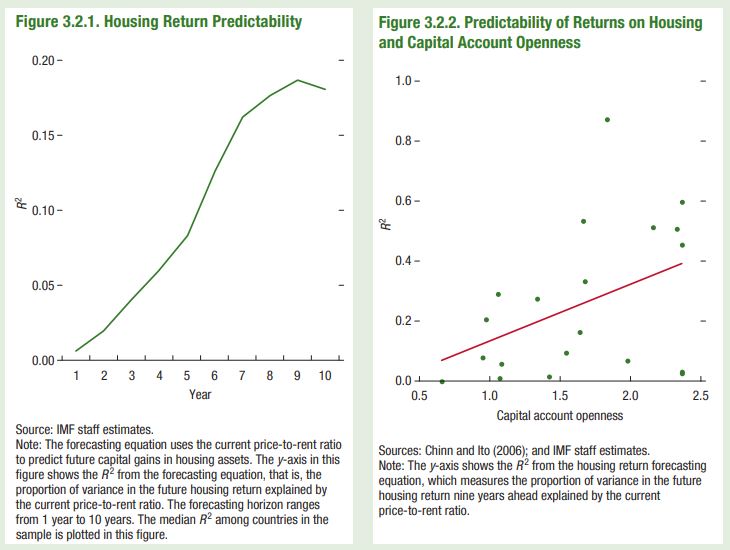
“Housing is an important asset class for households and investors. In a typical economy, housing wealth, on average, accounts for roughly one-half of total national wealth and can fluctuate considerably over time (Piketty 2014). Real estate investors often borrow to purchase housing assets, making mortgage payments and receiving rental income and potential capital gains. Publicly traded real estate investment trusts have become available in many countries, allowing investors to invest indirectly in the real estate market. In addition, institutional investors have been increasing their direct exposure to residential real estate in recent years (see Figure 3.3 in the main text).
Investing in housing assets can yield considerable returns in the long term, but is subject to significant variation over time. In many advanced economies, the average annual real return on housing assets between 1950 and 2015 lies between 5 percent and 8 percent,comparable in magnitude to that of equity investment but with a lower standard deviation (Jordà and others 2017). In the shorter term, however, the expected returns on housing assets can vary significantly over time and are affected by the risk appetite of financial market investors as well as other behavioral factors (for example, Cheng, Raina, and Xiong 2014; Brunnermeier and Julliard 2008).”
Continue reading here.
From IMF’s Global Financial Stability Report – April 2018:
“Housing is an important asset class for households and investors. In a typical economy, housing wealth, on average, accounts for roughly one-half of total national wealth and can fluctuate considerably over time (Piketty 2014). Real estate investors often borrow to purchase housing assets, making mortgage payments and receiving rental income and potential capital gains. Publicly traded real estate investment trusts have become available in many countries,
Posted by at 10:33 AM
Labels: Global Housing Watch
Global Investors, House Price Dispersion, and Synchronicity
From IMF’s Global Financial Stability Report – April 2018:
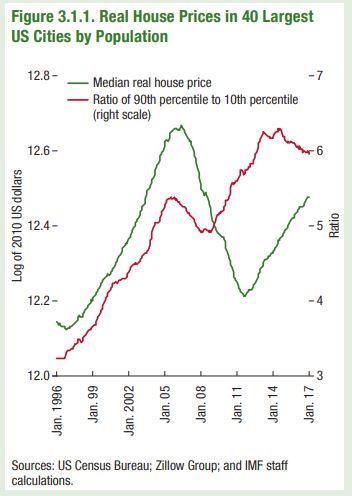
“House price dispersion can be used as a proxy for demand from high-net-worth foreign investors with a preference for luxury housing. Using granular data from the US housing market, this box finds that house price dispersion in the United States has increased sharply over recent decades, and it increases when house prices in alternative investment destinations outside the United States rise. Both findings point to global investors contributing to house price synchronicity across cities and countries.”
Continue reading here.
From IMF’s Global Financial Stability Report – April 2018:
“House price dispersion can be used as a proxy for demand from high-net-worth foreign investors with a preference for luxury housing. Using granular data from the US housing market, this box finds that house price dispersion in the United States has increased sharply over recent decades, and it increases when house prices in alternative investment destinations outside the United States rise.
Posted by at 10:29 AM
Labels: Global Housing Watch
For Home Prices in London, Check the Tokyo Listings
From IMFBlog:
“If house prices are rising in Tokyo, are they also going up in London?
Increasingly, the answer is yes.
In recent decades, house prices around the world have shown a growing tendency to move in the same direction at the same time. What accounts for this phenomenon, and what are the implications for the world economy? These are questions that IMF economists explore in Chapter 3 of the latest Global Financial Stability Report.
Our study of 44 cities and 40 advanced and emerging-market economies shows that the growing integration of financial markets plays an important role. As a result, housing markets in one country are more sensitive to swings in another. Policy makers should pay attention, because the heightened tendency for house prices to move in tandem may signal greater odds of an economic slowdown. An economic shock in one part of the world is more likely to affect housing markets elsewhere.
Let’s look at why home prices are more synchronized in a financially integrated world.
- Interest rates: The world’s major central banks have kept interest rates unusually low for a long time in a bid to stimulate growth. That has produced a ripple effect of low borrowing costs, including cheap mortgages, across the globe, which has helped push up prices.
- Institutional investors , private equity firms, and Real Estate Investment Trusts have been increasingly active in major cities such as Amsterdam, Sydney, and Vancouver as they seek out higher returns.
- Wealthy individuals have also snapped up properties in major financial centers in search of safe places to invest their money (and perhaps to live). One result: because the wealthy prefer high-end properties, their investments push up prices in expensive neighborhoods in places like New York and London at the same time.
- Economic growth: In addition to financial factors, coordinated movements in the real economy contribute to the phenomenon. In 2017, growth picked up in 120 economies, accounting for three-quarters of world GDP. It was the broadest synchronized growth surge since 2010. Economic growth is a major driver of demand for homes, and hence prices.
All of this suggests that house prices are starting to behave more like the prices of financial assets, such as stocks and bonds, which are influenced by investors elsewhere in the world. In countries that are more open to global capital flows, prices of both homes and equities tend to be more synchronized with global markets.”

Continue reading here.
From IMFBlog:
“If house prices are rising in Tokyo, are they also going up in London?
Increasingly, the answer is yes.
In recent decades, house prices around the world have shown a growing tendency to move in the same direction at the same time. What accounts for this phenomenon, and what are the implications for the world economy? These are questions that IMF economists explore in Chapter 3 of the latest Global Financial Stability Report.
Posted by at 10:25 AM
Labels: Global Housing Watch
Friday, April 6, 2018
Housing View – April 6, 2018
On cross-country:
- European Mortgage Markets Quarterly Review – European Covered Bond Council
- Singapore’s private-public housing mix could offer solutions for Toronto and Vancouver – The Globe and Mail
- Financial cycles in euro area economies: a cross-country perspective – Deutsche Bundesbank
On the US:
- Quantities and Prices during the Housing Bust – Federal Reserve Bank of New York
- Characteristics of Domestic Cross-Metropolitan Migrants – BuildZoom
- San Diego’s Mexican property market at risk from Trump tariffs – Financial Times
- House Price Markups and Mortgage Defaults – Federal Housing Finance Agency
- Case-Shiller – A surprise in the bottom 3 cities – Real Estate Decoded
- The Unfulfilled Promise of Fair Housing – The Atlantic
- Housing Wealth, Health and Deaths of Despair – IESE Business School
- Nearly two-thirds of renters say they can’t afford to buy a home – Wall Street Journal
On other countries:
- [Botswana] Housing delivery to the low income in Botswana – Emerald Insight
- [China] Housing conditions and life satisfaction in urban China – Cities
- [China] Accounting for China’s real estate boom – Financial Times
- [China] Macro-economic index effect on house prices in China – Universiti Teknologi Malaysia
- [China] Has Monetary Policy Caused Housing Price to Rise or Fall in China? – The Singapore Economic Review
- [China] Exploring the relationship between urban land supply and housing stock: Evidence from 35 cities in China – Habitat International
- [France] Taxing Vacant Dwellings: Can fiscal policy reduce vacancy? – RePec
- [Hong Kong] The impact of government housing policy and development controls on the dynamics of Hong Kong’s residential property market – The Hong Kong Polytechnic University
- [Italy] Average Time to Sell a Property and Credit Conditions: Evidence from the Italian Housing Market Survey – LUISS Guido Carli
- [Vietnam] Vietnam’s rapid growth fuels Ho Chi Minh property boom – Financial Times

Photo by Aliis Sinisalu
On cross-country:
- European Mortgage Markets Quarterly Review – European Covered Bond Council
- Singapore’s private-public housing mix could offer solutions for Toronto and Vancouver – The Globe and Mail
- Financial cycles in euro area economies: a cross-country perspective – Deutsche Bundesbank
On the US:
- Quantities and Prices during the Housing Bust – Federal Reserve Bank of New York
- Characteristics of Domestic Cross-Metropolitan Migrants – BuildZoom
- San Diego’s Mexican property market at risk from Trump tariffs – Financial Times
- House Price Markups and Mortgage Defaults – Federal Housing Finance Agency
- Case-Shiller – A surprise in the bottom 3 cities – Real Estate Decoded
- The Unfulfilled Promise of Fair Housing – The Atlantic
- Housing Wealth,
Posted by at 5:00 AM
Labels: Global Housing Watch
Thursday, April 5, 2018
House Prices in Mongolia
The IMF’s latest report on Mongolia says that “(…) housing prices stabilized after years of deflation, in line with stronger economic activity and household lending.”
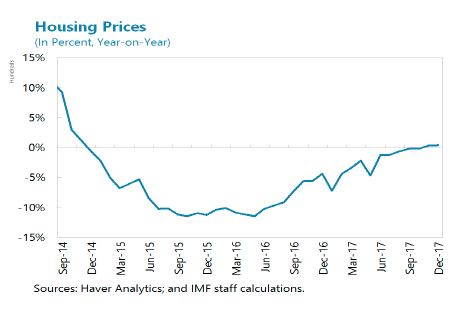
The IMF’s latest report on Mongolia says that “(…) housing prices stabilized after years of deflation, in line with stronger economic activity and household lending.”
Posted by at 10:40 AM
Labels: Global Housing Watch
Subscribe to: Posts