Showing posts with label Global Housing Watch. Show all posts
Wednesday, June 27, 2018
House Prices in Lithuania
The IMF’s latest report on Lithuania says that:
“Household credit remained strong, rising by 7 percent thanks to solid wage growth, and coincided with a surge in housing activity. The number of transactions in the real estate market rose sharply and neared the pre-crisis peak. Moreover, housing prices, especially in major urban centers, rose sharply, prompting the Bank of Lithuania (BoL) to raise the countercyclical capital buffer by 0.5 percentage points in December 2017. Nonetheless, the stock of credit is still modest at 41 percent of GDP, well below the pre-crisis peak of 68 percent of GDP. Similarly, housing prices remain significantly below their 2007 peak, especially when adjusted for inflation. Financial soundness indicators remain strong. Lithuania’s banking system is well capitalized, liquid, and profitable despite the low interest rate environment. Nevertheless, spillovers from real-estate related vulnerabilities in Nordic parent banks, which control most of Lithuania’s financial sector, remain a risk.”
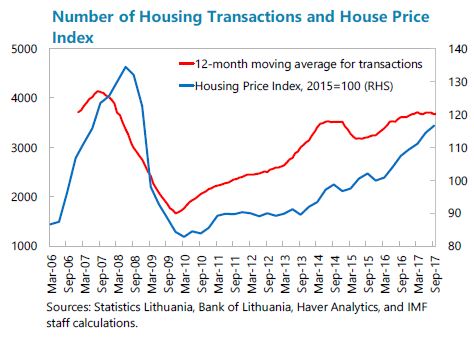
The report also says:
“An analysis of Lithuania’s credit, housing price, and output cycles during 1995–2017Q3, reveals that housing price cycles are more frequent, but shorter-lived than the other two with credit cycles being the most volatile. The analysis finds strong synchronization among them in Lithuania, particularly between the credit and housing price cycles.
Lithuania’s cycles are highly synchronized with those of other Baltic and Nordic countries. This is particularly true for credit due to the close links of Lithuania’s financial system to parent bank developments. Housing price cycles are the least synchronized possibly because real estate markets are mostly affected by local conditions.
An econometric exercise shows that housing price booms are the key determinant of credit upturns. Other factors causing a credit upturn include the negative impact of the global financial crisis, bank profitability, deposit growth, interest rates, and private sector indebtedness. The presence of an economic boom does not seem to be a significant determinant of a credit upturn, suggesting that other, potentially external, factors play a more significant role.
A panel VAR that includes other variables potentially influencing credit demand and supply shows that Lithuania is more vulnerable to shocks than the region as a whole, and that credit and real GDP shocks in Lithuania have a particularly strong impact on Lithuania’s credit. Credit, housing price, and output shocks in other Baltic and Nordic countries on average also have a strong impact on Lithuania’s credit.”
The IMF’s latest report on Lithuania says that:
“Household credit remained strong, rising by 7 percent thanks to solid wage growth, and coincided with a surge in housing activity. The number of transactions in the real estate market rose sharply and neared the pre-crisis peak. Moreover, housing prices, especially in major urban centers, rose sharply, prompting the Bank of Lithuania (BoL) to raise the countercyclical capital buffer by 0.5 percentage points in December 2017.
Posted by at 6:56 AM
Labels: Global Housing Watch
Friday, June 22, 2018
Housing View – June 22, 2018
Journal of Housing Economics (June 2018 Volume)
- Race and the City by Ingrid Gould Ellen, Stephen L. Ross
- Are inclusionary housing programs color-blind? The case of Montgomery County MPDU program by Adji Fatou Diagne, Haydar Kurban, Benoit Schmutz
- The Visible Host: Does race guide Airbnb rental rates in San Francisco? by Venoo Kakar, Joel Voelz, Julia Wu, Julisa Franco
- Racial climate and homeownership by Timothy F. Harris, Aaron Yelowitz
- The non-financial costs of violent public disturbances: Emotional responses to the 2011 riots in England by Panka Bencsik
- Are central cities poor and non-white? by Jenny Schuetz, Jeff Larrimore, Ellen A. Merry, Barbara J. Robles, Arturo Gonzalez
- Racial segregation in the United States since the Great Depression: A dynamic segregation approach by Trevor Kollmann, Simone Marsiglio, Sandy Suardi
- The paradox of expanding ghettos and declining racial segregation in large U.S. metropolitan areas, 1970–2010 by Janice Fanning Madden, Matt Ruther
- Does segregation matter for Latinos? by Jorge De la Roca, Ingrid Gould Ellen, Justin Steil
- There’s no place like home: Racial disparities in household formation in the 2000s by Sandra Newman, Scott Holupka, Stephen L. Ross
On cross-country:
- The unaffordable city: Housing and transit in North American cities – Cities
- Rethinking Urban Sprawl: Moving Towards Sustainable Cities – OECD
- Innovando la política de vivienda a través del alquiler: de la ‘casa propia’ a una vivienda que sirva – Inter-American Development Bank
- How cities can lead the way in bridging the global housing gap – World Economic Forum
- Real Estate & Aging – UBS
On the US:
- Housing Wealth Effects: The Long View – NBER
- Don’t Blame Expensive Housing for Falling Fertility – Citylab
- The 0.25% Fed Rate Increase Doesn’t Mean Mortgage Rates Will Increase 0.25% – Forbes
- Climate Change May Already Be Hitting the Housing Market – Bloomberg
- Zillow Data Used To Project Impact Of Sea Level Rise On Real Estate – NPR
- The High Cost of Low Credit – Zillow
- Negative Equity Dips Below 10 Percent for First Time Since the Bottom of the Market – Zillow
- Birth Rates are Falling Most where Homes are Appreciating Fastest – Zillow
- Californians Are Leaving, Where Are They Looking to Go? – Trulia
- Housing: The Case for YIMBY (Yes, In My Back Yard!) – Foundation for Economic Education
- Threading the Needle of Fair Housing Law in a Gentrifying City with a Legacy of Discrimination – University of San Francisco
- S. Home Prices at Least Affordable Level Since Q3 2008 – ATTOM
On other countries:
- [China] China’s Home Prices Rise at Faster Pace Despite Curbs – Bloomberg
- [Ireland] Surging Irish Home Prices to Cool Off, Central Bank Chief Says – Bloomberg
- [Netherlands] Sizzling Amsterdam Housing Market Pushes People to Other Cities – Bloomberg
- [Spain] New Build Residential Snapshot – Q1 2018 – Knight Frank
- [United Arab Emirates] Dubai / Abu Dhabi Residential Property Price Indices: May 2018 Results – REIDIN

Photo by Aliis Sinisalu
Journal of Housing Economics (June 2018 Volume)
- Race and the City by Ingrid Gould Ellen, Stephen L. Ross
- Are inclusionary housing programs color-blind? The case of Montgomery County MPDU program by Adji Fatou Diagne, Haydar Kurban, Benoit Schmutz
- The Visible Host: Does race guide Airbnb rental rates in San Francisco? by Venoo Kakar, Joel Voelz, Julia Wu, Julisa Franco
- Racial climate and homeownership by Timothy F.
Posted by at 5:00 AM
Labels: Global Housing Watch
Thursday, June 21, 2018
Housing Market in Denmark
The IMF’s latest report on Denmark says that:
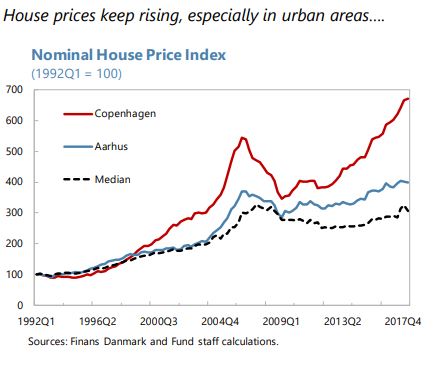
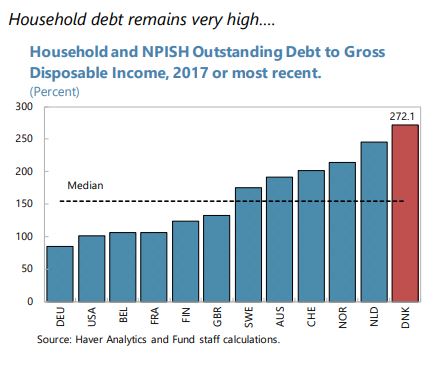
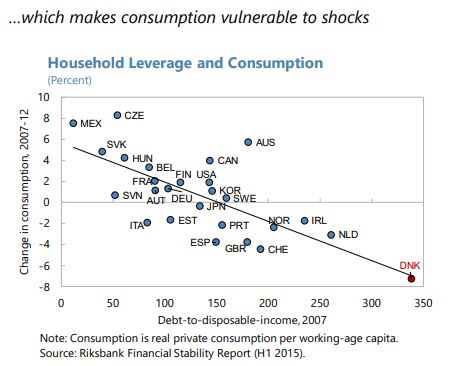
“The adverse feedback loops between housing and the real economy in Denmark are important. The centrality of housing in the Danish economy reflects at least three aspects. First, housing is a major asset of Danish households, together with pensions. Second, MCIs issue covered bonds to fund the mortgages provided to households, transferring part of mortgage risks to investors, mainly financial institutions, including pension funds and insurance companies (Figure 4). Third, because of the high real estate valuations and low interest rates, house purchases typically need to be funded via large mortgage multiples relative to disposable income. These factors help to explain why Danish households’ debt to income ratios are among the highest among advanced economies, and why consumption is sensitive to house price developments.
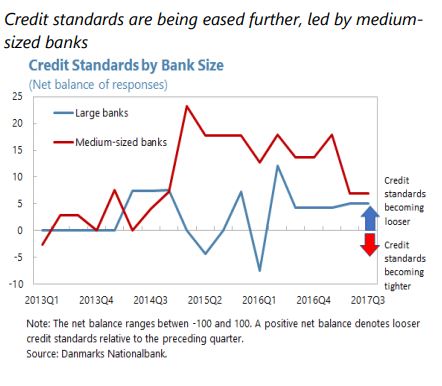
High household leverage combined with high and rising house prices could raise macrofinancial vulnerabilities. There is a risk that high and still rising house prices (particularly in urban areas), the relaxation of credit standards (Figure 4), and mortgage rates near all time-lows, may increase the perception of affordability across a broad spectrum of income levels. In this environment, two types of Danish households are particularly vulnerable to shocks. First, low-income households who spend more than 40 percent of their disposable income on housing (Figure 4). Second, households who have purchased in highly appreciating and potentially overvalued urban areas such as Copenhagen (Selected Issues), where LTI ratios and credit growth are noticeably higher than in the rest of the country. These vulnerabilities are compounded by the large proportion of variable-rate and interest-only mortgages in the system.
In recent years, authorities have implemented an extensive package of policies to address rising vulnerabilities. These include diverse macroprudential policies, 10 various supervisory guidance for MCIs and banks, and a reform of property taxation (Denmark 2017 Article IV report). The authorities continued building their macroprudential toolbox. Following the March 2017 Systemic Risk Council’s recommendation to limit lending via interest-only and floating-rate mortgages to high DTI households in areas with rapid housing prices growth, authorities introduced LTV restrictions. Effective from 2018, changes to consumer protection rules limit lending via interest-only and floating-rate mortgages to highly indebted households. Specifically, there are lending restrictions for households with DTI greater than 4 times and LTV greater than 60 percent: (i) the interest-rate fixation of floating-rate mortgages needs to be at least 5 years, and (ii) deferred amortization is only applicable on 30-year fixed-rate loans.
Coordinated policies are needed to tackle macro-financial vulnerabilities, including those stemming from excessive household leverage combined with rising house prices and affordability. Staff recognized authorities’ efforts and advocated continuing with the deployment of policies as follows.
Macroprudential instruments. The existing macroprudential measures should be tightened further. Staff analysis suggests that the LTV limit should be lowered from 95 to 90 percent to better protect households from house price declines. This decrease would lower aggregate consumption by about 1.5 percentage points one year after introduction, but increase it by 0.2 percentage points in a new steady-state because of lower debt-servicing costs (Denmark 2016 Article IV, Selected Issues). Thus, tightening the LTV limit would have a positive spillover by alleviating demand pressures in the near-term. DTI restrictions should be strengthened for all loans irrespective of LTV considerations. Tighter DTI limits for interest-only and adjustable-rate mortgages should also be considered to contain leverage, increase resilience, and limit the drag on consumption. Highly leveraged households—with debt-to-income above 400 percent—should be subject to mandatory amortization.11 To encourage further reduction of interest-rate sensitivity, the DTI limit could be calibrated to account for lower risk if financing is via fixed–rate mortgages.
Tax policy. Mortgage interest deductibility (MID) should be reduced further than currently planned, as MID distorts investment incentives and incentivizes leverage (Gruber, 2017). During the transition period to a lower mortgage deductibility regime, the current low rate environment would mitigate the adverse impact on homeowners. Also, fiscal savings from this measure could be used to reduce labor tax burden.
Housing supply. Restrictions on the size of new apartments should be relaxed in urban areas where demand-supply imbalances appear to have been a factor pushing valuations higher.
Simpler and more streamlined zoning and planning processes would allow housing supply to respond to increases in demand without steep price increases. Rent controls are among the highest in the EU and should be reduced to incentivize the rental market and alleviate demand for housing. Below-market rents limit the incentive to supply rental units, and incentivize the purchase of housing, adding upward pressure to property prices. Upgrading public and transport infrastructure—especially around inner-city areas experiencing strong house price growth—would help mitigate house prices pressures.The interaction between high household leverage and rising house prices poses macrofinancial risks. Authorities indicated that household resilience to interest rate increases likely improved as more homeowners had shifted towards fixed rate mortgages and longer fixing periods. But if risks continue to build up, the DN sees scope for tighter LTV limit, higher countercyclical capital buffer, amortization requirements and reduction of variable-rate loans. The government argued that additional measures would require further analysis of the effects on the housing market and the overall economy. The government considers unlikely that mortgage interest deductibility will be reduced beyond the planned gradual decline ending next year, and noted that mortgage interest deductibility should take into account balances towards other capital taxation rates.”


The IMF’s latest report on Denmark says that:
“The adverse feedback loops between housing and the real economy in Denmark are important. The centrality of housing in the Danish economy reflects at least three aspects. First, housing is a major asset of Danish households, together with pensions. Second, MCIs issue covered bonds to fund the mortgages provided to households, transferring part of mortgage risks to investors, mainly financial institutions, including pension funds and insurance companies (Figure 4).
Posted by at 11:23 AM
Labels: Global Housing Watch
Wednesday, June 20, 2018
Housing Market in Sri Lanka
From the IMF’s latest report on Sri Lanka:
- “Credit growth decelerated gradually to 14.7 percent (y/y) in December 2017 from its 28.5 percent peak in July 2016. However, credit to construction continued to grow rapidly at around 22.5 percent in 2017, reflecting buoyant real estate markets for both personal and commercial properties. Land prices in Colombo appreciated by 10.4 percent (y/y) in December 2017. Real lending rates stood at above 5 percent for most of 2017 but increased to about 7 percent in February 2018 with the deceleration in inflation. “
- “The authorities viewed the financial system as well-capitalized and stable. They did not see systemic risks arising from credit to the construction sector but agreed on the need to remain vigilant, especially in high segments of the real estate market. “
From the IMF’s latest report on Sri Lanka:
- “Credit growth decelerated gradually to 14.7 percent (y/y) in December 2017 from its 28.5 percent peak in July 2016. However, credit to construction continued to grow rapidly at around 22.5 percent in 2017, reflecting buoyant real estate markets for both personal and commercial properties. Land prices in Colombo appreciated by 10.4 percent (y/y) in December 2017. Real lending rates stood at above 5 percent for most of 2017 but increased to about 7 percent in February 2018 with the deceleration in inflation.
Posted by at 1:31 PM
Labels: Global Housing Watch
Are House Prices and Homeownership Moving in Tandem?
Global Housing Watch Newsletter: June 2018
In this interview, Carlos Garriga and Pedro Gete talk about their latest research: “Housing Recoveries without Homeowners: A Global Perspective.” Garriga is a Vice President at the Federal Reserve Bank of St. Louis. Gete is a Finance Professor at IE Business School.
Hites Ahir: “Housing Recoveries without Homeowners: A Global Perspective” is a blog that you recently co-authored with Daniel Eubanks (Federal Reserve Bank of St. Louis). What triggered your interest to work on this?
Carlos Garriga and Pedro Gete: Housing markets and housing finance are at the center of our research in macroeconomics. Housing played a key role in the lead up to the Great Recession, but also in the aftermath. Most of the new research has focused on analyzing that boom-bust cycle, ignoring the recovery period. We wanted to study what happened to housing markets after the Great Recession, and we found some new patterns that are surprisingly strong across countries.
Hites Ahir: What did you find?
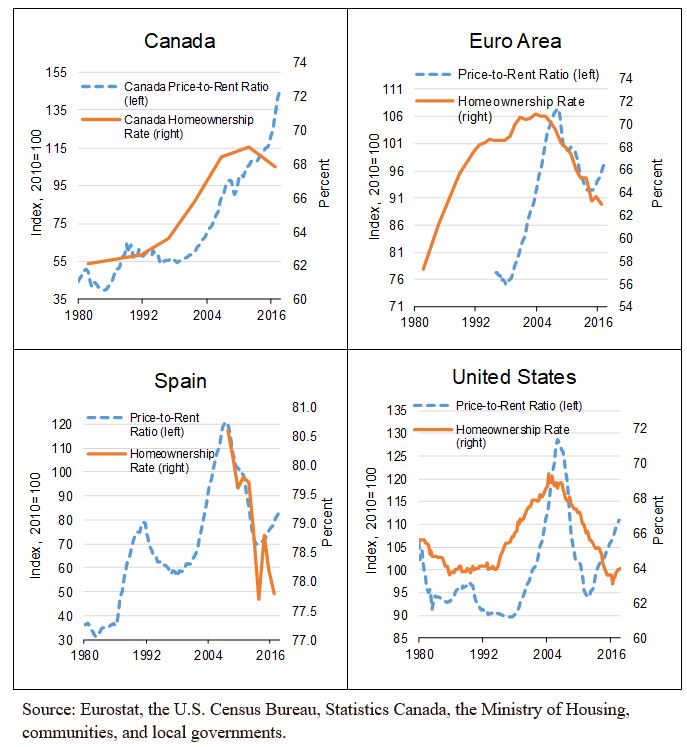
Carlos Garriga and Pedro Gete: In the postwar period, booms in house prices have been accompanied by sizeable increases in homeownership; that is, an increase in the number of households that own the house they occupy. Historically, these two series have usually been positively related. Our research, however, finds an important change in the correlation between these series in the post-Great Recession period for a large number of countries, including the United States. We currently observe a decoupling of house prices and homeownership.
This shift changes the traditional cyclical view of homeownership and house prices. Normally, during a recovery, households buy houses, driving up house values. In the post-Great Recession period, however, we see global increases in house prices and decreases in homeownership. Thus, we identify a new stylized fact that decouples the variables, hence the title “Housing Recoveries without Homeowners.”
Hites Ahir: Is this good news or bad news?
Carlos Garriga and Pedro Gete: Well, the ownership of housing wealth is becoming concentrated among a smaller number of individuals. Whether this is good or bad news is difficult to assess, as we are still in the early stages of the research project documenting these novel facts. It is essential to understand the key driving forces before assessing the welfare effects and prescribing particular policies. The key issue is that in many countries and cities, the focus of the policy debate has changed: households are complaining that “rents are too high,” when the usual complaint used to be that “prices are unaffordable.”
Hites Ahir: Is this also happening in countries with different circumstances (e.g., diverging monetary policy rates)?
Carlos Garriga and Pedro Gete: The fact is very robust across countries, and in the United States it is very evident across most MSAs. We need more work to understand the exact drivers, but it does not seem to be that monetary policy alone can explain the fact.
Hites Ahir: So, we are transitioning from a nation of homeowners to a nation of renters. Has this type of development happened before?
Carlos Garriga and Pedro Gete: In the United States and United Kingdom, homeownership rates were low until post WWII. It seems this was the case in other countries as well. Going back even earlier, the homeownership rate was even lower, as the absence of credit markets makes it very difficult to undertake such a large investment as a house.
Figure 1: Homeownership and Price-to-Rent Ratio
Hites Ahir: What explains the decoupling of house prices and homeownership?
Carlos Garriga and Pedro Gete: Several factors could be driving the decoupling of the price-to-rent ratio and the homeownership rate. From the housing supply side, there is a trend toward decreased construction of starter and midsized housing units. Developers have increased the construction of large single-family homes at the expense of the other segments in the market. Recent increases in regulatory costs could have encouraged builders to focus on larger homes with higher margins. Supply may be just reacting to developments in demand (discussed next).
From the demand side, there are three leading explanations, which are likely to be complementary and self-reinforcing. The first focuses on changes in individual preferences or attitudes toward homeownership. The second builds on changes in the access to mortgage credit. The third tentative explanation relates to changes in the investment nature of real estate.
Hites Ahir: In your note, you say that the “price of houses is again increasing more quickly than the price of rentals.” But, as you know, in some countries, rents are controlled. So how do you reconcile this fact with your findings?
Carlos Garriga and Pedro Gete: It is true that in some countries and cities rent controls might limit the growth of one factor. There are also areas, however, with units not subject to controls that cause prices to rise faster than rents, for example, San Francisco and New York City.
Hites Ahir: In your blog, you also talk about “changes in the investment nature of real estate.” Could you elaborate on this?
Carlos Garriga and Pedro Gete: There are several types of real estate investors with different goals and targets in terms of the type of investment (i.e., single family vs. multi-family homes): First, there are sole proprietorship investors (i.e., “mom & pop”) looking for investment income. Second, there are foreign investors. Third, there are new institutional property owners, such Invitation Homes and American Homes 4 Rent, among others. In fact, since 2016, the real estate industry group has been elevated to the sector level in the S&P Dow Jones Indices.
Technology and globalization have made it easier for the second and third types to increase. For example, technology now makes it profitable to rent single-family houses. In addition, the widespread use of Internet rental portals such as Airbnb and VRBO has increased the opportunity to offer short-term leases, increasing the revenue stream from rental housing.
Hites Ahir: What is next for your research?
Carlos Garriga and Pedro Gete: A closely related issue is to what extent current homeownership rates are artificially high because of an aging population—a global phenomenon. The decline in the number of homeowners is observed across most age groups, but it is also true that the fraction of households over age 45 that are homeowners is substantially larger than for younger households. For this reason, population aging mechanically increases the homeownership rate. For example, in the United States, eliminating the aging effect would generate a homeownership rate of 60.9 percent instead of the observed 63.9 percent—suggesting the impact of aging is quite large. We have a lot of work to do, but we are enthusiastic the topic is worthy!
Global Housing Watch Newsletter: June 2018
In this interview, Carlos Garriga and Pedro Gete talk about their latest research: “Housing Recoveries without Homeowners: A Global Perspective.” Garriga is a Vice President at the Federal Reserve Bank of St. Louis. Gete is a Finance Professor at IE Business School.
Posted by at 5:01 AM
Labels: Global Housing Watch
Subscribe to: Posts