Showing posts with label Global Housing Watch. Show all posts
Friday, July 6, 2018
Housing View – July 6, 2018
On cross-country:
- Global cities record weakest [house] price growth since 2015 – Knight Frank
- Top employers are helping with city housing – Raconteur
- Airbnb’s newest weapon against regulation: The Real Estate Industry – Wired
On the US:
- Are Affordability Perceptions Reducing Household Mobility and Exacerbating the Housing Shortage? – Fannie Mae
- Why does cost of living vary so much? Housing, housing, housing – Federal Reserve Bank of St. Louis
- Why is it so difficult to live where you work? Housing costs and homeownership in economic centers – Federal Reserve Bank of St. Louis
- What Will It Cost to Fix New York’s Public Housing? – New York Times
- San Francisco Is So Expensive, You Can Make Six Figures and Still Be ‘Low Income’ – New York Times
On other countries:
- [Australia] The Outlook for the Housing Market – Reserve Bank of Australia
- [Canada] Pricey Vancouver Housing Market Weakens With Buyers on Sidelines – Bloomberg
- [Germany] Berlin Aims to Cut Its Residential Real-Estate Boom Down to Size – Wall Street Journal
- [Hong Kong] Don’t Expect Hong Kong’s Vacant-Home Tax to Cool Prices – Bloomberg
- [Ireland] Irish lenders told to raise capital buffers – Financial Times
- [Singapore] Singapore Property Curbs Are a Mallet, Not a Hammer – Bloomberg
- [Spain] Housing In Spain: An Unbalanced Market, But Not A Bubble – The Corner
- [United Kingdom] Policy Exchange: housing speech – UK.Gov
- [United Kingdom] UK housing market stuck in doldrums as prices stagnate – Financial Times

Photo by Aliis Sinisalu
On cross-country:
- Global cities record weakest [house] price growth since 2015 – Knight Frank
- Top employers are helping with city housing – Raconteur
- Airbnb’s newest weapon against regulation: The Real Estate Industry – Wired
On the US:
- Are Affordability Perceptions Reducing Household Mobility and Exacerbating the Housing Shortage? – Fannie Mae
- Why does cost of living vary so much?
Posted by at 4:56 PM
Labels: Global Housing Watch
Thursday, July 5, 2018
House Prices in Mongolia
The IMF’s latest report on Mongolia says that:
“(…) …and housing prices stabilized after years of deflation, in line with stronger economic activity and household lending.”
The IMF’s latest report on Mongolia says that:
“(…) …and housing prices stabilized after years of deflation, in line with stronger economic activity and household lending.”

Posted by at 4:07 PM
Labels: Global Housing Watch
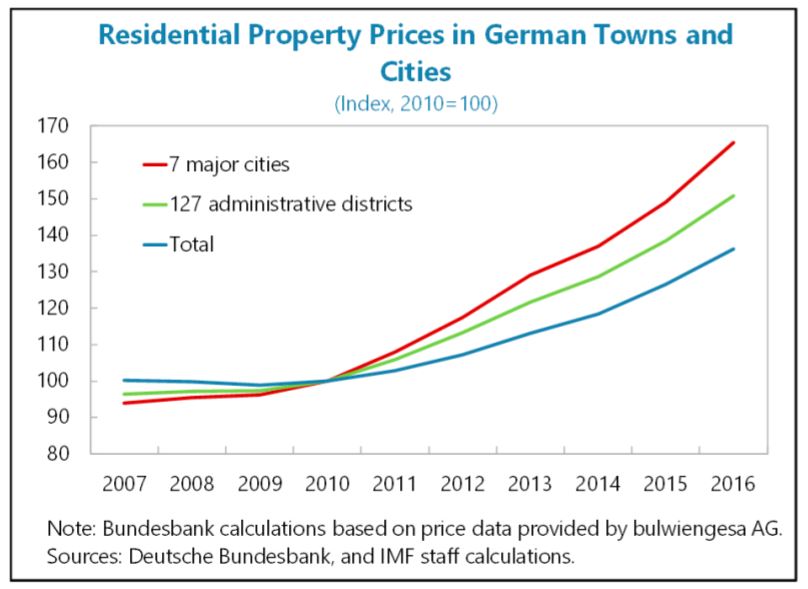
Germany’s Housing Market: Preventing Financial Excesses
The IMF’s latest report on Germany says that:
“Staff analysis suggests that house prices have risen faster than can be explained by demand and supply fundamentals in Germany’s major cities. House prices are rising moderately at the aggregate level, but have increased at double-digit rates in some hot spots where they
appear overvalued. Housing demand is driven by rising household income, large immigration flows in recent years, and low interest rates (…). On the supply side, stringent zoning restrictions (including for environmental protection) and high and rising capacity utilization (including labor shortages) in the construction sector prevent a more agile response of supply to price developments. House prices are most overvalued in Munich, Hamburg, Hannover, and Frankfurt, and are estimated to be more than 20 percent above their fundament level on average in major German cities (…). The Bundesbank obtains similar overvaluation estimates for some German cities in its latest assessment. As recommended in the past, lowering the effective burden of tax on new construction and reexamining zoning restrictions, in particular where demand is not likely to abate, would help mitigate price pressures.New housing policies, aimed at improving affordability, are not expected to have a
noticeable impact on prices. The government foresees spending €2 billion in renewed support for social housing in 2020–21, expanding the land available at a discount for social housing construction, and creating tax incentives to build on unused land. It also plans to allocate €2 billion to families with children acquiring a first home. Other measures are still being contemplated, including tax subsidies for rental housing, public loan guarantees and real estate tax exemptions to reduce equity requirements for owner-occupied houses, and strengthening rent controls. As these measures have counteracting effects on housing supply and demand, the overall impact on housing prices is likely to be small.Mortgage growth at the aggregate level has been moderate so far. Housing loans have
grown only marginally faster than GDP in recent years. German households are not highly leveraged (household debt stood at 53 percent of GDP at end-2017) and the overall debt-service-to-income ratio is low and declining (…). Mortgage lending spreads have compressed due to high competition among banks, but no widespread deterioration of lending conditions has been observed. Mortgage credit is recourse and based on fixed interest rates.However, data gaps prevent a full assessment of financial stability risks in the housing sector and should be urgently addressed. The absence of regional credit statistics and granular loan information prevents a full assessment of potential financial stability risks in specific market segments. The distribution of housing credit growth by type of bank, for instance, suggests that there could be important differences between major urban centers and the rest of the country. Given this, it is increasingly urgent that data gaps should be addressed.
The macroprudential toolkit should be strengthened. New tools—loan to value (LTV)
caps and amortization requirements—were legally created in 2017, a welcome development.
However, income-based instruments, such as the debt-to-income ratio and the debt-service-to income ratio, are not included in the legislation. These tools, which can help prevent an excessive build-up of debt by households when house prices are rising rapidly, should be added.Given rapidly rising house prices in some cities alongside data gaps that hinder a full
assessment of risks, early activation of macroprudential tools should be considered. As noted
in the 2016 Financial Sector Assessment Program (FSAP), international experience suggests that macroprudential tools should be deployed early to be most effective. It is therefore important that the macroprudential framework is sufficiently nimble such that instruments can be utilized preventatively to avoid the build-up of vulnerabilities. In Germany, early activation would help preserve financial stability by dampening risks of excessive leverage, especially in the context of insufficient data to assess whether pockets of vulnerability are arising. To the extent that vulnerabilities are not present, macroprudential measures—such as application of LTV caps and amortization requirements—would not likely be binding anyway. On this basis, consideration should be given to early activation of the existing macroprudential tools.Authorities’ Views
The Bundesbank monitors developments in the real estate markets closely, and authorities assess corresponding financial stability risks to be low. An early activation of borrower-based macroprudential tools is deemed unjustified at this stage and would face legal obstacles. They saw overvaluation concerns as localized and the lack of substantial credit growth or deterioration of credit standards, alongside households’ strong balance-sheets, as reassuring. They therefore saw no need for activation of LTV caps or amortization requirements at the present juncture. They fully shared staff’s concern over the information gaps which prevent a fuller assessment of risks. The authorities highlighted that microprudential tools are available and can be effectively used to address bank-specific concerns.”

The IMF’s latest report on Germany says that:
“Staff analysis suggests that house prices have risen faster than can be explained by demand and supply fundamentals in Germany’s major cities. House prices are rising moderately at the aggregate level, but have increased at double-digit rates in some hot spots where they
appear overvalued. Housing demand is driven by rising household income, large immigration flows in recent years, and low interest rates (…).
Posted by at 11:04 AM
Labels: Global Housing Watch
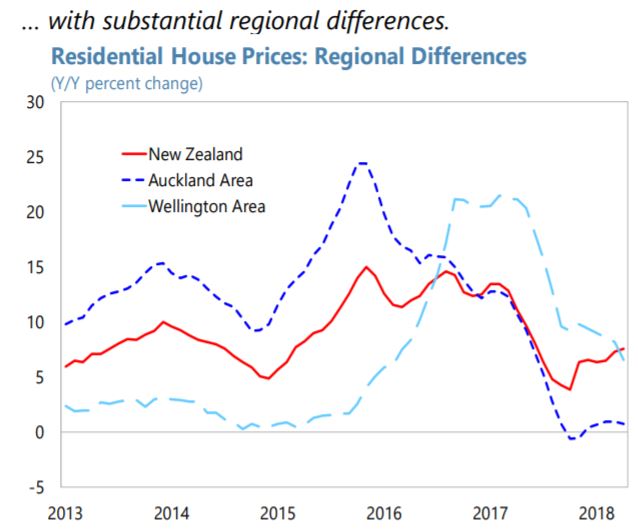
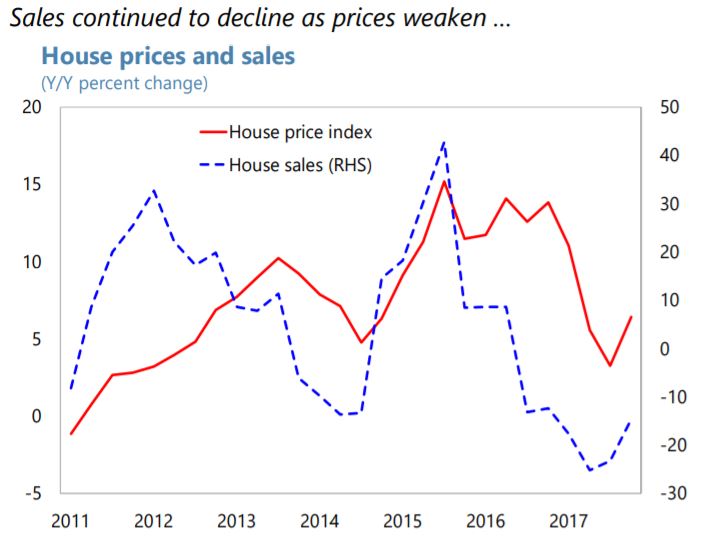
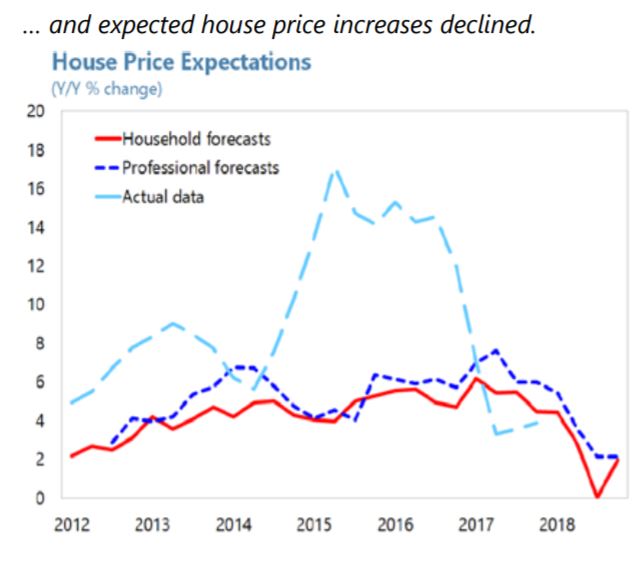
New Zealand: Managing Housing Market Imbalances
The IMF’s latest report on New Zealand says that:
“Context
The new government’s housing policy agenda focuses on direct supply initiatives, tax
policy changes, and restrictions on home ownership by nonresidents. Addressing declining
housing affordability has become a policy priority (…).
- Supply initiatives. Under the KiwiBuild program, the government plans to build 100,000 affordable houses over 10 years (about one third of average annual residential building authorizations) for first-time homebuyers. After initial financing of NZ$2 billion, the program would be sustained through the sales of completed houses.
- Addressing other supply constraints. Besides the KiwiBuild program, the Urban Growth
Agenda aims to increase the availability of developable land and the supply response to higher house prices by addressing regulatory, planning and other policy constraints, including the underfunding of locally-provided infrastructure.
- Tax policy changes. To dampen property speculation, more residential property sales will be subject to capital gains taxes, as the related bright-line test has been extended from a two-year to a five-year holding period. Residential properties other than main home acquired after March 29, 2018 will be subject to capital gain taxes if disposed of within five years of acquisition. The government also proposed to limit negative gearing from rental properties, such that the deductibility of net losses from property investment (and interest costs) from other taxable income would be eliminated. A Tax Working Group is considering possible additional reform, including a broader capital gains tax on real estate investment and land tax reform.
- Restrictions on nonresidents’ real estate purchases. A proposed ban in a draft amendment to the Overseas Investment Act is scheduled for a parliamentary vote as early as late June 2018. Under the amendment, all residential land would be re-classified as “sensitive land,” which would require approval for foreign buyers under tighter qualifying criteria.
Staff’s Views
The housing policy agenda appropriately focuses on closing key gaps on the supply
side and in the tax system. While demand-side drivers have stabilized, they remain robust, and improved housing affordability ultimately requires a stronger housing supply response. These measures are complementary, and the success of the housing policy agenda will depend on well coordinated progress on all fronts. While the large scale of the KiwiBuild program can provide the certainty needed to redirect builders’ incentives toward lower-price housing and adopt new, more cost-effective building technology, the direct market intervention by the government also comes with risks to the budget and risks of crowding out private housing supply and market distortions more broadly. The Tax Working Group should also consider raising land taxes, which are efficient and would increase the recurrent cost of holding land, thereby encouraging its (re)development.A ban of residential real estate purchases by nonresidents is unlikely to improve housing affordability significantly. The proposed draft amendment to the Overseas Investment Act would be a capital flow management measure (CFM) under the IMF’s Institutional View (IV) on capital flows, as it would introduce discrimination based on residency and thus limit capital flows by its design. Its use would not be in line with the IV. While macroeconomic and macroprudential policy settings are broadly appropriate, available data suggest that foreign buyers appear to have played a minor role in New Zealand’s residential real estate markets recently. And in its current design, the CFM is unlikely to be temporary or targeted. The broad housing policy agenda above, if fully implemented, would address most of the potential problems associated with foreign buyers on a non-discriminatory basis.
Authorities’ Views
The authorities concurred that restoring housing affordability required a focus on
strengthening supply and lowering tax distortions. They noted that measures to intensify
competition in land markets via the Urban Growth Agenda would not be sufficient. Direct
intervention, through the KiwiBuild program, was also required. On tax policy, while the extension of the bright-line test to five years for capital gains taxation on non-primary residences is now in place, a wider set of reforms are being considered to the tax treatment of residential real estate investment. This includes ring-fencing negative gearing on investment properties. The Tax Working Group has been directed to consider whether a system of taxing capital gains or land (not applying to the family home or the land under it), or other housing tax measures, would improve the tax system.The authorities disagreed with the assessment that a ban on residential real estate
purchases by nonresidents, if implemented, would be a CFM under the IV. They emphasized
that the ban must be assessed holistically, taking into account the broader social, economic and political context. Declining housing affordability and greater inequality have become a major concern, which has lowered approval of globalization and immigration in New Zealand. Given the central role that home ownership plays in New Zealanders’ sense of well being, the government has taken steps to ensure that housing prices will be shaped by domestic market forces. If the government had not committed to extend its domestic screening regime for sensitive New Zealand assets to residential land, it would not have been able to secure the public’s support for additional international trade agreements. The authorities noted that the proposed screening regime will allow nonresidents to obtain consent to acquire residential land where they are committed to reside and become tax residents, in New Zealand; where their investment will increase housing supply; or where they will develop the land for other purposes (such as commercial premises). They also think that the new regime will help ensure that foreign direct investment flows into the productive economy rather than unproductive speculation. Finally, the authorities do not consider this measure to be a CFM; it will only have a limited effect on aggregate capital flows or the balance of payments, and it will have no material impact on the broader direction of or the openness of New Zealand’s economy.”

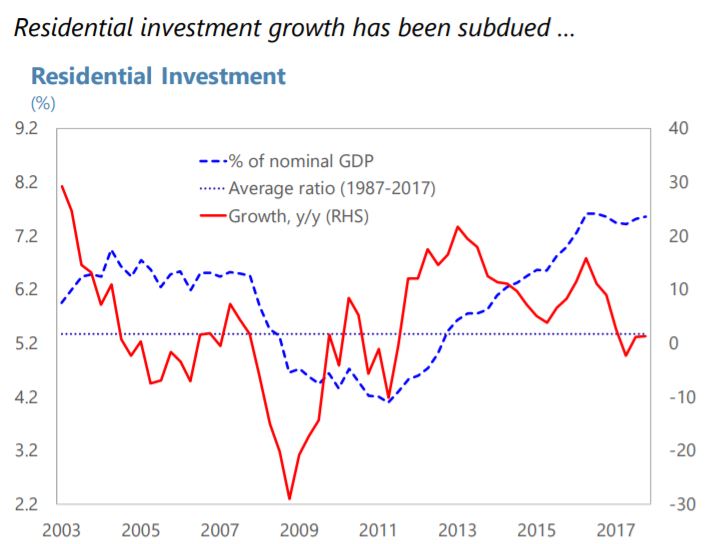

The IMF’s latest report on New Zealand says that:
“Context
The new government’s housing policy agenda focuses on direct supply initiatives, tax
policy changes, and restrictions on home ownership by nonresidents. Addressing declining
housing affordability has become a policy priority (…).
- Supply initiatives. Under the KiwiBuild program, the government plans to build 100,000 affordable houses over 10 years (about one third of average annual residential building authorizations) for first-time homebuyers.
Posted by at 10:48 AM
Labels: Global Housing Watch
Wednesday, July 4, 2018
Housing in the United States
The IMF’s latest report on the United States says that:
“Housing finance and the U.S. housing market have not been reformed comprehensively. To date, no legislative or executive action has been taken to reduce substantially the footprint of Fannie Mae and Freddie Mac (“Enterprises”). However, as conservator, the Federal Housing Finance Agency (FHFA) has required market-based credit risk transfers from the Enterprises to the private sector at an increasing level since 2013. The Enterprises have also jointly developed a common securitization platform and have announced that they will issue a new uniform mortgage backed security starting June 2019. These Enterprise reforms have been accomplished administratively and have not reformed the entire housing finance system, which would require legislative action.
Since 2015, the FHFA has directed the Enterprises to fund the Housing Trust Fund and Capital Magnet Funds (as required by the 2008 Housing and Economic Recovery Act) by transferring a portion of total new acquisitions to these funds, which are administered by the Department of Housing and Urban Development and Treasury Department, respectively.
FHFA has the discretion to suspend the Enterprise allocations to the affordable housing funds, including the Housing Trust Fund, if the allocations are contributing to the Enterprise’s financial instability. Moreover, the Senior Preferred Stock Purchase Agreements (PSPA’s) are sources of strength for the Enterprises. Indeed, the PSPA’s between the Treasury and each Enterprise both ensure the ability of each Enterprise to meet its financial obligations and to ensure that they will have minimal net worth as all profits above the capital reserve amount are transferred to Treasury each quarter. The capital reserve amount had been declining by $600 million per year and was scheduled to decline to $0 on January 1, 2018. However, on December 21, 2017, FHFA and the Department of the Treasury agreed to reinstate a $3 billion capital reserve amount for each Enterprise to prevent draws on the PSPA due to fluctuations in the Enterprises’ income due to the normal course of business. Despite the new capital reserve, the December 2017 tax cuts caused the Enterprises to draw a combined total of $4 billion at the end of that quarter. Policymakers have been evaluating and developing a potential comprehensive overhaul of the mortgage finance system over ten years after the federal government took control of Fannie Mae and Freddie Mac that could shrink or eventually close the two entities and create a system with more private capital. The Congressional Budget Office (CBO) has provided analyses on these issues. One such analysis prepared at the request of the Chairman of the House Committee on Financial Services, analyzed alternatives for attracting more private capital to the secondary mortgage market and alternative structures for that market, including a fully federal agency, a hybrid, public-private market, a market with a government guarantor of last resort, and a largely private secondary market.In 2018, the U.S. Senate passed The Economic Grown, Regulatory Relief and Consumer Protection Act (S. 2155), which has emphasized providing regulatory relief for small banks and credit unions and amending the Dodd-Frank Act. Moreover, on June 12, 2017, the Department of the Treasury published a comprehensive report containing recommendations for the financial regulation of banks and credit unions (“A Financial System that Creates Economic Opportunities: Banks and Credit Unions”).”
The IMF’s latest report on the United States says that:
“Housing finance and the U.S. housing market have not been reformed comprehensively. To date, no legislative or executive action has been taken to reduce substantially the footprint of Fannie Mae and Freddie Mac (“Enterprises”). However, as conservator, the Federal Housing Finance Agency (FHFA) has required market-based credit risk transfers from the Enterprises to the private sector at an increasing level since 2013.
Posted by at 2:11 PM
Labels: Global Housing Watch
Subscribe to: Posts