


Inclusive Growth

Global Housing Watch

Forecasting Forum

Energy & Climate Change

House Prices in Jordan

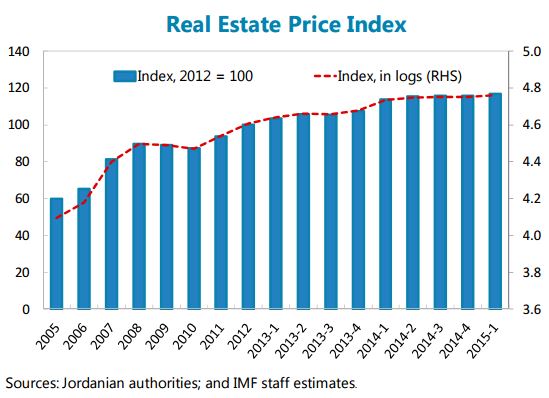
“Mortgages slowed down in tandem with real estate prices; exposure of banks to real estate credit risk has remained limited”, notes the latest IMF report on Jordan.

“Mortgages slowed down in tandem with real estate prices; exposure of banks to real estate credit risk has remained limited”, notes the latest IMF report on Jordan.

Read the full article…

Posted by at 9:00 AM

Labels: Global Housing Watch

House Prices in United Arab Emirates

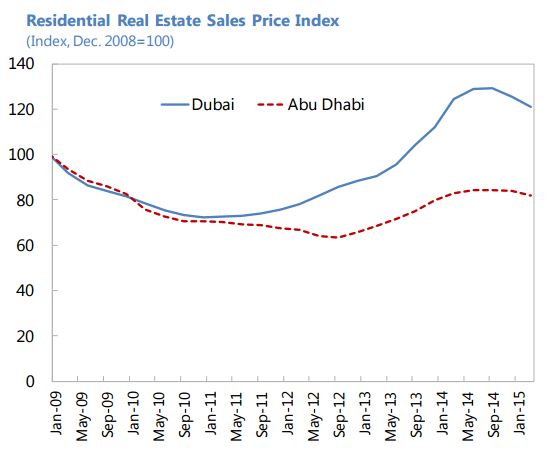
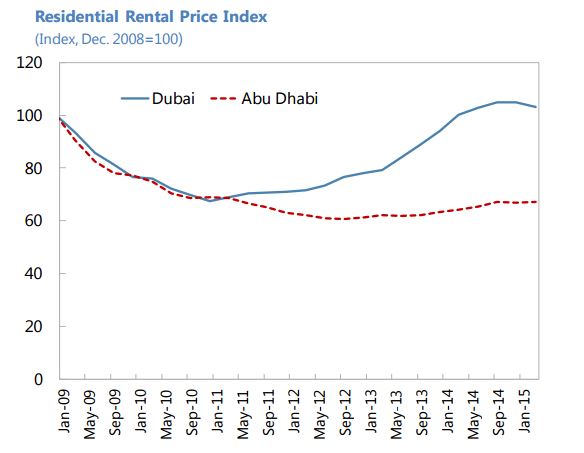
“The real estate market in the UAE has cooled down after expanding strongly in 2013 and the first half of 2014. By end-2014, sales price increases moderated in Dubai and Abu Dhabi, and in March 2015, growth in residential sales prices turned slightly negative in both Emirates, in year-on-year terms (…). These developments are taking place amid increased supply, particularly in Dubai, and reduced demand associated with lower oil prices and appreciating US dollar, and following the introduction of mortgage regulations based on loan-to-value ratios and an increase in the property transfer fee in late 2013. With the additional new supply in the market, Dubai’s sales’ prices are expected to further decline over the course of the year, while constrained supply through 2017 will support prices in Abu Dhabi. (…) Price-to-rent ratios have declined since mid-2014 in both metropolitan areas, indicating a healthy correction in the UAE’s likely overpriced housing market”, says the IMF new report on UAE. 

“The real estate market in the UAE has cooled down after expanding strongly in 2013 and the first half of 2014. By end-2014, sales price increases moderated in Dubai and Abu Dhabi, and in March 2015, growth in residential sales prices turned slightly negative in both Emirates, in year-on-year terms (…). These developments are taking place amid increased supply, particularly in Dubai, and reduced demand associated with lower oil prices and appreciating US dollar, and following the introduction of mortgage regulations based on loan-to-value ratios and an increase in the property transfer fee in late 2013. Read the full article…

Posted by at 9:00 AM

Labels: Global Housing Watch

Price Expectations and the US Housing Boom

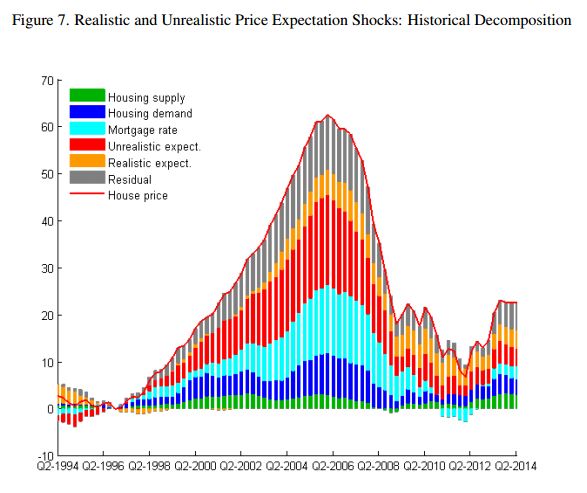
A new IMF paper by Pascal Towbin and Sebastian Weber looks at the shifts in house price expectations as an important driver of the US house price boom that preceded the financial crisis. 

The authors find “that the contribution of price expectation shocks to the U.S. housing boom in the 2000s has been substantial. In our baseline specification, price expectation shocks explain roughly 30% of the increase. Another 30% of the increase in house prices remains, however, unaccounted for by the four identified shocks. This indicates that attributing the entire residual that cannot be explained by standard shocks to price expectations will lead to an overestimation of their contribution. We also find that a model-based measure of house price expectations is strongly positively correlated with leads of a survey based measure of house price expectations. This indicates that our measure contains similar information as a survey-based measure, but tends to provide the information more timely. Our approach to identify price expectation shocks leaves the reason why expectations change open. When using an additional constraint to distinguish realistic from unrealistic price expectation shocks, we provide evidence that the housing boom was driven to an important extent by unrealistic price expectations.”

A new IMF paper by Pascal Towbin and Sebastian Weber looks at the shifts in house price expectations as an important driver of the US house price boom that preceded the financial crisis. 

The authors find “that the contribution of price expectation shocks to the U.S. housing boom in the 2000s has been substantial. In our baseline specification, price expectation shocks explain roughly 30% of the increase. Another 30% of the increase in house prices remains, Read the full article…

Posted by at 12:00 PM

Labels: Global Housing Watch

House Prices in Europe

“Credit
growth is still low and the housing market recovery is still at an early stage. Macroprudential policies
are the first option, although responsibility in this area is shared between the ECB and national
authorities” notes the IMF report on the Euro Area. 

“Credit
growth is still low and the housing market recovery is still at an early stage. Macroprudential policies
are the first option, although responsibility in this area is shared between the ECB and national
authorities” notes the IMF report on the Euro Area. 

Read the full article…

Posted by at 4:20 PM

Labels: Global Housing Watch

House Prices in Singapore
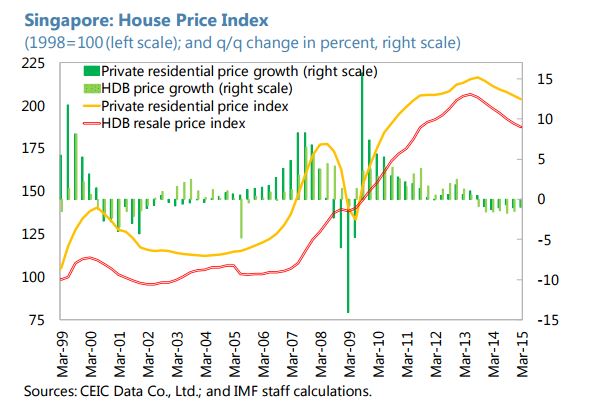
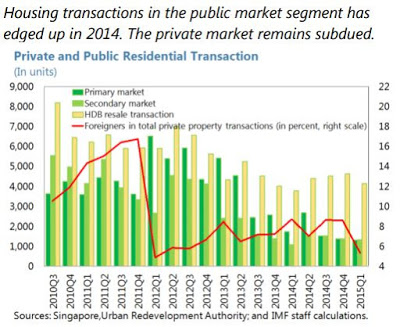
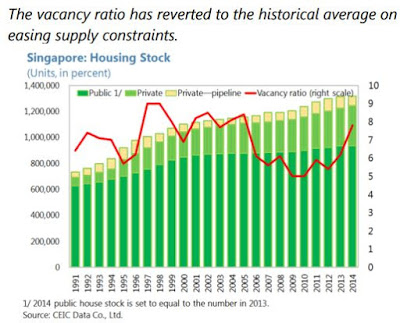
“Recent macroprudential measures have contributed to smoothing the cycle for credit and house prices”, says IMF’s annual report on Singapore. More specifically, the report notes that “House prices have continued to decline modestly and are below their peaks by 9 percent and 6 percent in the public resale and private market segments as of the first quarter of 2015, respectively. The pace of house price decline has been slower over the past 7 quarters, suggesting that policy actions such as the introduction of the total debt service ratio (TDSR) framework in mid- 2013 have helped engineer the soft landing targeted by policy makers.”

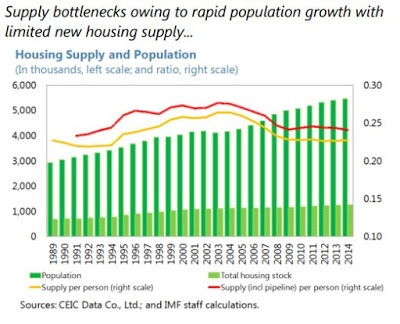
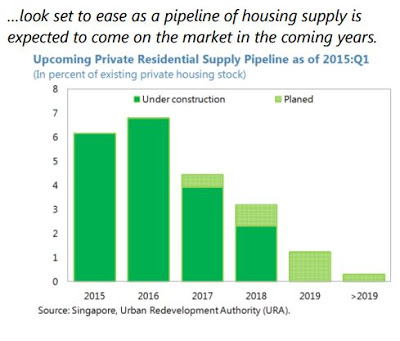
Moreover, the report says that “A further measured decline in residential real estate prices seems likely. The large supply of new homes coming on the market in the next two years should alleviate supply pressures and the expected increase in interest rates will reduce demand, helping moderate prices and increasing affordability. Price adjustments to date have been modest and gradual, and robust demand for new housing projects suggests that the risk of disorderly adjustment in house prices is low. Therefore, core macroprudential measures such as the TDSR, ceilings on loan-to-value ratios and loan tenure limits should be maintained to prevent a buildup of excessive leverage that could lead to systemic risks. Other measures, for example stamp duties, could be relaxed to arrest potential adverse feedback loops between economic activity and financial conditions, without loosening banks’ lending standards. But this should only be done in case of signs of excessive house price declines, associated with clear evidence of a tightening of financial conditions.”


The housing market developments in six charts:

“Recent macroprudential measures have contributed to smoothing the cycle for credit and house prices”, says IMF’s annual report on Singapore. More specifically, the report notes that “House prices have continued to decline modestly and are below their peaks by 9 percent and 6 percent in the public resale and private market segments as of the first quarter of 2015, respectively. The pace of house price decline has been slower over the past 7 quarters, Read the full article…

Posted by at 3:52 PM

Labels: Global Housing Watch

Newer Posts Home Older Posts

Subscribe to: Posts