



Friday, August 25, 2017
Housing View – August 25, 2017
On cross-country:
- Dealing with the effects of one bubble creating more – Financial Times
- Real Estate Summary – Edition 2, 2017 – UBS
On the US:
- The Housing Boom and Bust: Model Meets Evidence – NBER
- Oil Change: Fueling Housing and Land Prices? – Real Estate Center at Texas A&M University
- Why Housing Has Outperformed Equities Over the Long Run – Policy Tensor
- The Appropriate Government Role in U.S. Mortgage Markets – Federal Reserve Bank of New York
- Mortgage Lenders Shift Focus to Enhancing the Consumer Experience – FannieMae
On other countries:
- [Canada] Foreign Buyers and Home-Price Growth: 15% nonresident foreign buyer tax enacted in Toronto and Vancouver – CoreLogic
- [Canada] Interest Rates and Mortgage Borrowing Power in Canada – Fraser Institute
- [China] Beijing plans to extend homeowners’ right to schools to tenants – Financial Times
- [Colombia] Housing Finance and Real Estate Markets in Colombia – IMF
- [Germany] Germany’s Housing Market Is Red Hot, But Don’t Call It a Bubble – Bloomberg
- [Israel] Spatial Planning and Policy in Israel: The Cases of Netanya and Umm al-Fahm – OECD
- [Ireland] An analysis of recent trends in the Irish rental market 2017 Q2 – Daft.ie
- [Turkey] Housing price dynamics and bubble risk: the case of Turkey – Journal of Housing Studies
- [United Arab Emirates] Dubai Supply: Myth Busters – REIDIN
- [United Kingdom] Major land reform urged to fix UK housing crisis – Financial Times
On cross-country:
- Dealing with the effects of one bubble creating more – Financial Times
- Real Estate Summary – Edition 2, 2017 – UBS
On the US:
- The Housing Boom and Bust: Model Meets Evidence – NBER
- Oil Change: Fueling Housing and Land Prices? – Real Estate Center at Texas A&M University
- Why Housing Has Outperformed Equities Over the Long Run – Policy Tensor
- The Appropriate Government Role in U.S.
Posted by at 5:00 AM
Labels: Global Housing Watch
Sunday, August 20, 2017
Housing Finance and Real Estate Markets in Colombia
A new IMF working paper on Colombia says that:
“Overall, risks from the housing market seem to be contained. While the results from the VAR model suggest that a negative house price shock could have sizable implications on activity (GDP, consumption and investment), house prices do not seem to be largely above levels justified by economic fundamentals (the average estimated gap is at 13 percent). Moreover, after the 1999 financial crisis the authorities have adopted macroprudential measures such as the use of LTV limits, which together with other housing financing characteristics, limit the vulnerabilities stemming from the housing market. At the same time, the current slowdown in economic activity should decelerate mortgage growth and impact the growth of house prices, which has started to show some signs of weakening. However, the authorities should continue to monitor closely the developments in credit and house price growth.”
A new IMF working paper on Colombia says that:
“Overall, risks from the housing market seem to be contained. While the results from the VAR model suggest that a negative house price shock could have sizable implications on activity (GDP, consumption and investment), house prices do not seem to be largely above levels justified by economic fundamentals (the average estimated gap is at 13 percent). Moreover, after the 1999 financial crisis the authorities have adopted macroprudential measures such as the use of LTV limits,
Posted by at 6:40 PM
Labels: Global Housing Watch
Friday, August 18, 2017
Housing View – August 18, 2017
On cross-country:
- Housing for the long run? – Financial Times
- Construction: How to build more efficiently – The Economist
- The construction industry: Least improved – The Economist
On the US:
- Worst Case Housing Needs: 2017 Report to Congress – U.S. Department of Housing and Urban Development
- Housing is too expensive for low-skilled workers to move to cities with the highest-paid jobs – Quartz
- S. Housing: The (Young) Kids Are Alright – Roubini Global Economics
- Banking integration and house price comovement – European Systemic Risk Board
- NY Fed President Wants Consumers to Tap Home Equity: Didn’t We Try That Before? – MishTalk
- Affordable Housing Regulations Crushing New Home Construction in L.A. – Reason
On other countries:
- [Australia] Speech on Some Innovative Mortgage Data – Reserve Bank of Australia
- [Australia] Monthly Property Update – CoreLogic
- Assessing China’s Residential Real Estate Market – IMF
- [China] Home Purchase Restriction and Housing Price: A Distribution Dynamics Analysis – Regional Science and Urban Economics
- [Netherlands] Regional house price differences are widening: Dutch Housing Market Quarterly – Rabobank
- [Spain] What has happened in Spain? The real estate bubble, corruption and housing development: A view from the local level – Geoforum
- [United Kingdom] Residential Market Outlook – Cluttons
- [United Kingdom] London mayor targets developers over affordable housing obligations – Financial Times
On cross-country:
- Housing for the long run? – Financial Times
- Construction: How to build more efficiently – The Economist
- The construction industry: Least improved – The Economist
On the US:
- Worst Case Housing Needs: 2017 Report to Congress – U.S. Department of Housing and Urban Development
- Housing is too expensive for low-skilled workers to move to cities with the highest-paid jobs – Quartz
- S.
Posted by at 5:00 AM
Labels: Global Housing Watch
Tuesday, August 15, 2017
Inequality in China – Trends, Drivers, and Policy Remedies
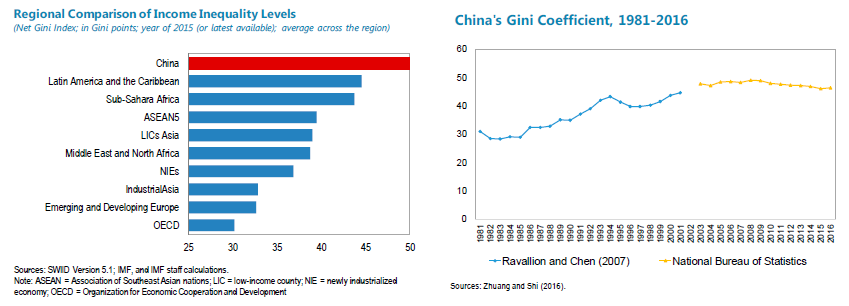
A new IMF reports finds that “China has grown rapidly and is on the brink of eradicating poverty. However, income inequality increased sharply from the early 1980s. While less equality is to be expected in the transition from central planning to a market-based economy, China is now among the most unequal countries in the world, despite a recent modest improvement.
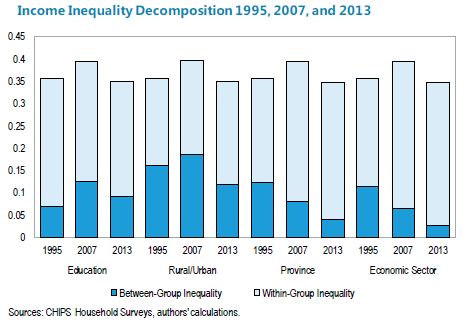
Inequality has been driven by structural factors (especially demographics, the urban/rural divide and education/skills), with little offset from fiscal policies. These structural factors are likely to drive inequality higher.
This calls for more proactive use of fiscal policies to reduce inequality. On the revenue side: (1) increasing the progressivity of social security contributions and of personal and property taxes. On the spending side: (2) boosting social spending and promoting equal access across provinces and regardless of residency.”
Continue reading here.
A new IMF reports finds that “China has grown rapidly and is on the brink of eradicating poverty. However, income inequality increased sharply from the early 1980s. While less equality is to be expected in the transition from central planning to a market-based economy, China is now among the most unequal countries in the world, despite a recent modest improvement.
Inequality has been driven by structural factors (especially demographics,
Posted by at 10:11 AM
Labels: Inclusive Growth
Assessing China’s Residential Real Estate Market
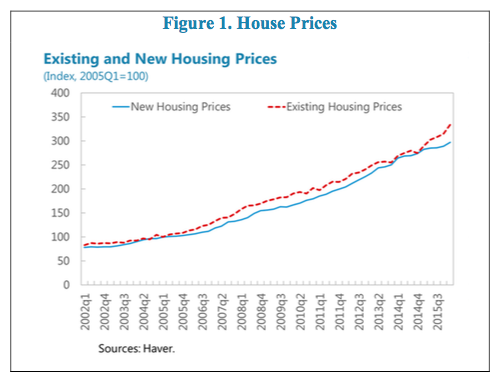
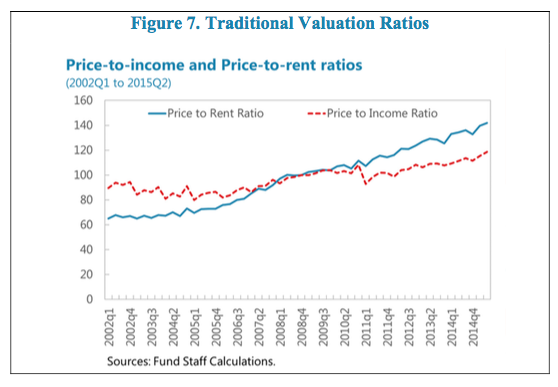
A new IMF report on China says:
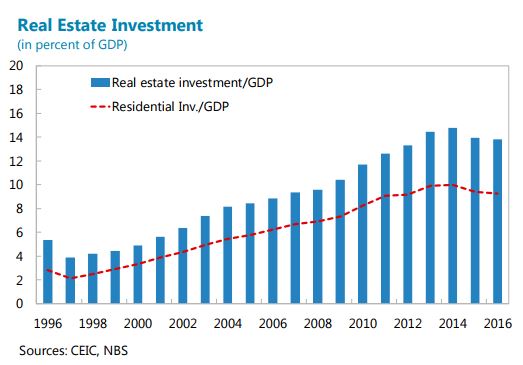
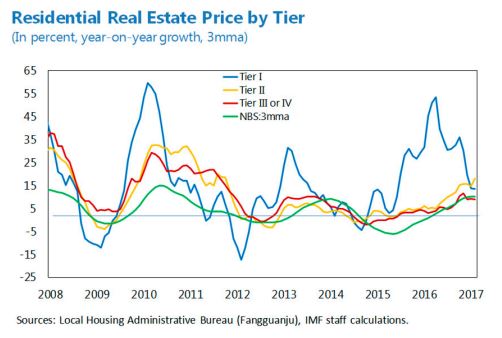
- “China’s real estate market rebounded sharply after a temporary slowdown in 2014-2015. The tightening measures since late 2016 seem to have dampened market activity, but house prices and sales remain strong, particularly in smaller cities.”
- “Risks are significant on the downside. If house prices rise further beyond “fundamental” levels and the bubble expands to smaller cities, it would increase the likelihood and costs of a sharp correction, which would weaken overall growth, undermine financial stability, reduce local government spending room, and spur capital outflows.”
- “To stave off such risks, the increasing intensity of macro-prudential and city-specific policies is appropriate, given the diversity in housing conditions, and should continue to be deployed to ensure a smooth adjustment. The government should expand its toolkit to include additional macroprudential measures including more active use of debt servicing-to-income (DSTI) caps and capital requirements on banks’ exposure to the real estate sector.”
- “A longer-term solution to manage better the frequent house price cycles is to introduce recurrent property taxes, resolve land supply constraints in large cities, mitigate local governments’ reliance on land sales, and accelerate reforms of the social security and “hukou” systems.”
A new IMF report on China says:
- “China’s real estate market rebounded sharply after a temporary slowdown in 2014-2015. The tightening measures since late 2016 seem to have dampened market activity, but house prices and sales remain strong, particularly in smaller cities.”
- “Risks are significant on the downside. If house prices rise further beyond “fundamental” levels and the bubble expands to smaller cities, it would increase the likelihood and costs of a sharp correction,
Posted by at 9:28 AM
Labels: Global Housing Watch
Subscribe to: Posts