



Friday, December 1, 2017
Housing View – December 1, 2017
On cross-country:
- Europe’s central banks warn about bubbles critics say they helped create – Reuters
- Conference on Housing, Household Debt and Policy – Reserve Bank of New Zealand
- Why Economists Love Property Taxes and You Don’t – Bloomberg
- Risky business: when will the threat of natural disaster hit property prices? – Financial Times
On the US:
- Millennials Want to Own Homes Too, If U.S. Economy Would Consent – Bloomberg
- Alumni gather to discuss Affordable Housing Policy in the 21st Century – NYU Wagner
- Mortgage Supply and Housing Rents – Harvard University
- Unemployment and the Housing Market during the Great Recession – Stanford University
- Houston Market: Impact of Harvey Strongest in the Resale Market; New Home Sales Should Surge in 2018 – Metrostudy
- Affordable-Housing Industry Braces for GOP Tax Overhaul – Wall Street Journal
On other countries:
- [Australia] What Is The Spread In The Cost Of Housing? – CoreLogic
- [Brazil] Loan-to-value policy and housing finance: effects on constrained borrowers – Bank for International Settlements
- [Canada] Bank of Canada accentuates risks from loose lending – Financial Times
- [Canada] Government of Canada announces National Housing Strategy – CMHC
- [Canada] Trudeau government’s new housing benefit seems to ignore regional differences – Fraser Institute
- [Canada] City of Vancouver (finally) acknowledges importance of housing supply – Fraser Institute
- [Canada] Curbing Mortgage Risk, Canada-Style – Roubini Global Economics
- [Canada] Filtering—how markets, not national strategies, make housing affordable – Fraser Institute
- [China] China housing inventory hits 4-year low on de-stocking success – Financial Times
- [Germany] German residential property prices on the rise – Financial Times
- [Hong Kong] IMF Says Hong Kong Property to Slow If Fed Delivers Rate Hikes – Bloomberg
- [Sweden] Swedish central bank says mortgages top risk, wants govt action – Reuters
- [Sweden] Sweden’s cooling housing market is a preview for others with low rates and property bubbles – Quartz
- Sweden’s Housing Market May Be Facing a 10% Slump, S&P Warns – Bloomberg
- [Sweden] Here Are Some Worrying Charts About Sweden’s Housing Market – Bloomberg
- [Sweden] Swedish government set to give green light to tougher mortgage rules – Reuters
- [United Kingdom] Reactions to Autumn Budget 2017: housing measures – BBC, Centre for Cities, Guardian, Inside Housing, Institute for Fiscal Studies, Reuters
- [United Kingdom] House prices and the UK economy: Views of leading economists – Vox
- [United Kingdom] London, Residential Market Outlook, Winter 2017 – Cluttons
- [United Kingdom] Social housing models: past and future – London School of Economics
- [United Kingdom] Priced out? Affordable Housing in England – Institute for Public Policy Research
- [United Arab Emirates] UAE Residential Market Overview – October Results – Reidin

Photo by Aliis Sinisalu
On cross-country:
- Europe’s central banks warn about bubbles critics say they helped create – Reuters
- Conference on Housing, Household Debt and Policy – Reserve Bank of New Zealand
- Why Economists Love Property Taxes and You Don’t – Bloomberg
- Risky business: when will the threat of natural disaster hit property prices? – Financial Times
On the US:
- Millennials Want to Own Homes Too,
Posted by at 5:00 AM
Labels: Global Housing Watch
Monday, November 27, 2017
New eBook: Ordoliberalism: A German oddity?
From VoxEU: “The Eurozone crisis has opened fault lines between German economists and policymakers and those in a number of Eurozone (in particular periphery) countries.This column introduces a new eBook explaining the historical development of the ordoliberal school of economics and its influence on German policymaking, and contrasting it critically with what we like to call the Anglo-Saxon-Latin pragmatism of economic policymaking.”
Download the new eBook here.
From VoxEU: “The Eurozone crisis has opened fault lines between German economists and policymakers and those in a number of Eurozone (in particular periphery) countries.This column introduces a new eBook explaining the historical development of the ordoliberal school of economics and its influence on German policymaking, and contrasting it critically with what we like to call the Anglo-Saxon-Latin pragmatism of economic policymaking.”
Download the new eBook here.
Posted by at 9:18 AM
Labels: Inclusive Growth, Macro Demystified
Friday, November 24, 2017
Housing View – November 24, 2017
On cross-country:
- A quarter of household expenditure allocated to housing – Eurostat
- The Problem With Expensive Real Estate – Bloomberg
- Capacity Building & Disseminating best practices in affordable housing – Housing Europe
On the US:
- More reactions to House Tax Reform Bill – Curbed, Foreign Affairs, NAHB, Politico, Seattle Times
- A duopsony built around rent-seeking – American Enterprise Institute
- After a Natural Disaster, Do Landlords Jack Up the Rent? – Priceonomics
- Why Does Land-Use Regulation (Still) Matter in Oregon? – Cato Institute
- House and Senate Tax Plans Cut Affordable Housing, Set Stage for Deeper Cuts Later – Center on Budget and Policy Priorities
- The Mortgage Credit Channel of Macroeconomic Transmission – MIT
- What the Housing Market in America Needs Is More Options – Smithsonian
On other countries:
- [Australia] Speech on Mortgage Insights From Securitisation Data – Reserve Bank of Australia
- [Australia] Regional housing supply and demand in Australia – Australian National University
- [Brazil] Loan-to-value policy and housing finance: effects on constrained borrowers – Bank for International Settlements
- [Canada] Even Real Estate Developers Can’t Afford Toronto’s Housing Market – Bloomberg
- [China] China to step up property market regulation to avoid bubble risk – Reuters
- [Japan] Is Tokyo’s property market reaching its peak? – Financial Times
- [Romania] Housing privatization in Romania – Economics of Transition
- [Sweden] Slowdown in Swedish house prices is ‘positive’ for stability – Riksbank – Financial Times
- [Sweden] Riksbank Governor Tries to Quell Fears of Swedish Housing Slump – Bloomberg
- [Switzerland] Zurich’s Public Housing Problem: The Tenants Are Too Rich – Citylab
- [Switzerland] Lessons from Zurich – Inside Housing
- [United Kingdom] Your regular reminder that stamp duty cuts make nearly no difference to anything – Financial Times
- [United Kingdom] 2017 Autumn Statement Response – Cluttons
On cross-country:
- A quarter of household expenditure allocated to housing – Eurostat
- The Problem With Expensive Real Estate – Bloomberg
- Capacity Building & Disseminating best practices in affordable housing – Housing Europe
On the US:
- More reactions to House Tax Reform Bill – Curbed, Foreign Affairs, NAHB,
Posted by at 5:00 AM
Labels: Global Housing Watch
Wednesday, November 22, 2017
House Prices in Philippines
The IMF’s latest report on Philippines says that “However, credit growth has accelerated from 13.6 percent in 2015 to 19.7 percent in July 2017, led by consumer credit and real estate loans. Although most indicators show no evidence of a credit boom so far, property prices have stabilized, and lending standards have not deteriorated, some indicators suggest that, under current trends, credit gaps could approach early warning levels of credit booms in 2017−18 (…)”.
The IMF’s latest report on Philippines says that “However, credit growth has accelerated from 13.6 percent in 2015 to 19.7 percent in July 2017, led by consumer credit and real estate loans. Although most indicators show no evidence of a credit boom so far, property prices have stabilized, and lending standards have not deteriorated, some indicators suggest that, under current trends, credit gaps could approach early warning levels of credit booms in 2017−18 (…)”.
Posted by at 3:04 PM
Labels: Global Housing Watch
Tuesday, November 21, 2017
Korea’s Paradigm Shift for Sustainable and Inclusive Growth: A Proposal
From a new IMF working paper:
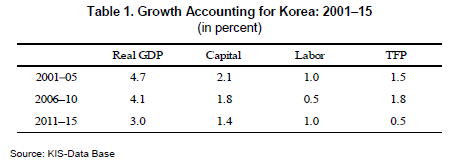
“Korea is facing mounting economic challenges. Productivity growth has been on a trend decline amid demographic headwinds, while the societal demand for inclusive growth has been on a steep rise. Furthermore, the government-led unbalanced growth model—which served Korea well in the past—has become less effective and politically palatable in recent years. As such, Korea needs a major paradigm shift to embark on a new sustainable and inclusive growth path. But policy response has been modest at best with no major reforms being implemented over the past two decades. We propose a paradigm shift in Korea’s economic framework, involving a simultaneous big push for greater economic freedom and stronger social protection within the parameters set by long-run fiscal sustainability. We also provide a detailed account of structural reforms to boost economic freedom and sustainable funding plans for stronger social protection.”
From a new IMF working paper:
“Korea is facing mounting economic challenges. Productivity growth has been on a trend decline amid demographic headwinds, while the societal demand for inclusive growth has been on a steep rise. Furthermore, the government-led unbalanced growth model—which served Korea well in the past—has become less effective and politically palatable in recent years. As such, Korea needs a major paradigm shift to embark on a new sustainable and inclusive growth path.
Posted by at 4:50 PM
Labels: Inclusive Growth
Subscribe to: Posts