



Friday, December 15, 2017
The Impact of Fiscal Consolidations on Growth in Sub-Saharan Africa
From the latest IMF working paper:
“This paper examines the output effects of changes in public expenditure and revenue in sub-Saharan African countries during 1990–2016. Fiscal multipliers in sub-Saharan Africa are somewhat smaller than those in advanced and emerging economies. The effect of changes in fiscal policy on output depends on the composition: cutting public investment has a larger effect on output than cutting public consumption or raising revenue. Episodes of fiscal consolidation have short- and medium-term output effects, but here, too, composition matters: fiscal consolidations based on reducing public investment have the largest effect on output, while fiscal consolidations based on revenue mobilization are less harmful than those based on public investment cuts. These findings suggest that the negative impact on growth can be mitigated through the design of fiscal adjustment and the accompanying policy environment.”

From the latest IMF working paper:
“This paper examines the output effects of changes in public expenditure and revenue in sub-Saharan African countries during 1990–2016. Fiscal multipliers in sub-Saharan Africa are somewhat smaller than those in advanced and emerging economies. The effect of changes in fiscal policy on output depends on the composition: cutting public investment has a larger effect on output than cutting public consumption or raising revenue. Episodes of fiscal consolidation have short- and medium-term output effects,
Posted by at 10:29 PM
Labels: Inclusive Growth
Housing View – December 15, 2017
On cross-country:
- Conference on Urban Development and Economics in Developing World – Asian Development Bank
- Data needs and Statistics compilation for macroprudential analysis – Bank for International Settlements
- The Future of Global Real Estate – Savills
On the US:
- The Inflow of New Bay Area Residents Has Grown More Financially Selective, While the Outflow Has Spread to Higher Income Levels – BuildZoom
- Reactions to the tax plan – Bloomberg, Curbed, NPR, NYU Furman Center, Politico, Reason, Washington Post
- Snapshots of the US Housing Market: Ten Years Later – Conversable Economist
- Mortgage-Default Research and the Recent Foreclosure Crisis – Federal Reserve Bank of Boston
- Cities turn to ‘missing middle’ housing to keep older millennials from leaving – Washington Post
- How Affordable Urban Housing Stays Affordable – Bloomberg
- House hunting: State-by-state differences in house price appreciation – Federal Reserve Bank of St. Louis
- How Will a Turbulent 2017 Affect Housing in 2018? – Trulia
- Housing Wealth Fluctuations Affect Seniors’ Health Care Choices – NBER
- New Report: Surge in the Supply of Higher-Cost Rental Housing is Slowing Amidst Persistent Affordability Challenges for Working-Class Households – Harvard Joint Center for Housing Studies
- House prices in Chicago suburbs fall as crime rate rises – Financial Times
On other countries:
- [Australia] Housing Accessibility for First Home Buyers – Reserve Bank of Australia
- [Australia] Chinese capital controls send tremor through Australian property – Reuters
- [Australia] Australian housing markets hurt by Chinese capital outflow restrictions – Global Property Guide
- [Australia] ‘Share of foreign ownership in Australian housing market not significant enough to raise concerns’ – Global Property Guide
- [Australia] Construction boom poses risk to housing markets in Australia – Global Property Guide
- [Canada] Three Things Keeping Me Awake at Night – Bank of Canada
- [Canada] Shadow Lending Growing as Canadians Chase Housing Dream – Bloomberg
- [Canada] Jennifer Keesmaat: It’s time to rethink Canada’s housing system – Maclean’s
- [Canada] Is Canada One Step Closer to Declaring Housing a Human Right? – Citylab
- [China] Beijing housing demolitions spark rare street protests – Financial Times
- [Germany] Unemployment Benefit Recipients: Causes, Reactions and Consequences of Housing Relocations – SpringerLink
- [Germany] The Americans are coming to Germany – Global Property Guide
- [Greece] Why real estate prices in Greece are set to rise? – Global Property Guide
- [Ireland] Housing Supply Coordination Task Force for Dublin – Department of Housing, Planning and Local Government
- [Netherlands] Brexit Refugees Heading to Amsterdam Raise Local Housing Concern – Bloomberg
- [New Zealand] New Zealand looks to ban foreigners from buying houses – Financial Times
- [Singapore] Singapore land supply for private housing in H1 2018 almost steady – Reuters
- [Sweden] Amortization Requirements Benefit Well-Off and Hurt Liquidity-Constrained Housing Buyers – Lars E.O. Svensson
- [United Kingdom] Britain’s buy-to-let boom is coming to an end – Economist
- [United Arab Emirates] Abu Dhabi, Property Market Outlook, Winter 2017 – Cluttons

Photo by Aliis Sinisalu
On cross-country:
- Conference on Urban Development and Economics in Developing World – Asian Development Bank
- Data needs and Statistics compilation for macroprudential analysis – Bank for International Settlements
- The Future of Global Real Estate – Savills
On the US:
Posted by at 9:06 AM
Labels: Global Housing Watch
Thursday, December 14, 2017
How can Natural Gas from TAP increase Productivity?
From the IMF’s latest report on Albania:
“Natural gas will have significant implications on Albania in the medium term. Substituting natural gas for electricity will reduce business costs and households’ expenses. The cost reductions for firms and households will not be minor considering the cost of heating can be reduced to 1/3 by substituting natural gas for electricity. The challenge is that the existing pipelines and distribution networks are almost obsolete.
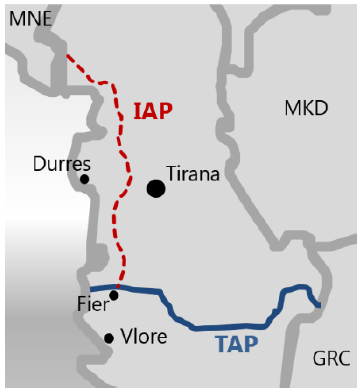
Construction of new pipelines and distributions networks will be needed. The government is already analyzing the cost and potential tariffs. The economically feasible infrastructure has an approximated cost of €0.5 billion for the distribution network and about €0.2-0.3 billion for the main pipelines. A key component of this new infrastructure will be Ionian Adriatic Pipeline (IAP) to bring natural gas from Trans Adriatic Pipeline (TAP) to the main urban centers (including Tirana).
The development of this infrastructure will require significant efforts to attract private sector investment. Building a sound regulatory framework is a key priority.”
From the IMF’s latest report on Albania:
“Natural gas will have significant implications on Albania in the medium term. Substituting natural gas for electricity will reduce business costs and households’ expenses. The cost reductions for firms and households will not be minor considering the cost of heating can be reduced to 1/3 by substituting natural gas for electricity. The challenge is that the existing pipelines and distribution networks are almost obsolete.
Posted by at 10:36 AM
Labels: Energy & Climate Change
Medium Term Growth in Albania
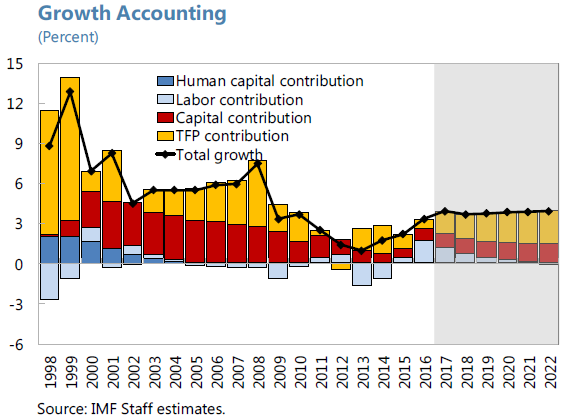
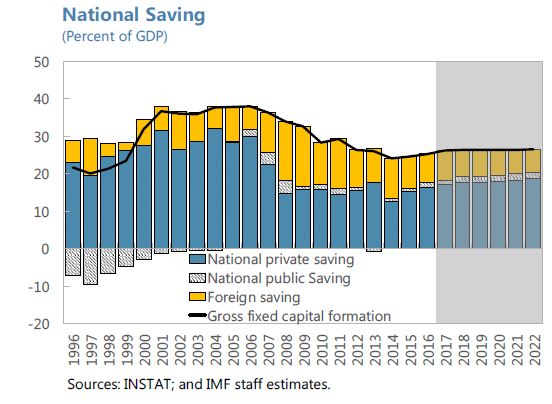
IMF’s latest report says that “Growth in Albania is recovering but has recently been driven by large FDI projects, raising concerns about the sustainability of the recovery and underlying growth potential. This study assesses the prospects and challenges for medium term growth. While Albania’s external conditions are favorable, low savings and demographic trends are expected to weigh on investment and labor utilization. However, EU accession literature suggests that institutional reforms as an EU candidate country can catalyze productivity improvements and potential growth in Albania.”
IMF’s latest report says that “Growth in Albania is recovering but has recently been driven by large FDI projects, raising concerns about the sustainability of the recovery and underlying growth potential. This study assesses the prospects and challenges for medium term growth. While Albania’s external conditions are favorable, low savings and demographic trends are expected to weigh on investment and labor utilization. However, EU accession literature suggests that institutional reforms as an EU candidate country can catalyze productivity improvements and potential growth in Albania.”
Posted by at 10:31 AM
Labels: Forecasting Forum, Inclusive Growth
Okun’s Law in Finland: Declining Labor Market Sensitivity
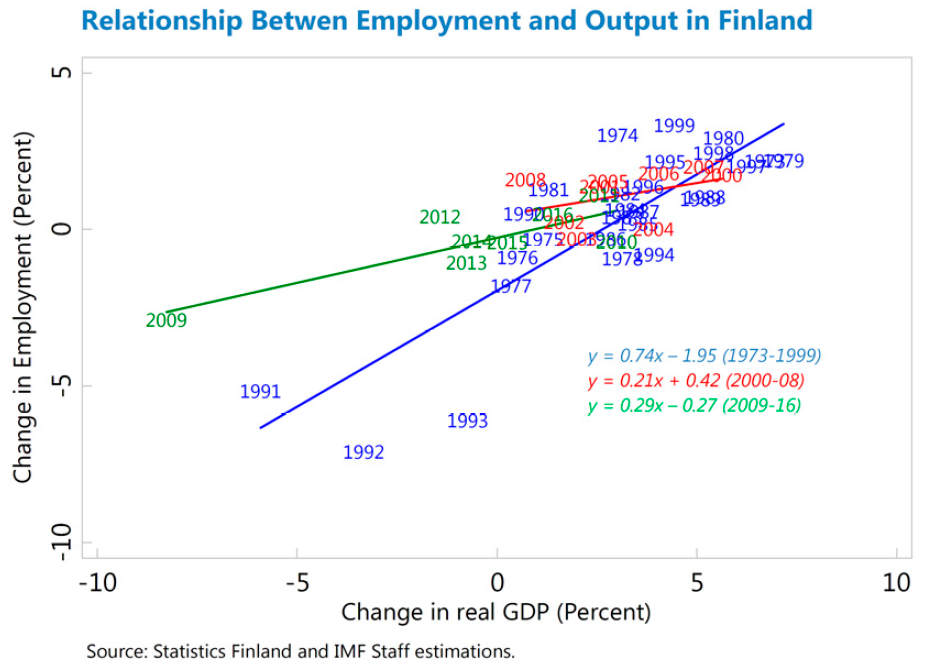
A new IMF report on Finland’s labor market finds that “the response of employment to output seems to have slowed since 2000. Based on the entire 1973–2016 sample, the estimate of [Okun coefficient] is equal to 0.5. However, there are substantial differences between the subsamples considered. For example, using data until 2000 yields a [Okun coefficient] of 0.75, while more recently a one percent increase in output has been associated only with a 0.3 percent expansion of employment.”
Continue reading here, page 23-30.
A new IMF report on Finland’s labor market finds that “the response of employment to output seems to have slowed since 2000. Based on the entire 1973–2016 sample, the estimate of [Okun coefficient] is equal to 0.5. However, there are substantial differences between the subsamples considered. For example, using data until 2000 yields a [Okun coefficient] of 0.75, while more recently a one percent increase in output has been associated only with a 0.3 percent expansion of employment.”
Posted by at 10:16 AM
Labels: Inclusive Growth
Subscribe to: Posts