



Monday, January 15, 2018
2018 AEA Annual Meeting’s Papers on Inequality
On income inequality
- Top Income Inequality in the 21st Century: Some Cautionary Notes – AEA
- Capitalists in the Twenty-first Century – Paper
- Long Run Developments of Income and Wealth Inequality: Do They Move Together? – AEA
- Has Middle Class Wealth Recovered? – Paper
- Income and Wealth Inequality in America, 1949-2013 – Paper
- Recent Trends in the Variability of Men’s Earnings: Evidence From Administrative and Survey Data – Paper
- Taxes, Regulations of Businesses and Evolution of Income Inequality in the United States – Paper
- Origins of Wealth Inequality – AEA
- An Empirical Institutionalist Analysis of the Determinants of Income and Wealth Inequality in USA Since the 1980s – Paper
- Road to Despair and the Geography of the America Left Behind – AEA
On gender inequality
- Top Income Inequality and the Gender Pay Gap – Paper and Presentation
- Choosing Between Career and Family – Gender Roles as a Coordination Device in a Specialization Game – AEA
- Gender Inequality in Post-capitalism: Theorizing Institutions for Democratic Workplaces – Paper
On racial inequality
- Examining the Black-White Earnings Differential with Administrative Records – Paper
- Occupational Licensing Reduces Racial and Gender Wage Gaps: Evidence From the Survey of Income and Program Participation – AEA
- Higher Education in Orthodox, Heterodox, and Stratification Economics Perspectives on Racial Economic Inequality – AEA
- Poverty and Inequality – AEA
- Inequality Between and Within Immigrant Groups in the United States – Paper
- Revising The Racial Wage Gap Among Men: The Role Of Non-employment And Incarceration – AEA
- Revisiting Bergmann’s Occupational Crowding Model – AEA
- Racial Differences in Labor Force Participation Since the Great Recession: What’s Happening? – Paper
- The Color of Wealth: Evidence Across United States Cities – AEA
- No End in Sight? The Widening Racial Wealth Gap Since The Great Recession – AEA
On populism and globalization
- Understanding the Rise of Populism: Financialisation, Household Balance Sheet Structures, and Inequality in the United States Since 1980s – Paper
- Trade and Inequality: Evidence From Worker-level Adjustment in France – AEA
- Trade, Jobs, and Inequality – AEA
- Globalization and Inequality in Innovation: A Perspective from U.S. R&D Tax Credit Policy – Paper
- Making Financial Globalization More Inclusive – Paper and Presentation
- Making Globalization More Inclusive: When Compensation Is Not Enough – Paper
On labor
- Earnings Inequality and Mobility Trends in the United States: Nationally Representative Estimates from Longitudinally Linked Employer-employee Data – Paper and Presentation
- Theories of Redistribution and Share of Labor Income – Paper
- Labor Unions and Wealth Inequality – AEA
- The Care Penalty and the Power Premium: Earnings Inequality in the United States – AEA
- Inequality, Good Governance and Endemic Corruption – Paper
- Inequality and the Disappearing Large Firm Pay Premium – Paper
- Earnings Inequality and the Minimum Wage: Evidence From Brazil – Paper
- Unequal Growth in Local Wages: Rail Versus Internet Infrastructure – Paper
- Determinants of the Wage Share: Evidence From Firm-level Data – Presentation
- Declining Labor and Capital Shares – Paper
- Labor Share and Technology Dynamics – Paper
- Theories of Redistribution and Share of Labor Income – Paper
- Earnings Inequality and the Role of the Firm – Paper and Presentation
- Inequality in Retirement Wealth – Paper and Presentation
- Delayed Retirement and the Growth in Economic Inequality by Work Ability – Paper
- Robots, Growth and Inequality: Should We Fear the Robot Revolution? – Paper and Presentation
- Endogenous Skill Choice as Source of Productivity Dispersion – Presentation
- The Fall of the Labor Share and the Rise of Superstar Firms – Paper
On Africa
- Inclusive Finance for SMEs in South Africa and Its Impact on Growth and Inequality – Paper
- Institutions, Structures and Policy Paradigms: Toward Understanding Inequality in Africa – AEA
On other issues
- Extreme Inequality: Evidence From Brazil, India, the Middle-East, and South Africa – Paper and Presentation
- When Inequality Matters for Macro and Macro Matters for Inequality – Paper
- Estimating Unequal Gains Across United States Consumers With Supplier Trade Data – Paper and Presentation
- Why Does Portfolio Choice Correlate Across Generations? – Paper
- Ten Years after the Crisis: A Lost Decade? – Paper
- Military Expenditures And Income Inequality, Evidence From A Panel Of Transition Countries (1990-2015) – AEA
- Tax Rates and Progressivity: Was the System More Progressive when the Top Rate was 91 Percent? – Paper and Presentation
- Rising Inequality, Household Debt, And The Slow Recovery After Great Recession – AEA
- Consumption Inequality and The Frequency of Purchases – Paper
- Mergers and Acquisitions, Technological Change and Inequality – Paper
- Same Storm, Different Disasters: Consumer Credit Access, Income Inequality, and Natural Disaster Recovery – Paper
- Rethinking Inequality in 21st Century – Financial Sector, Household Balance Sheet Structures and Distribution in the United States Since 1980s – Paper
- The Effects of Technical Change: Does Capital Aggregation Matter? – AEA
On income inequality
- Top Income Inequality in the 21st Century: Some Cautionary Notes – AEA
- Capitalists in the Twenty-first Century – Paper
- Long Run Developments of Income and Wealth Inequality: Do They Move Together? – AEA
- Has Middle Class Wealth Recovered? – Paper
- Income and Wealth Inequality in America, 1949-2013 – Paper
- Recent Trends in the Variability of Men’s Earnings: Evidence From Administrative and Survey Data – Paper
- Taxes,
Posted by at 1:33 PM
Labels: Inclusive Growth
Friday, January 12, 2018
Housing View – January 12, 2018
On cross-country:
- Q3 2017: Continued strong house price rises in Europe, Canada and parts of Asia, but globally housing markets are slowing sharply – Global Property Guide
- High house prices pose persistent risks in countries with housing markets slow to react to homeownership costs – Moody’s
- Real and financial cycles in EU countries: Stylised facts and modelling implications – European Central Bank
- Housing finance – International Growth Centre
- What if Real Estate Investors Are Looking at the Housing Market All Wrong? – Bloomberg
On the US:
- Pent-Up Demand and Continuing Price Increases: The Outlook for Housing in 2018 – Federal Reserve Bank of Kansas
- The Effects of Rent Control Expansion on Tenants, Landlords, and Inequality: Evidence from San Francisco – NBER
- The Housing Market Crash and Wealth Inequality in the U.S. – NBER
- Are Lemons Sold First? Dynamic Signaling in the Mortgage Market – NBER
- Portfolio Choice with House Value Misperception – Federal Reserve Bank of Boston
- The Impact of Interest Rates on House Prices and Housing Demand: Evidence from a Quasi-Experiment – American Enterprise Institute
- Housing Voucher Policy Designed to Expand Opportunity Targets Areas That Need It – Center on Budget and Policy Priorities
- Rent Control: Econ 101 Applies – Cato Institute
On other countries:
- [Brazil] No more roller coaster ride for Brazilian housing market? – Global Property Guide
- [Cambodia] Cambodia Finds New Target for Real Estate: Chinese Investors – New York Times
- [China] A Reexamination of Housing Price and Household Consumption in China: The Dual Role of Housing Consumption and Housing Investment – The Journal of Real Estate Finance and Economics
- [Germany] German house prices are accelerating! – Global Property Guide
- [Hungary] Property boom in Hungary continues in 2017 – Global Property Guide
- [India] Mumbai Home Prices Post First Drop in Decade Amid Modi Crackdown – Bloomberg
- [Ireland] Irish house prices will outpace all Europe over next 2 years – Global Property Guide
- [Italy] Italy an outlier as property prices continue to fall, data show – Financial Times
- [Montenegro] Montenegro’s housing market recovering, amidst booming tourism – Global Property Guide
- [Peru] House prices in Lima plunged in Q1 2017 – Global Property Guide
- [Thailand] Thailand’s housing market losing steam – Global Property Guide
- [Uruguay] House prices rising in Montevideo – Global Property Guide

Photo by Aliis Sinisalu
On cross-country:
- Q3 2017: Continued strong house price rises in Europe, Canada and parts of Asia, but globally housing markets are slowing sharply – Global Property Guide
- High house prices pose persistent risks in countries with housing markets slow to react to homeownership costs – Moody’s
- Real and financial cycles in EU countries: Stylised facts and modelling implications – European Central Bank
- Housing finance – International Growth Centre
- What if Real Estate Investors Are Looking at the Housing Market All Wrong?
Posted by at 5:00 AM
Labels: Global Housing Watch
Thursday, January 11, 2018
10 top thinkers on Development, summarized in 700 words by Stefan Dercon
From a blog by Duncan Green: “Stefan gave us a tour of the ‘Big Ideals, Big Egos and Big Thinkers in development’. Here they are, points for recognizing them.” Continue reading the wonderful summary here.
From a blog by Duncan Green: “Stefan gave us a tour of the ‘Big Ideals, Big Egos and Big Thinkers in development’. Here they are, points for recognizing them.” Continue reading the wonderful summary here.
Posted by at 10:24 AM
Labels: Inclusive Growth, Macro Demystified
Wednesday, January 10, 2018
Workshop: Trade Policy, Inclusion and the Rise of the Service Economy
The Council on Economic Policies, the International Monetary Fund and the World Trade Organization are organizing a workshop on 25-26 April, 2018 in Geneva, Switzerland, on policy relevant aspects of the links between trade in services and inclusive growth. Papers presented in the workshop will be considered for an expedited review process for a Review of International Economics special issue to be published in 2019.
Topics
We particularly encourage the submission of unpublished empirical work that uses new datasets or exploits policy experiments in a novel and informative way. Topics of interest include, but are not limited to:
- What is the effect of services trade on inclusive growth and structural transformation? Is trade in services a promising development strategy for developing economies?
- How does services trade affect employment, income and gender inequality, quality of and access to service delivery, and innovation?
- What are key determinants of and barriers to services trade? To what extent have trade agreements reduced them?
- What policies are needed to increase services trade opportunities for inclusive growth?
Program
The workshop will start with a welcome dinner on April 24. April 25 will be devoted to paper presentations as well as a policy debate with trade negotiators and other practitioners in the evening. Presentations will continue in the morning of April 26, followed by an exploration of new directions for research in the afternoon. The workshop will take place at the WTO Secretariat.
Submissions
Papers should be submitted by February 15, 2018 to trade@cepweb.org. Successful submissions will be notified by beginning of March 2018.
Program Committee
- Peter Egger, ETH Zurich
- Ricardo Hausmann, Harvard University
- Bernard Hoekman, European University Institute
- Bob Koopman, World Trade Organization
- Aaditya Mattoo, World Bank
- Margaret McMillan, Tufts University
- Chris Papageorgiou, International Monetary Fund
- Johannes Schwarzer, Council on Economic Policies
The Council on Economic Policies, the International Monetary Fund and the World Trade Organization are organizing a workshop on 25-26 April, 2018 in Geneva, Switzerland, on policy relevant aspects of the links between trade in services and inclusive growth. Papers presented in the workshop will be considered for an expedited review process for a Review of International Economics special issue to be published in 2019.
Topics
We particularly encourage the submission of unpublished empirical work that uses new datasets or exploits policy experiments in a novel and informative way.
Posted by at 11:04 PM
Labels: Inclusive Growth
Tuesday, January 9, 2018
For Vietnam, Greener Growth Can Reduce Climate Change Risks
A new IMF report says that: “By 2100, climate change could impact more than 12 percent of the Vietnamese population and reduce growth by 10 percent. The Vietnamese government considers the response to climate change a vital issue and has implemented environmental policies to better cope with these risks.”
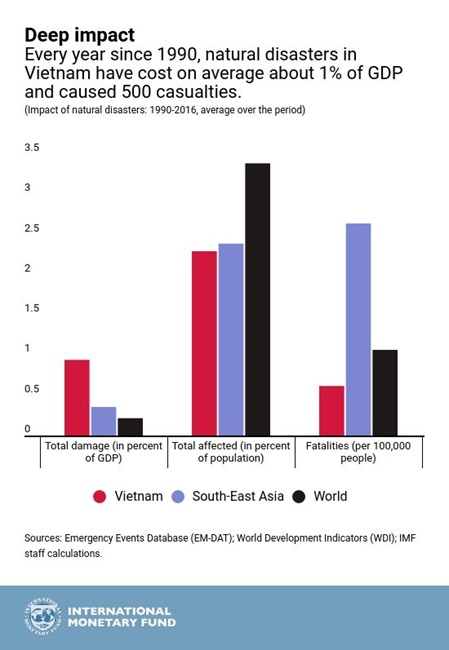
“But the country—which has relied heavily on fossil fuels and overexploitation of natural resources—needs to further adapt its economy toward a more sustainable and ecofriendly growth model.”
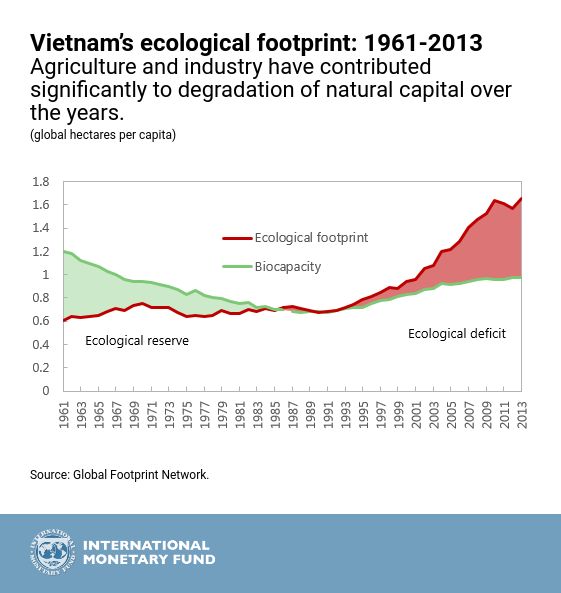
“Policies that can better prepare Vietnam for the future impact of climate change should focus on:
- Lowering the intensity of fossil fuels in Vietnam’s GDP: raising the contribution of renewable energy would help to break the link between greenhouse gas emissions and output.
- Providing stronger incentives for households, firms, and government to pursue green growth: taxation of fossil fuels that fully prices environmental and health externalities would nudge energy demand toward renewables and generate revenue to finance adaptation and mitigation plans.
- Investing in climate resilient infrastructure would help households and firms cope with storms. The expected cost of natural disasters could be usefully included in public debt sustainability analyses.
- Promoting research and development and other innovation policies can provide further incentives to investment in existing clean energy sources and improvements in clean technologies.
- Shifting to autonomous, electric, shared vehicles, as already planned in Singapore, would help reduce congestion and pollution in cities. Improved government capacity to coordinate technological change and promote innovation and green growth would be key.”
A new IMF report says that: “By 2100, climate change could impact more than 12 percent of the Vietnamese population and reduce growth by 10 percent. The Vietnamese government considers the response to climate change a vital issue and has implemented environmental policies to better cope with these risks.”
“But the country—which has relied heavily on fossil fuels and overexploitation of natural resources—needs to further adapt its economy toward a more sustainable and ecofriendly growth model.”
Posted by at 9:01 PM
Labels: Energy & Climate Change
Subscribe to: Posts