



Monday, March 19, 2018
Creative Destruction, the Uber Effect, and the Slow Death of the NYC Taxi Cartel
HT: Carpe Diem. From the article “This Chart Shows the Slow Death of the NYC Yellow Taxi” by Nick Lucchesi:
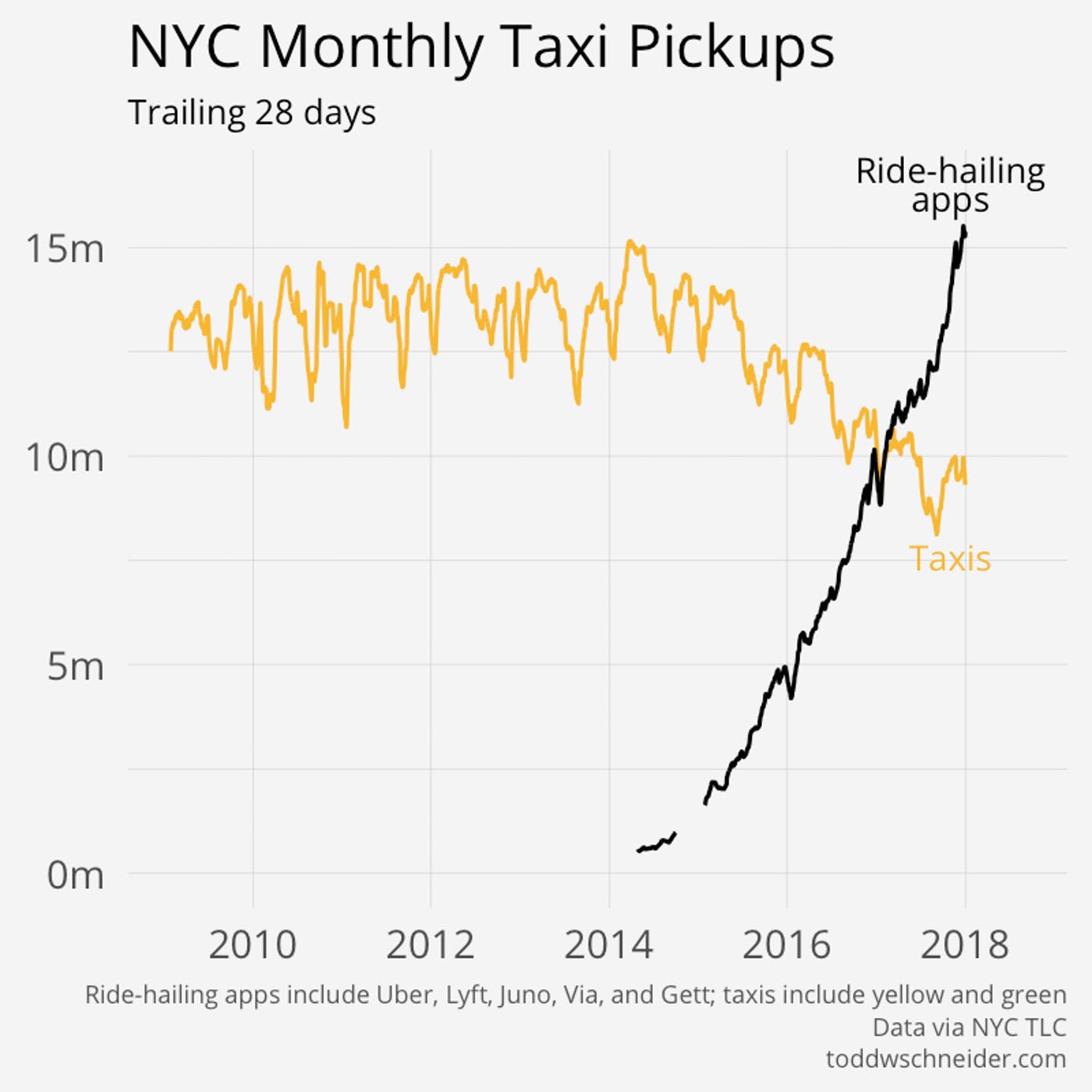
“A new chart released this week shows that the New York City taxi cab is not only an endangered species but that its days are numbered. Today, there are 65 percent more ride-hailing trips than taxi trips in New York City (see chart above).
Genius employee and data-visual enthusiast Todd Schneider pulled from the reams of data released by the New York City Taxi & Limousine Commission each month that shows fares by car type — taxi or ride-hailing service. His analysis shows the tide has turned: At the end of 2017, all monthly ride-hailing pickups (Uber, Lyft, Juno, Via, Gett) numbered 15 million, while taxi pickups numbered less than 10 million. As use of yellow taxis (which primarily serve Manhattan) and green taxis (which primarily serve the other four boroughs) has been on the decline, there’s been a sharp increase in the use of ride-hailing apps.
The chart above shows the data behind one of the most dramatic changes in America’s largest city over the past five years. The way people in New York (tourists and locals alike) get around has flipped, and it doesn’t show any sign of stopping, according to Schneider’s analysis.”
HT: Carpe Diem. From the article “This Chart Shows the Slow Death of the NYC Yellow Taxi” by Nick Lucchesi:
“A new chart released this week shows that the New York City taxi cab is not only an endangered species but that its days are numbered. Today, there are 65 percent more ride-hailing trips than taxi trips in New York City (see chart above).
Genius employee and data-visual enthusiast Todd Schneider pulled from the reams of data released by the New York City Taxi &
Posted by at 10:18 AM
Labels: Macro Demystified
Friday, March 16, 2018
Housing View – March 16, 2018
On cross-country:
- Mortgages, developers and property prices – Bank for International Settlements
- FT Special Report on Property Market – Financial Times
- The US homeownership rate has lost ground compared with other developed countries – Urban Institute
On the US:
- It All Adds Up: The Cost of Housing Development Fees in Seven California Cities – Terner Center for Housing Innovation (UC Berkely)
- “Sand castles before the tide”: How can America’s most expensive cities keep themselves affordable? – American Economic Association
- Student Debt vs. Homeownership – Federal Reserve Bank of Richmond
- Rising Mortgage Rates Threaten Housing Affordability and Inventory – Zillow
- The Trump Administration’s War on New Housing – Citylab
- Black homeownership rates haven’t changed much in the 50 years since the Fair Housing Act – Curbed
- With Some Homeownership Incentives Gone, Will More Americans Actually Rent? – Governing
- White Flight’ Persists in America’s Suburbs – Citylab
- Want Affordable Housing? Just Build More of It – Bloomberg
- Panel Discussion Explores Potential for Small Unit Housing in New York City – NYU Furman Center
- First-Time Homebuyer Counseling and the Mortgage Selection Experience in the United States: Evidence from the National Survey of Mortgage Originations – Federal Housing Finance Agency
- Mortgage Experiences of Rural Borrowers in the United States: Insights from the National Survey of Mortgage Originations – Federal Housing Finance Agency
On other countries:
- [Australia] The Effect of Zoning on Housing Prices – Reserve Bank of Australia
- [Australia] The Distribution of Mortgage Rates – Reserve Bank of Australia
- [Australia] Making Better Economic Cases For Housing Policies – University of New South Wales
- [Belgium] Housing Market in Belgium – IMF
- [Canada] Vancouver’s empty-homes tax might not affect as many homeowners as predicted – The Globe and Mail
- [Malaysia] Housing Market in Malaysia – IMF
- [Netherlands] Gentrification through the sale of rental housing? Evidence from Amsterdam – EconPapers
- [New Zealand] Getting the best out of macro-prudential policy – Reserve Bank of New Zealand
- [Portugal] Increasing number of foreigners snap up beachside homes in Portugal – Global Property Guide
- [Sweden] Sweden Responds to Worst Housing Slump Since 2008 With Supply – Bloomberg
- [United Arab Emirates] Dubai: Come Undone – REIDIN
- [United Kingdom] Housing Crisis: Big Speeches, Small Steps – New Economics Foundation

Photo by Aliis Sinisalu
On cross-country:
- Mortgages, developers and property prices – Bank for International Settlements
- FT Special Report on Property Market – Financial Times
- The US homeownership rate has lost ground compared with other developed countries – Urban Institute
On the US:
- It All Adds Up: The Cost of Housing Development Fees in Seven California Cities – Terner Center for Housing Innovation (UC Berkely)
- “Sand castles before the tide”: How can America’s most expensive cities keep themselves affordable?
Posted by at 5:00 AM
Labels: Global Housing Watch
Wednesday, March 14, 2018
The Distributional Effects of Government Spending Shocks in Developing Economies
From my latest IMF working paper with Davide Furceri, Jun Ge, and Giovanni Melina:
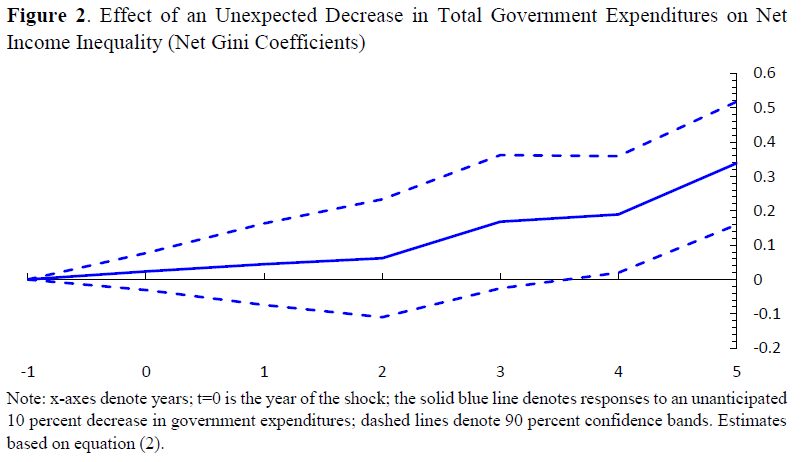
“We construct unanticipated government spending shocks for 103 developing countries from 1990 to 2015 and study their effects on income distribution. We find that unanticipated fiscal consolidations lead to a long-lasting increase in income inequality, while fiscal expansions lower inequality. The results are robust to several measures of income distribution and size of the fiscal shocks, to an alternative identification strategy, across expansions and recessions and across country groups (low-income countries versus emerging markets). An additional contribution of the paper is the computation of the medium-term inequality multiplier. This is on average about 1 in our sample, meaning that a cumulative decrease in government spending of 1 percent of GDP over 5 years is associated with a cumulative increase in the Gini coefficient over the same period of about 1 percentage point. The multiplier is larger for total government expenditure than for public investment and consumption (with the former having larger effect), likely due to the redistributive role of transfers. Finally, we find that (unanticipated) fiscal consolidations lead to an increase in poverty.”
From my latest IMF working paper with Davide Furceri, Jun Ge, and Giovanni Melina:
“We construct unanticipated government spending shocks for 103 developing countries from 1990 to 2015 and study their effects on income distribution. We find that unanticipated fiscal consolidations lead to a long-lasting increase in income inequality, while fiscal expansions lower inequality. The results are robust to several measures of income distribution and size of the fiscal shocks,
Posted by at 4:52 PM
Labels: Inclusive Growth
The Long-Run Decoupling of Emissions and Output: Evidence from the Largest Emitters
From my latest IMF working paper with Gail Cohen, Joao Jalles, and Ricardo Marto:
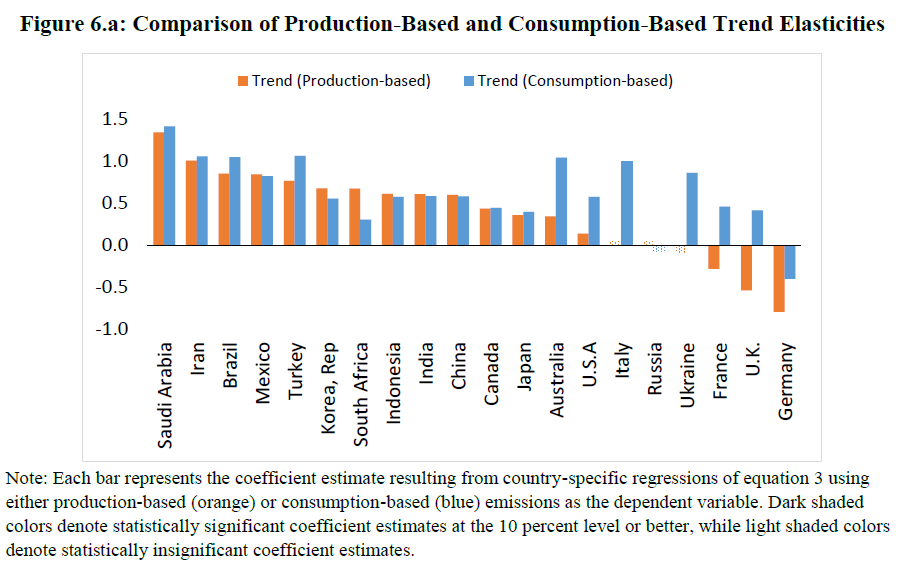
“For the world’s 20 largest emitters, we use a simple trend/cycle decomposition to provide evidence of decoupling between greenhouse gas emissions and output in richer nations, particularly in European countries, but not yet in emerging markets. If consumption-based emissions—measures that account for countries’ net emissions embodied in cross-border trade—are used, the evidence for decoupling in the richer economies gets weaker. Countries with underlying policy frameworks more supportive of renewable energy and climate change mitigation efforts tend to show greater decoupling between trend emissions and trend GDP, and for both production- and consumption-based emissions. The relationship between trend emissions and trend GDP has also become much weaker in the last two decades than in preceding decades.”
From my latest IMF working paper with Gail Cohen, Joao Jalles, and Ricardo Marto:
“For the world’s 20 largest emitters, we use a simple trend/cycle decomposition to provide evidence of decoupling between greenhouse gas emissions and output in richer nations, particularly in European countries, but not yet in emerging markets. If consumption-based emissions—measures that account for countries’ net emissions embodied in cross-border trade—are used,
Posted by at 4:35 PM
Labels: Energy & Climate Change
Tuesday, March 13, 2018
The Distribution of Gains from Globalization
From a new IMF working paper:
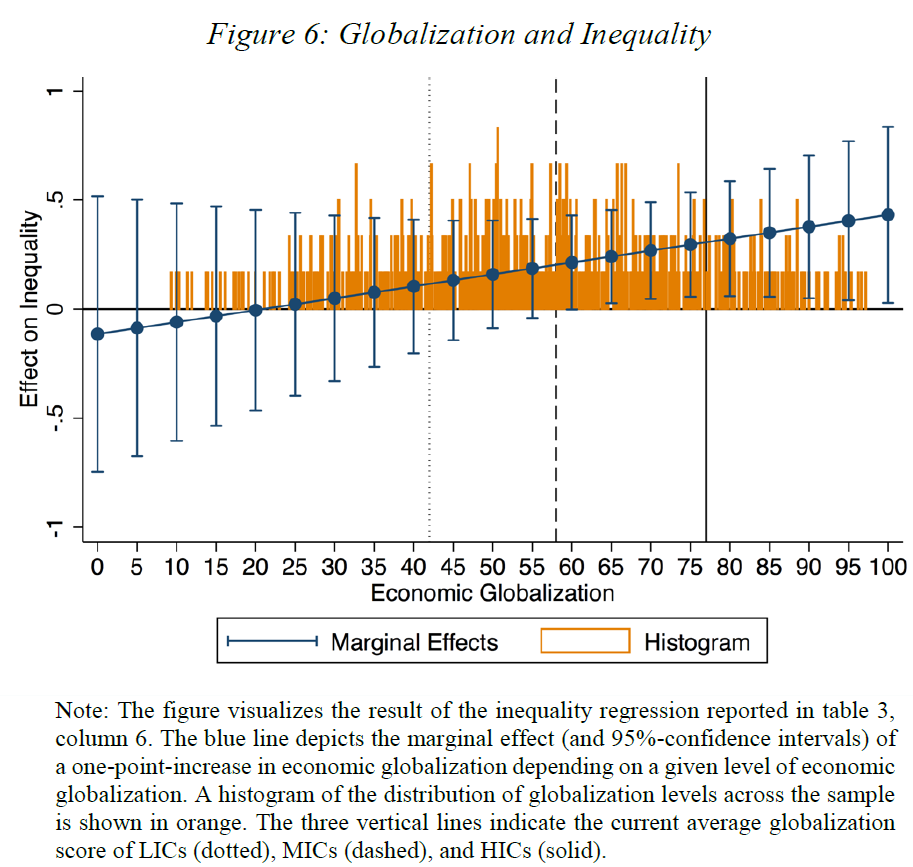
“We study economic globalization as a multidimensional process and investigate its effect on incomes. In a panel of 147 countries during 1970-2014, we apply a new instrumental variable, exploiting globalization’s geographically diffusive character, and find differential gains from globalization both across and within countries: Income gains are substantial for countries at early and medium stages of the globalization process, but the marginal returns diminish as globalization rises, eventually becoming insignificant. Within countries, these gains are concentrated at the top of national income distributions, resulting in rising inequality. We find that domestic policies can mitigate the adverse distributional effects of globalization.”
From a new IMF working paper:
“We study economic globalization as a multidimensional process and investigate its effect on incomes. In a panel of 147 countries during 1970-2014, we apply a new instrumental variable, exploiting globalization’s geographically diffusive character, and find differential gains from globalization both across and within countries: Income gains are substantial for countries at early and medium stages of the globalization process, but the marginal returns diminish as globalization rises,
Posted by at 8:12 PM
Labels: Inclusive Growth
Subscribe to: Posts