



Monday, June 11, 2018
Impact of Emigration
From a new IMF report:
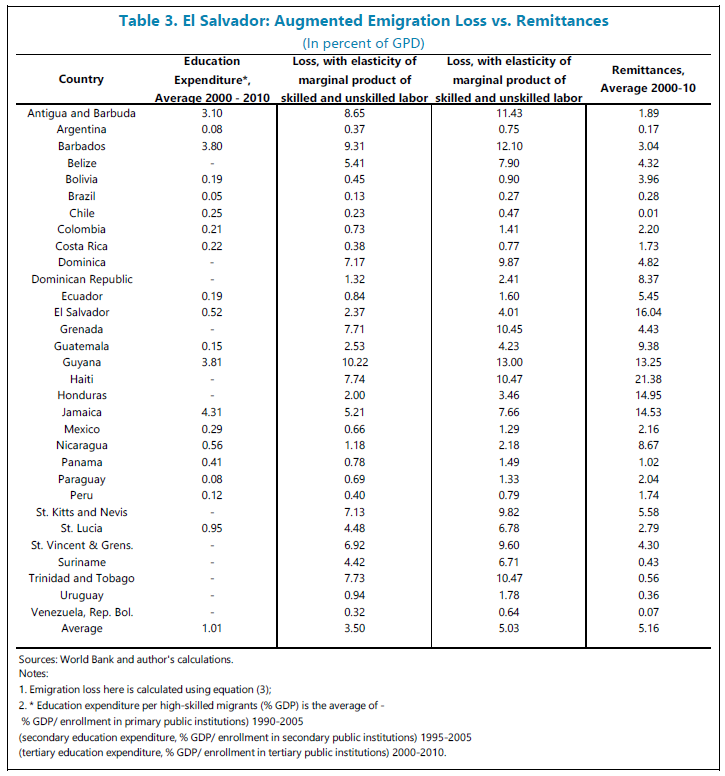
“Remittances outweigh the sum of augmented emigration loss and education expenditure for nearly half of the 31 countries in this sample. Most of these countries are from Central America. The countries for which remittances are not able to outweigh the above sum are mostly the Caribbean ones.
Of course, these results need to be qualified by the fact that there are other costs and benefits of emigration which have not been included in this framework, for e.g. the impact on trade, investment and marginal productivity of capital, and some others which are harder to measure. Other characteristics like demography, civil unrest, and natural disasters have also not been captured. The value of elasticity of factor price of skilled labor may be different from that of overall labor. Estimating country‐level elasticities would better capture country characteristics, but is subject to the availability of detailed survey data.”
From a new IMF report:
“Remittances outweigh the sum of augmented emigration loss and education expenditure for nearly half of the 31 countries in this sample. Most of these countries are from Central America. The countries for which remittances are not able to outweigh the above sum are mostly the Caribbean ones.
Of course, these results need to be qualified by the fact that there are other costs and benefits of emigration which have not been included in this framework,
Posted by at 3:33 PM
Labels: Inclusive Growth
Saturday, June 9, 2018
House Prices in Qatar
The IMF’s latest report on Qatar says that:
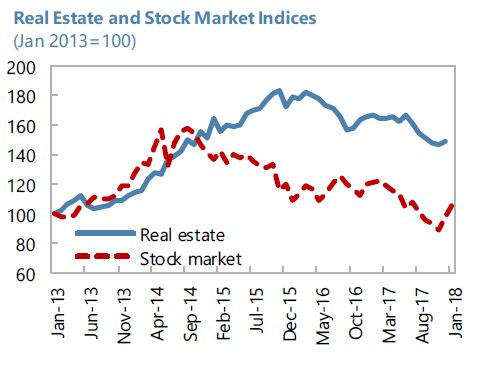
“Developments in the real estate market and the related price movements warrant vigilance. The real estate price index fell by about 10 percent in 2017 (year-on-year basis) following cumulative increase of 53 percent during 2014–16, reflecting increased supply of new
properties and lower effective demand. Though banks have substantial loss absorption capacity in terms of capital and loan loss provisioning, a sharper decline in property prices presents a risk to the banking system given its sizable exposure to the real estate sector. While the banking sector can withstand even a very sharp deterioration in real estate prices and rise in NPLs (…), in its supervisory role, QCB should periodically revisit the existing macroprudential measures, such as real estate exposure limits, loan-to-value and loan-to-deposit ratios and recalibrate these as needed to ensure that they are sufficiently countercyclical. Enhanced real estate statistics would facilitate monitoring of developments in the sector.”
The IMF’s latest report on Qatar says that:
“Developments in the real estate market and the related price movements warrant vigilance. The real estate price index fell by about 10 percent in 2017 (year-on-year basis) following cumulative increase of 53 percent during 2014–16, reflecting increased supply of new
properties and lower effective demand. Though banks have substantial loss absorption capacity in terms of capital and loan loss provisioning, a sharper decline in property prices presents a risk to the banking system given its sizable exposure to the real estate sector.
Posted by at 1:19 PM
Labels: Global Housing Watch
Friday, June 8, 2018
Housing View – June 8, 2018
On cross-country:
- Western Cities Want to Slow Flood of Chinese Home Buying. Nothing Works. – Wall Street Journal
- International comparisons of mortgage markets, part II – Rutgers Center for Real Estate
- A Guide to Some of My Blog Posts, Hither and Yon – Steve Malpezzi
- Residential investment and economic activity: evidence from the past five decades – Bank for International Settlements
- Q1 2018: Strong house price rises continue in Europe, US and parts of Asia – Global Property Guide
- Book Review: Municipal Dreams: The Rise and Fall of Social Housing, by John Boughton – Financial Times
- Affordable housing solutions in pipes, containers and 3D printers – Reuters
- The financing of renovation in the social housing sector: A comparative study in 6 European countries – Housing Europe
- Why loan-to-value matters when you shop for a mortgage – Financial Times
- Blackstone remains global king of property funds – Financial Times
On the US:
- Can a new mayor fix San Francisco’s housing and homelessness problems? – Economist
- The Political and Policy Conundrum of Rent Control – Zillow
- A First Look at the Tax Cut and Jobs Act, the Economy, and Real Estate – Steve Malpezzi
- The Death of the Small Apartment Building – Bloomberg
- Why reducing urban traffic congestion can help the American middle class – London School of Economics
- California’s emigrants aren’t all moving to cheaper housing markets – MarketWatch
- After Years of Disinvestment, City Public Housing Is Poised to Get U.S. Oversight – New York Times
- In Vancouver, a Housing Frenzy That Even Owners Want to End – New York Times
- Los Angeles tenants increasingly engaging in rent strikes amid housing crisis – Washington Post
- Strategies for Responding to Gentrification – Harvard Joint Center for Housing Studies
- The Sharing Economy and Housing Affordability: Evidence from Airbnb – SSRN
- The Latest HUD Proposal Would Exacerbate the Housing Insecurity Crisis – Center for American Progress
- Shifting the risk of mortgage defaults from taxpayers to investors – Brookings
- Home Value Forecast: Does Quality of School System Impact Home Prices? – Pro Teck
- Housing Was Undersupplied during the Great Housing Bubble – George Mason University
- Response to the Federal Housing Finance Agency Request for Comment on How Its Regulations May Be Made More Effective and Less Burdensome – George Mason University
- Underwriting Loosening for Conventional Conforming Loans – CoreLogic
- Booming cities, unintended consequences – McKinsey
- S. house prices to rise at twice the speed of inflation and pay: Reuters poll – Reuters
- ‘YIMBY’ call to build more housing divides booming San Francisco – Reuters
- Red Tape Is What Keeps Housing Unaffordable – Foundation For Economic Education
- Boston’s housing market, in three charts – Urban Institute
- The Tight Housing Supply Is Raising Prices – Wall Street Journal
- Seattle Declares War on Workers With Wage and Housing Regulations – Mises Institute
- S. Home Flipping Rate Matches Six-Year High in Q1 2018 – ATTOM
On other countries:
- [Australia] Australia’s House Prices Retreat Appears Entrenched – Wall Street Journal
- [Canada] OPINION: All three major parties ignore real solutions to Ontario’s housing crunch – Toronto Sun
- [Canada] Steel and Aluminum Tariffs Could Leave Canada’s Housing Sector on Shakier Foundation – Wall Street Journal
- [China] Luxury Real Estate Comes to Urban Chinatowns – Wall Street Journal
- [China] China pushes state banks into home rental market at their own risk – Reuters
- [Denmark] Danish non-profit social housing and mortgage institutes – a common stand on future financial regulation – European Covered Bond Council
- [France] Airbnb: The home-sharing site’s number one destination is Paris, where it stands accused of driving up rents and house prices – Financial Times
- [Germany] Germany to toughen laws to stem steep rent hikes – Reuters
- [Ireland] Home mortgage debt outstanding legacy of Ireland’s financial crisis – Reuters
- [Ireland] Ireland’s housing crisis – The case for a European cost rental model – Nevin Economic Research Institute
- [Netherlands] Exploding house prices and imploding affordability in urban housing markets – Rabobank
- [Norway] Strong Norway house prices fuel August or September rate hike view – Reuters
- [United Kingdom] ‘Reform land valuation’ call to unlock housing plots in the UK – Financial Times
- [United Kingdom] Brexit puts a ceiling on London housing demand, prices – Reuters poll – Financial Times

Photo by Aliis Sinisalu
On cross-country:
- Western Cities Want to Slow Flood of Chinese Home Buying. Nothing Works. – Wall Street Journal
- International comparisons of mortgage markets, part II – Rutgers Center for Real Estate
- A Guide to Some of My Blog Posts, Hither and Yon – Steve Malpezzi
- Residential investment and economic activity: evidence from the past five decades – Bank for International Settlements
- Q1 2018: Strong house price rises continue in Europe,
Posted by at 5:00 AM
Labels: Global Housing Watch
Thursday, June 7, 2018
Snapshots of the Salubrious US Labor Market
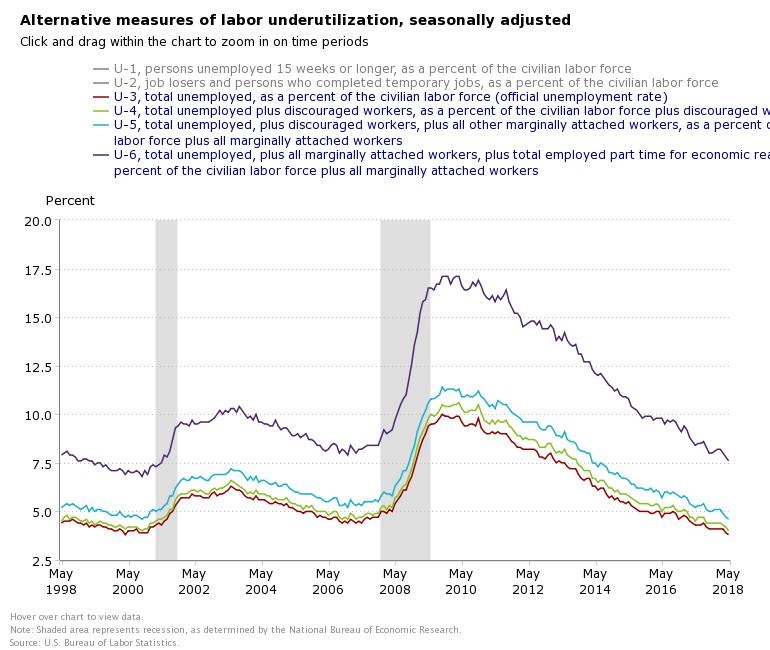
A new post by Timothy Taylor says that “there are a lot of ways to look at unemployment, but whatever measure you choose, the measure is essentially back to what it was before the Great Recession.” “There is no heaven on Earth, and there is no ultimate perfection to be found in real-world labor markets. But the current US labor market situation is really quite good.”
A new post by Timothy Taylor says that “there are a lot of ways to look at unemployment, but whatever measure you choose, the measure is essentially back to what it was before the Great Recession.” “There is no heaven on Earth, and there is no ultimate perfection to be found in real-world labor markets. But the current US labor market situation is really quite good.”
Posted by at 10:18 AM
Labels: Inclusive Growth
Wednesday, June 6, 2018
Housing Market in Romania
The IMF’s latest report on Romania says that:
- “Notwithstanding these improvements, vulnerabilities arise from the high exposure of banks to the real estate sector and sovereign debt. Real estate exposure rose with housing loans increasing from 21 to 54 percent of household loans between 2008 and 2017. These mortgage contracts (mostly at variable rates) expose banks to credit risks in the event of sharp increases in interest rates. The effectiveness of existing macroprudential tools on mortgages is undermined by the Prima Casa program, which allows loan-to-value ratios up to 95 percent. The Romanian banking system has also a large exposure to their own sovereign debt (one of the highest in the EU at around 20 percent of assets in 2017), that could lead to valuation losses in the event of interest rate increases. Finally, despite declining considerably since 2011, about 35 percent of banks’ liabilities and assets remain denominated in foreign exchange (FX), and FX liquidity risks can exist within an environment of ample overall liquidity.”
- “A Debt-Service-to-Income (DSTI) limit on mortgage lending would mitigate risks from the exposure of banks to the real estate sector. An appropriately set DSTI limit can boost borrowers’ resilience and should be imposed on all mortgages, including those made under
the Prima Casa program. In this context, staff welcomed the government’s strategy to gradually scale back the program.”
The IMF’s latest report on Romania says that:
- “Notwithstanding these improvements, vulnerabilities arise from the high exposure of banks to the real estate sector and sovereign debt. Real estate exposure rose with housing loans increasing from 21 to 54 percent of household loans between 2008 and 2017. These mortgage contracts (mostly at variable rates) expose banks to credit risks in the event of sharp increases in interest rates. The effectiveness of existing macroprudential tools on mortgages is undermined by the Prima Casa program,
Posted by at 10:12 PM
Labels: Global Housing Watch
Subscribe to: Posts