



Monday, April 9, 2018
Financial Times: IMF Shows Poor Track Record at Forecasting Recessions
The FT cites my new working paper with Zidong An and Joao Jalles:
“Recessions are not rare,” echoed Prakash Loungani, a macro-economist at the IMF. “What is rare is a recession that is forecast in advance.” Despite an increased amount of economic data being available, “the ability to predict downturns remains dismal”, he told the FT.”
[…]
The fact that forecasts are “typically over-optimistic for horizons beyond the current year” is not necessarily the result of economist optimism. They “fail to forecast strong booms, just as they fail to predict recessions,” said Mr Loungani, suggesting that economic forecasts “are too rooted in thinking that things stay close to normal or will revert to normal soon”.
[…]
“The IMF’s April outlook is often more accurate. This is because it is easier to get a forecast right for the current year than the following year. The April report is better able to signal a recession for the current year than the October publication, “but one that is much milder than what transpires”, says Mr Loungani, author of several studies.”
Continue reading here.
The FT cites my new working paper with Zidong An and Joao Jalles:
“Recessions are not rare,” echoed Prakash Loungani, a macro-economist at the IMF. “What is rare is a recession that is forecast in advance.” Despite an increased amount of economic data being available, “the ability to predict downturns remains dismal”, he told the FT.”
[…]
The fact that forecasts are “typically over-optimistic for horizons beyond the current year”
Posted by at 11:08 AM
Labels: Forecasting Forum
Friday, April 6, 2018
Work-Welfare Trade-offs and Structural Unemployment in Luxembourg
From the IMF’s latest report on Luxembourg:
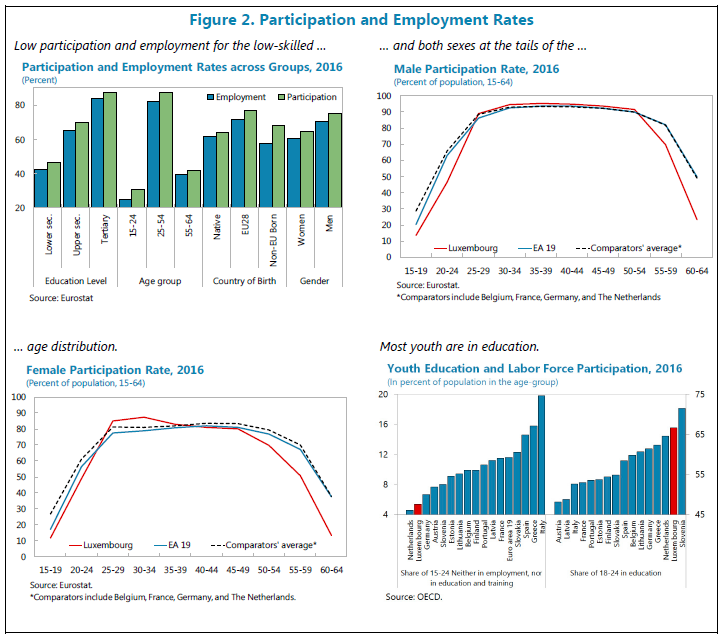
“Job creation is strong in Luxembourg, but unemployment is declining gradually and many newly created jobs go to cross-border workers. The employment rate of residents is relatively low, especially for low-skilled, young, and older workers. Moreover, female attachment to the labor market is weak, and the share of the long-term unemployed has increased over the last ten years, but seems to have come down somewhat in recent months. In addition to skills mismatches, work disincentives inherent to the tax-benefits system are a factor in explaining structural unemployment.”
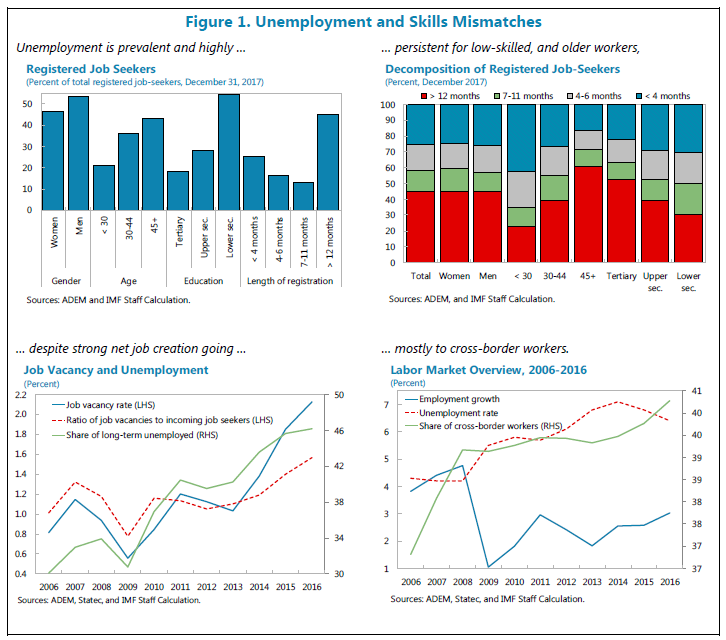
“[…] low employment of older workers and women is largely driven by low participation rates among these groups, while both higher unemployment and lower participation contribute to the low employment rates of low-skilled workers. The relative importance of the different benefit schemes varies across groups of workers. The high unemployment of young and low-skilled workers reflects substantial unemployment traps inherent to the tax-benefits system, while high disincentives for second earners contribute to lower participation of women, and weak labor market attachment of seniors is predominantly driven by the generosity of the pensions system. Substantially increasing employment requires efforts to reduce skills mismatches and to make work more rewarding.”
Continue reading here.
From the IMF’s latest report on Luxembourg:
“Job creation is strong in Luxembourg, but unemployment is declining gradually and many newly created jobs go to cross-border workers. The employment rate of residents is relatively low, especially for low-skilled, young, and older workers. Moreover, female attachment to the labor market is weak, and the share of the long-term unemployed has increased over the last ten years, but seems to have come down somewhat in recent months.
Posted by at 1:23 PM
Labels: Inclusive Growth
Impact of Monetary Policy on Luxembourg
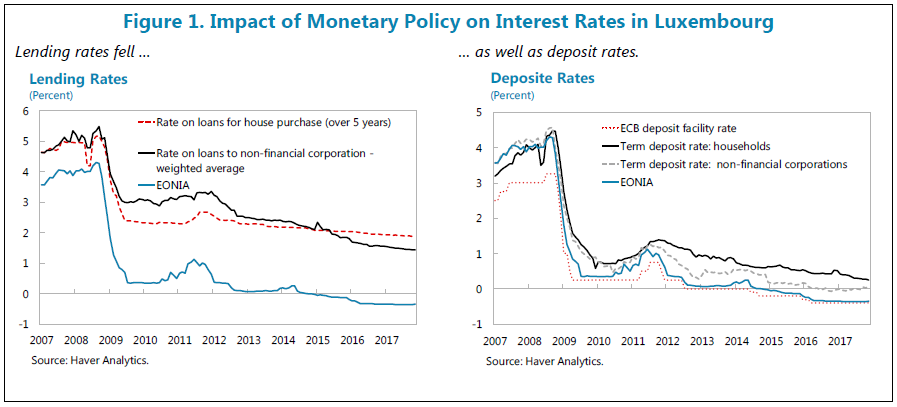
A new IMF report says that “Accommodative monetary policy has contributed to the performance of the Luxembourg economy through some expansion of aggregate demand and through its impact on the financial system. Banks have remained profitable and interest margins stable, while fee and commission income from fund and other activity has been healthy. The investment fund industry has benefited from various factors such as portfolio rebalancing, search for yield, and other market developments leading to strong inflows into various classes of investment funds, and through strong valuation effects. Scenario analysis suggest that the fund industry could be adversely impacted by sharp interest rate increases and that, because of interconnections, the banking system would also be affected. Margins of some banks could also decline when interest rate normalize. Against this backdrop, it is important to implement all 2017 FSAP recommendations that will contribute to making the financial system more resilient to shocks, including those arising from faster-than-expected monetary policy normalization.”
Continue reading here.
A new IMF report says that “Accommodative monetary policy has contributed to the performance of the Luxembourg economy through some expansion of aggregate demand and through its impact on the financial system. Banks have remained profitable and interest margins stable, while fee and commission income from fund and other activity has been healthy. The investment fund industry has benefited from various factors such as portfolio rebalancing, search for yield, and other market developments leading to strong inflows into various classes of investment funds,
Posted by at 1:13 PM
Labels: Inclusive Growth
Housing View – April 6, 2018
On cross-country:
- European Mortgage Markets Quarterly Review – European Covered Bond Council
- Singapore’s private-public housing mix could offer solutions for Toronto and Vancouver – The Globe and Mail
- Financial cycles in euro area economies: a cross-country perspective – Deutsche Bundesbank
On the US:
- Quantities and Prices during the Housing Bust – Federal Reserve Bank of New York
- Characteristics of Domestic Cross-Metropolitan Migrants – BuildZoom
- San Diego’s Mexican property market at risk from Trump tariffs – Financial Times
- House Price Markups and Mortgage Defaults – Federal Housing Finance Agency
- Case-Shiller – A surprise in the bottom 3 cities – Real Estate Decoded
- The Unfulfilled Promise of Fair Housing – The Atlantic
- Housing Wealth, Health and Deaths of Despair – IESE Business School
- Nearly two-thirds of renters say they can’t afford to buy a home – Wall Street Journal
On other countries:
- [Botswana] Housing delivery to the low income in Botswana – Emerald Insight
- [China] Housing conditions and life satisfaction in urban China – Cities
- [China] Accounting for China’s real estate boom – Financial Times
- [China] Macro-economic index effect on house prices in China – Universiti Teknologi Malaysia
- [China] Has Monetary Policy Caused Housing Price to Rise or Fall in China? – The Singapore Economic Review
- [China] Exploring the relationship between urban land supply and housing stock: Evidence from 35 cities in China – Habitat International
- [France] Taxing Vacant Dwellings: Can fiscal policy reduce vacancy? – RePec
- [Hong Kong] The impact of government housing policy and development controls on the dynamics of Hong Kong’s residential property market – The Hong Kong Polytechnic University
- [Italy] Average Time to Sell a Property and Credit Conditions: Evidence from the Italian Housing Market Survey – LUISS Guido Carli
- [Vietnam] Vietnam’s rapid growth fuels Ho Chi Minh property boom – Financial Times

Photo by Aliis Sinisalu
On cross-country:
- European Mortgage Markets Quarterly Review – European Covered Bond Council
- Singapore’s private-public housing mix could offer solutions for Toronto and Vancouver – The Globe and Mail
- Financial cycles in euro area economies: a cross-country perspective – Deutsche Bundesbank
On the US:
- Quantities and Prices during the Housing Bust – Federal Reserve Bank of New York
- Characteristics of Domestic Cross-Metropolitan Migrants – BuildZoom
- San Diego’s Mexican property market at risk from Trump tariffs – Financial Times
- House Price Markups and Mortgage Defaults – Federal Housing Finance Agency
- Case-Shiller – A surprise in the bottom 3 cities – Real Estate Decoded
- The Unfulfilled Promise of Fair Housing – The Atlantic
- Housing Wealth,
Posted by at 5:00 AM
Labels: Global Housing Watch
Thursday, April 5, 2018
House Prices in Mongolia
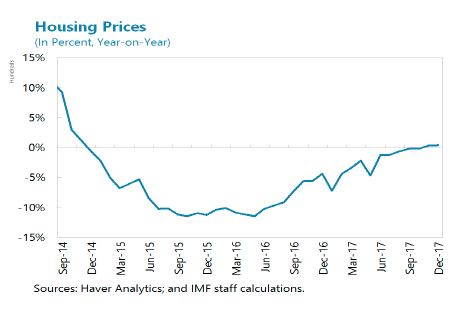
The IMF’s latest report on Mongolia says that “(…) housing prices stabilized after years of deflation, in line with stronger economic activity and household lending.”
The IMF’s latest report on Mongolia says that “(…) housing prices stabilized after years of deflation, in line with stronger economic activity and household lending.”
Posted by at 10:40 AM
Labels: Global Housing Watch
Subscribe to: Posts