



Tuesday, July 31, 2018
Housing Price, Credit, and Output Cycles: How Domestic and External Shocks Impact Lithuania’s Credit
A new IMF working paper by Iacovos Ioannou says that:
“Lithuania’s current credit cycle highlights the strong link between housing prices and credit. We explore this relationship in more detail by analyzing the main features of credit, housing price, and output cycles in Baltic and Nordic countries during 1995–2017. We find a high degree of synchronization between Lithuania’s credit and housing price cycles. Panel regressions show a strong correlation between a credit upturn and housing price upturn. Moreover, panel VAR suggests that shocks in housing prices, credit, and output within and
outside Lithuania strongly impact Lithuania’s credit.”
A new IMF working paper by Iacovos Ioannou says that:
“Lithuania’s current credit cycle highlights the strong link between housing prices and credit. We explore this relationship in more detail by analyzing the main features of credit, housing price, and output cycles in Baltic and Nordic countries during 1995–2017. We find a high degree of synchronization between Lithuania’s credit and housing price cycles. Panel regressions show a strong correlation between a credit upturn and housing price upturn.
Posted by at 10:05 AM
Labels: Global Housing Watch
Housing Market in Singapore
The IMF’s latest report on Singapore says that:
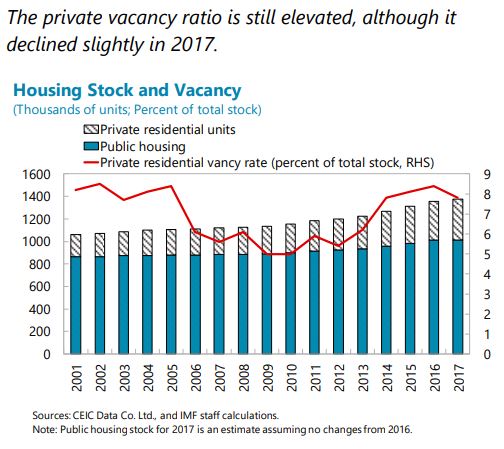
“In the housing market, prices of private residential properties staged a steady recovery in 2017, for the first time since 2013, and were up by 5.4 percent y/y in 2018Q1. The share of foreign transactions has remained stable over the past six years (close to 7 percent) but is significantly below the 2011 peak (19.5 percent). Vacancy rates have come down slightly but
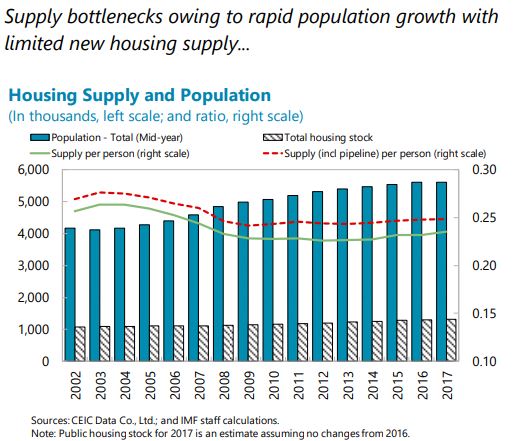
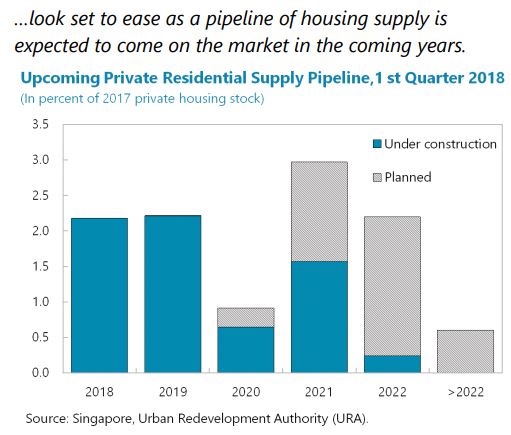
are still elevated. In recent quarters, supply in the pipeline (i.e., new and redevelopment projects of private residential units with planning approvals that are expected to be on the market within a few years) has also increased after a few years of falling.”
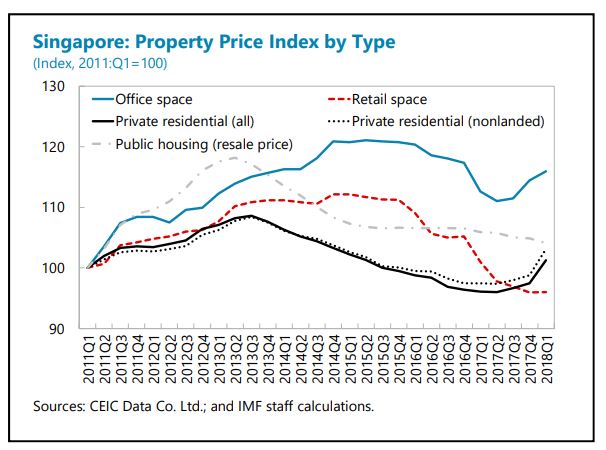
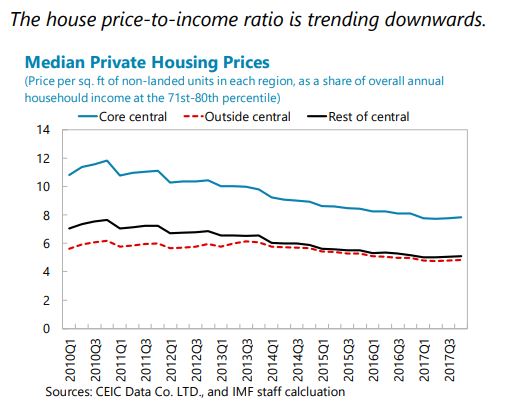
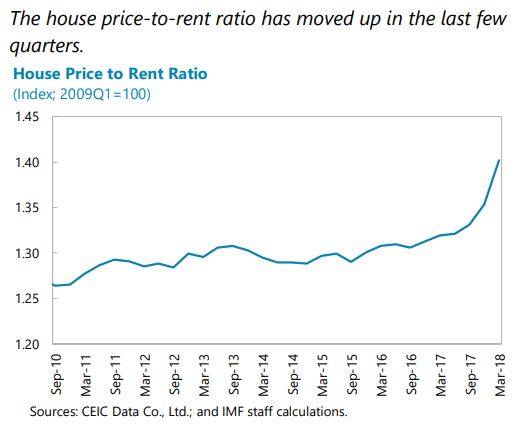
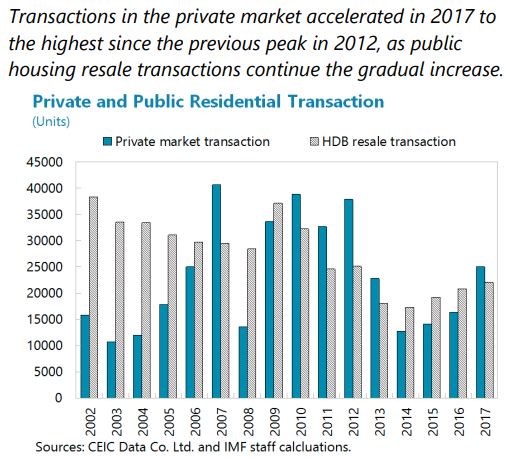
Singapore’s property market policies are comprehensive, aiming to manage demand and supply with active monitoring and periodic adjustments. Staff’s empirical analysis suggests that the prices of private housing in Singapore are affected by a host of factors, including incomes, rents and interest rates, and by supply and cost determinants. Moreover, while housing prices in major Asian cities are increasingly synchronized, Singapore’s property prices appear to have decoupled and are now relatively attractive to international investors (…). Singapore’s comprehensive set of property market cooling measures, including Additional Buyer’s Stamp Duty (ABSD) and limits on Total Debt Servicing Ratio (TDSR) and Loan to Value (LTV) caps, have been critical to stabilizing the property market. Property prices picked up in the last three quarters and are expected to increase further in the near term. Staff analysis also suggests that prices are now moderately above levels consistent with long-term fundamentals. Higher private property prices have been accompanied by increased transaction volumes amid a stronger economy, improved market sentiments, and the recent increase in collective sales for redevelopment projects. The Seller’s Stamp Duty was relaxed in March 2017. In the 2018 Budget, the Buyer’s Stamp Duty was raised by one percentage point for residential properties valued over S$1 million, justified by the need to make property
taxation more progressive.Against this background, staff’s views on property market measures are as follows:
- On the demand side, property market cooling measures should be maintained, including structural macroprudential policies (TDSR and LTV caps) and cyclical measures, such as ABSD, given the elevated financial risks. However, ABSD is a residency-based capital flow management/macro-prudential measure, and staff recommends eliminating residency-based differentiation by unifying rates (lowering rates charged foreigners to the level charged Singaporeans and foreign residents), and then phasing out the measure once systemic risks from the housing market dissipate.
- On the supply side, housing supply in the pipeline has continued to rise in 2018Q1. A large part of those will be on the market for sale in later this year or the next year, adding significant new supplies of housing stock. Staff encourages the authorities to continue to monitor the supply side to ensure that sufficient land is reserved and released in a timely manner through the government land sales program. In addition, other supply-side measures such as the process of building approval could be targeted to meet housing demand.”
The IMF’s latest report on Singapore says that:
“In the housing market, prices of private residential properties staged a steady recovery in 2017, for the first time since 2013, and were up by 5.4 percent y/y in 2018Q1. The share of foreign transactions has remained stable over the past six years (close to 7 percent) but is significantly below the 2011 peak (19.5 percent). Vacancy rates have come down slightly but
are still elevated.
Posted by at 10:01 AM
Labels: Global Housing Watch
Monday, July 30, 2018
Twin Deficits in Developing Economies
From a new IMF working paper by Davide Furceri and Aleksandra Zdzienicka:
“We provide new evidence of the existence of the “twin deficits” in developing economies. Using unanticipated government spending shocks for an unbalanced panel of 114 developing economies from 1990 to 2015, we find that a one percent of GDP unanticipated improvement in the government budget balance improves, on average, the current account balance by 0.8 percentage point of GDP. This effect is substantially larger than usually found in the literature using standard measures of fiscal policy changes such as the CAB. This finding has important policy implications as for a given target of external adjustment less fiscal consolidation is required than normally assumed.
Beyond this average effect lies some heterogeneity, both across states of the business cycle and across countries. The effect tends to be larger: (i) during recessions; (ii) in countries that are more open to trade; (iii) that have less flexible exchange rate regimes; and (iv) with lower initial public debt-to-GDP ratios. This heterogeneity has far-reaching implications for policymakers in deciding the magnitude of the fiscal adjustment needed to address external imbalances.”
From a new IMF working paper by Davide Furceri and Aleksandra Zdzienicka:
“We provide new evidence of the existence of the “twin deficits” in developing economies. Using unanticipated government spending shocks for an unbalanced panel of 114 developing economies from 1990 to 2015, we find that a one percent of GDP unanticipated improvement in the government budget balance improves, on average, the current account balance by 0.8 percentage point of GDP.
Posted by at 10:16 AM
Labels: Macro Demystified
Sunday, July 29, 2018
Difficulties of Making Predictions: Global Power Politics Edition
A new post by Timothy Taylor says that “Making predictions is hard, especially about the future. It’s a comment that seems to have been attributed to everyone from Nostradamus to Niels Bohr to Yogi Berra. But it’s deeply true. Most of us have a tendency to make statements about the future with a high level of self-belief, avoid later reconsidering how wrong we were, and then make more statements. […] The questions of how to predict for what you don’t expect, and how to plan for what you don’t expect, are admittedly difficult. The ability to pivot smoothly to face the new challenge may be one of the most underrated skills in politics and management. ”
Continue reading here.
A new post by Timothy Taylor says that “Making predictions is hard, especially about the future. It’s a comment that seems to have been attributed to everyone from Nostradamus to Niels Bohr to Yogi Berra. But it’s deeply true. Most of us have a tendency to make statements about the future with a high level of self-belief, avoid later reconsidering how wrong we were, and then make more statements. […] The questions of how to predict for what you don’t expect,
Posted by at 3:45 PM
Labels: Forecasting Forum
Heterogeneity and Persistence in Returns to Wealth
From a new IMF working paper:
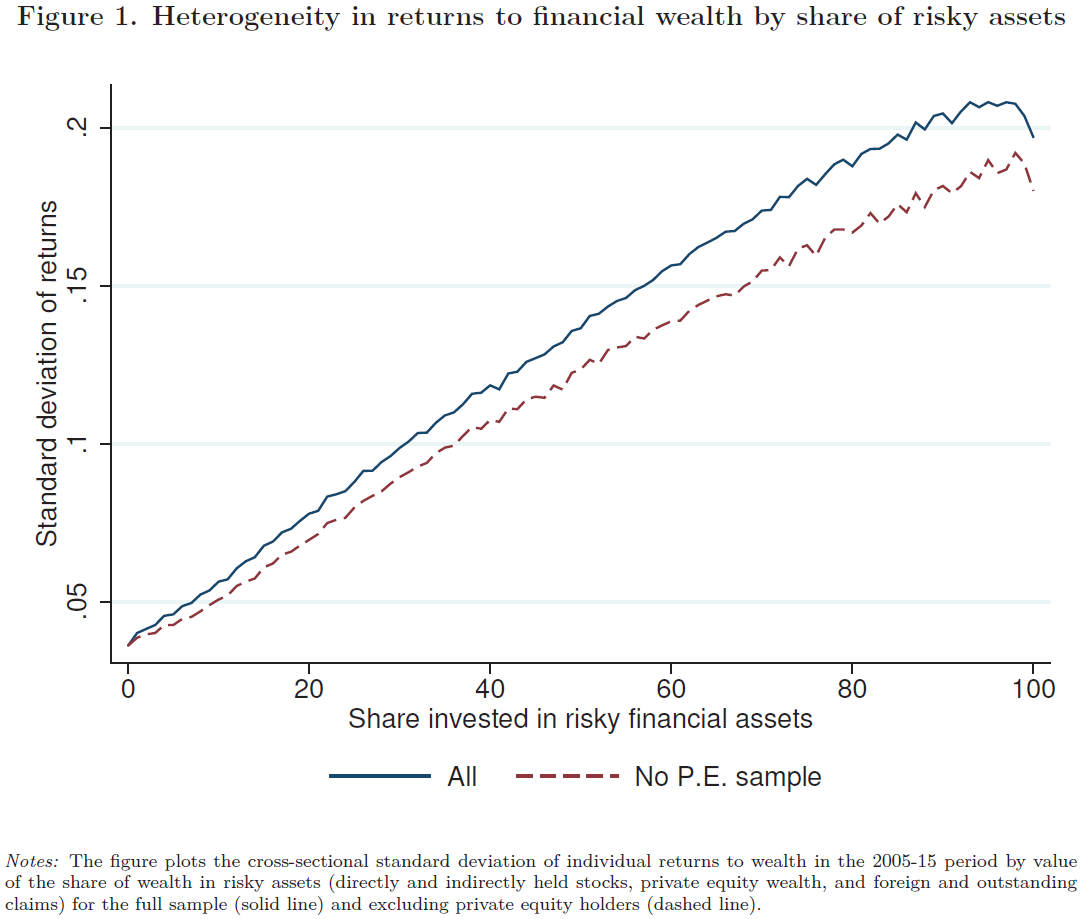
“We provide a systematic analysis of the properties of individual returns to wealth using twelve years of
population data from Norway’s administrative tax records. We document a number of novel results.
First, during our sample period individuals earn markedly different average returns on their financial
assets (a standard deviation of 14%) and on their net worth (a standard deviation of 8%). Second,
heterogeneity in returns does not arise merely from differences in the allocation of wealth between safe
and risky assets: returns are heterogeneous even within asset classes. Third, returns are positively
correlated with wealth: moving from the 10th to the 90th percentile of the financial wealth distribution
increases the return by 3 percentage points – and by 17 percentage points when the same exercise is
performed for the return to net worth. Fourth, wealth returns exhibit substantial persistence over time.
We argue that while this persistence partly reflects stable differences in risk exposure and assets scale,
it also reflects persistent heterogeneity in sophistication and financial information, as well as
entrepreneurial talent. Finally, wealth returns are (mildly) correlated across generations. We discuss the
implications of these findings for several strands of the wealth inequality debate.”
From a new IMF working paper:
“We provide a systematic analysis of the properties of individual returns to wealth using twelve years of
population data from Norway’s administrative tax records. We document a number of novel results.
First, during our sample period individuals earn markedly different average returns on their financial
assets (a standard deviation of 14%) and on their net worth (a standard deviation of 8%).
Posted by at 3:41 PM
Labels: Inclusive Growth
Subscribe to: Posts