



Saturday, August 4, 2018
Predicting Fiscal Crises
A new IMF working paper finds that “both nonfiscal (external and internal imbalances) and fiscal variables help predict crises among advanced and emerging economies.”
“Our analysis identifies robust indicators of vulnerabilities that can help signal a high probability of the onset of a crisis in the near future. Building early warning indicators that help predict future fiscal crises is inherently difficult, including because countries may take mitigating action as they see the growing vulnerabilities. However, we find that some types of vulnerabilities are consistently relevant to explain fiscal crises. This raises the question why governments do not act as they see signals. In large measure they do, as crises among advanced economies are rare. Still, the occurrence of crises may reflect overly optimistic projections about the future (e.g., economic growth, cost of debt), and as such governments underestimate the risks and fail to take mitigating measures. Another possibility could be that other shocks or crisis (e.g., banking) could lead to fiscal pressures”
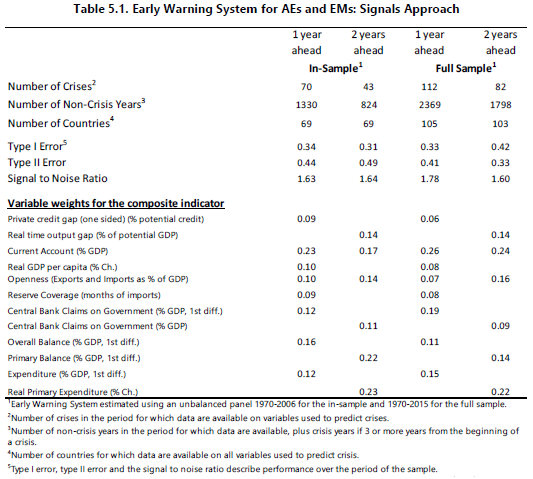
A new IMF working paper finds that “both nonfiscal (external and internal imbalances) and fiscal variables help predict crises among advanced and emerging economies.”
“Our analysis identifies robust indicators of vulnerabilities that can help signal a high probability of the onset of a crisis in the near future. Building early warning indicators that help predict future fiscal crises is inherently difficult, including because countries may take mitigating action as they see the growing vulnerabilities.
Posted by at 5:35 PM
Labels: Forecasting Forum
Friday, August 3, 2018
Housing View – August 3, 2018
On cross-country:
- Housing, Debt and the Economy: a Tale of Two Countries – University of Oxford
- The End of the Global Housing Boom – Bloomberg
- Housing Costs and Regional Income Inequality in China and the U.S. – Federal Reserve Bank of St. Louis
- Charlemagne: the backlash against Airbnb – Economist
- ¿Es posible alquilar en la ciudad sin dejarse el sueldo en ello? – GQ
- Prime price growth drift lower across global cities – Knight Frank
On the US:
- The Scar From Which The Construction Workforce Has Yet To Recover – BuildZoom, Wall Street Journal
- Eyes Wide Shut? The Moral Hazard of Mortgage Insurers during the Housing Boom – NBER
- What is driving America’s housing crisis? A long-read Q&A with Lynn Fisher – American Enterprise Institute
- Fixing Public Housing: A Day Inside a $32 Billion Problem – New York Times
- Blackstone Makes First Bet on Manufactured Housing – Blackstone
- The Urbanist Case for Trailer Parks – CityLab
- The U.S. Housing Market Looks Headed for Its Worst Slowdown in Years – Bloomberg
- A Greater Share of Rentals Are Out of Reach for Blacks, Hispanics – Zillow
- Buying a Home Is Less Affordable Than It’s Been in Almost a Decade – Zillow
- Homeownership Aspirations: The Enduring & Evolving American Dream – Zillow
- Non-Resident Foreigners Sell for Twice Median U.S. Home Value – Zillow
- When Rent Growth Signals Stability, Not Stress – Zillow
- The Real Reasons Millennials Are Struggling to Become Homeowners – Zillow
- Housing’s Headwinds Are Getting Stiffer – Bloomberg
- Nation’s housing market may be headed for biggest slowdown in years – Seattle Times
- As Affordable Housing Crisis Grows, HUD Sits on the Sidelines – New York Times
- MLS Information Sharing Intensity and Housing Market Outcomes – The Journal of Real Estate Finance and Economics
- New York City Sues Airbnb to Force Compliance With Subpoena – Bloomberg
- Best Neighborhoods for Real Estate Buying and Investing – ATTOM
On other countries:
- [Australia] Australia House Prices Fall the Most in 7 Years – Bloomberg
- [Canada] Canada Risks Creating ‘A Permanent Generation Of Middle-Class Renters’: Industry Group – Huffington Post
- [China] China Toughens Housing Policy as Shenzhen Imposes More Curbs – Bloomberg
- [Poland] Disequilibrium in the real estate market: Evidence from Poland – Land Use Policy

Photo by Aliis Sinisalu
On cross-country:
- Housing, Debt and the Economy: a Tale of Two Countries – University of Oxford
- The End of the Global Housing Boom – Bloomberg
- Housing Costs and Regional Income Inequality in China and the U.S. – Federal Reserve Bank of St. Louis
- Charlemagne: the backlash against Airbnb – Economist
- ¿Es posible alquilar en la ciudad sin dejarse el sueldo en ello?
Posted by at 5:00 AM
Labels: Global Housing Watch
Thursday, August 2, 2018
What Are Economists Getting Wrong Today?
A new BloombergQuint post by Simon Kennedy notes my research on forecasting recessions that “Indeed, a 2014 study by Prakash Loungani of the International Monetary Fund found that not one of the 49 recessions suffered around the world in 2009 had been predicted by a consensus of economists a year earlier. Further back, he discovered only two of the 60 recessions of the 1990s were anticipated a year in advance.”
It also summarizes the views of many economists:
“Given our past record in predicting the economic impact of technology, economists will probably get this wrong again. Today, weak productivity growth seems puzzling at a time of great new technological innovations. But in the past, it took decades for electricity or cars or computers to be fully integrated into our production processes and business practices and to boost productivity growth. Likewise, the internet of things or artificial intelligence will take time to be similarly integrated and to be visible in our measures of productivity. While being well aware that, in the 1930s, [John Maynard] Keynes famously predicted that automation would lead to a three-hour working day, my sense is that this process is likely to speed up and surprise on the positive side.”—Peter Praet, Chief Economist at the European Central Bank
A new BloombergQuint post by Simon Kennedy notes my research on forecasting recessions that “Indeed, a 2014 study by Prakash Loungani of the International Monetary Fund found that not one of the 49 recessions suffered around the world in 2009 had been predicted by a consensus of economists a year earlier. Further back, he discovered only two of the 60 recessions of the 1990s were anticipated a year in advance.”
It also summarizes the views of many economists:
“Given our past record in predicting the economic impact of technology,
Posted by at 9:46 PM
Labels: Forecasting Forum
International Corporate Tax Avoidance: A Review of the Channels, Magnitudes, and Blind Spots
A new IMF working paper surveys evidence “on main channels of corporate tax avoidance including transfer mispricing, international debt shifting, treaty shopping, tax deferral and corporate inversions.” and finds that “the literature suggests that, for the most recent year, a 1 percentage-point lower corporate tax rate compared to other countries will expand before-tax income by 1.5 percent—an effect that is larger than reported as the consensus estimate in previous surveys and tends to be increasing over time. The literature on tax avoidance still has several unresolved puzzles and blind spots that require further research.”
A new IMF working paper surveys evidence “on main channels of corporate tax avoidance including transfer mispricing, international debt shifting, treaty shopping, tax deferral and corporate inversions.” and finds that “the literature suggests that, for the most recent year, a 1 percentage-point lower corporate tax rate compared to other countries will expand before-tax income by 1.5 percent—an effect that is larger than reported as the consensus estimate in previous surveys and tends to be increasing over time.
Posted by at 9:38 PM
Labels: Inclusive Growth
Tuesday, July 31, 2018
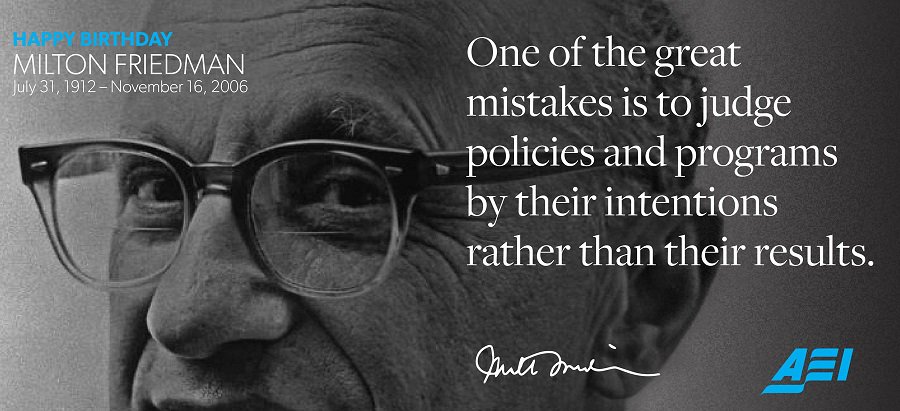
Happy 106th birthday on July 31, Milton Friedman!
From American Enterprise Institute (AEI):
“An important event takes place this week that is recognized annually on CD. Tuesday, July 31 is Milton Friedman’s birthday — he was born on that day in 1912 and would have been 106 years old this year. Unfortunately, Milton died on November 16, 2006, when he was 94 years old. In an editorial in the Wall Street Journal following Professor Friedman’s death, they reported his loss with the same tribute Milton used when Ronald Reagan died, saying “few people in human history have contributed more to the achievement of human freedom.” In honor of his legacy and birthday, here are 20 of my favorite Milton Friedman quotes, along with a bonus video and some special birthday graphics:
1. There is nothing as permanent as a temporary government program.
2. Many well-meaning people favor legal minimum-wage rates in the mistaken belief that they help the poor. These people confuse wage rates with wage income. It has always been a mystery to me to understand why a youngster is better off unemployed at $15 an hour than employed at $7.25 (updated). The rise in the legal minimum-wage rate is a monument to the power of superficial thinking.
3. First of all, the government doesn’t have any responsibility to the poor. People have responsibility. This building doesn’t have responsibility. You and I have responsibility. People have responsibility. Second, the question is how can we as people exercise our responsibility to our fellow man most effectively? That’s the problem. So far as poverty is concerned, there has never been a more effective machine for eliminating poverty than the free enterprise system and the free market. The period in which you had the greatest improvement in the lot of the ordinary man was the period of the 19th and early 20th century.
4. In the international trade area, the language is almost always about how we must export, and what’s really good is an industry that produces exports, and if we buy from abroad and import, that’s bad. But surely that’s upside-down. What we send abroad, we can’t eat, we can’t wear, we can’t use for our houses. On the other hand, the goods and services we import, they provide us with TV sets we can watch, with automobiles we can drive, with all sorts of nice things for us to use.”
Continue reading here.
From American Enterprise Institute (AEI):
“An important event takes place this week that is recognized annually on CD. Tuesday, July 31 is Milton Friedman’s birthday — he was born on that day in 1912 and would have been 106 years old this year. Unfortunately, Milton died on November 16, 2006, when he was 94 years old. In an editorial in the Wall Street Journal following Professor Friedman’s death,
Posted by at 10:08 AM
Labels: Profiles of Economists
Subscribe to: Posts