



Friday, February 1, 2019
Housing View – February 1, 2019
On cross-country:
- Global Home Price Growth under Pressure – Fitch Ratings
- House Prices to Fall in Several APAC Markets in 2019 – Fitch Ratings
On the US:
- The Dream Revisited – Columbia University Press
- Supply Skepticism: Housing Supply and Affordability – NYU Furman Center
- In Lieu of Gifts, Please Make a Down Payment on Our New Home – Citylab
- Could High-Speed Rail Ease California’s Housing Crisis? See Japan. – Citylab
- More Housing Would Mean Cheaper Housing – Wall Street Journal
- California housing crisis podcast: Where’s the home building for the middle class? – Los Angeles Times
- AEI Housing Market Indicators release on October 2018 data – American Enterprise Institute
- Mortgage Risk Premiums during the Housing Bubble – The Journal of Real Estate Finance and Economics
- Big drop in US homebuilders’ shares could spell trouble – Financial Times
- Americans stopped buying homes in 2018, mortgage lenders are getting crushed, and an economic storm could be brewing – Business Insider
- Two Lawsuits Show What a Hot Mess California Housing Politics Is Right Now – Reason
On other countries:
- [China] Chinese Exiting U.S. Real Estate as Beijing Directs Money Back to Shore Up Economy – Wall Street Journal
- [India] Too slow for the urban march: Litigations and real estate market in Mumbai, India – Brookings
- [Lebanon] Lebanese Central Bank to Reinstate Subsidized Housing Loans – Bloomberg
- [New Zealand] New Zealand Vowed 100,000 New Homes to Ease Crunch. So Far It Has Built 47. – New York Times
- [Singapore] Singapore Is Seeing an Unprecedented Mortgage Slowdown – Bloomberg
- [United Kingdom] What goes up must come down: modelling the mortgage cycle – Bank of England
- [United Kingdom] London property transactions drop to decade low – Financial Times
- [United Kingdom] Call for rethink on UK planning rules for housing – Financial Times

Photo by Aliis Sinisalu
On cross-country:
- Global Home Price Growth under Pressure – Fitch Ratings
- House Prices to Fall in Several APAC Markets in 2019 – Fitch Ratings
On the US:
- The Dream Revisited – Columbia University Press
- Supply Skepticism: Housing Supply and Affordability – NYU Furman Center
- In Lieu of Gifts, Please Make a Down Payment on Our New Home – Citylab
- Could High-Speed Rail Ease California’s Housing Crisis?
Posted by at 5:00 AM
Labels: Global Housing Watch
Tuesday, January 29, 2019
Budget Deficits and Debt: Background and Tradeoffs
From Conversable Economist:
“Twice a year the Congressional Budget Office publishes a “just the facts” overview of the federal budget picture and the US economy. The latest version is “The Budget andEconomic Outlook:2019 to 2029 (January 2019). Here, I’ll focus on the US budget deficit and debt.
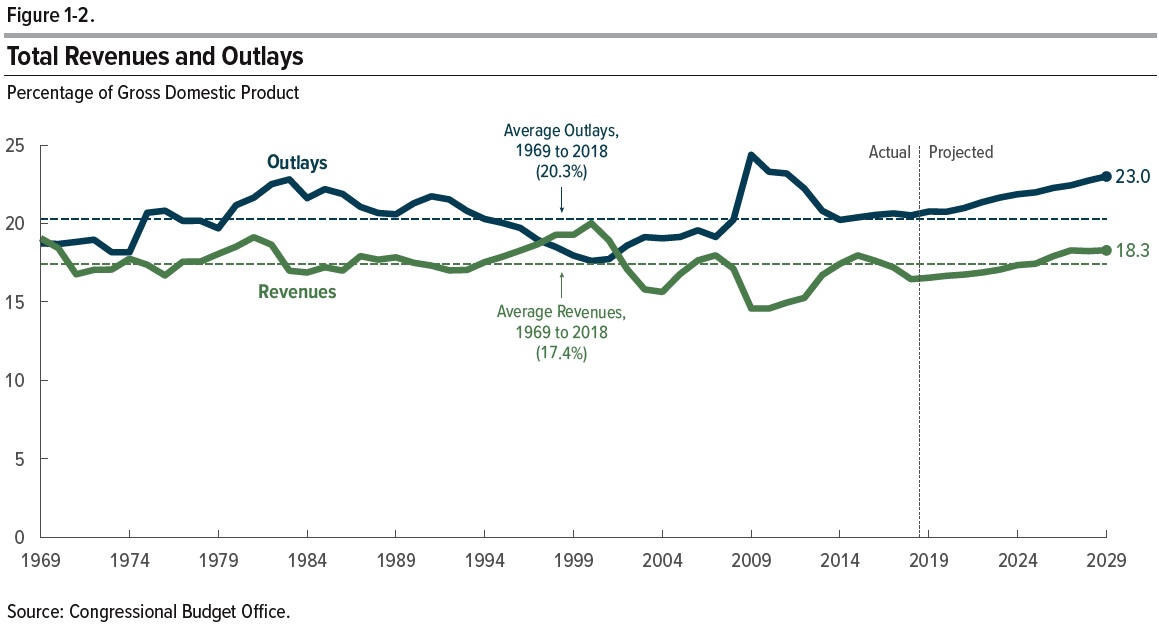
Here’s the pattern of US federal government spending and revenues in the last 50 years. Average outlays during that time were 20.7% of GDP. Average revenues were 17.4% of GDP. Contrary to the widespread belief that US government spending and taxes have over time surged ever higher, to me the more obvious pattern here over the half-century is one of stability. Sure, government spending is higher and taxes are lower than the historical averages during the Great Recession. But during boom times like the late 1990s, taxes are above their historical average while spending is below. When President Trump took office early in 2017, US government spending and taxes were–whether for better or worse–almost bang on their long-run averages.
But under the surface, two changes are going on–one medium-term and one longer-term. The medium-term change is that the usual pattern over time has been that when the US economy is proceeding strongly, with sustained growth and a relatively low unemployment rate, the budget deficits are usually lower, or in the late 1990s even turned into surpluses. But at present, the trajectory is a relatively healthy economy but with larger-than-usual budget deficits.
This CBO figures shows that if one looks back at years when the unemployment rate was below 6%, the average budget deficit has been 1.5% of GDP. But although the current unemployment rate has been substantially below 6% for several years, the projected budget deficits for the next decade are projected at 4.4% of GDP.
Continue reading here.
From Conversable Economist:
“Twice a year the Congressional Budget Office publishes a “just the facts” overview of the federal budget picture and the US economy. The latest version is “The Budget andEconomic Outlook:2019 to 2029 (January 2019). Here, I’ll focus on the US budget deficit and debt.
Here’s the pattern of US federal government spending and revenues in the last 50 years. Average outlays during that time were 20.7% of GDP.
Posted by at 9:34 AM
Labels: Macro Demystified
Stock market turbulence: is US recession risk rising?
From The Irish Times:
“The US economic expansion, now almost 10 years old, is within seven months of becoming the longest in history. However with stocks falling into bear market territory last month amid mounting fears regarding global growth, is a recession around the corner for the world’s biggest economy?
The year began with stocks enjoying a strong rebound while Merrill Lynch’s latest monthly fund manager survey shows only 14 per cent expect a global recession in 2019.
Still, the “overall judgment of financial markets is that recession is significantly more likely than not in the next two years”, warned Harvard professor and former treasury secretary Larry Summers earlier this month, citing bond market movements, softening commodity prices and widening credit spreads.
Globally, most equity markets have fallen into bear markets notes Goldman Sachs, and almost all have experienced double-digit corrections.
Bulls point out that while the stock market is meant to be a leading economic indicator that anticipates the future, it is far from omniscient and has, as Nobel economist Paul Samuelson once quipped, predicted nine of the last five recessions.
Still, there’s no shortage of concerned experts. Summers thinks there’s “better than a 50/50 chance” of a US recession in 2020. “It wouldn’t surprise me at all if we slipped into a recession real soon,” says Nobel economist Robert Shiller, who famously foresaw the popping of the late 1990s technology bubble as well as the US housing crash that ushered in the global financial crisis.
Economist polls
The US economy is expected to continue growing in 2019 but concerns are growing. There is a 40 per cent chance of a US recession in the next two years, according to a Reuters poll of economists last month. A more recent Bloomberg economist poll found a quarter expect a recession in the next 12 months – the highest number in seven years, and one that closely corresponds to economist polls conducted by CNBC and the Wall Street Journal.
(…)
Still, economists rarely see recessions coming. Only two of the 60 recessions recorded (in 77 countries) during the 1990s were predicted a year in advance, according to a 2008 paper by the International Monetary Fund’s (IMF) Prakash Loungani, and 40 were not spotted just seven months before onset. Forecasters are too slow to update their forecasts and are “also slow to absorb news about developments outside their own economies”, leaving the impression they are “chasing the data rather than being a step ahead of it”.
The IMF updated its analysis last year, but the conclusion was unchanged: forecasts are revised too slowly and while forecasters are “generally aware that recession years will be different from other years”, they miss the magnitude of the downturn until the year is almost over.”
Continue reading here.
From The Irish Times:
“The US economic expansion, now almost 10 years old, is within seven months of becoming the longest in history. However with stocks falling into bear market territory last month amid mounting fears regarding global growth, is a recession around the corner for the world’s biggest economy?
The year began with stocks enjoying a strong rebound while Merrill Lynch’s latest monthly fund manager survey shows only 14 per cent expect a global recession in 2019.
Posted by at 9:31 AM
Labels: Forecasting Forum
Revenue Mobilization and Inequality in Senegal
From the IMF’s latest report on Senegal:
“This paper quantitatively assesses the macroeconomic and distributional impacts of fiscal consolidation in Senegal through value added tax (VAT), personal income tax (PIT), and corporate income tax (CIT). We analyze the trade-offs between growth and equity for each tax instrument. We find that VAT has the least efficiency cost in output and consumption but expands the rural-urban inequality gap because significant VAT tax incidence falls on the rural area. PIT is the most detrimental in terms of growth and inequality. CIT on the other hand, despite causing large efficiency loss, has better distributional implications by distributing the tax burden more evenly across regions. Much of the output and distributional costs can be mitigated by using the additional revenue for infrastructure investment and cash transfer.”
From the IMF’s latest report on Senegal:
“This paper quantitatively assesses the macroeconomic and distributional impacts of fiscal consolidation in Senegal through value added tax (VAT), personal income tax (PIT), and corporate income tax (CIT). We analyze the trade-offs between growth and equity for each tax instrument. We find that VAT has the least efficiency cost in output and consumption but expands the rural-urban inequality gap because significant VAT tax incidence falls on the rural area.
Posted by at 9:26 AM
Labels: Inclusive Growth
Gender Gaps in Senegal: From Education to Labor Market
From the IMF’s latest report on Senegal:
“For Senegal to meet its goal of reaching emerging market status by 2035, reforms should address development challenges, including gender inequality. Gender inequality is associated with lower economic growth (IMF 2015, Hakura and others 2016; Gonzales and others 2015), higher income inequality (Gonzales and others 2015, IMF 2016), lower economic diversification (Kazandjian and others 2016), and less bank stability (Sahay and others 2017), while it worsens other development indicators.
Senegal still has large gender gaps in both education access and labor opportunities. Authorities should improve incentives for girls to continue their studies, by diminishing indirect costs of studying (such as those in transportation and in school supplies); enforcing civil laws and campaigning against child marriage and early pregnancy; targeting areas with higher gender gaps (especially rural areas); and reducing discrimination in the labor market (thus increasing the financial returns from studying). To improve outcomes in the labor market, authorities should address gender gaps in access to assets, especially credit and land, and employment segregation.
Net costs of policies can be mitigated through an enlargement of the formal sector and an improvement of spending efficiency. As shown in the model simulations, increasing average years of education to 5, combined with increasing the formal sector share of GDP by 10 percentage points can boost government tax revenues to more than cover the costs, generating a net surplus for the government budget. Furthermore, improving education spending efficiency (for instance as pointed out by the experiments in Senegal by Carneiro and others, 2016) would reduce the government’s overall cost of education.
Mixed policies are necessary to tackle all sources of macro-critical gender inequalities. The framework presented is a valuable tool to show how gender gaps should be tackled from different angles simultaneously to end gender gaps in economic opportunities. For instance, although higher expected returns from labor expands female labor force participation (as seen in Figure 6), it is difficult to close the participation gap entirely if policies to address family costs for women to work outside the house (such as those in Table 1) are not implemented. Similarly, wage gaps cannot be closed if authorities address education gaps but ignore gaps in the labor market.”
From the IMF’s latest report on Senegal:
“For Senegal to meet its goal of reaching emerging market status by 2035, reforms should address development challenges, including gender inequality. Gender inequality is associated with lower economic growth (IMF 2015, Hakura and others 2016; Gonzales and others 2015), higher income inequality (Gonzales and others 2015, IMF 2016), lower economic diversification (Kazandjian and others 2016), and less bank stability (Sahay and others 2017), while it worsens other development indicators.
Posted by at 9:25 AM
Labels: Inclusive Growth
Subscribe to: Posts