



Thursday, February 21, 2019
The whys and wherefores of short-time work: Evidence from 20 countries
From a new VOX post:
“Short-time work schemes are a fiscal stabiliser in Europe. Between 2010 and 2013, they were used by 7% of firms, employing 9% of workers in the region. This column uses ECB data to show that firms use the schemes to offset negative shocks and retain high-productivity workers. High firing costs and wage rigidity increase the use of short-time work, which in turn reduces the fall in employment brought on by a recession.”
“STW clearly shelters individual workers or firms from the worst effects of recessions. The question of whether it has a significant aggregate impact is the focus of several country-specific papers (Balleer et al. 2016, for Germany, is one example).
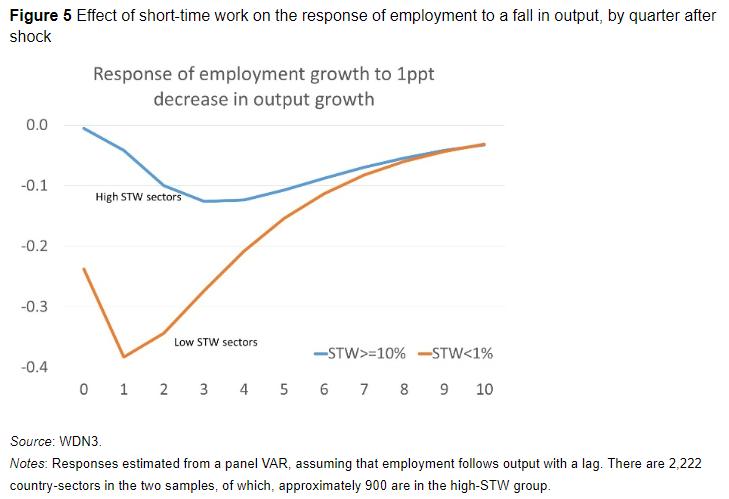
To answer this question using the WDN3 data, we divide countries and sectors into those with high levels of STW take-up (in which more than 10% of firms use STW in the country-sector) and those with low levels (in which fewer than 1% of firms use STW). Using Eurostat data on employment and output per sector from 2008-13, we then estimate the response of employment to falls in output for high- and low-STW sectors.
Figure 5 shows the results in the form of the responses of employment to a 1% fall in output. The fall in employment is considerably lower for high-STW sectors, where it peaks at 0.12% after three to four quarters. In low-STW sectors, by contrast, the employment fall peaks at the much higher level of almost 0.40%,after just two quarters. This suggests that STW can have significant aggregate effects, smoothing changes in overall employment through the cycle.”
From a new VOX post:
“Short-time work schemes are a fiscal stabiliser in Europe. Between 2010 and 2013, they were used by 7% of firms, employing 9% of workers in the region. This column uses ECB data to show that firms use the schemes to offset negative shocks and retain high-productivity workers. High firing costs and wage rigidity increase the use of short-time work, which in turn reduces the fall in employment brought on by a recession.”
Posted by at 9:46 AM
Labels: Inclusive Growth
Some Proposals for Improving Work, Wages, and Skills for Americans
From a new post by Timothy Taylor:
“The Aspen Institute Economic Study Group has published a collection of 12 papers on the theme Expanding Economic Opportunity for More Americans Bipartisan Policies to Increase Work, Wages, and Skills, edited by Melissa S. Kearney and Amy Ganz (February 2019). I’ll list the complete Table of Contents for the volume below. Here, I’ll just focus on four of the proposals that struck me as especially thought-provoking: caught
1) A Boost for Community Colleges
From “A Policy Agenda to Develop Human Capital for the Modern Economy,” by Austan Goolsbee, Glenn Hubbard, and Amy Ganz:
The United States should make a bold and dedicated commitment to increasing the skills and productivity of its workforce by leveraging the potential of the community college sector. We propose a federal grant program to provide new funding to community colleges, contingent on institutional outcomes in degree completion rates and labor market outcomes. We believe a program of a similar scale to the 19th century Morrill Land Grant Program, which dramatically expanded access to higher education for working-class Americans, is needed to ensure our workforce meets the demands of the modern economy. …
In 1910, fewer than 10% of Americans had a high school degree. By 1935, nearly 40% of the population had earned their degrees. This inflection point came from substantial new investments in the nation’s education resources. We aim to achieve increases of a similar magnitude …by 2030:
- Close the completion gap between two-year college students aged 18 to 24 and their peers at four-year institutions by increasing the average completion/transfer rate among 18- to 24-year-olds at community colleges from 37.5% to 60% by 2030.3 This would result in 3.6 million additional 18- to 24-year-olds with college degrees in 2030.
- Increase the share of Americans aged 25 to 64 with a college degree or other high-quality credential from 46.9% to 65% by 2030, which reflects the expected share of jobs requiring advanced skills by that year. This goal would require 28 million additional workers to earn first-time degrees or high-quality credentials by 2030. …
We estimate an annual investment of $22 billion.
2) A Boost for Apprenticeships
From “Scaling Apprenticeship to Increase Human Capital,” by Robert I. Lerman
[T]he United States has lagged far behind other developed countries—countries like Germany and Switzerland, but also Australia, Canada, and England—in creating apprenticeships. In these countries, apprentices constitute about 2.5-3.0% of the labor force, or about 10 times the U.S. rate. Increasing the availability of apprenticeships would increase youth employment and wages, improve workers’ transitions from school to careers, upgrade those skills that employers most value, broaden access to rewarding careers, increase economic productivity, and contribute to positive returns for employers and workers. …
The experiences of Australia, Canada, and England demonstrate that scaling apprenticeship is quite possible, even outside countries with a strong tradition of apprenticeship. While none of these countries have the strong apprenticeship tradition seen in countries like Austria, Germany, or Switzerland, they have nonetheless grown significant programs. In fact, if apprenticeships as a share of the U.S. labor force reached the levels already achieved in Australia, Canada, and England (on average), the United States would attain over 4 million apprenticeships, about 9 times the current number of registered apprenticeships in the civilian sector. …
Overall, the federal government has devoted less than $30 million (per year) to the Office of Apprenticeship (OA) to supervise, market, regulate, and publicize the system. Many states have only one employee working under their OA. Were the United States to spend what Britain spends annually on apprenticeship, adjusting for differences in the size and composition of the labor force, it would provide at least $9 billion per year for apprenticeship. In fact, the British government spends as much on advertising its apprenticeship programs as the entire U.S. budget for apprenticeship. …
Today, funding for the “academic only” approach to skill development in the United States dwarfs the very limited amounts available to market and support apprenticeship. Yet apprenticeship programs yield far higher and more immediate gains in earnings than do community or career college programs and cost students and the government far less.
3) Sharing the Costs of Higher Minimum Wages with a Tax Credit
From “The Higher Wages Tax Credit,” by David Neumark
In recent years, there has been a torrent of state and local minimum wage increases. For example, as of the end of 2017, 30 states (including the District of Columbia) had minimum wages above the $7.25 federal minimum wage, with an average difference of 26%. At the state and local level, California, New York, Seattle, and the District of Columbia have or will soon have a $15 minimum wage; other localities may follow. Finally, a change in the national political alignment could result in a $15 national minimum. …
While the effects of minimum wage increases are contested, it is impossible to dismiss the sizeable body of evidence that suggests minimum wage hikes reduce employment among the least skilled (including recent research that addresses criticisms of earlier evidence). In addition, it is uncontested that higher minimum wages do not target low-income families very well, in part because of the large number of teenagers earning the minimum wage, and in part because poverty is more strongly related to whether or not one works and how many hours one works, rather than low wages ….
I propose a Higher Wages Tax Credit (HWTC) to partially offset the costs imposed by minimum wage increases on firms that employ low-skilled labor. Following a minimum wage increase, the HWTC would provide a tax credit of 50% of the difference between the prior minimum wage and the new minimum wage, for each hour of labor employed; the credit would phase out at wages higher than the minimum wage, and as wage inflation erodes the real cost of higher nominal minimum wages. The HWTC would reduce the incentive for employers to substitute away from low-skilled workers in the face of minimum wage increases, thus mitigating the potential adverse effects of minimum wage increases while simultaneously preserving and possibly enhancing some of the benefits of minimum wage hikes.
4) Minimum Zoning to Ease Movement to Higher-Cost, Higher-Wage Locations
From “How Minimum Zoning Mandates Can Improve Housing Markets and Expand Opportunity,” by Joshua D. Gottlieb
Dramatic differences in income, productivity, and housing costs within the United States make geographic mobility important for spreading prosperity. But Americans’ ability to move to places like San Francisco, Boston, and New York in search of economic opportunities is limited by severe restrictions on new housing supply in these productive places.State-level Minimum Zoning Mandates (MZMs) allowing landowners to build at a state-guaranteed minimum density, even in municipalities resistant to development, would be an effective means of encouraging denser housing development. These MZMs would improve housing affordability, spread economic opportunity more broadly, and limit the environmental impact of new development. …
I propose that state governments adopt Minimum Zoning Mandates (MZMs). These MZMs would be explicit zoning codes that provide a baseline minimum density that land owners, such as developers, can invoke when municipal zoning and permitting processes prevent useful development.
The MZMs should provide all land owners with a meaningful right to build housing up to a certain density significantly beyond single-family houses. Medium-density rowhouses and small apartment buildings should be allowed in every location where any sort of development is allowed. This is the type of density that is associated with some of America’s most-loved neighborhoods: Greenwich Village and other parts of Lower Manhattan, Boston’s North End and South End, the Mission in San Francisco, Lincoln Park in Chicago, and much of historic Philadelphia. It meshes well with existing single-family homes, as we see in places like Cambridge, Massachusetts. MZMs need not enable high-rise condo towers that would change the character of leafy, low-density neighborhoods. Even medium-density zoning rules could generate interesting new neighborhoods and resolve the housing shortages in productive cities.”
From a new post by Timothy Taylor:
“The Aspen Institute Economic Study Group has published a collection of 12 papers on the theme Expanding Economic Opportunity for More Americans Bipartisan Policies to Increase Work, Wages, and Skills, edited by Melissa S. Kearney and Amy Ganz (February 2019). I’ll list the complete Table of Contents for the volume below. Here, I’ll just focus on four of the proposals that struck me as especially thought-provoking: caught
1) A Boost for Community Colleges
From “A Policy Agenda to Develop Human Capital for the Modern Economy,”
Posted by at 9:43 AM
Labels: Inclusive Growth
Wednesday, February 20, 2019
Wellbeing measurements, Easterlin’s paradox and new growth models: A perspective through gross national happiness
From VoxEU:
“There has been considerable criticism of the general reliance on GDP as an indicator of growth and development. One strand of criticism focuses on the inability of GDP to capture the subjective well-being or happiness of a populace. This column examines new growth models, paying particular attention to Bhutan, which has pursued gross national happiness, rather than GDP, since the 1970s. It finds evidence of the Easterlin paradox in Bhutan, and draws out lessons for macroeconomic growth models.
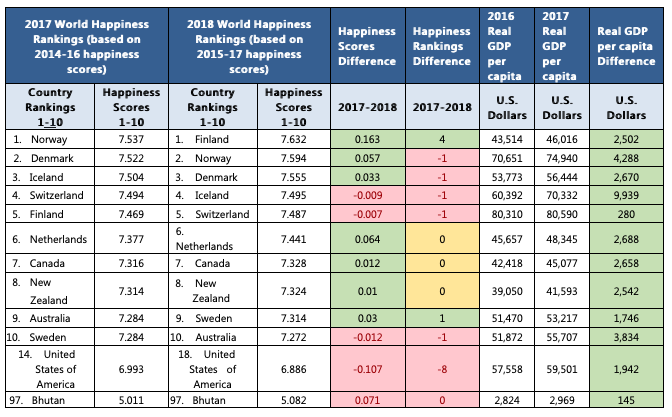
New Zealand’s Prime Minister, Jacinda Arden, recently proposed the idea of a ‘wellness budget’ for the country, and suggested that wellbeing should be incorporated into their growth agenda (Arden 2019). In a similar vein, William Nordhaus incorporated climate change into traditional growth models, efforts for which he was awarded the Nobel Memorial Prize in Economics (Gillingham 2018). In a famous article, Easterlin (1974, revised 1995) asked whether “raising the incomes of all will raise the happiness of all?”. This question was raised following the observation that reported happiness levels remained flat over the long-run in countries which had experienced high rates of real income growth. This anomaly was subsequently dubbed the Easterlin Paradox. How relevant is this in today’s times? The following table provides some interesting clues.
Table 1 World Happiness Rankings
Source: Helliwell et al. (2018)
In Table 1, the World Happiness Rankings for different years are compared with their respective real GDP per capita outcomes. According to the Easterlin Paradox (ceteris paribus), the change in World Happiness Scores should not be proportional to the change in real GDP per capita (year-on-year difference) in any given year. If this is the case, then the country with the highest per capita income will not necessarily be that with the highest levels of happiness.
As can be noted in the table, countries such as Iceland, Switzerland, and Australia seem to be in line with the Easterlin Paradox. Bhutan seems to follow a similar trend. Interestingly, the US seems to be following the Easterlin Paradox. This has been largely attributed to the reduction in America’s social capital and the fact that “…certain non-income determinants of US happiness are worsening alongside the rise in US per capita income, thereby offsetting the gains in subjective well-being that would normally arise with economic growth” (Helliwell 2018). As such, it is quite apparent that there is a discrepancy at some level between the perceived positive proportional relationship between the notion of incomes (input) and happiness (outcome). Not only does this introduce the need to look beyond income levels, it also reasserts the need to look at other well-being measurements, such as happiness, as key measures of growth outcomes.
How can this discrepancy be bridged? More importantly, how can these elements be incorporated in a systematic manner into the policymaking ecosystem, rather than merely being proclamations from higher moral ground?”
Continue reading here.
From VoxEU:
“There has been considerable criticism of the general reliance on GDP as an indicator of growth and development. One strand of criticism focuses on the inability of GDP to capture the subjective well-being or happiness of a populace. This column examines new growth models, paying particular attention to Bhutan, which has pursued gross national happiness, rather than GDP, since the 1970s. It finds evidence of the Easterlin paradox in Bhutan,
Posted by at 7:28 PM
Labels: Inclusive Growth
Tuesday, February 19, 2019
Housing Market in Slovenia
From the IMF’s latest report on Slovenia:
“Housing prices have completed their recovery from the deep slump during the double-dip crisis (2008–14) and continue to grow robustly, but current valuations do not point to overheating. The authorities have adopted macroprudential policy tools preemptively and continue to monitor developments. Easing supply constraints on the housing market could help to moderate future price increases.
Residential real estate prices rose at their fastest pace in 2017 since the outbreak of the crisis, recording the third highest rate in the euro area and a record number of transaction. Prices of used apartments in Ljubljana increased by 14.8 percent during 2017, compared to the national average increase of 11.8 percent. The overall housing price index rose 13.4 percent during the year to 2018: Q2.
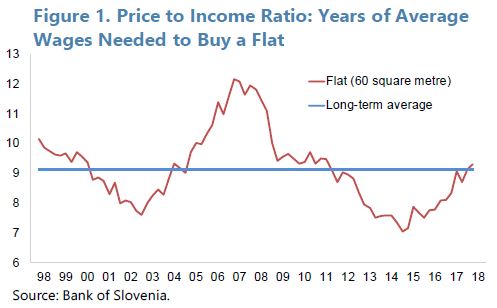
Housing remains affordable in historical and international comparison, and further appreciation in real house prices is likely. Wages and disposable incomes have increased since 2008, while real estate prices have only just reached their pre-crisis level. By some measures, the ratio of real estate prices to incomes stood at their long-term average in 2018 (Figure 1). At 54.4 percent, Slovenia has the second-lowest urbanization rate in the EU. Continued urbanization and growth in household incomes are expected to fuel continued appreciation of real estate prices.
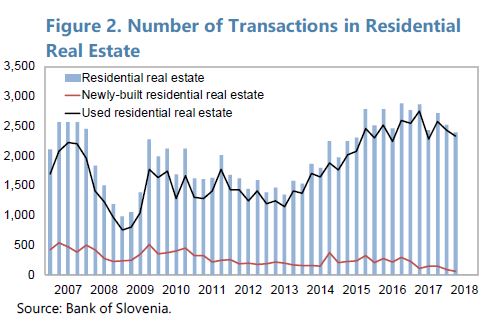
The supply of new residential housing has failed to keep pace with demand. The stock of housing in Slovenia is low by regional standards with 410 units per 1000 residents (compared to 547 in Austria and 524 in Croatia). The number of residential real estate transactions has been rising after 2013, yet the sales of newly-built units has dropped further from very low levels (Figure 2). The lack of supply response is related to the bankruptcy of major construction companies during the crisis years, the reluctance of banks to finance new construction, and constraints placed on new construction by urban planning and regulation.
Mortgage financing is not a significant driver of housing price developments. Slovenia has a comparatively high level of owner-occupied housing (77 percent of households, compared to 60 percent in the euro area, but comparable to other CEE countries). Only about 10 percent of households have a mortgage (19 percent in the euro area), and about a third of recent housing transactions was carried out with equity (i.e., without bank financing). The growth in mortgage lending has been positive since 2013, nearly reaching 5 percent year-on-year in 2017, but has since fallen back to below 4 percent.
The BoS has adopted macro-prudential policy tools as a preemptive step. Current data do not point to an overheating housing market or exposure by the banking sector. However, continued price increases and the inflexible supply response suggest the need for close monitoring. Guidance to banks on loan-to-value and DSTI ratios related to residential real estate transactions and a countercyclical capital buffer were implemented in 2016. In 2018, the applicability of the ratios was expanded to include not only mortgages but all household debt, prompted by rapidly growing consumer lending (albeit from a low level). Early adoption of the tools affords the banking sector time to adjust and monitor lending practices accordingly.
The government seeks to improve the supply of social housing. In 2015, Slovenia adopted its National Housing Program 2015–25 which calls for a new rental policy and an increase in social housing stock for the benefit of vulnerable groups, including young families and the elderly. The National Housing Fund, currently financing social housing investments by municipalities, could become a direct supplier, alleviating shortages of affordable housing.
Urban planning practices could be reformed to ease the supply of new housing. Zoning restrictions and the effort and time required to obtain all required permits before starting new construction projects impede the market response to rising house prices. Regulatory reform could therefore help to increase supply and slow the increases in real estate prices and rents.”
From the IMF’s latest report on Slovenia:
“Housing prices have completed their recovery from the deep slump during the double-dip crisis (2008–14) and continue to grow robustly, but current valuations do not point to overheating. The authorities have adopted macroprudential policy tools preemptively and continue to monitor developments. Easing supply constraints on the housing market could help to moderate future price increases.
Residential real estate prices rose at their fastest pace in 2017 since the outbreak of the crisis,
Posted by at 3:28 PM
Labels: Global Housing Watch
Housing Market in Nepal
From the IMF’s latest report on Nepal:
“Existing macroprudential measures, including the loan-to-value ratios on car loans and residential real estate, and limits on real estate sector exposure have helped to contain credit growth, but need to be tightened further. Staff welcomes the authorities’ stated intention to
adhere to the ceiling on the loan-to-deposit (LTD) ratio—so-called credit-to-core capital cum deposit (CCD) ratio.2 Several carve-outs have been introduced over time to provide more room for credit growth. These carve-outs, including the recent decision to allow funds obtained through interbank borrowing to count as deposits, should be phased out and the authorities should resist banks’ pressures for further effective relaxation of the CCD ratio and other macroprudential rules.”
From the IMF’s latest report on Nepal:
“Existing macroprudential measures, including the loan-to-value ratios on car loans and residential real estate, and limits on real estate sector exposure have helped to contain credit growth, but need to be tightened further. Staff welcomes the authorities’ stated intention to
adhere to the ceiling on the loan-to-deposit (LTD) ratio—so-called credit-to-core capital cum deposit (CCD) ratio.2 Several carve-outs have been introduced over time to provide more room for credit growth.
Posted by at 3:23 PM
Labels: Global Housing Watch
Subscribe to: Posts