



Friday, May 3, 2019
The next US recession is likely to be around the corner
From a VOX article:
“Business economists argue that the length of an expansion is a good indicator of when a recession will hit. Using both parametric and non-parametric measures, this column finds strong support for the theory from post-WWII data on the US economy. The findings suggest there is good reason to expect a US recession in the next two years.”
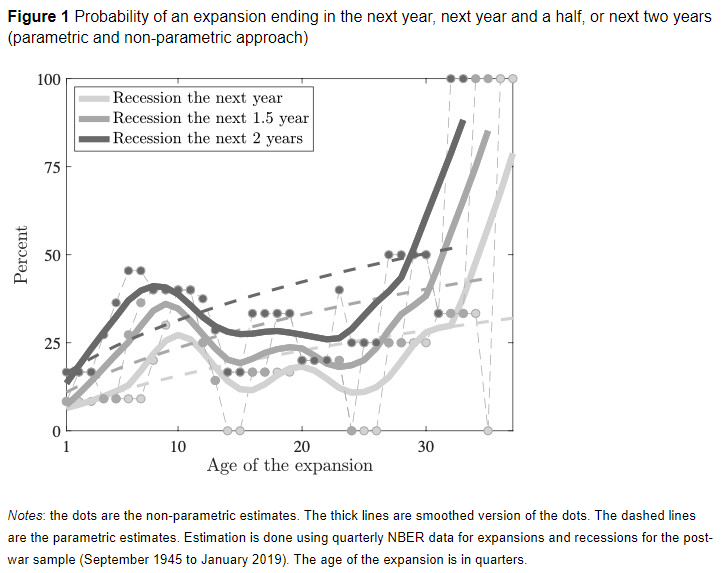
“[…] we estimate in Beaudry and Portier (2019) the probability of the US economy entering a recession in the following year (or following two years), conditional on the expansion having lasted q quarters. This can be done in a parametric way based on the Weibull distribution, or non-parametrically using Kaplan and Meier’s estimator of the survival function. Regardless of the method, and using post-WW2 US data, there is consistent evidence of age-dependence, as shown in Figure 1. For an expansion that has lasted only five quarters, the probability of entering a recession in the next year is around 10%, while this increases to 30-40% if the expansion has lasted over 35 quarters. Similarly, if looking at a two years window, we find the probability of entering a recession in the next two years raises from 25-30% to around 50-80% as the expansion extends from five quarters to 32 quarters (the exact probability depends on whether we use a parametric or a non-parametric approach). ”
From a VOX article:
“Business economists argue that the length of an expansion is a good indicator of when a recession will hit. Using both parametric and non-parametric measures, this column finds strong support for the theory from post-WWII data on the US economy. The findings suggest there is good reason to expect a US recession in the next two years.”
“[…] we estimate in Beaudry and Portier (2019) the probability of the US economy entering a recession in the following year (or following two years),
Posted by at 9:41 AM
Labels: Forecasting Forum
The Great Divide: Regional Inequality and Fiscal Policy
From a new IMF working paper by William Gbohoui,W. Raphael Lam and Victor Duarte Lledo:
“Growing regional inequality within countries has raised the perception that “some places and people” are left behind. This has prompted a shift toward inward-looking policies and away from pro-growth reforms. This paper presents novel stylized facts on regional inequality for OECD countries. It shows that regional disparity in per-capita GDP is large (even after adjusting for regional price differences), persistent, and widening over time. The paper also finds that rising nationwide income inequality is associated with both rising within-region income inequality and widening average income across regions. The rise in inequality is related to declining incentives for interregional labor mobility, especially for poor households in lagging regions, which are estimated to reduce by as much as one-third in the United States. Against these facts, the paper proposes a framework to identify whether, how and by whom fiscal policies can be used to tackle regional inequality. It outlines conditions under which those policies should be spatially-targeted and illustrates how they can be complementary to conventional means-testing methods in mitigating income inequality.”
From a new IMF working paper by William Gbohoui,W. Raphael Lam and Victor Duarte Lledo:
“Growing regional inequality within countries has raised the perception that “some places and people” are left behind. This has prompted a shift toward inward-looking policies and away from pro-growth reforms. This paper presents novel stylized facts on regional inequality for OECD countries. It shows that regional disparity in per-capita GDP is large (even after adjusting for regional price differences),
Posted by at 9:25 AM
Labels: Inclusive Growth
The next US recession is likely to be around the corner
From a VoxEU post by Franck Portier:
“Business economists argue that the length of an expansion is a good indicator of when a recession will hit. Using both parametric and non-parametric measures, this column finds strong support for the theory from post-WWII data on the US economy. The findings suggest there is good reason to expect a US recession in the next two years.
This summer, the current US expansion, which started in June 2009, is likely to break the historical post-WWII record of 120 months long, which is currently held by the March 1991-March 2001 expansion. It is already longer than the post-WWII average of 58 months. Should we be worried? Is the next recession around the corner?
Yes, according to business economists. For example, according to the semi-annual National Association for Business Economics survey released last February, three-quarters of the panellists expect an economic recession by the end of 2021. While only 10% of panellists expect a recession in 2019, 42% say a recession will happen in 2020, and 25% expect one in 2021.
No, according to the conventional wisdom among more academic-oriented economists, who believe that “expansions, like Peter Pan, endure but never seem to grow old”, as Rudebusch (2016) recently argued. As he wrote, “based only on age, an 80-month-old expansion has effectively the same chance of ending as a 40-month-old expansion”. This view was also forcefully expressed last December by the (now ex-) Federal Reserve Board Chair Janet Yellen, who said “… I think it’s a myth that expansions die of old age. I do not think they die of old age. So the fact that this has been quite a long expansion doesn’t lead me to believe that … its days are numbered”.
My research with Paul Beaudry and Dana Galizia tends to favour the former view, that we should be worried about a recession hitting the US economy in the next 18 months.
There are two reasons why we reach this conclusion. The first relies on a statistical analysis that uses only the age of an expansion to predict the probability of a recession. The second digs deeper into the very functioning of market economies.
First, we estimate in Beaudry and Portier (2019) the probability of the US economy entering a recession in the following year (or following two years), conditional on the expansion having lasted q quarters. This can be done in a parametric way based on the Weibull distribution, or non-parametrically using Kaplan and Meier’s estimator of the survival function. Regardless of the method, and using post-WW2 US data, there is consistent evidence of age-dependence, as shown in Figure 1. For an expansion that has lasted only five quarters, the probability of entering a recession in the next year is around 10%, while this increases to 30-40% if the expansion has lasted over 35 quarters. Similarly, if looking at a two years window, we find the probability of entering a recession in the next two years raises from 25-30% to around 50-80% as the expansion extends from five quarters to 32 quarters (the exact probability depends on whether we use a parametric or a non-parametric approach).”
Continue reading here.
From a VoxEU post by Franck Portier:
“Business economists argue that the length of an expansion is a good indicator of when a recession will hit. Using both parametric and non-parametric measures, this column finds strong support for the theory from post-WWII data on the US economy. The findings suggest there is good reason to expect a US recession in the next two years.
This summer, the current US expansion,
Posted by at 9:23 AM
Labels: Forecasting Forum
Housing View – May 3, 2019
On cross-country:
- Four Pillars and a Roof: Building cohesive plans for making adequate housing universal – OECD
- Urbanization and the Growth of Mega-Cities – University of Chicago
On the US:
- Preventing the Next Housing Crisis – Wharton
- California Has a Housing Crisis. The Answer Is More Housing. – New York Times
- Crises in the Housing Market: Causes, Consequences, and Policy Lessons – The Center for Growth and Opportunity
- AEI Housing Market Indicators release on January 2019 data – American Enterprise Institute
- Do you still love L.A.? The high cost of housing is testing our affections, poll shows – Los Angeles Times
- Florida Bill Would Ban Cities From Requiring Developers to Build Affordable Housing – Reason
- Eight ways state lawmakers addressed housing affordability – The Seattle Times
- A One-Stop Shop for Affordable Backyard Homes Advances in L.A. – Citylab
On other countries:
- [Australia] How Foreigners Helped Cool Australian Housing – Bloomberg
- [Brazil] Brazil’s house prices continue to fall – Global Property Guide
- [Canada] Is elevating housing prices a good way to make homes more affordable? – Globe and Mail
- [China] China developers push land prices up as credit, purchase rules ease – Reuters
- [Spain] Impact of the new law on real estate credit – Bank of Spain
On cross-country:
- Four Pillars and a Roof: Building cohesive plans for making adequate housing universal – OECD
- Urbanization and the Growth of Mega-Cities – University of Chicago
On the US:
- Preventing the Next Housing Crisis – Wharton
- California Has a Housing Crisis. The Answer Is More Housing. – New York Times
- Crises in the Housing Market: Causes,
Posted by at 5:00 AM
Labels: Global Housing Watch
Monday, April 29, 2019
Revisiting the causal effect of democracy on long-run development
From a VoxEU post by Markus Eberhardt:
“Recent evidence suggests that a country switching to democracy achieves about 20% higher per capita GDP over subsequent decades. This column demonstrates the sensitivity of these findings to sample selection and presents an implementation which generalises the empirical approach. If we assume that the democracy–growth nexus can differ across countries and may be distorted by common shocks or network effects, the average long-run effect of democracy falls to 10%.
In a recent paper, Acemoglu et al. (2019), henceforth “ANRR”, demonstrated a significant and large causal effect of democracy on long-run growth. By adopting a simple binary indicator for democracy, and accounting for the dynamics of development, these authors found that a shift to democracy leads to a 20% higher level of development in the long run.1
The findings are remarkable in three ways:
- Previous research often emphasised that a simple binary measure for democracy was perhaps “too blunt a concept” (Persson and Tabellini 2006) to provide robust empirical evidence.
- Positive effects of democracy on growth were typically only a “short-run boost” (Rodrik and Wacziarg 2005).
- The empirical findings are robust across a host of empirical estimators with different assumptions about the data generating process, including one adopting a novel instrumentation strategy (regional waves of democratisation).
ANRR’s findings are important because, as they highlight in a column on Vox, there is “a belief that democracy is bad for economic growth is common in both academic political economy as well as the popular press.” For example, Posner (2010) wrote that “[d]ictatorship will often be optimal for very poor countries”.
The simplicity of ANRR’s empirical setup, the large sample of countries, the long time horizon (1960 to 2010), and the robust positive – and remarkably stable – results across the many empirical methods they employ send a very powerful message against such doubts that democracy does cause growth.
I agree with their conclusion, but with qualifications. My investigation of democracy and growth (Eberhardt 2019) captures two important aspects that were assumed away in ANRR’s analysis:
- Different countries may experience different relationships between democracy and growth. Existing work (including by ANRR) suggests that there may be thresholds related to democratic legacy, or level of development, or level of human capital, or whether the democratisation process was peaceful or violent. All may lead to differential growth trajectories.2
- The world is a network. It is subject to common shocks that may affect countries differently. The Global Crisis is one example, as are spillovers across countries (Acemoglu et al. 2015, in the case of financial networks).”
Continue reading here.
From a VoxEU post by Markus Eberhardt:
“Recent evidence suggests that a country switching to democracy achieves about 20% higher per capita GDP over subsequent decades. This column demonstrates the sensitivity of these findings to sample selection and presents an implementation which generalises the empirical approach. If we assume that the democracy–growth nexus can differ across countries and may be distorted by common shocks or network effects, the average long-run effect of democracy falls to 10%.
Posted by at 7:27 AM
Labels: Inclusive Growth
Subscribe to: Posts