



Wednesday, February 27, 2019
Macro Aspects of Housing
From a paper by Charles Ka Yui Leung and Joe Cho Yiu Ng:
“This paper aims to achieve two objectives. First, we demonstrate that with respect to business cycle frequency (Burns and Mitchell, 1946), there was a general decrease in the association between macroeconomic variables (MV) and housing market variables (HMV) following the global financial crisis (GFC). However, there are macro-finance variables that exhibited a strong association with the HMV following the GFC. For the medium-term business cycle frequency (Comin and Gertler, 2006), we find that while some correlations exhibit the same change as the business cycle counterparts, others do not. These “new stylized facts” suggest that a reconsideration and refinement of existing “macro-housing” theories would be appropriate. We also provide a review of the recent literature, which may enhance our understanding of the evolving macro-housing-finance linkage.”
From a paper by Charles Ka Yui Leung and Joe Cho Yiu Ng:
“This paper aims to achieve two objectives. First, we demonstrate that with respect to business cycle frequency (Burns and Mitchell, 1946), there was a general decrease in the association between macroeconomic variables (MV) and housing market variables (HMV) following the global financial crisis (GFC). However, there are macro-finance variables that exhibited a strong association with the HMV following the GFC.
Posted by at 10:13 AM
Labels: Global Housing Watch
Tuesday, February 26, 2019
Are Labor Market Indicators Telling the Truth? Role of Measurement Error in the U.S. Current Population Survey
A new IMF working paper revisits ” the issue of classification errors in the U.S. Current Population Survey. While the results still support the previous literature’s conclusion that the job finding probability plays a more important role in explaining unemployment fluctuations (“outs of unemployment”) than the job separation probability does (“ins to unemployment”), they moderate the conclusion that “Out Wins”. Moreover, once the proposed adjustment is applied, the importance of the participation margin in explaining unemployment fluctuations becomes smaller than previously argued—around 10 percent in this paper vs previous estimates of 20 to 30 percent (Elsby, Hobijn and Sahin, 2015). Therefore, the misclassification correction procedures in the labor force survey continue to be an important issue in understanding labor market dynamics. The results of this paper suggest that policymakers should pay closer attention to the job separation margin than previously thought and less on the participation margin.”
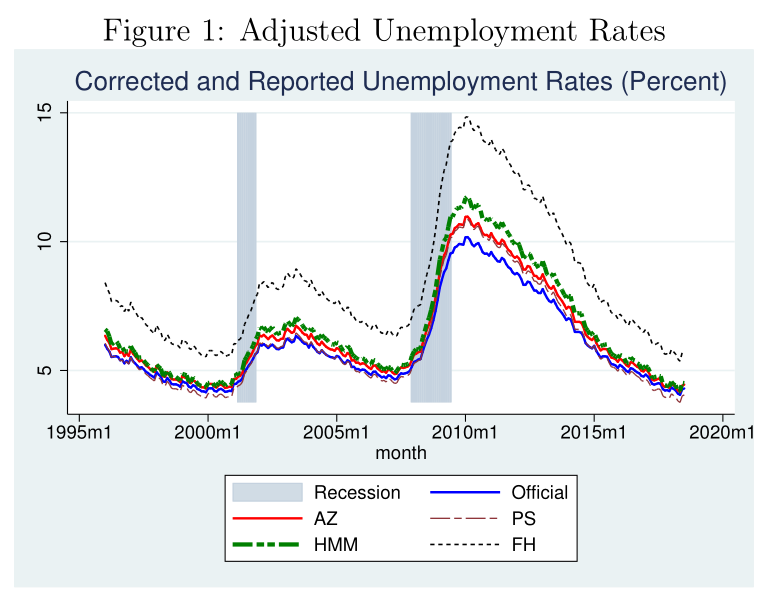
A new IMF working paper revisits ” the issue of classification errors in the U.S. Current Population Survey. While the results still support the previous literature’s conclusion that the job finding probability plays a more important role in explaining unemployment fluctuations (“outs of unemployment”) than the job separation probability does (“ins to unemployment”), they moderate the conclusion that “Out Wins”. Moreover, once the proposed adjustment is applied, the importance of the participation margin in explaining unemployment fluctuations becomes smaller than previously argued—around 10 percent in this paper vs previous estimates of 20 to 30 percent (Elsby,
Posted by at 8:58 PM
Labels: Inclusive Growth
Gross National Happiness and Macro Indicators in Bhutan
From a new post by Timothy Taylor:
“A lot of people have heard, one way or another, that the country of Bhutan decided back in the early 1970s to pursue Gross National Happiness. The King at that time is supposed to have said: “Gross National Happiness is more important than Gross Domestic Product.” But in practical terms, what does that actually mean?”
[…]
“1) It is bog standard economics that GDP was never intended to measure happiness, nor to measure broader social welfare. Any intro econ textbook makes the point. A well-known comment from “Robert Kennedy on Shortcomings of GDP in 1968” (January 30, 2012) make the point more poetically. But for those who need a reminder that social welfare is based on a wide variety of outcomes, not just GDP, I suppose a reminder about Gross National Happiness might be useful.
2) Bhutan’s measurement of 124 weighted indicator variables, and their distribution through the population, is probably about as good a way of measuring Gross National Happiness as any other, and better than some. But it’s also pretty arbitrary in its own way.
3) The interesting question about GDP and social welfare isn’t whether they are identical, but whether they tend to rise together in a broad sense. For example, countries with higher per capita income also tend to have more education and health care, better housing and nutrition, more participatory governance, and a variety of other good things. .A few years ago I wrote about “GDP and Social Welfare in the Long Run” (April 6, 2015), or see “Why GDP Growth is Good” (October 11, 2012).
4) “Happiness” is of course a tricky subject, which is why it’s the stuff of literature and love. After a lot of consideration, Daniel Kahneman has argued that “people don’t want to be happy.” Instead, they want to have a satisfactory narrative that they can tell themselves about how their life is unfolding. If incomes, education, and life expectancy rise over, say, 40-50 years but on a scale of 1-10 people don’t express greater “happiness” with their live, does that really mean they would be equally happy with lower incomes, education and life expectancy–especially if other countries in the world were continuing to make gains on these dimensions? There is an ongoing argument over whether those who have higher income express more happiness because they get to consume more, or because they feel good about comparing themselves who are worse off. It’s easy to say that “money doesn’t bring happiness,” and there’s some truth in the claim. But for most of us, if we lived in a country with lower income levels and could watch the rest of the world through the internet and television, it would bug us at least a little, now and then.
It seems to me easy enough to make the case that looking at Gross National Happiness as is better than an exclusive focus on doing nothing but boosting short-term GDP. But outside the fictional mustachio-twirling econo-villains of anti-capitalist comic books, no one actually believes in an exclusive focus on GDP. For me as an outsider, it’s hard to see how Gross National Happiness has made Bhutan’s development strategy different. After all, lots of countries at all income levels emphasize lots of goals other than short-term GDP. And the government of Bhutan pays considerable attention to GDP, as the authors note, “While there is importance given to GNH in Bhutan, governmental organizations (especially commerce related ones) focus keen attention on GDP and how it measures trade, commerce and the economic prosperity of the country. In addition, the IMF has provided a great deal of technical assistance to Bhutan to help improve its national accounts …”
My own favorite comment on the connection from GDP to social welfare is from a 1986 essay by Robert Solow (“James Meade at Eighty,” Economic Journal, December 1986, pp. 986-988), where he wrote: “If you have to be obsessed by something, maximizing real National Income is not a bad choice.” At least to me, the clear implication is that it’s perhaps better not to be obsessed by one number, and instead to cultivate a broader and multidimensional perspective. If you want to refer to that mix of statistics as Gross National Happiness, no harm is done. But yes, if you need to pick one number out of all the rest (and again, you don’t!), real per capita GDP isn’t a bad choice. To put it another way, a high or rising GDP certainly doesn’t assure a high level of social welfare, but it makes it easier to accomplish those goals than a low and falling GDP.”
From a new post by Timothy Taylor:
“A lot of people have heard, one way or another, that the country of Bhutan decided back in the early 1970s to pursue Gross National Happiness. The King at that time is supposed to have said: “Gross National Happiness is more important than Gross Domestic Product.” But in practical terms, what does that actually mean?”
[…]
“1) It is bog standard economics that GDP was never intended to measure happiness,
Posted by at 8:51 PM
Labels: Inclusive Growth
Friday, February 22, 2019
Housing Market in Australia
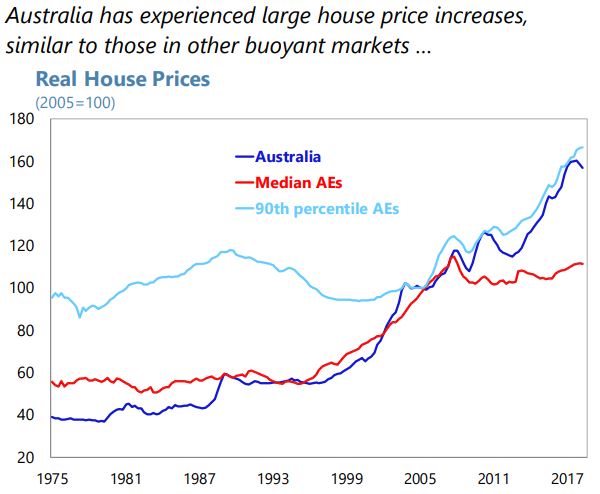
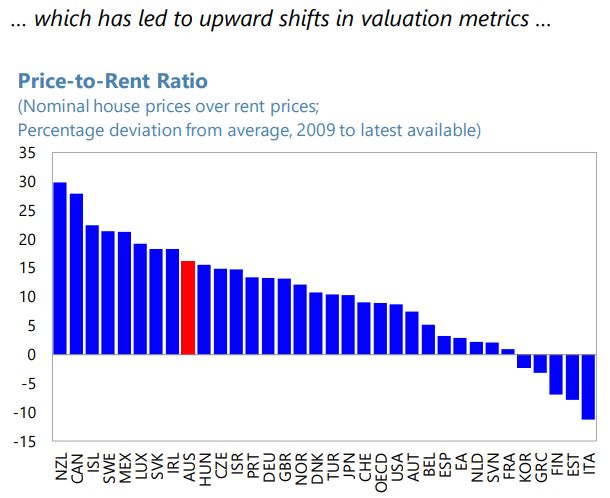
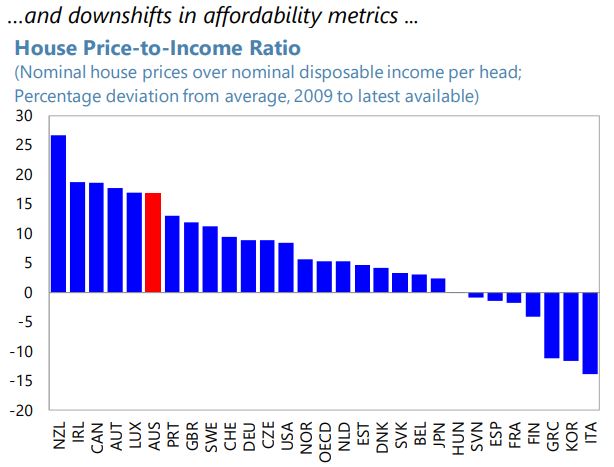
From the IMF’s latest report on Australia:
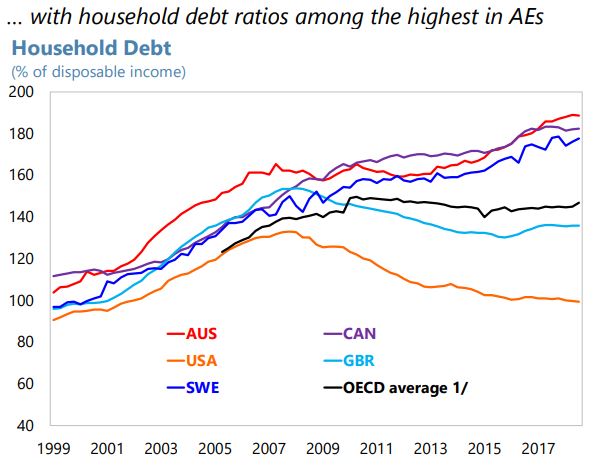
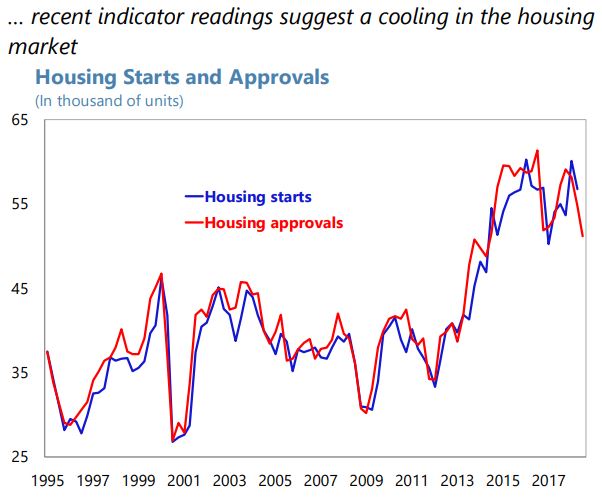
“The housing market correction is helping housing affordability. Foreign and domestic investor demand has moderated, thereby enhancing opportunities for first-time home buyers and purchases by owner-occupiers more broadly. On the supply side, progress has been made in using City Deals, agreements across all levels of government that integrate planning and infrastructure delivery for new developments and redevelopments. A prominent example―the City Deal for western Sydney―encompasses the development of the urban area around the new airport. Two states (Western Australia and Tasmania) introduced or announced housing-related tax policy measures discriminating between residents and non-residents since the last Article IV Consultation.
Housing supply reforms will remain critical to restoring housing affordability. While the housing market correction will help, it is unlikely to be sufficient for inclusive, broad-based affordability and growth. The underlying demand for housing is widely expected to remain strong with a robust economic growth outlook for and high population growth in urban areas. At the same time, broad affordability will also be a precondition for a significant reduction in related macro-financial vulnerabilities. As planning, zoning, and other reforms affect supply and prices with long lags, housing supply reforms should, therefore, not be delayed because of the housing market correction. City Deals are a useful catalyst for the large-scale development or redevelopment of urban areas. Nevertheless, this instrument has limited reach, although the Regional Deals envisaged by the government would provide for a welcome extension. Some states should still take the opportunity for further streamlining and consolidation in planning and zoning regulation.
Broader tax reforms that also address housing and land use would reinforce the impact of supply-side measures. Stamp duties should be replaced by broader land taxes, which would strengthen incentives for efficient land use. Within the context of a broader tax reform, gradual lowering of capital gains discounts and limits on negative gearing for investors would reduce structural incentives for leveraged investment by households, including in residential real estate. A more limited capital gains tax exemption for owner-occupiers should also be considered.
The housing policy measures discriminating nonresident buyers should be reconsidered. As the role of foreign buyers in residential real estate markets has started to decline, the discriminatory measures should be reconsidered, as they may no longer be needed to address housing market imbalances. They should be replaced by alternative and effective non-discriminatory measures where possible (e.g., a general surcharge on all vacant property).
The state governments of New South Wales and Victoria noted that the fall in housing prices in Sydney and Melbourne was larger than originally projected in their budgets. Nevertheless, despite their limited progress on zoning and planning reform to reduce impediments to housing supply and affordability, they expected house prices to find support from both housing demand and supply factors. The authorities highlighted that City Deals could be important tools to foster urban housing supply. City Deals have allowed all levels of government to coordinate planning and construction decisions, thereby facilitating infrastructure provision which can in turn support housing supply expansion. Deals agreed on or announced in 2018 included Darwin, Geelong, Hobart, and Perth. There are also plans underway to pilot Regional Deals outside of the major urban areas.”

From the IMF’s latest report on Australia:
“The housing market correction is helping housing affordability. Foreign and domestic investor demand has moderated, thereby enhancing opportunities for first-time home buyers and purchases by owner-occupiers more broadly. On the supply side, progress has been made in using City Deals, agreements across all levels of government that integrate planning and infrastructure delivery for new developments and redevelopments. A prominent example―the City Deal for western Sydney―encompasses the development of the urban area around the new airport.
Posted by at 10:59 AM
Labels: Global Housing Watch
Housing View – February 22, 2019
On cross-country:
- Peter Praet: On the importance of real estate statistics – European Central Bank
On the US:
- Housing Is Already in a Slump. So It (Probably) Can’t Cause a Recession. – New York Times
- Despite contrary claims, African-Americans believe in the American dream — even millennials – American Enterprise Institute
- Oregon’s Rent Control Bill Would Ultimately Please Nobody – Cato Institute
- HUD Funding Bill Will Launch Housing Voucher Mobility Demonstration – Center on Budget and Policy Priorities
- Housing investment, sea level rise, and climate change beliefs – Economic Letters
- “Debtless” Housing Boom Leads Household Wealth Recovery – Federal Reserve Bank of St. Louis
- A Red-State Take on a YIMBY Housing Bill – Citylab
- Why Unions Must Bargain for Affordable Housing—and How – American Prospect
- Without Amazon HQ2, What Happens to Housing in Queens? – Citylab
- The Super Bowl: Key Housing Indicator – NPR
- Yet another sign from the housing market of a looming recession – HousingWire
- A Shortage of Short Sales: Explaining the Underutilization of a Foreclosure Alternative – Federal Reserve Bank of Philadelphia
- Recession not likely before 2021, housing economists say – The Orange County Register
- The Federal Shutdown Damaged Housing Voucher Programs – American Prospect
On other countries:
- [Australia] The Housing Slump Down Under Is Getting Serious – Bloomberg
- [Canada] Montreal’s Real-Estate Market Is About to Eclipse Vancouver’s – Bloomberg
- [China] The Effect of a Subway on House Prices: Evidence from Shanghai – Real Estate Economics
- [China] China Property ‘Stealth Easing’ Spreads in Boost to Home Prices – Bloomberg
- [Greece] Greece to Subsidize Mortgage Payments to Tackle Bad Loan Crisis – Bloomberg
- [China] China developers snap up distressed real estate debt – Financial Times
- [Greece] Athens property boom: Greeks left out as prices rise – BBC
- [Hong Kong] The Hong Kong property bubble that won’t burst – Financial Times
- [United Kingdom] Research reveals who made the most money from UK property – Financial Times
On cross-country:
- Peter Praet: On the importance of real estate statistics – European Central Bank
On the US:
- Housing Is Already in a Slump. So It (Probably) Can’t Cause a Recession. – New York Times
- Despite contrary claims, African-Americans believe in the American dream — even millennials – American Enterprise Institute
- Oregon’s Rent Control Bill Would Ultimately Please Nobody – Cato Institute
- HUD Funding Bill Will Launch Housing Voucher Mobility Demonstration – Center on Budget and Policy Priorities
- Housing investment,
Posted by at 5:14 AM
Labels: Global Housing Watch
Subscribe to: Posts