


Tuesday, May 21, 2019
How inequality makes us poorer
From Stumbling and Mumbling:
“I welcome the Deaton report into inequality. I especially like its emphasis (pdf)upon the causes of inequality:
To understand whether inequality is a problem, we need to understand the sources of inequality, views of what is fair and the implications of inequality as well as the levels of inequality. Are present levels of inequalities due to well-deserved rewards or to unfair bargaining power, regulatory failure or political capture?
I fear, however, that there might be something missing here – the impact that inequality has upon economic performance.
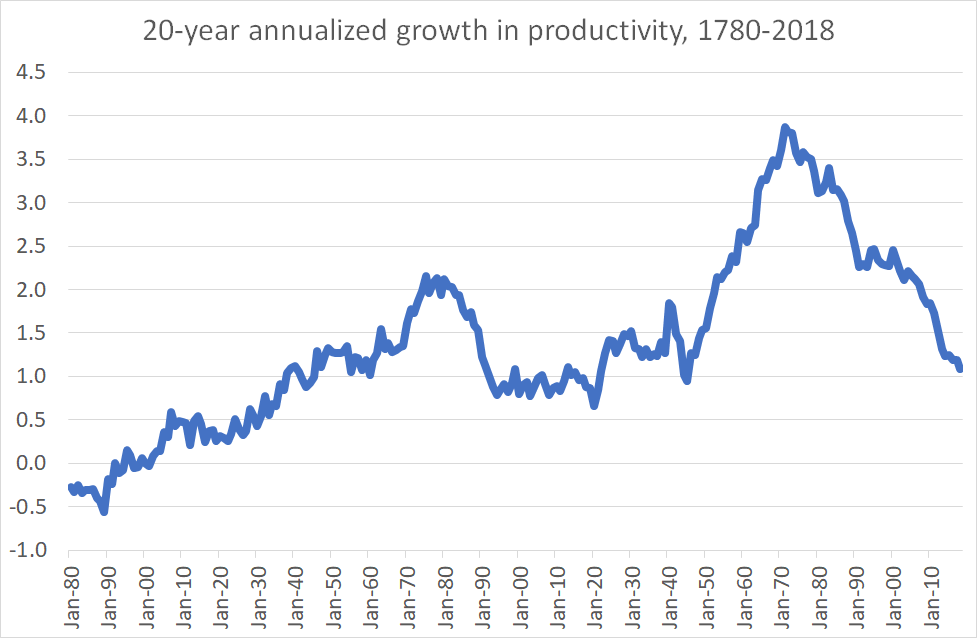
My chart shows the point. It shows the 20-year annualized rate of growth in GDP per worker-hour. It’s clear that this was much stronger during the relatively egalitarian period from 1945 to the mid-70s than it was before or since, when inequality was higher.
This might, of course, be coincidence: maybe WWII caused both a backlog of investment and innovation which allowed a subsequent growth spurt and a desire for greater equality.
Or it might not. This is not the only evidence for the possibility that inequality is bad for growth. Roland Benabou gave the example (pdf) of how egalitarian South Korea has done much better than the unequal Philippines. And IMF researchers have found (pdf) a “strong negative relation” between inequality and the rate and duration of subsequent growth spells across 153 countries between 1960 and 2010.”
From Stumbling and Mumbling:
“I welcome the Deaton report into inequality. I especially like its emphasis (pdf)upon the causes of inequality:
To understand whether inequality is a problem, we need to understand the sources of inequality, views of what is fair and the implications of inequality as well as the levels of inequality. Are present levels of inequalities due to well-deserved rewards or to unfair bargaining power,
Posted by at 8:17 AM
Labels: Inclusive Growth
Climate Change Heterogeneity
From Francis Diebold:
“One can only go so far in climate econometrics studying time series like the proverbial “global average temperature”, just as one can only go so far in macroeconomics with the proverbial “representative agent”. Disaggregation will be key to additional progress, as different people in different places experience different climate “treatments” and different economic outcomes. The impressive new paper below begins to confront the massive tasks of data collection, manipulation, analysis, and visualization, in the context of a disaggregated analysis of the effects of temperature change on aggregate output.
“Climatic Constraints on Aggregate Economic Output”, by Marshall Burke and Vincent Tanutama, NBER Working Paper No. 25779, 2019.
Abstract: Efficient responses to climate change require accurate estimates of both aggregate damages and where and to whom they occur. While specific case studies and simulations have suggested that climate change disproportionately affects the poor, large-scale direct evidence of the magnitude and origins of this disparity is lacking. Similarly, evidence on aggregate damages, which is a central input into the evaluation of mitigation policy, often relies on country-level data whose accuracy has been questioned. Here we assemble longitudinal data on economic output from over 11,000 districts across 37 countries, including previously nondigitized sources in multiple languages, to assess both the aggregate and distributional impacts of warming temperatures. We find that local-level growth in aggregate output responds non-linearly to temperature across all regions, with output peaking at cooler temperatures (<10°C) than estimated in earlier country analyses and declining steeply thereafter. Long difference estimates of the impact of longer-term (decadal) trends in temperature on income are larger than estimates from an annual panel model, providing additional evidence for growth effects. Impacts of a given temperature exposure do not vary meaningfully between rich and poor regions, but exposure to damaging temperatures is much more common in poor regions. These results indicate that additional warming will exacerbate inequality, particularly across countries, and that economic development alone will be unlikely to reduce damages, as commonly hypothesized. We estimate that since 2000, warming has already cost both the US and the EU at least $4 trillion in lost output, and tropical countries are >5% poorer than they would have been without this warming.”
From Francis Diebold:
“One can only go so far in climate econometrics studying time series like the proverbial “global average temperature”, just as one can only go so far in macroeconomics with the proverbial “representative agent”. Disaggregation will be key to additional progress, as different people in different places experience different climate “treatments” and different economic outcomes. The impressive new paper below begins to confront the massive tasks of data collection,
Posted by at 8:15 AM
Labels: Energy & Climate Change
Monday, May 20, 2019
The Rise of Robots in China
From a new paper on robot adoption in China
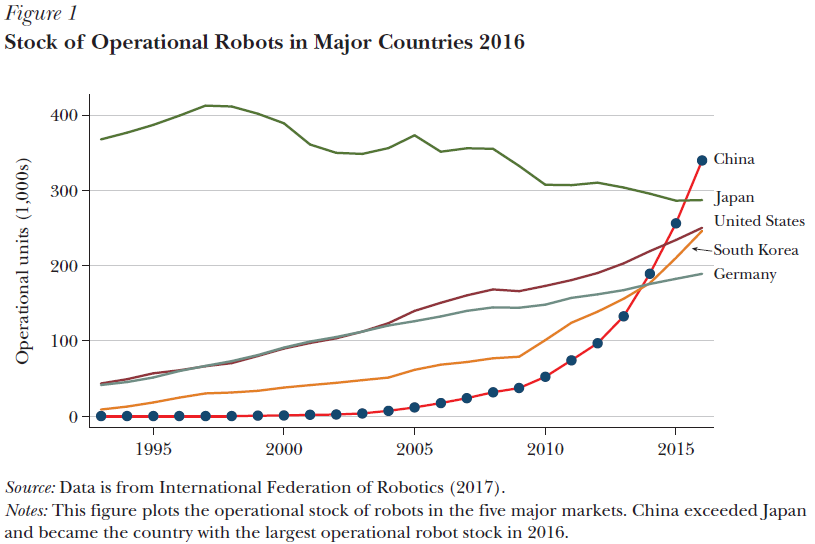
“China is the world’s largest user of industrial robots. In 2016, sales of industrial robots in China reached 87,000 units, accounting for around 30 percent of the global market. To put this number in perspective, robot sales in all of Europe and the Americas in 2016 reached 97,300 units (according to data from the International Federation of Robotics). Between 2005 and 2016, the operational stock of industrial robots in China increased at an annual average rate of 38 percent. In this paper, we describe the adoption of robots by China’s manufacturers using both aggregate industry-level and firm-level data, and we provide possible explanations from both the supply and demand sides for why robot use has risen so quickly in China. A key contribution of this paper is that we have collected some of the world’s first data on firms’ robot adoption behaviors with our China Employer-Employee Survey (CEES), which contains the first firm-level data that is representative of the entire Chinese manufacturing sector.”
From a new paper on robot adoption in China
“China is the world’s largest user of industrial robots. In 2016, sales of industrial robots in China reached 87,000 units, accounting for around 30 percent of the global market. To put this number in perspective, robot sales in all of Europe and the Americas in 2016 reached 97,300 units (according to data from the International Federation of Robotics). Between 2005 and 2016,
Posted by at 6:02 PM
Labels: Inclusive Growth
Daniel Hamermesh: How Do People Spend Time?
From Conversable Economist:
“For economists, the idea of “spending” time isn’t a metaphor. You can spend any resource, not just money. Among all the inequalities in our world, it remains true that every person is allocated precisely the same 24 hours in each day. In “Escaping the Rat Race: Why We Are Always Running Out of Time,” the Knowledge@Wharton website interviews Daniel Hamermesh, focusing on themes from his just-published book Spending Time: The Most Valuable Resource.
The introductory material at the start quotes William Penn, who apparently once said, “Time is what we want most, but what we use worst.” Here are some comments from Hamermesh:
Time for the Rich, Time for the Poor
The rich, of course, work more than the others. They should. There’s a bigger incentive to work more. But even if they don’t work, they use their time differently. A rich person does much less TV watching — over an hour less a day than a poor person. They sleep less. They do more museum-going, more theater. Anything that takes money, the rich will do more of. Things that take a lot of time and little money, the rich do less of. …
I think complaining is the American national pastime, not baseball. But the thing is, those who are complaining about the time as being scarce are the rich. People who are poor complain about not having enough money. I’m sympathetic to that. They’re stuck. The rich — if you want to stop complaining, give up some money. Don’t work so hard. Walk to work. Sleep more. Take it easy. I have no sympathy for people who say they’re too rushed for time. It’s their own darn fault.
Time Spent Working Across CountriesAmericans are the champions of work among rich countries. We work on average eight hours more per week in a typical week than Germans do, six hours more than the French do. It used to be quite a bit different. Forty years ago, we worked about average for rich countries. Today, even the Japanese work less than we do. The reason is very simple: We take very short vacations, if we take any. Other countries get four, five, six weeks. That’s the major difference. …
What’s most interesting about when we work is you compare America to western European countries, and it’s hard to find a shop open on a Sunday in western Europe. Here, we’re open all the time. Americans work more at night than anybody else. It’s not just that we work more; we also work a lot more at night, a lot more in the evenings, and a heck of a lot more on Sundays and Saturdays than people in other rich countries. We’re working all the time and more. …
It’s a rat race. If I don’t work on a Sunday and other people do, I’m not going to get ahead. Therefore, I have no incentive to get off that gerbil tube, get out of it and try to behave in a more rational way. … The only way it’s going to be solved is if somehow some external force, which in the U.S. and other rich countries is the government, imposes a mandate that forces us to behave differently. No individual can do it. …
We have to force ourselves, as a collective, as a polity, to change our behavior. Pass legislation to do it. Every other rich country did that between 1979 and 2000. We think the Japanese are workaholics. They’re not workaholics. Compared to us, they work less than we do, yet 40 years ago they worked a heck of a lot more. They chose to cut back. ,.. It’s going to be a heck of a lot of trouble to change the rules so that people are mandated to take four weeks of vacation or to take a few more paid holidays. Other countries have done it. It didn’t just happen from the day the countries were born. They chose to do it. It’s a political issue, like the most important things in life. “
Continue reading here.
From Conversable Economist:
“For economists, the idea of “spending” time isn’t a metaphor. You can spend any resource, not just money. Among all the inequalities in our world, it remains true that every person is allocated precisely the same 24 hours in each day. In “Escaping the Rat Race: Why We Are Always Running Out of Time,” the Knowledge@Wharton website interviews Daniel Hamermesh, focusing on themes from his just-published book Spending Time: The Most Valuable Resource.
Posted by at 5:09 PM
Labels: Inclusive Growth
Energy and the Military: Leading by Example
From YaleGlobal Online:
“As the world demands more energy, nations face the often-competing pressures to increase energy access and affordability, protect the environment, and assure energy security. The military, long focused on energy issues related to mission delivery, has often been at the forefront of technological innovation and deployment. The quiet innovations in the defense sector could help solve energy challenges nations confront today.
In energy policy circles, the conventional concept of energy security relates to economic prosperity and social harmony. In a globalized energy market, energy policies are designed to reduce the economic impacts of supply and price shocks through efficiency, diversified supplies, and fuel choice. In military energy decision-making, however, “security” focuses on achieving strategic objectives, and enables nearly everything the military does. In the defense domain, energy has the potential to be both an enabler of hard power but also a weapon of war via denial and willful coercion.
Energy has played a role in every facet of war. Many of the lessons learned during the world wars of the 20th century are still being appreciated and relearned in today’s conflicts. One of the most famous examples of energy influencing military strategy comes from 1911, when Winston Churchill, then First Lord of the Admiralty, converted the British fleet from Welsh coal to foreign oil. The gain in speed and decrease in logistical burden gave the British Royal Navy a critical advantage over the Axis powers. The policy brought further advantage as oil’s less smoky combustion allowed the Royal Navy to avoid coal’s telltale plumes that revealed a fleet’s position.
As militaries shifted toward oil during the early 20th century as the main energy source, a scramble to secure oil supplies influenced events leading to and throughout WWII. Some of the greatest strategic decisions in World War II had their roots in a desire to access energy resources. The German military’s perceived need for oil created a two-front war, and its failure to take and hold Soviet oilfields spelled disaster at Stalingrad. The Japanese surprised the American naval fleet on December 7, 1941, an attempt to secure oil-shipping lanes and secure other natural resources, such as rubber, from Southeast Asia. Energy’s link to World War II conflict had as much to do with denial of resources to the enemy as securing one’s own oil supply chains. The stalling of General Patton’s Third Army following its campaign across France in summer 1944 is a telling example of fuel acting as “tether” to military operations.
The skill and technologies of logistics forces in providing fuel has grown significantly since World War II. Energy security has been a challenge in Afghanistan, NATO’s largest operation. In late 2012, more than 100,000 troops consumed more than 6.8 million liters of fuel per day, 99 percent delivered by truck, from Pakistan and later through a complex Central Asia route. The enduring criticality of energy logistics was highlighted when retired General James N. Mattis entreated the US Department of Defense to “unleash us from the tether of fuel.” The 2010 test deployment of portable solar-powered generation systems at US Marine forward operating bases in Afghanistan reduced the bases’ diesel generator usage by more than 90 percent.”
Continue reading here.
From YaleGlobal Online:
“As the world demands more energy, nations face the often-competing pressures to increase energy access and affordability, protect the environment, and assure energy security. The military, long focused on energy issues related to mission delivery, has often been at the forefront of technological innovation and deployment. The quiet innovations in the defense sector could help solve energy challenges nations confront today.
In energy policy circles,
Posted by at 9:39 AM
Labels: Energy & Climate Change
Subscribe to: Posts